










Most LLM Developer contract work on Lemon.io comes from US, EU, and Australian product companies and well-funded AI-native startups. The verticals concentrate around HealthTech (clinical AI, mental wellness, AI-assisted health), Fintech (AI-financial-analytics, earnings-call processing, market intelligence), AI-native consumer products (voice AI, photo-to-content, agentic productivity tools), Legal Tech (AI compliance automation, document analysis, RAG over legal corpora), Marketing Tech (AI content generation, personalization, agent-driven workflows), and EdTech (interactive learning, AI tutoring, language learning with voice). The LLM Developer market on the platform is structurally newer than most stacks but growing faster than any other vertical. Rates anchor to Python base rates because LLM is a Python specialization — but production LLM work commands a consistent premium of +$10–$25/hour over generic Python backend work. The rate distribution is more globally uniform than most stacks because LLM expertise concentrates in technically deep specialists rather than commodity-priced generalists. The fastest-growing LLM verticals in 2026 are production agentic systems (multi-agent orchestration with LangGraph, tool use, planning architectures, real workflow automation), AI-aware RAG infrastructure (production retrieval optimization with chunking strategies, hybrid search, reranking), real-time voice AI (interruptible LLM agents with Whisper + ElevenLabs streaming), and fine-tuned custom models (LoRA / QLoRA / full fine-tuning for domain-specific or proprietary data).
The LLM specializations that drive rates in 2026
Not all LLM experience is valued equally. Specialization depth — much more than “I’ve called the OpenAI API” — determines rate ceiling. – Fine-tuning + Custom Models commands the highest premium: $65–$100/hour. Demand concentrates in HealthTech (clinical models trained on proprietary data), Fintech (proprietary financial models), and any product where off-the-shelf foundation models don’t meet accuracy or compliance requirements. Production experience with LoRA, QLoRA, full fine-tuning pipelines, model evaluation, and HuggingFace Trainer / Axolotl / TRL puts you in the top demand bracket. – Agentic Systems commands $60–$95/hour. Demand concentrates in productivity tools, customer service automation, and any product moving from single-LLM-call to multi-step agent workflows. Production patterns: LangChain / LangGraph orchestration, tool use, planning architectures, agent memory + state management, observability for agent decisions. – RAG Architecture commands $55–$90/hour. Demand concentrates in legal tech, healthcare, knowledge bases, and any product where LLMs need access to proprietary data corpora. The dividing line at senior level: production retrieval optimization (not just “I dumped docs into Pinecone”). Chunking strategy, hybrid search, reranking, evaluation harnesses, and retrieval quality observability all matter. – Real-time Voice AI commands $60–$90/hour. Demand concentrates in language learning, accessibility (transcription for hearing-impaired users), AI assistants, and customer service voice agents. Production patterns: Whisper for transcription, ElevenLabs / Cartesia for TTS, interruptible agent architectures, low-latency streaming inference, sub-second response cycles. – Production Inference + GPU Optimization commands $60–$95/hour. Demand concentrates in cost-conscious AI-native products, on-device inference (Core ML, TensorFlow Lite, ONNX Runtime mobile), and any team running their own model serving infrastructure (vLLM, TensorRT-LLM, Ray Serve). CUDA profiling, distributed training, GPU economics, and cold-start mitigation matter at senior level. – Evaluation + Observability Infrastructure is an emerging premium specialization: $55–$80/hour. Demand concentrates in mature AI products dealing with LLM behavior drift across model versions. Production patterns: Phoenix, LangSmith, Helicone, custom eval harnesses, prompt versioning, hallucination detection, A/B testing for prompts.
What gets you matched fastest (decision framework)
Three factors predict matching speed for LLM developers. 1. Production LLM experience beats notebook prototype work. A developer who lists “production RAG pipeline serving 10K+ daily queries with eval harness, retry logic, and incident response history” matches into significantly more high-rate projects than a “I built a chatbot with OpenAI” generalist profile. Real production deployment matters at senior level here in a way that’s even more pronounced than other Python work. 2. Specialization claim compounds rate ceilings. Strong Senior tier rates ($70–$100/hour) cluster in roles requiring at least one of: fine-tuning, agentic system architecture, production inference, or evaluation/observability infrastructure. Pick 1–2 specializations, ship in production, then explicitly claim them on your profile. 3. Evaluation + observability mindset is the senior bar. LLM candidates who can build LLM apps but can’t reason about evaluation methodology (golden datasets, eval harnesses, drift detection, A/B testing for prompts) miss premium-tier roles. The platform pattern: clients hiring senior LLM specialists explicitly want eval-first thinking, not vibe-coded LLM features.
What "$80/hour LLM work" actually looks like
— $100/hr — Senior Fine-tuning Engineer (Python + LoRA + Modal + HuggingFace) at a Funded HealthTech AI platform, training clinical models on proprietary patient data with full evaluation pipelines. — $95/hr — Senior LLM Architect (LangGraph + multi-agent + GCP) at an AI-native legal tech startup, designing multi-agent orchestration for compliance automation across thousands of audit packages. — $90/hr — Senior LLM Engineer (Python + FastAPI + WebRTC + Whisper + ElevenLabs) at a Seed real-time voice AI startup, building interruptible LLM agents for language learning with sub-second response cycles. — $85/hr — Senior RAG Engineer (Python + Pinecone + LangChain + production observability) at a Funded knowledge-base SaaS, optimizing retrieval quality at production scale with full eval harness. — $70/hr — Senior LLM Engineer (Python + agentic systems + Anthropic API) at a Seed productivity tool, building agent-driven workflow automation for customer service teams. Common pattern: production LLM deployment fluency, specialized vertical (fine-tuning, agentic, RAG, voice AI, inference), eval-first mindset, small-to-mid teams, and direct collaboration with founders or AI architects. Generic “build me an OpenAI wrapper” work clusters in the $35–$50/hour band — but is increasingly rare on the platform because clients seeking senior LLM engineers self-select for technically substantive work.
Why LLM devs fail Lemon.io vetting (and how to pass)
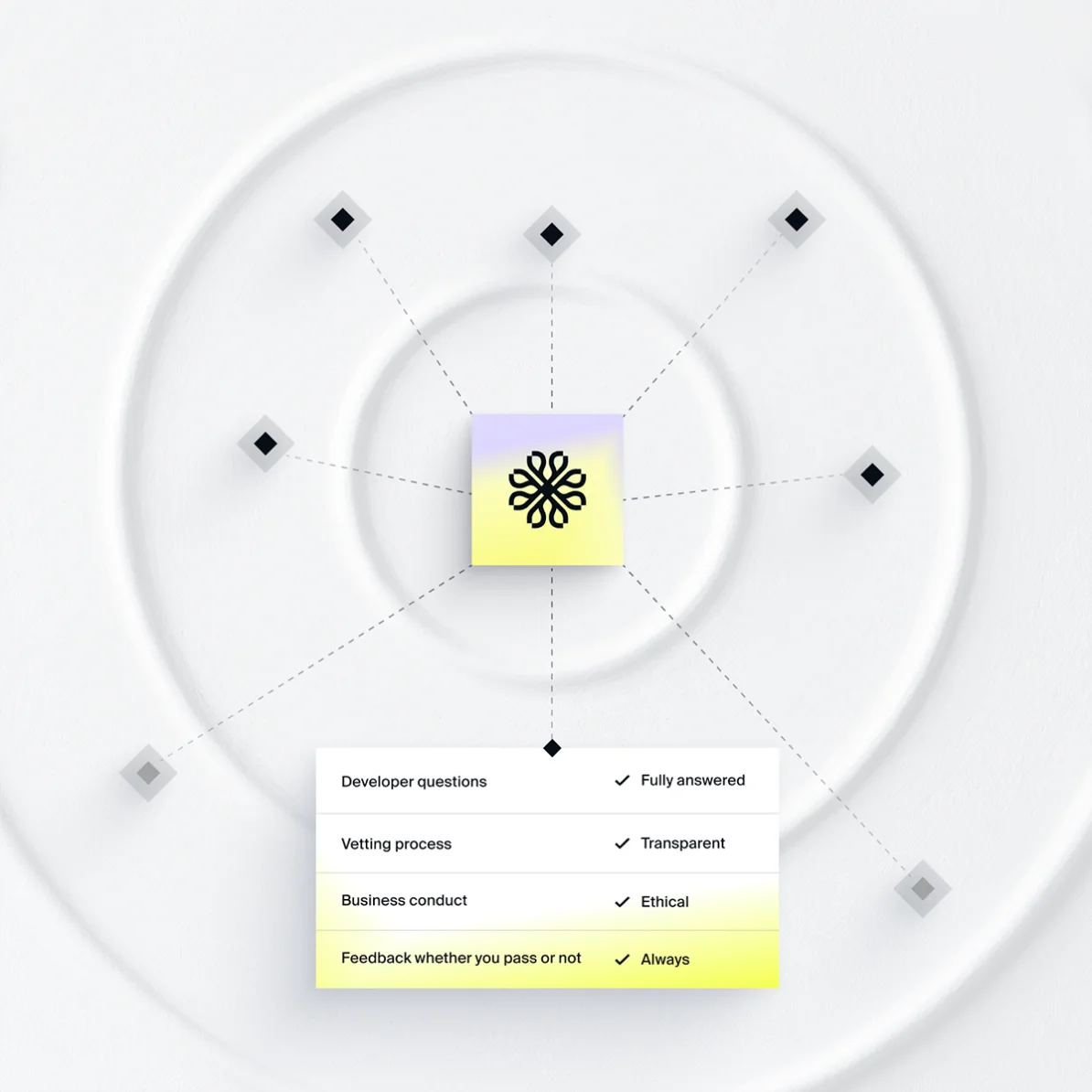
Across vetting interviews, four rejection patterns dominate for LLM candidates: 1. Notebook-only experience presented as production. Candidates who’ve built impressive Jupyter prototypes but have never shipped LLM features to real users miss the senior bar. The fix: ship at least one production LLM feature with real users, evaluation, and observability before applying. 2. No evaluation methodology. “I tested it and it works” fails. Senior LLM matches go to candidates who can articulate: golden dataset construction, eval harness design (LangSmith / Phoenix / Helicone or custom), prompt regression testing, drift detection across model versions, and A/B testing for prompt changes. 3. Single-provider lock-in. Candidates who only know OpenAI API patterns and can’t reason about Anthropic / Google / open-source model trade-offs (cost, latency, capability, fine-tuning availability, data privacy) miss roles where provider-agnostic architecture matters. 4. No production failure-mode thinking. “I called the API and got a response” fails when the topic is production reliability. Senior LLM matches require thinking about retry logic, fallback chains (when GPT-4 fails, fall back to Claude), circuit breakers, hallucination detection, content moderation, prompt injection defense, and graceful degradation when models change behavior. The fix is structural: when describing past work, lead with the eval methodology, the production failure-mode handling, and the measurable outcome (accuracy lift, cost reduction, latency improvement) — not the model used.
Modern LLM development in 2026 — what's actually changing
Three structural shifts are reshaping what senior LLM looks like. 1. Multi-provider, provider-agnostic architecture is the default. OpenAI-only codebases are increasingly legacy. New LLM projects on the platform overwhelmingly architect for multi-provider routing — OpenAI for speed, Anthropic for safety-critical reasoning, Google for cost-efficient bulk, open-source (Llama, Mistral, Qwen) for privacy or cost-sensitive workloads. Senior matches expect provider-agnostic architecture as table stakes. 2. Evaluation has moved from afterthought to first-class. Where “we’ll evaluate before shipping” was acceptable in 2023, senior LLM development in 2026 expects eval-driven development from day one. Phoenix, LangSmith, Helicone, custom eval harnesses, and continuous evaluation infrastructure are now standard. Candidates without eval-first thinking get filtered out of premium roles. 3. Agentic systems are the new frontier. Single-call LLM features have largely commoditized. The 2026 frontier is multi-agent orchestration: LangGraph + tool use + planning architectures + agent memory + observability for agent decisions. Senior LLM engineers who can ship production agentic systems (with full eval, failure-mode handling, and observability) command the premium tier.
Freelance vs full-time: the real numbers
Senior LLM developers on Lemon.io earn a median of $55/hour (Python senior baseline + LLM premium), working 35–40 billable hours per week. North American developers command higher: $71/hour senior median. Strong Senior LLM engineers earn $70/hour median — production LLM tier — with top observed rates of $100/hour for fine-tuning, agentic system architecture, and production inference work. LLM Developer rates on Lemon.io anchor to Python rates because LLM is a Python specialization — but production LLM work consistently commands +$10–$25/hour over generic Python backend work. The implication for Python developers considering LLM specialization: the upskilling investment pays for itself within months at typical contract volumes. The +48% NA-vs-EU senior premium follows the same Python pattern. Like Python, LLM Developer rates are more globally uniform than most stacks — specialization (RAG vs agents vs fine-tuning vs voice) is the primary earnings lever, not geography. In all geographies, contract LLM senior earnings consistently match or exceed full-time total compensation when factoring in benefits cost (~$15K–$25K to replicate independently), no equity vesting cliffs, and no multi-month job searches between roles. Strong Senior tier rates ($70–$100/hour) significantly outpace local full-time AI engineer salaries in most markets — and uniquely, contract LLM work avoids the equity-vesting volatility that defines much full-time AI startup compensation. The most common transition pattern: start with a part-time contract (15–20 hours/week) while still employed, validate income stability, then scale to full-time. Both schedules are fully supported. For the full rate breakdown by seniority and stack, see the 2026 Software Developer Salary Report.
How remote LLM contracting actually works
The day-to-day looks more like being a senior AI engineer at an AI-native product team than a traditional freelancer.
On a typical project, you join the client’s Slack workspace on day one. Your Lemon.io success manager facilitates a 30-minute onboarding call with the engineering lead, AI architect, or technical co-founder. You get access to the codebase, model serving infrastructure (vLLM cluster, Modal deployment, Bedrock account, etc.), eval harnesses (LangSmith / Phoenix / custom), prompt registries, observability dashboards (Helicone, Langfuse), and project management tool (usually Linear, Notion, GitHub Projects). Most LLM developers ship their first pull request within the first week — typically a small RAG retrieval improvement, prompt optimization, or eval harness extension — then graduate to feature work and architecture contributions.
Communication cadence varies. Async-first teams (most AI-native teams skew async-first) do brief daily check-ins via Slack and rely on PR reviews, eval reports, and architecture documents. Sync-heavy teams may have 2–3 video calls per week including model-selection sessions and eval-prep meetings.
Code review, eval methodology, prompt iteration, and incident response work the same as any senior AI engineering team. You’re part of the AI engineering core, not an outsourced resource.
Contracts run as monthly agreements with project-based scope. Average contract length: 9+ months — LLM infrastructure work compounds across model iterations and product expansion phases. When a project nears completion, your success manager begins matching you with the next opportunity. Average downtime between projects: less than 2 weeks.