










Laravel Developer Jobs — Vetted Remote Contracts, $18–$100/hr

Pass vetting once. Get matched to relevant projects – no re-applying, no bidding wars.

Apply now
  • Time to first offer

    ~13 days

  • Average contract length

    9+ months

  • Vetted developers

    1,500+

Recent Laravel projects on Lemon.io

Lemon.io is a developer talent marketplace connecting senior Laravel developers (5+ years experience) with funded startups for remote contract roles. The platform has a 1.2% acceptance rate, matches developers with companies in under 24 hours, and offers rates of $20–$100/hour.

Average contract length: 9+ months. Since 2015, Lemon.io has facilitated 9,000+ developer contracts across 71+ countries.

Last updated: July 2026

LaravelPHPHTML5

Senior Full-Stack Developer: a 160-hour Laravel port

Duration
1 to 3 months
Type
Part-time or Full-time
Involvement
20–40h/week
Apply now
LaravelVue.jsReact

Senior Full-Stack Developer: choose the frontend architecture

Duration
3 to 4 months
Type
Part-time
Involvement
20h/week
Apply now
Laravel 12Vue 3AWS Lambda

Full-Stack Developer on an exceptionally modern Laravel stack

Duration
1 month
Type
Full-time
Involvement
40h/week
Apply now
LaravelPHPAngular

Senior Full-Stack Developer who hates handoffs

Duration
3 to 4 months
Type
Full-time
Involvement
40h/week
Apply now
LaravelMicroservicesAngular

Senior Full-Stack Developer: API aggregation at a fintech

Duration
7+ months
Type
Full-time
Involvement
40h/week
Apply now
Log in to see more

Laravel developer rates – what you'll actually earn (2026)

$150
$100
$50
$0
Mid-Level $18 – $63/hr
Senior $20 – $100/hr
Strong Senior $34 – $86/hr

Ready to find your next Laravel project?

  • Mid-level Python developers (2–5 years) earn $18–$63/hour.
  • Senior developers (5–8 years) earn $20–$100/hour (median $45).
  • Strong senior engineers (8+ years) earn $34–$86/hour (median $54).

Based on 9,000+ developer contracts. Updated quarterly.

Stack Premiums

  • Laravel + Vue 3 & Vite $40–$60/hr
  • Laravel + TALL $45–$65/hr
  • Laravel + Serverless/Vapor $45–$70/hr
  • Laravel + AI/OpenAI $40–$55/hr

We reject 60% of companies that apply.
What we screen for

Proven Funding

Stable funding or proven revenue — verified before a project is listed, so contracts don't die mid-sprint.

Clear Vision

A defined product vision, technical specs, and realistic expectations — before you write a line of code.

Engineering Culture

Team autonomy, documentation standards, and organized project management — we check how they actually ship.

Real Challenges

Meaningful technical problems, not routine CRUD maintenance. If the work is boring, it doesn't get listed.

Direct Access

No intermediaries — you always work directly with the company and its decision-makers.

Payment Reliability

We verify companies can sustain contracted rates — payouts on time, every time.

What we don't do

  • No throwaway gigs

    Average contract runs 9+ months — no 2-week gigs.

  • No unverified companies

    We don't accept companies without verified funding.

  • No repeated interviews

    We don't make you repeat long interview processes for every project.

  • No developer fees

    We don't charge developer fees — ever.

Apply to get matched

Having the Lemon team handle client matchmaking, making sure I receive my payments in a timely manner, and providing great support in general is a relief. It allows me to focus on what I want to focus on, which is writing great code.

Santiago GonzálezSantiago GonzálezSenior Full-Stack & Mobile Developer, Technical Interviewer

We're looking for

  • 3+ years of commercial Laravel experience
  • Modern PHP 8.1+: types, attributes, readonly, enums
  • Laravel 10+ depth: Eloquent, queues, events, container
  • TALL stack (Tailwind + Alpine + Livewire 3) is a differentiator
  • Production databases: MySQL, PostgreSQL, Redis
  • Cloud: AWS (Lambda + Vapor a plus), GCP, or Forge
  • Frontend pairing: Vue 3, React, or deep TALL/Livewire
  • Testing: PHPUnit or Pest; toolchain: Vite, Pint, Pulse
  • Comfortable working async with US/EU teams
  • English: Upper-Intermediate or higher
  • Available for 20+ hours/week — part-time and full-time both supported
Apply now

Contract work, without the instability

  • Average contract length 9+ months
  • Average downtime between contracts <2 weeks
  • Average re-matching time if a project ends early 48 hours

Addressing the "What If" Fears

  • What if the company runs out of money?

    We verify funding status before listing — our 60% rejection rate filters out speculative bets. If a project ends early, we re-match you within 48 hours.

  • What about holidays and vacation?

    You set your own schedule and availability. Contracts account for time off. Most devs take 3–4 weeks/year without issues.

  • What if I'm transitioning from full-time?

    40% of our network made this transition. Start part-time during your notice period — average earnings increase is 30–50% over corporate salary.

  • What about burnout?

    You choose your projects. No forced overtime, no "we ship at all costs" cultures — those get rejected during company vetting.

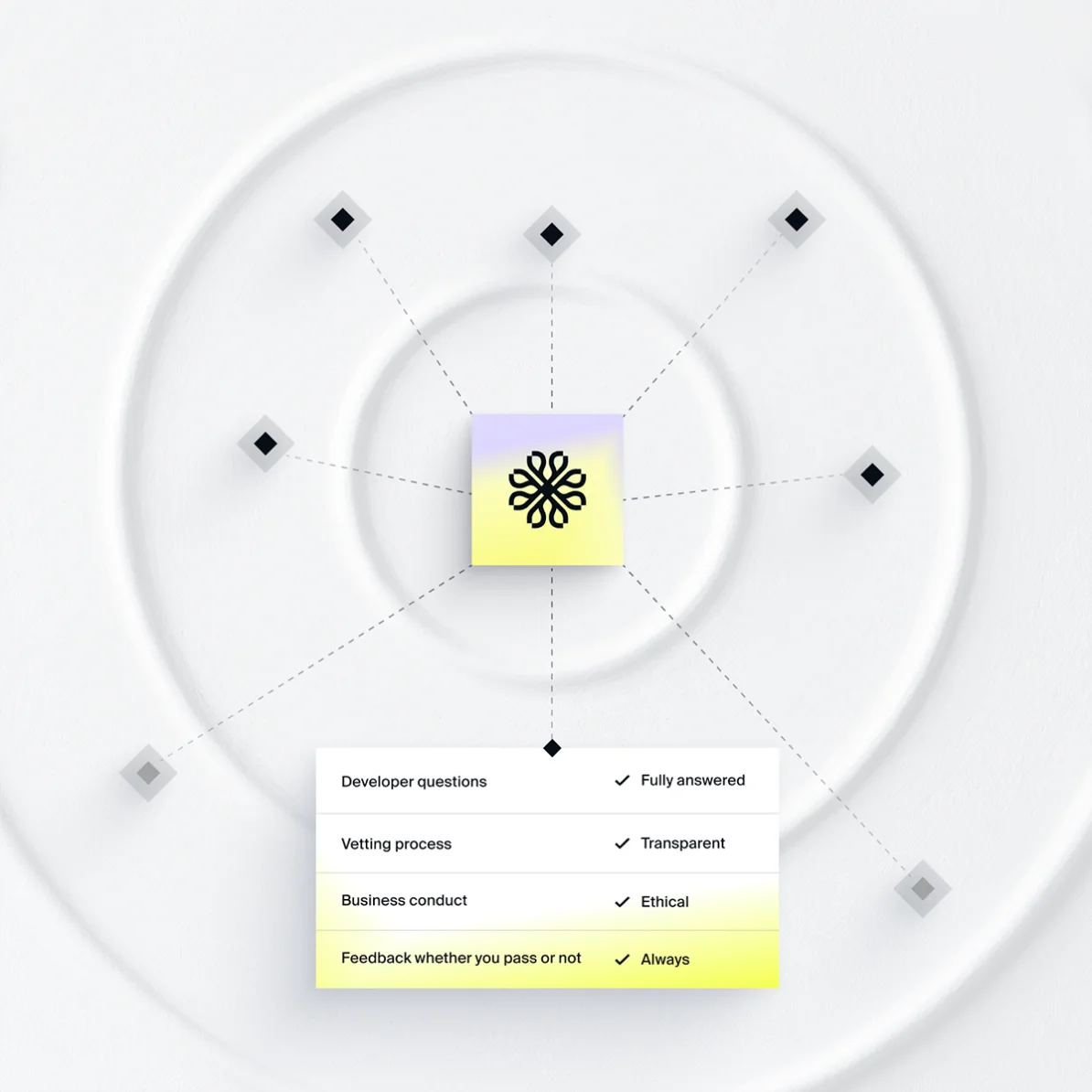
What every developer in the network gets: developer questions — fully answered, vetting process — transparent, business conduct — ethical, feedback whether you pass or not — always. Apply to get matched

Hear from our developers

Rated 5 out of 5 on Trustpilot

One of the best things about Lemon is the opportunities you get. They have the connections, the clients, new companies who are constantly looking for engineers in different stacks.

Sam OykeyeSam OykeyeSenior Full-Stack Developer
Rated 5 out of 5 on Trustpilot

I’ve been working with Lemon since 2021, building projects across healthcare, travel, ecommerce, and fintech. I really appreciate the team’s support and truly believe this company is unique.

Viktoria BohomazViktoria BohomazFull-Stack Developer
Rated 5 out of 5 on Trustpilot

I’ve been able to work from the Philippines, all over Europe, and Brazil without missing a single project, learning a ton of different technologies.

Iven PratsIven PratsSenior Full-Stack Developer

Ready to find your next Laravel project?

Skip the job board grind. Get matched with pre-vetted companies in 24 hours.

Apply to Get Matched

How it works

From application to approval in days

No back and forth scheduling, unnecessary steps, or coding marathons. Know exactly where you stand at each stage, and talk to real engineers who make the final call.

  1. 1

    Share your info

    Upload your CV and LinkedIn link to create your Lemon profile quickly. Then, choose a suitable role from options like “full-stack, Python/React” or “backend, Node.js, PostgreSQL” to select your technical assessments.

  2. 2

    Schedule a call

    In 20 minutes or less, our AI assistant Mark confirms your experience, availability, time zone, rates, and the kinds of projects you want. It’s audio only, so you can take the call from your couch, your commute, wherever.

    Human or AI-vetted path
  3. 3

    Pass a 15-min quiz

    Complete a role-specific task to skip the basics when speaking to technical interviewers.

  4. 4

    Meet a recruiter

    Book a call as soon as you pass the quiz. This focused, 20-minute conversation centers on your work style and communication. The recruiter already has Mark's notes, so you won't re-explain your resume.

  5. 5

    Finish the technical interview

    Tackle a complex problem with a senior engineer live. Talk through how you approach problems, discuss tradeoffs, and make decisions. Find out if you made the cut a few days later.

Frequently asked questions

What is the average hourly rate for senior Laravel developers in 2026?

Senior Laravel developers on Lemon.io earn $20–$100/hour (median $45/hour) based on rate observations across 71+ countries. Strong Senior engineers (8+ years) earn $34–$86/hour (median $54/hour). North American developers earn $45/hour senior median — only a +13% premium over the European baseline of $40, the smallest geographic rate gap of any backend stack on the platform. Stack matters: Laravel 12 + Vue 3 modern toolchain, TALL stack specialization, and Laravel + Vapor (serverless) command the highest premiums.

Can I work part-time as a contract Laravel developer?

Yes — and many developers start that way. Part-time engagements (15–25 hours/week) are fully supported and a common entry point. Several active Laravel projects on the platform are explicitly part-time or “part-time → full-time” tracks. Both schedules are equally supported.

How long does it take to get a Laravel developer job through Lemon.io?

After passing vetting (5 days average), Lemon.io continuously sends Laravel developers opportunities matched to their stack and timezone — until the right project lands. The fastest matches go to developers who list specific stack combinations clients filter on (Laravel 12 + Vue 3 + Vite, TALL stack — Tailwind + Alpine + Livewire, Laravel + AWS Lambda / Vapor, Laravel + AI/OpenAI integration). Broader “general Laravel” profiles see longer cycles. Once you’re vetted, you stay in the pool indefinitely.

Why does USA dominate Laravel volume on Lemon.io?

Across the platform’s developer network, Eastern European countries (Ukraine, Poland, Romania) typically lead volume for backend stacks — but Laravel is the rare case where USA dominates with significantly more active Laravel developers than any other country. The pattern reflects Laravel’s strong adoption in US-based agencies, SaaS startups, and bootstrapped product companies — combined with the Laravel ecosystem’s deep roots in the American developer community (Laracon, Laravel News, the original Laravel team). The takeaway for European Laravel developers: serving US clients is the highest-leverage move, since the US has the largest concentration of Laravel companies on the platform.

Is this the same page as the PHP Developer Jobs page?

No — these are intentionally separate pages. This page is for Laravel-specialist developers (Laravel 12, TALL stack, Vapor, Livewire, Eloquent depth). For broader PHP roles — including Symfony, Joomla, custom PHP, modern PHP 8+ without Laravel, AI-integrated PHP platforms, and non-Laravel framework work — see our dedicated PHP Developer Jobs page. The two pages share the underlying language but target different specializations.

Which Laravel + frontend combinations are most common on Lemon.io?

Across active Laravel projects, four pairings dominate: Laravel 12 + Vue 3 + Vite + TypeScript (most common modern combination, $40–$60/hr); TALL stack — Tailwind + Alpine + Laravel + Livewire 3 ($45–$65/hr, often direct-hire path); Laravel + React ($45–$65/hr, common in greenfield rebuilds); Laravel + Inertia.js (less common but growing — single-codebase full-stack pattern). Pure-backend Laravel API-only roles exist but are less common than full-stack pairings.

What's the vetting process for Laravel developers?

Five business days. Four stages. No whiteboards, no algorithm trivia, no recruiter screens. Stage 1: profile + LinkedIn review. Stage 2: soft-skills interview — English, communication, role-play, not rehearsed pitches. Stage 3: technical interview with a senior Laravel engineer — small talk, an experience dive, a theory check, and a practice challenge (system design, live coding, code review of the interviewer’s own code, smelly-code debugging). Every interviewer is a senior engineer or tech lead, not a generalist recruiter. Stage 4: you’re listed and visible to vetted companies. We vet companies too — about 60% are rejected for shaky funding, unclear roadmaps, or weak engineering culture, so the projects on the other side are worth the bar. Every candidate who doesn’t pass gets detailed technical feedback — specific gaps, code observations, and what to ship before re-applying. Pass once, stay in — no re-vetting for new projects.

State of Laravel contracting in 2026

Most Laravel contract work on Lemon.io comes from US-based product companies and agencies — significantly more so than any other backend stack on the platform. The verticals span SaaS (multi-tenant platforms, accounting tech, civic tech, fintech workflows), E-commerce (marketplaces, Shopify-adjacent ecosystems, headless commerce), Marketing Tech (API aggregation, e-commerce automation), Legal Tech (content protection, compliance), Entertainment (gambling, gaming), Real Estate Tech, and increasingly AI-integrated Laravel apps adding OpenAI features to existing codebases. Laravel’s geographic signature is the most distinctive on the platform: USA dominates network volume with significantly more active Laravel developers than any other country, far ahead of #2 Ukraine. The pattern reflects Laravel’s deep American roots (Laracon, Laravel News, original team based in the US, the bootstrapped/agency culture that built the framework’s early adopters). For European Laravel developers, the implication is strategic: serving US clients is the highest-leverage move, because the US has the largest concentration of Laravel companies on the platform. The fastest-growing Laravel verticals in 2026 are Laravel 12 + modern toolchain (Vue 3 + Vite + TS + Pusher + Sentry — the new SaaS default), TALL-stack apps (Tailwind + Alpine + Laravel + Livewire 3 — increasingly the default for marketplaces and admin-heavy products), Laravel + Vapor / serverless deployment (AWS Lambda-deployed Laravel for cost efficiency at scale), and AI-integrated Laravel (OpenAI features added to existing Laravel SaaS — emerging premium niche).

The Laravel specializations that drive rates in 2026

Not all Laravel experience is valued equally. Specialization depth and modern Laravel fluency determine both rate and matching speed. Laravel 12 + Vue 3 + Modern toolchain is the platform’s default for new SaaS builds: $40–$60/hour. PHP 8.1+ types + attributes, Laravel 12 features (process management, prompt builder, peek), Vue 3 + TypeScript + Vite for the front end, Pusher/Laravel Echo + WebSockets for real-time, AWS Lambda + S3 for serverless, Sentry for monitoring. If you’ve shipped this stack in production, you’re in the largest matchable Laravel project pool on the platform. TALL stack (Tailwind + Alpine + Laravel + Livewire) commands $45–$65/hour and is increasingly common in marketplaces, admin-heavy products, and Laravel-native SaaS. Production Livewire 3 + Alpine.js component patterns are now expected at senior level for TALL-stack roles. Several TALL-stack projects on the platform are direct-hire-track engagements — TALL specialists with deep production experience match into long-haul opportunities. Laravel + AWS Lambda / Vapor (serverless) commands $45–$70/hour. Demand concentrates in cost-conscious SaaS where serverless deployment beats managed-server economics, and in teams that want auto-scaling without managing infrastructure. Vapor-specific deployment fluency, queue worker design for serverless context, and cold-start mitigation are senior-level differentiators. Laravel + React full-stack commands $45–$65/hour and is common in greenfield rebuilds where Laravel becomes the API and React handles the SPA. Production patterns: Laravel Sanctum or Passport for auth, Inertia.js as the bridge layer, or full API-first separation. Laravel + AI Integration commands $40–$55/hour and is an emerging specialization. The pattern: existing Laravel SaaS adding OpenAI features (content classification, generation, image analysis) without rewriting the core. Laravel devs who can integrate OpenAI/Anthropic APIs cleanly into existing codebases — including streaming, retry/backoff, prompt observability — match into a small but growing pool.

What gets you matched fastest (decision framework)

Three factors predict matching speed for Laravel developers. 1. Modern Laravel fluency beats legacy Laravel knowledge. A developer who lists “Laravel 12, PHP 8.3, Pest tests, Vite, Vue 3, Pusher, Sentry, Vapor” matches into significantly more high-rate projects than a “Laravel 5/6, jQuery, PHPUnit” profile. New projects on the platform are increasingly Laravel 11/12 — older Laravel knowledge alone reads as legacy. 2. Frontend pairing matters as much as Laravel depth. Most senior Laravel roles on the platform expect frontend pairing — Vue 3 (most common), React (for greenfield rebuilds), or TALL stack (Livewire + Alpine). Laravel-API-only specialists match into a smaller subset of pure-backend roles. 3. Modern PHP language fluency compounds. PHP 8.1+ types, readonly properties, enums, attributes, fibers, and named arguments are now expected at senior level. Candidates who default to PHP 7-style patterns (associative arrays, no types) match slower into modern Laravel projects.

What "$70/hour Laravel work" actually looks like

Concrete examples from real Lemon.io Laravel contracts at the upper rate band: 1. $70/hr — Senior Full-Stack (Laravel 12 + Next.js 14) at an Early-stage SaaS marketplace, taking ownership of the final 20% of an MVP — Admin panels, real-time chat, dual-rail payments via Stripe + Wise. 2. $65/hr — Senior Full-Stack (TALL stack) at an Established Cyprus gambling/casino service provider — direct hire with full relocation package, 6-engineer team plus 7-person design team. 3. $65/hr — Senior Full-Stack (TALL — Alaskan tours marketplace) at a part-time tours and experiences platform aggregating multiple providers — front-end revamp on the full TALL stack with Algolia search. 4. $60/hr — Senior Full-Stack (Laravel + Node + Angular) at a Bootstrapped Marketing Tech firm, architecting an API aggregation platform connecting Viator, Boke, and Fair Harbor APIs into a unified data pool. 5. $50/hr — Senior Full-Stack (Laravel 12 + Vue 3 + AWS Lambda) at a Funded multi-tenant workflow automation SaaS — payment systems, PDF parsing, serverless functions on Lambda. Common pattern: modern Laravel 11/12 fluency, strong frontend pairing (Vue, React, or TALL), greenfield or near-greenfield work (not legacy maintenance), and small-to-mid teams where senior judgment shapes architecture. Generic “Laravel CRUD admin panel” work clusters in the $25–$35/hr band.

Why Laravel devs fail Lemon.io vetting (and how to pass)

Across vetting interviews, four rejection patterns dominate for Laravel candidates: 1. PHP 7-style code in a PHP 8+ market. Candidates who default to associative arrays, missing types, or pre-attribute syntax patterns get filtered out. Senior matches expect PHP 8.1+ fluency: typed properties, readonly, enums, attributes, named arguments. The fix: ship modern PHP/Laravel in production before applying. 2. Laravel internals knowledge is shallow. Candidates who use Laravel daily but can’t explain query builder vs Eloquent trade-offs, queue/event/broadcasting differences, container binding patterns, or Laravel’s lifecycle hooks miss the senior bar. 3. No frontend pairing claim. Senior Laravel roles on the platform are mostly full-stack. Laravel-only specialists who can’t ship Vue 3 (most common pairing), React, or TALL stack match slower into modern projects. 4. Modern toolchain unfamiliarity. Vite (replacing Mix), Laravel Pint (replacing PHP-CS-Fixer), Pest (replacing PHPUnit-only setups), Pulse (built-in observability), Reverb (WebSockets), and Vapor (serverless) are now expected at senior level. Candidates who default to older Laravel toolchain miss roles that have already moved on. The fix is structural: when describing past work, lead with the architectural decision and the trade-off (e.g., why Laravel over Symfony for this domain, why Livewire over Vue for this UI layer, why Vapor over a managed server) — the technology used matters less than what you decided not to do.

Modern Laravel in 2026 — what's actually changing

Three structural shifts are reshaping what senior Laravel looks like. Laravel 12 is the senior bar. Process management improvements, prompt builder, peek, and continued performance optimization make Laravel 12 the de facto target for new builds. Pre-Laravel-10 codebase work is increasingly maintenance-only on the platform — new greenfield projects start in Laravel 11 or 12. TALL stack has matured into a serious production option. Tailwind + Alpine.js + Laravel + Livewire 3 is no longer the “lightweight alternative” — it’s a full production stack used in marketplaces, admin systems, and SaaS. Senior matches with deep TALL-stack production experience often command direct-hire-track engagements that Laravel + Vue specialists don’t see. Modern Laravel toolchain is non-negotiable. Vite (asset bundling), Pest (testing), Laravel Pint (linting), Pulse (observability), Reverb (WebSockets), Cashier (payments), Forge/Vapor (deployment) — fluency across this stack is now expected at senior level. Candidates still defaulting to Laravel Mix or PHPUnit-only setups get filtered out of newer projects.

Freelance vs full-time: the real numbers

Senior Laravel developers on Lemon.io earn a median of $45/hour, working 35–40 billable hours per week. North American developers earn $45/hour senior median — only +13% above the European baseline of $40, the smallest geographic rate gap of any backend stack on the platform. Strong Senior engineers earn $54/hour median — a +20% jump over Senior — with top observed rates of $100/hour for Laravel + serverless + AI specialization or premium agency engagements. The unusual pattern on Laravel: rates are both US-centric in volume (USA dominates network distribution) AND globally uniform in level (small geographic gap). The implication for European, Latin American, and Asian Laravel developers: serving US clients is the single largest leverage point. The +13% NA premium is small in percentage terms, but with the US holding the vast majority of active Laravel projects on the platform, the absolute opportunity volume is significantly larger when you can serve US-timezone work. In all geographies, contract Laravel senior earnings consistently match or exceed full-time total compensation when factoring in benefits cost (~$15K–$25K to replicate independently), no equity vesting cliffs, and no multi-month job searches between roles. Strong Senior tier rates in particular ($54–$86/hour) consistently outpace local full-time Laravel salaries in most markets. The most common transition pattern: start with a part-time contract (15–20 hours/week) while still employed, validate income stability, then scale to full-time. Both schedules are fully supported.

How remote Laravel contracting actually works

The day-to-day looks more like being a senior hire at a product company than a traditional freelancer.

On a typical project, you join the client’s Slack workspace on day one. Your Lemon.io success manager facilitates a 30-minute onboarding call with the engineering lead, designer, or CTO. You get access to the codebase, Forge/Vapor dashboards (where applicable), documentation, and project management tool (usually Linear, Jira, GitHub Projects). Most Laravel developers ship their first pull request within the first week — typically a small bug fix, dependency upgrade, or test addition — then graduate to feature work and architecture contributions.

Communication cadence varies. Async-first teams do a 15-minute daily standup and rely on Slack threads, PR reviews, and architecture documents. Sync-heavy teams may have 2–3 video calls per week including sprint planning and code reviews. Laravel teams tend to skew toward established async-friendly cultures because Laravel’s mature toolchain reduces the need for constant coordination on tooling decisions.

Code review, system design, on-call rotation, and incident response work the same as any remote engineering team. You’re part of the core team, not an outsourced resource.

Contracts run as monthly agreements with project-based scope. Average contract length: 9+ months. When a project nears completion, your success manager begins matching you with the next opportunity. Average downtime between projects: less than 2 weeks.


No bidding, no negotiating, no late payments. The work you want already exists — let's match you to it.

Apply now

No bidding, no negotiating, no late payments. The work you want already exists — let's match you to it.

Apply now