










Blockchain Developer Jobs — Vetted Contract Roles at Top Web3 Product Companies

Pass vetting once. Get continuous access to senior Blockchain projects across Solidity smart contracts, Solana / Rust, EVM L2s (Base, Optimism, Arbitrum), DeFi protocols, DEX development, smart contract auditing, Web3Auth wallet integration, and Web3 mobile — we’ll keep sending opportunities until the right match lands. No re-applying, no bidding wars.

how it works
1
Pass vetting once
Screening + tech assessment
2
Get matched to projects
We find the right fit for you
3
Meet Your Client & Start Building
Work directly with the team — no middlemen
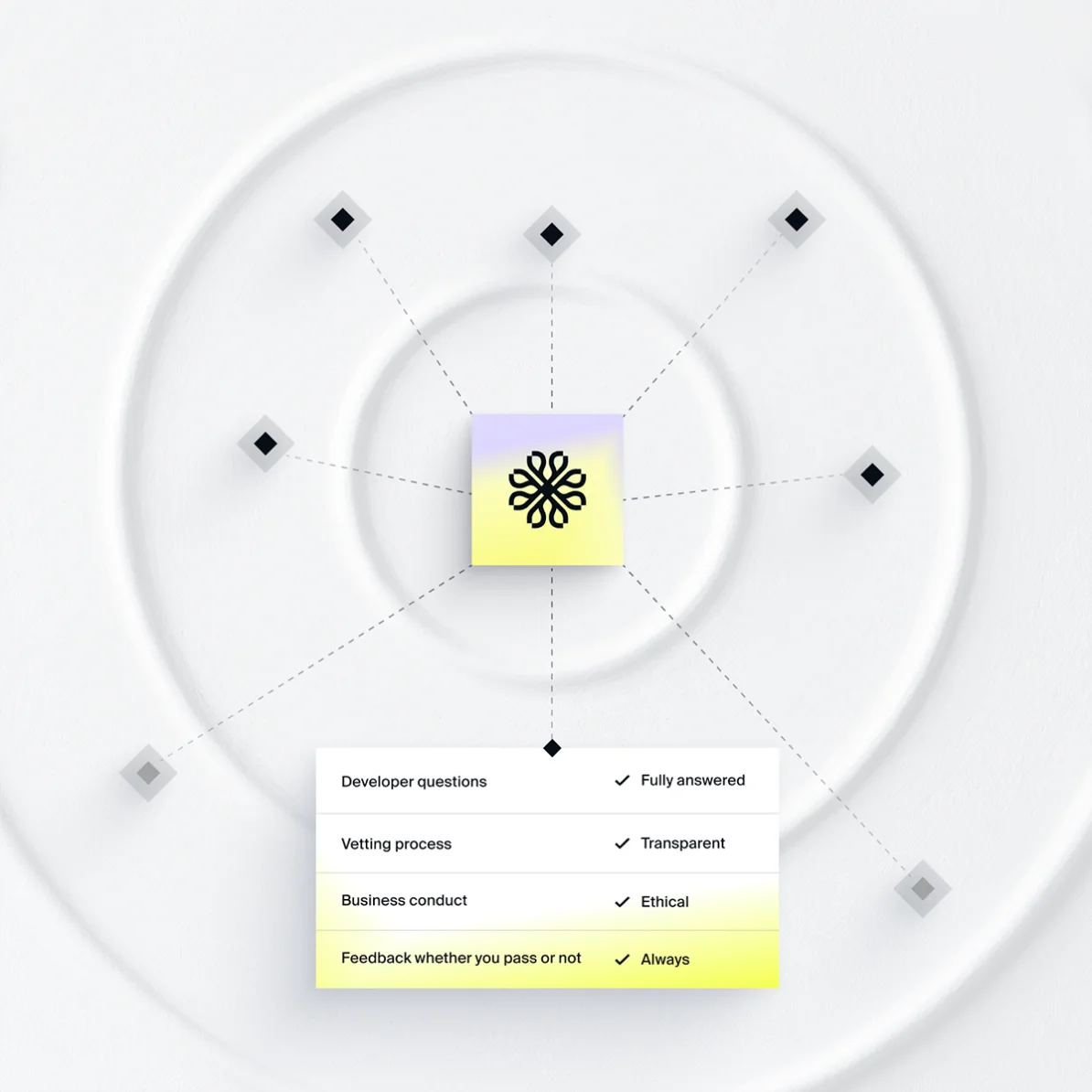
No re-vetting per project — ever. Detailed feedback whether you pass or not.
1,500+
vetted devs
9+ months
Average contract length
5 days
To get vetted
See Projects & Apply
illustration

Lemon.io is a developer talent marketplace connecting Blockchain Developers with funded Web3 product companies and SMBs for remote contract roles. Developers pass vetting once (5 days average) and get continuous access to a pipeline of pre-vetted projects — Lemon.io rejects 60% of applying companies based on funding stability, product clarity, technical specs, and engineering culture (a particularly important filter for Web3, where speculative projects are common). Blockchain senior rates: $35–$94/hour (median $55/hour); Strong Senior engineers: $50–$105/hour (median $81/hour) — the highest Strong Senior median of any stack on the platform. Average contract length: 9+ months. Both part-time and full-time engagements are supported. Lemon.io covers 71+ countries across 8 regions and works with Blockchain developers across Solidity (Ethereum, EVM L2s — Base, Optimism, Arbitrum), Solana / Rust, smart contract auditing, DeFi protocol design (DEXs, lending, derivatives), Web3Auth wallet integration, dual-rail crypto/fiat architectures, and Web3 mobile. Operating since 2015.

  • Free to join - No fees ever
  • Pre-vetted companies
  • Long-term projects (avg 9+ months)
  • No bidding wars

Blockchain Projects Actively Hiring Now

Real opportunities at vetted Web3 product companies and SMBs. When you apply, Lemon.io sends you opportunities tailored to your stack, timezone, and goals — until the right match lands.

Web3 / NFT Marketplace
Pre-seed
Blockchain Developer
$20-$50/hour 1–2 months
Senior Blockchain Developer (Ethereum/Solana/Solidity/Rust) building an MVP multi-chain NFT marketplace, full-time, 1–2 months, EST. NDA required.
What you’ll build
Build the core blockchain infrastructure for a multi-chain NFT marketplace from scratch. Initial focus: smart contracts for vaulting and swapping NFTs across Ethereum, Solana, and other blockchains, followed by the minting platform and an arbitrage system guiding users on the optimal blockchain for buying and selling assets. MVP target is 60 days, full product at 90 days.
Tech stack
Ethereum Solana Web3.js Smart Contracts Rust
Team
No team yet
stage
LAUNCHING MVP
why devs choose this
Technical scope is ambitious: cross-chain NFT vaulting and swapping, a minting platform, and an arbitrage engine — all within a 60-day MVP timeline. For a blockchain developer, this exercises every skill simultaneously: smart contract architecture, multi-chain interoperability, and real DeFi-adjacent logic with the arbitrage system. You'll be the first developer, so every architectural decision is yours. Client has developer management experience and sets clear milestones, so structure without micromanagement.
Fintech / Crypto / Web3
Funded Startup
Blockchain Developer
$20-$45/hour Ongoing (7+ months)
Senior Blockchain Developer (React/TS/AWS/MongoDB/Solana/Eth) at a funded crypto-native payments super app, part-time 20h/week with burst flex, ongoing, 4h EST overlap.
What you’ll build
Build and maintain a crypto payments platform letting users pay bills, manage payments, and maximize digital assets in a single app. Real tasks: translate Figma designs into pixel-perfect React/Tailwind implementations (rebuilding payment modals into existing flows), investigate and fix bugs using logs and code, refactor complex codebases, handle third-party integrations and migrations. Stack: React/Tailwind front end, TypeScript and GraphQL backend, serverless AWS, MongoDB. Web3 spans Ethereum and Solana.
Tech stack
React TypeScript GraphQL Tailwind CSS AWS MongoDB Solana Ethereum React Native
Team
1–3 Engineers
stage
SCALING
why devs choose this
Production crypto payments platform with real users paying real bills — so your code handles actual financial transactions across both traditional and blockchain rails. Part-time format with burst flexibility is ideal for a senior developer who wants meaningful Web3 work without full-time commitment, and the ongoing duration means stability than sprint-to-MVP pressure.
Web3 / Analytics
Seed
Blockchain Developer
$20-$50/hour 3–4 months
Blockchain Developer (React/D3.js/Next.js) at a seed-stage Web3 analytics startup, full-time, 3–4 months, AEST with EST overlap. No crypto experience required.
What you’ll build
Build data visualization products for a platform helping Web3 companies understand who their users are and where they come from — Google Analytics for blockchain. Application already exists, specs and designs for new features are complete. Implement blockchain-specific data products including historical asset balance visualizations across multiple chains using D3.js, with React, Next.js, and Tailwind CSS.
Tech stack
React D3.js Next.js Tailwind CSS
Team
1–3 Engineers
stage
SCALING
why devs choose this
D3.js data visualization is one of the highest-leverage front-end specializations, and this project gives you a continuous stream of complex charting challenges — that push your D3 skills far beyond standard dashboard work. Specs and designs are already done, so you start building immediately rather than waiting on requirements. No crypto experience needed — hiring bar is purely on front-end and visualization ability, not domain knowledge you may not have.
Web3 / Gambling / Entertainment
Pre-seed
Blockchain Developer
$20-$40/hour 1–2 months
Blockchain Developer (Solana/Rust/Anchor/React/RN) building a launching crypto-native casino platform, part-time 25h/week, 1–2 months ongoing potential, ~2h EST overlap.
What you’ll build
Take full technical ownership of a Solana-based gambling platform, building both web and mobile apps and the smart contract layer for two launch games: roulette and a custom slot machine. Smart contract work includes wallet-based betting and payout logic, provably fair randomness, and Phantom wallet integration with non-custodial flows. Set the technical direction, collaborate with design and product on game mechanics, lay the foundation for future engineers.
Tech stack
Solana Rust Anchor React React Native Smart Contracts
Team
No team yet
stage
LAUNCHING MVP
why devs choose this
First engineering hire with full technical ownership — every architectural decision, every smart contract, every game mechanic implementation is yours. The intersection of blockchain gambling and provably fair game logic is one of the most fascinating niches in Web3: VRF randomness, secure payout contracts, wallet-based betting flows that high-stakes users will trust with real money.
Web3 / Entertainment / Media
Pre-seed
Blockchain Developer
$20-$55/hour Ongoing (7+ months)
Blockchain Developer (Solidity/Polygon/OpenZeppelin/Node/React) building a launching utility token and staking system for a sci-fi Web3 universe, full-time, ongoing, 1–2h EST overlap.
What you’ll build
Lead the entire technical build for a Web3 platform expanding a published cyberpunk sci-fi book universe into blockchain. Phase one: design, code, deploy an ERC-20 utility token on Polygon with staking logic, liquidity pool farming contracts with APY and vesting, DAO-style governance for story content voting. Write gas-efficient upgradable smart contracts using OpenZeppelin patterns, prepare for audit and execute revisions, deploy to Polygon testnet and mainnet, verify on block explorers.
Tech stack
Solidity Polygon OpenZeppelin ERC-20 SushiSwap/Uniswap Cross Mint Node.js React
Team
No team yet
stage
LAUNCHING MVP
why devs choose this
Creative premise is unique — you're not building another DeFi clone but tokenizing a published sci-fi universe where the utility token unlocks story content, enables community governance, and gates NFT lore drops. Technical work is serious Solidity: staking contracts with APY/vesting, LP farming, upgradable patterns for future NFT integration, audit preparation on Polygon mainnet.
Web3 / Gaming / Fintech
Pre-seed
Blockchain Developer
$20-$50/hour 2–5 months
Blockchain Developer (RN/Node/TS/Solidity/USDC/Base) building a launching mobile gaming platform with dual crypto/fiat payments, part-time or full-time, 2–5 months, 2–3h Pacific overlap.
What you’ll build
Build the MVP for a mobile-first gaming platform blending traditional payments with cryptocurrency. Core challenge: build two parallel payment versions — a crypto version using USDC on Base with Solidity escrow logic and Web3Auth wallet integration, and a fiat fallback using Stripe, PayPal, or embedded banking. Architecture must be modular to support seamless transitions between both payment rails. UX is the top priority — minimal clicks to complete any action.
Tech stack
React Native Node.js TypeScript Solidity USDC Base (L2) Web3Auth Stripe PayPal
Team
No team yet
stage
LAUNCHING MVP
why devs choose this
Dual-rail architecture is a rare technical problem few developers have solved in production. You'll architect the payment modularization from scratch — your design decisions define how the platform scales to additional payment methods and chains. Non-technical founder has designs ready and is explicitly looking for someone who simplifies complexity and communicates clearly — not a developer who hides behind jargon.
Web3 / AI
Web3 / AI
Blockchain Developer
$20-$53/hour 1 month
Blockchain Developer (GPT/LangChain/Pinecone/Web3) building a ChatGPT-style interface for blockchain data, part-time or full-time, 160 hours, GMT+8.
What you’ll build
Build a prototype letting users query blockchain data using natural language — essentially a ChatGPT for crypto. Architecture involves ingesting blockchain data via APIs like Alchemy/Infura, converting to vectors with GPT-3, storing in Pinecone or Weaviate vector databases, and serving results through a GPT-wrapper-style front end. LangChain orchestrates the pipeline between data retrieval, embedding generation, vector search, and natural language response.
Tech stack
GPT-3 LangChain Pinecone Weaviate Blockchain Alchemy/Infura
Team
2 Co-Founders
stage
LAUNCHING MVP
why devs choose this
Intersection of LLMs and blockchain data is one of the most interesting problem spaces in AI right now — you're building a RAG pipeline over on-chain data, which involves challenges most ChatGPT wrappers never face: real-time data ingestion from blockchain APIs, embedding financial/transactional data meaningfully, and generating accurate natural language responses about crypto positions and transactions.
Fintech / Crypto / Web3
Funded Startup
Blockchain Developer
$20-$47/hour 5–6 months
Blockchain Developer (Node/TS/Jest) at a funded crypto tax platform serving 30+ countries, full-time, 5–6 months, EST.
What you’ll build
Build custom applications fetching cryptocurrency data from exchanges and wallets using TypeScript integrations, then format that data for internal tax calculation processes. Company's cost basis algorithm handles the rest — generating tax forms, real-time estimates, and full U.S. tax returns for individuals, businesses, and investment funds. Work is test-driven: Jest for unit and integration testing to ensure accuracy in financial data processing, because incorrect tax calculations have real consequences.
Tech stack
Node.js TypeScript JavaScript Jest
Team
3 Engineers
stage
SCALING
why devs choose this
Data accuracy requirements make engineering challenging — you're building integrations that pull financial data from every major exchange and wallet, and errors mean incorrect tax filings for real users in 30+ countries. TDD isn't aspirational here, it's mandatory, so you work in a codebase where testing discipline is real and code quality matters.
Agency / Web3
Bootstrapped
Blockchain Developer
$20-$47/hour 1 month
Blockchain Developer (React/Smart Contracts) at a boutique crypto design agency, part-time 20h/week, up to 160 hours ongoing potential, EST.
What you’ll build
Build React frontends connecting directly to blockchain networks instead of traditional backend setups — smart contract integration, wallet connections, on-chain data flows across multiple crypto and Web3 projects. Initial engagement is a short-term project (~3 weeks), after which you'll shift onto other existing projects within the agency's portfolio of internal products and client work. Team includes a CTO, 3 developers, and one existing engineer, so the collaboration model is proven.
Tech stack
React Smart Contracts
Team
4 Engineers + 1
stage
SCALING
why devs choose this
Agency model means project variety — you won't be stuck on one codebase for months but will rotate across multiple Web3 products and client projects, keeping the work fresh. A developer is already embedded on the team, validating the working relationship and expectations. Boutique crypto focus means every project is blockchain-native rather than adding Web3 as an afterthought, so your smart contract integration skills are the core value, not a bonus.
View all

Blockchain developer rates – what you'll actually earn (2026)

Based on Blockchain rate observations across the Lemon.io network, covering 71+ countries.

Mid-Level
$27–$60/hr
Senior
$35–$94/hr
Staff/Principal
$50–$105/hr

Mid-level Blockchain developers (2–5 years) earn $27–$60/hour on Lemon.io (median $45). Senior developers (5–8 years) earn $35–$94/hour (median $55). Strong Senior engineers (8+ years) earn $50–$105/hour (median $81) — the highest Strong Senior median of any stack on the platform. North American Blockchain developers command $66/hour senior median — only a +22% premium over the European baseline of $54, the second-smallest geographic gap on the platform after Swift. Within North America, East America and West America both lead at $68/hour senior median. The senior rate floor is $35/hour — one of the highest senior floors of any stack, reflecting that Blockchain is a specialized discipline with no commodity-priced senior tier. The Strong Senior tier shows a +47% jump in median earnings over Senior — one of the largest tier-progression gaps on the platform, signaling that production smart contract and protocol expertise (Solidity audit-grade, Solana / Rust, DeFi protocol design) is rare and meaningfully rewarded. Average weekly workload: 35–40 billable hours full-time, 15–20 hours part-time. Both engagement types fully supported.

Stack Premiums
Solidity + EVM (Ethereum, Base, Optimism, Arbitrum L2s)
$60–$90/hr
Solana + Rust
$65–$100/hr
DeFi Protocol Design (DEXs, lending, derivatives)
$70–$105/hr
Smart Contract Auditing
$70–$105/hr
+22%
North America rate premium over EU
$105/hr
Top observed Blockchain rate (Strong Senior)
+47%
Strong Senior earnings jump over Senior median
$81/hr
Strong Senior median rate

We reject 60% of companies that apply

What we screen for
  • Stable funding or proven revenue
  • Clear product vision and technical specs before you start
  • Engineering culture: autonomy, documentation, organized PMs
  • Real technical challenges (not CRUD maintenance)
  • Direct collaboration with decision-makers
hand
What we don’t do
  • We don't list 2-week throwaway gigs
  • We don't accept companies without verified funding
  • We don’t make you repeat long interview processes for every project
  • We don't charge developer fees — ever
hand

Apply once. Pass vetting in 5 days. Start in 2 weeks.

illustration
Tell us what you're looking for
Fill out a quick profile with your stack, rate, availability, and preferences.
illustration
Prove Your Skills
A soft skills interview, then a technical assessment with senior engineers. Real problems, no trick questions.
illustration
Start Building
We match you with clients that fit your criteria. Join the team and start working directly with your client.
Who we're looking for
  • 3+ years of commercial Blockchain development experience

  • Strong with at least one smart contract platform: Solidity (Ethereum, EVM L2s) or Solana / Rust

  • Production smart contract deployment experience (mainnet, not just testnet)

  • Strong understanding of Web3 security patterns (reentrancy, overflow, access control, common attack vectors)

  • Familiar with DeFi primitives (AMMs, lending, staking, oracles) and/or NFT standards (ERC-721, ERC-1155, Metaplex)

  • Experience with at least one Web3 development toolchain (Foundry, Hardhat, Anchor for Solana)

  • Frontend Web3 fluency a strong plus (Wagmi, Viem, Web3Auth, ethers.js, RainbowKit)

  • Smart contract auditing experience commands a premium tier

  • Comfortable working async with US/EU team

  • English: Upper-Intermediate or higher

  • Available for 20+ hours/week — part-time and full-time both supported

How it work
  • Apply once. Pass vetting in 5 days.

  • We continuously send you projects matched to your stack, rate, and timezone — until the right one lands.

  • Once you pass vetting, no re-screening for new projects.

  • During your first week, your success manager ensures clear expectations, documentation, and a direct line to the engineering lead.

Contract work, without the instability

9+ months
Average contract length
<2 weeks
Average downtime between contracts
48 hours
Average re-matching time if a project ends early
Addressing the "what if" fears
  • What if the Web3 startup is a rug-pull or speculative project?
    We screen for this aggressively. Web3 clients face stricter funding verification than other verticals — the 60% company rejection rate is even more relevant for Blockchain, where speculative or rug-adjacent projects are filtered out before joining the pool.
  • What about holidays and vacation?
    You set your own schedule and availability. Contracts account for time off. Most devs take 3–4 weeks/year without issues.
  • What if I'm transitioning from full-time?
    Many Blockchain devs in the network made this transition. Start part-time during your notice period to validate income before going independent.
  • What about token-only compensation offers?
    Lemon.io contracts are paid in fiat (USD or local equivalent). We don't structure token-only or token-equity-only compensation — you earn an hourly rate in cash. Token bonuses on top of fiat rates are negotiable per project.
Apply to Get Matched

Real developers. Real objections. Real outcomes.

thumbnail
Ivan Pratz
Senior Full-stack Developer
Javascript, Typescript, Vue.js, Node.js, Golang
ES flag Spain
thumbnail
Borisa Krstic
Senior Full-stack Developer
Javascript, Typescript, React, Node.js
BA flag Bosnia And Herzegovina
thumbnail
Bartek Slysz
Senior Front-end Developer
Javascript, Typescript, React
PL flag Poland
thumbnail
Viktoria Bohomaz
Full-stack Developer
Ruby, Ruby on Rails
PL flag Poland
thumbnail
Samuel Oyekeye
Senior Full-stack Developer & Technical Interviewer
Javascript, Typescript, React, Angular, Vue.js, Node.js
EE flag Estonia
thumbnail
Alla Hubko
Senior Full-stack Developer & Technical Interviewer
Javascript, PHP, React, Vue.js, Laravel
CA flag Canada
thumbnail
Matheus Fagundes
Senior Full-stack Developer
Javascript, Typescript, React, Vue.js, Node.js
BR flag Brazil
thumbnail
Jakub Brodecki
Senior Full-stack & Senior Mobile Developer
Javascript, Typescript, React, React Native, Node.js
PL flag Poland
thumbnail
Santiago González
Senior Full-stack & Senior Mobile Developer
Javascript, Typescript, React, React Native, Node.js
UY flag Uruguay
thumbnail
Carlos Henrique
Senior Full-stack Developer
Javascript, Typescript, React, Node.js
BR flag Brazil
View more

Hear from our developers

avatar
Alexandre
Senior Full-Stack Developer
Lemon is the best remote work company in place right now. Every single manager or person I talked to were super friendly and kind to me, and I never had a single issue while working with them. Despite how the market is going through bad times, we still made good work together and they ever managed to get things working for both sides.
avatar
Roger
Senior Full-Stack Developer
The folks at Lemon.io are not just super nice but also total pros. They make the whole process smooth and fun. I have been treated with respect and professionalism. This platform is a game-changer for us developers from South America who dream of landing cool jobs in US startups or Europe and starting to earn in a strong currency by doing what we are already good at.
avatar
Matheus
Senior Full-Stack Developer
Joining lemon.io has been an absolutely fantastic experience. From the moment I joined the platform, I knew I had made the right choice. People are great, educated, and have a good balance of work with great projects.
avatar
Eduard
Senior Full-Stack Developer
They're great at what they do: connecting you to the developer/client and stepping out of the way so the work gets done in the most efficient manner possible!

What Happens Next?

websites
Fill out a 5-minute profile
puzzle
Pass our vetting process (interviews & technical check)
lemon
Get matched with pre-vetted companies
lemon-rocket
Start your first project
Even if you don't pass vetting, you get detailed feedback from our senior technical interviewers — something most hiring processes never offer.

Frequently Asked Questions

  • What is the average hourly rate for senior Blockchain developers in 2026?

    Senior Blockchain developers on Lemon.io earn $35–$94/hour (median $55/hour) based on rate observations across 71+ countries. Strong Senior engineers (8+ years) earn $50–$105/hour (median $81/hour) — the highest Strong Senior median of any stack on the platform. North American developers earn $66/hour senior median — only a +22% premium over the European baseline of $54, the second-smallest geographic gap on the platform. Stack matters: smart contract auditing, DeFi protocol design (DEXs, lending), and Solana / Rust command the highest premiums.

  • Can I work part-time as a contract Blockchain developer?

    Yes — and many developers start that way. Part-time engagements (15–25 hours/week) are fully supported and a common entry point. Several active Blockchain projects on the platform are explicitly part-time tracks, especially for protocol design and smart contract auditing roles. Both schedules are equally supported.

  • How long does it take to get a Blockchain developer job through Lemon.io?

    After passing vetting (5 days average), Lemon.io continuously sends Blockchain developers opportunities matched to their stack and timezone — until the right project lands. The fastest matches go to developers who list specific specializations clients filter on (Solidity + Foundry + EVM L2 deployment, Solana + Rust + Anchor, DeFi protocol design, smart contract auditing, Web3Auth wallet integration). Broader “general Blockchain” profiles see longer cycles. Once you’re vetted, you stay in the pool indefinitely.

  • Why is Strong Senior Blockchain pay so high relative to other stacks?

    Across Lemon.io’s developer network, Blockchain has the highest Strong Senior median rate of any stack — $81/hour (compared with Data Engineer’s $67/hour, Android’s $71/hour, and Swift’s $71/hour). The pattern reflects three structural realities of the Blockchain market: (1) production smart contract expertise carries financial risk — bugs in Solidity or Solana code mean lost funds, so senior engineers carrying that responsibility command audit-grade rates; (2) the talent pool is structurally smaller than Web2 stacks, with no commodity-priced senior tier; (3) the +47% Senior-to-Strong-Senior jump is one of the largest on the platform, signaling that production blockchain mastery (audit-grade Solidity, DeFi protocol design, cross-chain architecture) is rare and rewarded.

  • Are Web3 contracts paid in tokens or fiat on Lemon.io? Fiat (USD or local equivalent).

    Lemon.io contracts are structured as standard hourly engagements paid in cash — not token-only or token-equity arrangements. Token bonuses on top of fiat hourly rates are negotiable per project, but the base contract is always cash. This matters for Blockchain developers because it removes the volatility risk of token-only compensation while still allowing upside through bonus structures.

  • Which Blockchain specializations command the highest premiums?

    Across active Blockchain projects on the platform, the highest-paying specializations are: Smart Contract Auditing ($70–$105/hr — Solidity audit-grade with formal verification or fuzzing experience); DeFi Protocol Design ($70–$105/hr — DEX architecture, lending protocols, derivatives, AMM design); Solana / Rust ($65–$100/hr — smaller talent pool than Solidity, growing demand); Cross-chain architecture (bridges, multi-chain DeFi — premium niche); Web3Auth + dual-rail crypto/fiat mobile (mobile-first Web3 with Stripe + USDC fallback — emerging premium pattern).

  • What's the vetting process for Blockchain developers?

    Five business days. Four stages. No whiteboards, no algorithm trivia, no recruiter screens. Stage 1: profile + LinkedIn review. Stage 2: soft-skills interview — English, communication, role-play, not rehearsed pitches. Stage 3: technical interview with a senior blockchain engineer — small talk, an experience dive, a theory check, and a practice challenge (smart-contract architecture, live coding, security review of the interviewer’s contract, gas-optimization analysis). Every interviewer is a senior engineer or tech lead, not a generalist recruiter. Stage 4: you’re listed and visible to vetted companies. We vet companies too — about 60% are rejected for shaky funding, unclear roadmaps, or weak engineering culture, so the projects on the other side are worth the bar. Every candidate who doesn’t pass gets detailed technical feedback — specific gaps, code observations, and what to ship before re-applying. Pass once, stay in — no re-vetting for new projects.

State of Blockchain contracting in 2026

Market insights from the Lemon.io developer network, active since 2015.

Head of Talent Acquisition at Lemon.io
Zhenya Kruglova
Verified expert in Talent Acquisition
8 years of experience

Zhenya Kruglova is a talent acquisition strategist with nearly a decade of experience designing scalable hiring systems for startups, marketplaces, and tech companies across Europe and Latin America. As Head of Talent Acquisition at Lemon.io, she leads the vetting process for top-tier engineers — making sure clients get the right talent quickly and with confidence. With a foundation in education and mentoring, she brings both empathy and structure to her role, overseeing recruitment and talent matching teams while shaping the overall strategy behind Lemon’s developer vetting process. Her focus is not just on matching skills, but on aligning values, goals, and team fit to build partnerships that last.

Expertise
Talent Acquisition
Management
Strategy
Recruitment
Talent matching
role
Head of Talent Acquisition at Lemon.io

Where the demand is

Most Blockchain contract work on Lemon.io comes from US-based Web3 product companies and well-funded crypto startups, with notable additional volume from EU, Singapore, and Australian product startups. Verticals concentrate around DeFi (DEXs, lending, derivatives, yield-bearing products), Crypto Tax / Compliance (multi-chain data integrations, exchange/wallet APIs, cost-basis algorithms), Web3 Mobile (Solidity + USDC on Base L2 + Web3Auth wallets, mobile-first gaming and finance), NFT / Digital Collectibles (ERC-721, ERC-1155, Metaplex on Solana), Cross-chain Infrastructure (bridges, multi-chain wallets, chain abstraction), DAO / Governance Tooling, and Smart Contract Auditing (a separate high-rate specialization).

The Blockchain ecosystem’s geographic signature on the platform is unusual: rates are more globally uniform than most stacks (+22% NA-vs-EU premium, second-smallest gap after Swift). The talent pool is smaller and more globally distributed — USA leads volume, but the next tier of countries (Germany, Canada, Brazil, Romania, Australia, Spain, Singapore, Austria, France) each contribute meaningfully without any single Eastern European country dominating in the way React or Python pages show.

The fastest-growing Blockchain verticals in 2026 are EVM L2 deployment (Base, Optimism, Arbitrum — replacing Ethereum mainnet for new product launches), Web3 mobile with dual-rail crypto/fiat (Stripe + USDC + Web3Auth — making Web3 invisible to mainstream users), AI + Blockchain hybrid products (LLM-driven smart contract analysis, agentic on-chain workflows), and Smart Contract Auditing (independent of which chain — auditing demand outpaces the supply of senior auditors).

The Blockchain specializations that drive rates in 2026

Not all Blockchain experience is valued equally. Specialization depth determines rate ceiling more than geography on this stack.

  • Solidity + EVM (Ethereum, Base, Optimism, Arbitrum)

    is the platform’s most common Blockchain stack: $60–$90/hour. Production deployment to mainnet (not just testnet), gas optimization fluency, OpenZeppelin pattern depth, and EVM L2-specific awareness (calldata costs on rollups, precompiles, native bridges) are now expected at senior level. Foundry has overtaken Hardhat as the modern dev toolchain default.

  • Solana + Rust

    commands $65–$100/hour. Demand concentrates in NFT/Metaplex products, high-throughput DeFi (Jupiter, Drift), Solana-native gaming, and any product where Solana’s transaction-cost economics matter. Anchor framework fluency is the senior bar — raw Rust + bare-metal Solana programs are rare and well-paid.

  • DeFi Protocol Design (DEXs, lending, derivatives)

    commands $70–$105/hour — the platform’s premium Blockchain tier. Demand concentrates in well-funded DeFi protocols, derivatives platforms, and yield aggregators. Production protocol design experience (AMM curve design, liquidation mechanisms, oracle integration, MEV-aware architecture) puts you in the top demand bracket.

  • Smart Contract Auditing

    commands $70–$105/hour — independent of chain. Demand outpaces supply; auditors with Foundry fuzzing, formal verification (Certora, K Framework), or invariant testing experience match within days. Audit-grade Solidity expertise is the most rare-and-rewarded specialization on the platform.

  • Web3 Mobile (Solidity + Web3Auth + dual-rail crypto/fiat)

    commands $50–$80/hour. The dual-rail architecture (crypto + fiat in the same app, seamlessly switchable via Web3Auth + Stripe + USDC on Base L2) is technically rare — few mobile devs have shipped this in production. Demand concentrates in mobile-first gaming, fintech, and consumer Web3 products.

  • Cross-chain Architecture

    (bridges, multi-chain DeFi, chain abstraction) is a niche premium: $70–$100/hour. Demand concentrates in infrastructure protocols, multi-chain DeFi products, and chain-abstraction projects (LayerZero, Wormhole, Axelar adjacent work).

What gets you matched fastest (decision framework)

Three factors predict matching speed for Blockchain developers.

1. Production mainnet deployment experience beats testnet-only profiles. A developer who lists “Solidity, Foundry, mainnet deployments on Ethereum + Base + Optimism, gas-optimized OpenZeppelin patterns, $X TVL audited contracts” matches into significantly more high-rate projects than a “Solidity, Hardhat, testnet smart contracts” profile. Real on-chain track record matters here in a way it doesn’t on Web2 stacks.

2. Specialization (auditing, DeFi protocol design, Solana) compounds rate ceilings. Strong Senior tier rates ($81–$105/hour) cluster in roles requiring at least one of: smart contract auditing, DeFi protocol design (DEX/lending/derivatives architecture), Solana/Rust, or cross-chain infrastructure. Pick 1–2 specializations, ship them in production, then explicitly claim them.

3. Security mindset is non-negotiable at senior level. Blockchain candidates who can’t articulate common attack vectors (reentrancy, integer overflow, access control bypass, oracle manipulation, MEV exploitation) get filtered out of higher-rate roles regardless of rate negotiated. Security depth is the most consistent senior-tier differentiator on this stack.

What “$100/hour Blockchain work” actually looks like

Concrete examples from real Lemon.io Blockchain contracts at the upper rate band:

1. $105/hr — Smart Contract Auditor (Solidity + Foundry + Fuzzing) at a well-funded DeFi protocol, conducting formal-verification-adjacent audits on lending and derivatives contracts before mainnet deployment.

2. $95/hr — Senior DeFi Protocol Engineer (Solidity + EVM L2) at a Funded DEX, designing AMM curve mechanics, liquidation flows, and oracle integration on Base + Optimism.

3. $80/hr — Senior Solana Engineer (Rust + Anchor) at a Seed Solana-native gaming protocol, building high-throughput on-chain game state with token-gated mechanics.

4. $65/hr — Senior Solidity Engineer (Mobile Web3 + Web3Auth) at a Pre-seed mobile gaming startup, building dual-rail crypto/fiat architecture with Solidity escrow + Web3Auth + Stripe fallback.

5. $50/hr — Senior Solidity Engineer (Smart contracts + agency work) at a Bootstrapped Web3 development agency, building custom smart contracts for client deployments.

Common pattern: production mainnet deployment fluency, specialized vertical (auditing, DeFi protocol design, Solana, Web3 mobile), small teams with technical co-founders, and direct collaboration with protocol architects. Generic “smart contract from spec” work clusters in the $35–$50/hour band.

Why Blockchain devs fail Lemon.io vetting (and how to pass)

Across vetting interviews, four rejection patterns dominate for Blockchain candidates:

1. Testnet-only experience presented as production. Candidates who’ve deployed to Sepolia or Goerli but never to mainnet (with real funds, real users, real audit feedback) get filtered out of higher-rate roles. The fix: ship at least one production mainnet contract — even a small one — before applying.

2. Security gaps in standard pattern recognition. Candidates who can write Solidity but can’t immediately recognize reentrancy patterns, integer overflow risks, access control bugs, or oracle manipulation vectors miss the senior bar. Senior Blockchain matches require security mindset as a default, not an afterthought.

3. Gas optimization at one altitude. Candidates who use OpenZeppelin contracts but can’t reason about gas costs (storage vs memory vs calldata, packing structs, custom errors vs require strings, EVM precompile usage on L2s) miss premium-tier roles. Gas optimization is now table stakes at senior level.

4. No DeFi or NFT primitive familiarity. Even non-DeFi-specialist Blockchain candidates are expected to understand AMMs, lending mechanics, staking, oracles, and standard NFT patterns at a working level. “I only do smart contracts, not DeFi” reads as legacy in 2026’s market.

The fix is structural: when describing past work, lead with the security decision, the gas optimization trade-off, the deployment context (mainnet vs testnet vs L2), and the measurable on-chain outcome (TVL, transaction volume, audit findings) — not the technology used.

Modern Blockchain in 2026 — what’s actually changing

Three structural shifts are reshaping what senior Blockchain looks like.

EVM L2s are now the production default. Base, Optimism, Arbitrum, and increasingly Linea / Scroll / zkSync are replacing Ethereum mainnet for new product launches. Senior matches expect L2-specific awareness — calldata costs on rollups, native bridges, sequencer trust assumptions, and L1-vs-L2 deployment trade-offs. Mainnet-only experience without L2 fluency reads as legacy.

Foundry has overtaken Hardhat as the modern dev toolchain. Foundry’s faster test runner, better fuzzing primitives, and Solidity-native scripting have made it the default for new Blockchain projects. Hardhat persists in older codebases but is increasingly legacy. Foundry + forge fuzz + invariant testing fluency is now the senior bar.

Audit-grade development is moving from specialty to baseline. Where smart contract auditing was once a separate post-development phase, it’s increasingly baked into the development workflow itself — formal verification (Certora, Halmos), invariant testing, fuzzing, and audit-driven development cycles are now expected at senior level for any contract handling real value. Senior Blockchain engineers who internalize audit-grade thinking command premium rates.

Freelance vs full-time: the real numbers

Senior Blockchain developers on Lemon.io earn a median of $55/hour, working 35–40 billable hours per week. North American developers earn $66/hour senior median. Strong Senior engineers earn $81/hour median — the highest Strong Senior median of any stack on the platform — with top observed rates of $105/hour for smart contract auditing and DeFi protocol design.

The +47% Strong Senior earnings jump over Senior is one of the largest tier-progression gaps on the platform — production Blockchain mastery compounds significantly. The $35/hour senior floor is also one of the highest of any stack, reflecting that there’s no commodity-priced entry-level senior tier on this discipline.

The unusual pattern on Blockchain: rates are more globally uniform than most stacks (+22% NA premium is second-smallest after Swift). This means specialization, not geography, is the primary earnings lever for Blockchain developers — a Strong Senior auditor or DeFi protocol designer in Eastern Europe can out-earn a generalist Senior Blockchain dev in San Francisco.

In all geographies, contract Blockchain senior earnings consistently match or exceed full-time total compensation when factoring in benefits cost (~$15K–$25K to replicate independently), no equity vesting cliffs, and no multi-month job searches between roles. Strong Senior tier rates ($81–$105/hour) significantly outpace local full-time Blockchain salaries in most markets — and uniquely, contract Blockchain work avoids the token-vesting volatility risk that defines much full-time Web3 compensation.

The most common transition pattern: start with a part-time contract (15–20 hours/week) while still employed, validate income stability, then scale to full-time. Both schedules are fully supported.

How remote Blockchain contracting actually works

The day-to-day looks more like being a senior protocol engineer at a Web3 product team than a traditional freelancer.

On a typical project, you join the client’s Slack or Discord workspace on day one. Your Lemon.io success manager facilitates a 30-minute onboarding call with the engineering lead, protocol architect, or technical co-founder. You get access to the codebase, smart contract repos, deployment scripts, audit reports, and project management tool (usually Linear, Notion, GitHub Projects). Most Blockchain developers ship their first pull request within the first week — typically a small contract improvement, gas optimization, or test coverage addition — then graduate to feature work and contract design contributions.

Communication cadence varies. Async-first teams (most Web3 teams skew async-first) do brief daily check-ins via Slack/Discord and rely on PR reviews, formal verification reports, and audit-driven iteration cycles. Sync-heavy teams may have 2–3 video calls per week including protocol design sessions and audit-prep meetings.

Smart contract review, formal verification, gas optimization, and audit-prep work happen the same as any senior Web3 team. You’re part of the protocol engineering core, not an outsourced resource.

Contracts run as monthly agreements with project-based scope. Average contract length: 9+ months — Web3 protocol work compounds across audit cycles and mainnet upgrade phases. When a project nears completion, your success manager begins matching you with the next opportunity. Average downtime between projects: less than 2 weeks.

Data Sources & Methodology

Rate ranges in this report are based on 2,500+ developer contracts analyzed on Lemon.io from January 2024 through April 2026 — actual hourly rates paid by vetted companies to engineers across 71+ countries and three seniority tiers (Middle 3–5 yrs, Senior 5–8 yrs, Strong Senior 8+ yrs). Lemon.io has operated as a talent marketplace since 2015.

Download the Full 2026 Report

Get complete salary tables for 50+ tech stacks, country-by-country breakdowns, and actionable hiring recommendations.
By clicking Download, you agree to our Privacy Policy and consent to receive the report and occasional insights on developer compensation and hiring from Lemon.io