










Most C++ contract work on Lemon.io comes from performance-critical and domain-specific verticals where C++ has a deep ecosystem moat in the US, EU, UK, Canada, and Australia. The verticals concentrate around HFT and quantitative finance (every major exchange, market-making firm, prop-trading shop, and quant fund runs core systems on C++ — ultra-low-latency, lock-free, NUMA-aware, kernel-bypass networking), AAA game development (Unreal Engine 5 is C++; in-house AAA engines are C++; gameplay programming, engine engineering, and rendering work are C++-dominated), embedded and robotics (automotive AUTOSAR is C++; ROS for robotics is C++; real-time systems and RTOS development; hardware-adjacent C++ for IoT, drones, autonomous systems), HPC and scientific computing (CUDA + OpenMP + MPI for high-performance computing, scientific simulations, machine-learning kernel work), graphics programming (Vulkan, DirectX 12, Metal native — game engines, rendering pipelines, GPU compute beyond CUDA), performance-critical infrastructure (databases like ClickHouse / Postgres extensions, browsers, OS-level work, codecs), and audio / video / DSP (real-time audio processing, video codecs, signal-processing pipelines). The fastest-growing C++ verticals in 2026 are modern C++20 / C++23 modernization migrations (existing C++11 / C++14 codebases adopting concepts, ranges, modules, coroutines, std::expected for ergonomics + safety wins), CUDA + GPU compute beyond ML training (real-time inference, scientific computing, custom kernels), embedded autonomous systems (autonomous vehicles, drones, robotics — where modern C++20 + ROS + RTOS expertise matters), and HFT modernization (existing HFT systems adopting modern C++20+ idioms while maintaining sub-microsecond latency budgets).
Why C++ specialization still commands premium rates in 2026
Three structural realities keep senior C++ work well-paid in 2026. The dev-pool concentration drove premium for senior specialists. As some C++ developers migrated toward Rust (security-sensitive servers, kernel modules), Go (cloud-native services), or stayed in JVM-language ecosystems, the senior C++ pool concentrated. Demand stayed steady (HFT systems, game engines, embedded codebases, HPC infrastructure don’t disappear; they generate value for years) while supply tightened. The result: senior C++ specialists in 2026 command meaningful rate premium — especially in domain-specialized work where the ecosystem moat matters. Modern C++20 / C++23 substantially improved the language. Concepts replaced cryptic SFINAE template error messages with readable constraints. Ranges replaced verbose iterator-pair APIs. Modules (with adoption still partial) are starting to replace the legacy header / preprocessor model. Coroutines added cooperative concurrency. std::expected (C++23) added Result-style error handling without exceptions. Three-way comparison simplified comparison operators. Deducing this simplified CRTP. Combined with smart pointers and move semantics from earlier modern C++, modern C++ is meaningfully more expressive and safer than C++03 / C++11. ISO C++ Safety Profiles (committee-driven memory-safety improvements) are addressing the Rust-driven safety conversation directly. Domain ecosystem moats are real. Rust competes meaningfully for new systems work in some domains. But HFT / quantitative finance, AAA game engines, automotive (AUTOSAR), robotics (ROS), HPC (CUDA), and graphics programming (Vulkan / DirectX / Metal native) all have 30+ year C++ ecosystem moats. The talent pool, the libraries, the build systems, the institutional knowledge, the regulatory frameworks (AUTOSAR for automotive) all assume C++. These domains aren’t moving to Rust en masse — they’re modernizing within C++ to C++20 / C++23. The rate consequence: senior C++ work in 2026 is steady and well-paid in the domains that need it, with the highest premiums concentrating in HFT / quant, embedded / robotics, HPC + CUDA, graphics programming, and modern C++20+ modernization migrations.
The C++ specializations that drive rates in 2026
Not all C++ experience is valued equally. Domain specialization — much more than “I write C++” — determines rate ceiling. HFT / Quantitative Finance C++ commands the highest rate band: $55–$95/hour. Demand concentrates in market-making firms, prop-trading shops, exchange engineering teams, and quant funds. Production patterns: lock-free data structures (Disruptor-style ring buffers, hazard pointers, atomic operations beyond simple types), NUMA-aware design, cache-line awareness and false-sharing avoidance, branch prediction, kernel-bypass networking (DPDK, Solarflare, custom drivers), sub-microsecond latency budgets, deterministic memory allocation (no malloc on hot paths), modern C++20 with coroutines for non-hot-path code. HPC + CUDA / SIMD + Graphics Programming commands $50–$75/hour. Demand concentrates in scientific computing, ML kernel work, and graphics-programming shops. Production patterns: CUDA kernel optimization, OpenMP / MPI for distributed HPC, SIMD intrinsics (AVX-512, NEON, etc.), Vulkan / DirectX 12 / Metal native graphics programming, GPU compute beyond ML training (scientific simulations, real-time inference, custom kernels), NSight / RenderDoc for profiling. Embedded C++ + Robotics / Automotive commands $50–$73/hour. Demand concentrates in automotive (AUTOSAR), robotics (ROS), drones, IoT, and real-time systems. Production patterns: AUTOSAR Classic + Adaptive, ROS 1 / ROS 2 + custom nodes, RTOS development (FreeRTOS, Zephyr), real-time systems with deterministic latency, hardware-adjacent C++ (DMA, interrupts, device drivers), MISRA-C++ compliance for safety-critical work. Modern C++20 / C++23 commands $50–$73/hour. Demand concentrates in modernization migrations and greenfield builds adopting concepts, ranges, modules, and coroutines. Production patterns: concepts for clearer template constraints, ranges for composable iteration, modules where compiler support is sufficient (Clang / MSVC primarily, GCC catching up), coroutines for cooperative concurrency, std::expected for Result-style error handling, ISO C++ Safety Profiles adoption.
What gets you matched fastest (decision framework)
Three factors predict matching speed for C++ developers. 1. Domain specialization beats generalist C++ knowledge. A developer who lists “C++20, HFT (lock-free, NUMA-aware, DPDK), modern concepts + ranges, sanitizer-driven undefined-behavior cleanup, BenchmarkDotNet-equivalent profiling discipline” matches into significantly more high-rate projects than a “C++, STL, generic backend” profile. Domain specialization is what the C++ Developer page is for. 2. Specialization claim compounds rate ceilings. Strong Senior tier rates ($47–$95/hour, with HFT specialists at the top) cluster in roles requiring at least one of: HFT / quantitative finance, embedded / robotics / automotive, HPC + CUDA / SIMD, graphics programming (Vulkan, DirectX 12, Metal native), or modern C++20+ modernization. Pick 1–2 specializations, ship them in production, then explicitly claim them. 3. Code-review fluency is the senior bar. C++ candidates who can write features but can’t read complex C++ in PR review — template metaprogramming with concepts, move semantics + perfect forwarding edge cases, ownership / lifetime reasoning, undefined behavior identification — miss premium-tier roles. Senior C++ at scale demands code-reading fluency more than feature velocity.
What "$80/hour C++ work" actually looks like
Concrete examples from real C++ contract patterns at the upper rate band: — $95/hr — Senior C++ Engineer (HFT + lock-free + NUMA-aware) at a Funded prop-trading firm, optimizing sub-microsecond hot paths with kernel-bypass networking and lock-free data structures. — $80/hr — Senior C++ Engineer (CUDA + custom kernels + scientific computing) at a Series B ML infrastructure company, building GPU compute kernels for real-time inference workloads. — $73/hr — Senior C++ Engineer (Embedded automotive + AUTOSAR Adaptive) at an Established automotive supplier, building production AUTOSAR Adaptive software components for ADAS systems. — $65/hr — Senior C++ Engineer (Vulkan + custom rendering pipeline) at a Funded indie AAA-adjacent game studio, building a custom rendering pipeline with Vulkan and modern C++20. — $50/hr — Senior C++ Engineer (Modern C++20 modernization) at an Established product team, modernizing a C++14 codebase to C++20 with concepts, ranges, and std::expected adoption. Common pattern: domain specialization (HFT / quant / embedded / HPC / graphics / modernization), modern C++20+ fluency, performance-critical discipline, and small-to-mid teams where senior judgment shapes architecture. Generic “C++ generalist” maintenance work clusters in the $20–$30/hour band — but is rare on Lemon.io because C++ clients self-select for substantive specialization work.
Why C++ devs fail Lemon.io vetting (and how to pass)
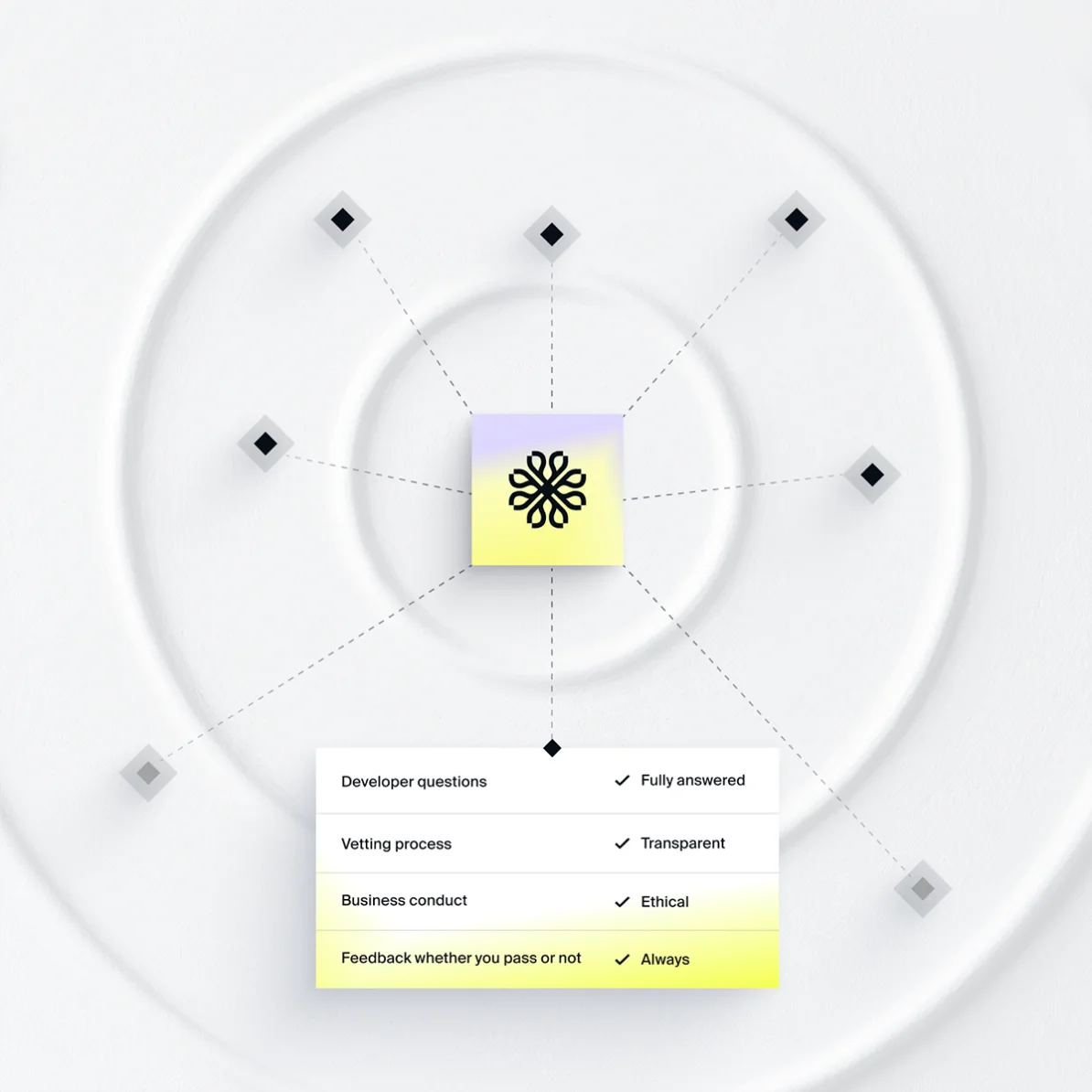
Across vetting interviews, four rejection patterns dominate for C++ candidates: 1. C++98 / C++11 thinking in a C++20 / C++23 market. Candidates defaulting to raw pointers, manual new / delete, no smart-pointer fluency, no move-semantics reasoning, no concept-based templates — get filtered out. Senior C++ matches expect modern C++17 fluency at minimum, C++20 / C++23 ideally. 2. No undefined-behavior reasoning. Candidates who can’t identify common UB patterns (reading uninitialized memory, signed integer overflow, type punning violations, dangling references, iterator invalidation, ODR violations) miss premium roles. Senior matches expect sanitizer-driven (ASan / UBSan / TSan) UB cleanup discipline. 3. No domain specialization. Generalist “I know C++” profiles match slower and at lower rates than specialists. The platform pattern: pick a domain (HFT / quant, embedded / robotics, HPC + CUDA, graphics, modernization), ship production work in it, then explicitly claim it. 4. No production performance discipline. “I built the system” without specifics fails when the topic is cache-line awareness, allocation profiling, branch prediction, NUMA-awareness, SIMD intrinsics, or domain-specific hardware behavior. Senior C++ matches require performance reasoning at machine level. The fix is structural: when describing past work, lead with the architectural decision (lock-free vs lock-based, NUMA-aware vs generic, modern C++20 vs legacy), the domain constraint, the trade-off, and the measurable outcome — not the language version used.
Modern C++ in 2026 — what's actually changing
Three structural shifts are reshaping what senior C++ looks like. Modern C++20 / C++23 are now the production default for new builds. What was experimental in 2020–2022 is the production default for new C++ builds in 2026. Senior matches expect concepts + ranges fluency at minimum, with coroutines and std::expected as common idioms in greenfield work. ISO C++ Safety Profiles are reshaping the safety conversation. The C++ committee’s response to the Rust-driven memory-safety conversation — Safety Profiles for committed-checkable subsets — is shipping incrementally and reshaping how senior C++ engineers think about safety in performance-critical work. Modernized C++ codebases with sanitizer-driven discipline + Safety Profiles narrow the safety gap with Rust meaningfully. Modules adoption is partial but growing. What was a 2020 standard feature with limited compiler support is now usable in production for Clang / MSVC-based builds and increasingly viable on GCC. Senior C++ engineers fluent in module-based builds (the post-header future of C++ compilation) match into modernization work at premium rates.
Freelance vs full-time: the real numbers
The day-to-day looks more like being a senior engineer at a domain-specialized team than a traditional freelancer.
On a typical project, you join the client’s Slack workspace on day one. Your Lemon.io success manager facilitates a 30-minute onboarding call with the engineering lead or CTO. You get access to the codebase (typically GitHub, GitLab, or for some HFT / embedded shops, Perforce / custom VCS), the C++ project + monorepo, build pipeline (CMake, modern Conan / vcpkg), CI/CD infrastructure with sanitizer-driven testing, and project management tool (usually Linear, Jira, GitHub Projects, ClickUp). Most C++ developers ship their first pull request within the first week — typically a small bug fix, performance refactor, or modernization step — then graduate to architecture work.
Communication cadence varies. Async-first product teams do brief daily check-ins via Slack and rely on PR reviews and architecture documents. Domain-specialized teams (HFT, embedded, HPC) tend toward sync-heavier cadences for compliance and domain-specific code-review reasons.
Code review, language-level architecture discussions, performance work (sanitizer-driven UB cleanup, profiler-driven optimization, BenchmarkDotNet-equivalent measurement, NSight / RenderDoc for graphics, perf for Linux), and deployment all happen the same as any senior engineering team. You’re part of the engineering core, not an outsourced resource.
Contracts run as monthly agreements with project-based scope. Average contract length: 9+ months — C++ projects compound across feature releases and architectural improvements, especially in HFT (multi-year systems) and embedded (long product lifecycles). When a project nears completion, your success manager begins matching you with the next opportunity. Average downtime between projects: less than 2 weeks.