










Golang Developer Jobs — Vetted Contract Roles at Top Cloud-Native Product Companies

Pass vetting once. Get continuous access to senior Go projects across Kubernetes (operators, controllers, custom controllers), microservices and gRPC, cloud-native infrastructure (Terraform providers, Kubernetes-native databases, observability tools), DevOps tooling (CLIs, automation), high-throughput backend services, and Go components in AI infrastructure — we’ll keep sending opportunities until the right match lands. No re-applying, no bidding wars.


how it works
1
Pass vetting once
Screening + tech assessment
2
Get matched to projects
We find the right fit for you
3
Meet Your Client & Start Building
Work directly with the team — no middlemen
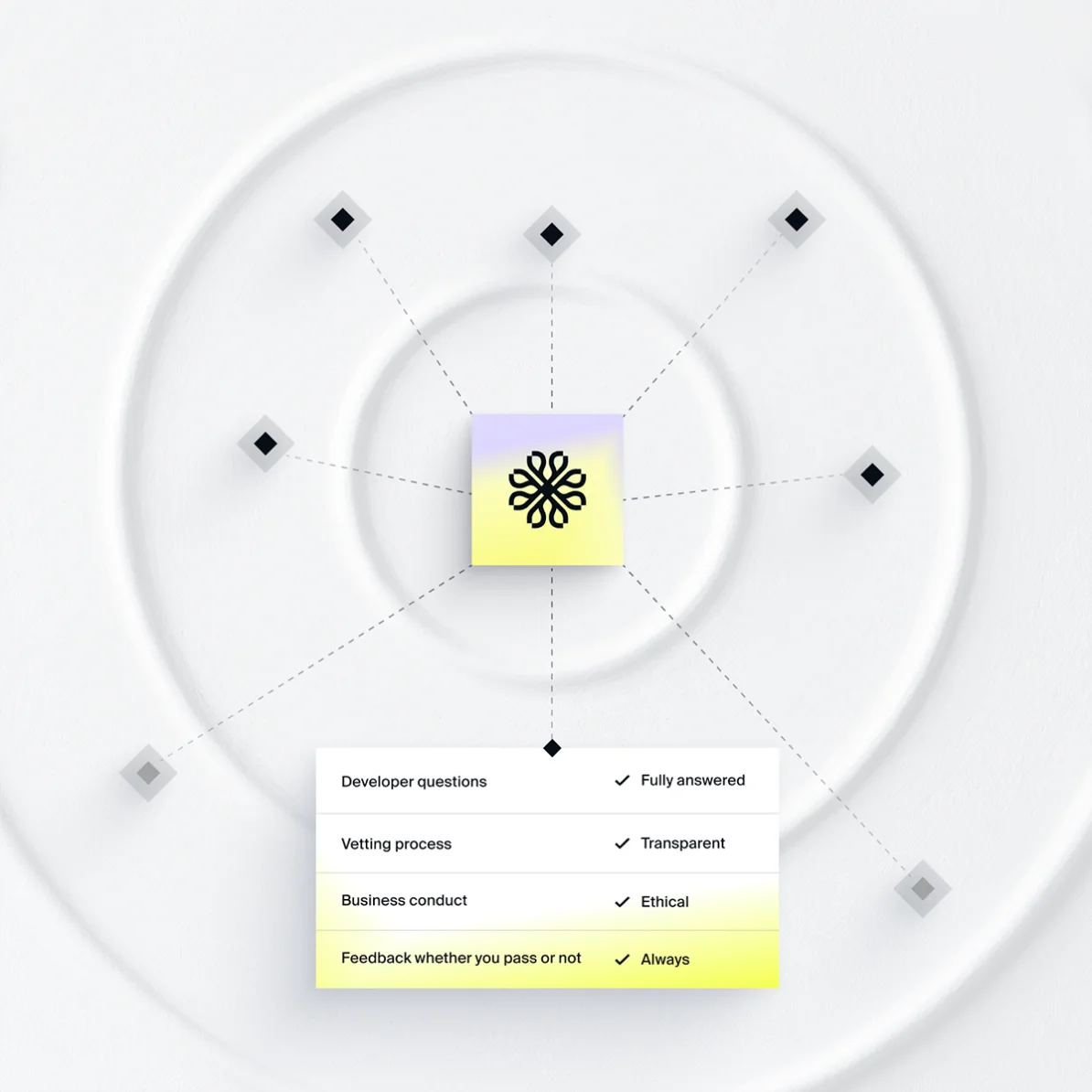
No re-vetting per project — ever. Detailed feedback whether you pass or not.
1,500+
vetted devs
9+ months
average contract length
5 days
to get vetted
See Projects & Apply
illustration

Lemon.io is a developer talent marketplace connecting Golang Developers with funded cloud-native product companies and SMBs for remote contract roles. Developers pass vetting once (5 days average) and get continuous access to a pipeline of pre-vetted projects — Lemon.io rejects 60% of applying companies based on funding stability, product clarity, technical specs, and engineering culture. Go senior rates: $37–$75/hour (median $50/hour); Strong Senior engineers: $32.80–$100/hour (median $55/hour). The Strong Senior tier shows only a +10% jump in median earnings over Senior — among the smallest tier-progression gaps on the platform, signaling that Go expertise plateaus at a high senior baseline rather than compounding through tiers. Average contract length: 9+ months. Both part-time and full-time engagements are supported. Lemon.io covers 71+ countries across 8 regions and works with Go developers across Kubernetes ecosystem, microservices and gRPC, cloud-native infrastructure, DevOps tooling, high-throughput backend services, and Go in AI infrastructure. Operating since 2015.

  • Free to join - No fees ever
  • Pre-vetted companies
  • Long-term projects (avg 9+ months)
  • No bidding wars

Golang Projects Actively Hiring Now

Real opportunities at vetted cloud-native product companies and SMBs. When you apply, Lemon.io sends you opportunities tailored to your stack, timezone, and goals — until the right match lands.

Consumer App / EdTech / Pet Care
Funded Startup
Backend Developer
$20-$35/hour 1 month
Backend Developer (Go/K8s/Postgres) at a science-backed dog education platform, building Facebook-groups-style social features, part-time or full-time, up to 160 hours, CET ±1.
What you’ll build
Build new social community features — enabling users to communicate, share experiences, and find guidance within the app. Designs will be ready at project start; review documentation before implementation. Design and develop backend services in Go, deploy microservices in Kubernetes, manage PostgreSQL databases, ensure scalability for growing user loads. Monitor performance and security, support CI/CD pipelines, troubleshoot bugs, collaborate closely with a front-end developer and designer.
Tech stack
Go Kubernetes PostgreSQL
Team
8 Team Members
stage
SCALING
why devs choose this
Immediate project is well-defined and design-ready (community/groups feature), so you can start building from day one without requirement ambiguity. The Go/Kubernetes/PostgreSQL stack is clean and modern, and social features (groups, communication, community) present interesting backend challenges around real-time messaging, scalability, and content management. Team culture is refreshingly human — eight multinational animal lovers who care about dogs, work-life balance, and having fun together. Single-call selection gets you started fast.
DevTools / Open Source
Funded Startup
Backend Developer
$20-$35/hour 5–6 months
Backend Developer (Go/Kafka) building data connectors for an open-source Kafka Connect replacement, full-time, 5–6 months, MT.
What you’ll build
Build source and destination connectors for an open-source project replacing Kafka Connect, written in Go. The team has built an SDK and connector template — your job is to use that framework to implement approximately 100 data integrations from a prioritized list. Each connector takes roughly two working days for a competent engineer, creating a steady rhythm of build-test-ship across a wide variety of data systems.
Tech stack
Go Apache Kafka Kubernetes Docker
Team
3 Engineers
stage
SCALING
why devs choose this
Work cadence is uniquely satisfying: well-scoped two-day connector builds using an existing SDK template, so you ship completed tested integrations every few days than spending months on a single feature. Open-source context means code is public, building professional portfolio with every connector. Variety is exceptional — ~100 different data systems means learning how dozens of databases, APIs, and services work under the hood.
SaaS / Compliance / RegTech
Funded Startup
Backend Developer
$20-$53/hour Ongoing (7+ months)
Backend Developer (Go/AWS) building data connectors for a compliance archiving platform extracting from Slack, LinkedIn, Zoom, full-time, ongoing, GMT.
What you’ll build
Build connectors that extract, authenticate against, and parse data from third-party platforms into a common data structure for a compliance archiving platform. Targets include well-known services and industry-specific vendors. The connector architecture is established — your work is reading third-party API documentation, figuring out efficient extraction methods, and implementing clean integrations. Stack is Go on AWS, with data processing at the core.
Tech stack
Go AWS Lambda S3 ECS
Team
24 Engineers
stage
SCALING
why devs choose this
Connector-building rhythm is structured and satisfying: read an API, design extraction, implement in Go, ship — then move to the next. Variety is exceptional: LinkedIn, Slack, Zoom, Facebook, Teams, plus niche industry-specific vendors, so you become an expert in how dozens of platforms expose and deliver data. Compliance archiving domain is stable and growing (regulatory requirements only increase), and the 24-person team with established connector architecture means real engineering support than solo guesswork
Logistics
Established
Senior Backend Developer
$20-$57/hour Ongoing (7+ months)
Senior Backend Developer (Go/Node) at a European corporate transportation marketplace with ~100 microservices and 25 engineers, full-time, ongoing, GMT.
What you’ll build
Join a 25-developer engineering team building a corporate car rental and transportation demand marketplace serving large businesses. The platform runs ~100 microservices on Kubernetes in Google Cloud, with PubSub for event-driven communication, BigQuery for analytics, and CloudML Engine for ML products. Work across relational and NoSQL databases, CI/CD pipelines, and apply advanced architecture patterns — sharding, CQRS, event sourcing, distributed locking, circuit breakers, and caching.
Tech stack
Go Node.js Kubernetes Google Cloud PubSub BigQuery Kafka Docker CI/CD
Team
25 Engineers + CTO
stage
SCALING
why devs choose this
The ~100 microservices architecture is genuine enterprise-scale distributed systems — sharding, CQRS, event sourcing, circuit breakers, distributed locking — patterns most developers only read about but this team implements daily. The 25-developer team with a CTO-led culture in Krakow provides real engineering peers and mentorship, not solo isolation. Explicitly progressive interview process (Google and ChatGPT allowed) signals a team that respects how real engineers actually work. Architecturally serious and professionally rewarding backend role.
Fintech
Funded Startup
DevOps Engineer
$20-$73/hour 4–6 months
DevOps Engineer (K8s/Terraform/Python/Go) at a fintech empowering working Americans with accelerated payments, full-time, 4–6 months, ET.
What you’ll build
Design, implement, and maintain infrastructure supporting a fintech platform helping companies accelerate payments and provide accessible financial services to working Americans. Manage Kubernetes clusters, develop and maintain CI/CD pipelines, build automation tools and infrastructure-as-code with Terraform, create self-service developer tooling so any team member can handle day-to-day infrastructure tasks. Monitor system performance with Prometheus and Grafana, troubleshoot across development and production, ensure security best practices, participate in on-call rotations.
Tech stack
Golang Kubernetes Terraform Docker Python Go AWS GCP Azure Prometheus Grafana CI/CD
Team
10+ Engineers
stage
SCALING
why devs choose this
Mission is impactful — helping working Americans access fee-free financial services and faster payments — and culture explicitly values employee ideas: share one today, see it implemented tomorrow. Multi-cloud infrastructure (AWS, GCP, Azure) with Kubernetes orchestration provides breadth most single-cloud roles can't match, and automation-first mindset means you build developer self-service tooling, not just maintain pipelines. The 10+ engineer team with SRE collaboration means real DevOps peers. CKA/CKAD and GCP certifications recognized.
Consumer App
Pre-seed
Senior Backend Developer
$20-$53/hour 4–6 months
Senior Backend Developer (Go/Python) at a generative AI social media startup building a daily emotional reflection app, full-time, 4–6 months, CET.
What you’ll build
Build the backend infrastructure for a novel social app where users daily answer NLP-generated questions about their emotional state, which gets transformed into a generative image — and friends compete on a leaderboard by guessing each other's emotions from the image alone. Backend handles daily prompt generation pipelines, NLP/NLG workflows, image generation API integrations, leaderboard and scoring systems, and social graph features including public discovery profiles for influencers.
Tech stack
Golang Python
Team
4–10 Engineers
stage
SEED STAGE
why devs choose this
Product concept is novel — daily generative AI-powered emotional reflection as a social mechanic is a fresh take on both mental wellness apps and social media engagement loops, and the founder has done serious LLM optimization work. Joining at MVP stage with an ambitious clearly scoped 6-month roadmap and a founder who has thought carefully about team structure and tech stack. Backend architecture goes well beyond standard CRUD.
DevTools
Seed
Backend Developer
$20-$35/hour 1–3 months
Backend Developer (Go/Postgres/AWS) at an enterprise AI integration platform, part-time 25h/week, 1–3 months, EST morning overlap.
What you’ll build
Work on PredictionGuard's developer-facing REST API — the primary product surface enterprise customers use to integrate AI models safely and reliably into their applications. Writing production-grade Golang, pick up work directly from GitHub issues and sprint board descriptions in Notion, implement new API features, fix bugs, write tests that keep the API reliable at enterprise quality standards.
Tech stack
Golang PostgreSQL AWS REST AP GitHub Actions Docker Python
Team
1–3 Engineers
stage
SEED STAGE
why devs choose this
PredictionGuard solves a real growing enterprise pain — making the latest AI models accessible, reliable, and safe for companies that can't navigate model integration complexity on their own. Golang API work is core product, not peripheral tooling, so commits ship directly to paying enterprise customers. Team is tiny, communication is async-first with one weekly live sync, single call with Daniel gets you started.
DevTools
Seed
Senior Backend Developer
$20-$60/hour 1–3 months
Senior Golang Backend Developer at a GPU-over-IP infrastructure startup, part-time 20h/week, 1–3 months, MT.
What you’ll build
Design and build the orchestration layer and interface for a GPU-over-IP product — the core infrastructure allowing GPU resources to be accessed and managed over a network than locally. Golang-based networking, database integration, and web services work that enables the platform to coordinate GPU resource allocation, routing, and availability across clients.
Tech stack
Golang
Team
1–3 Engineers
stage
EARLY STAGE
why devs choose this
GPU-over-IP is a technically niche and forward-looking infrastructure problem — as GPU compute demand grows across AI workloads, the ability to pool and distribute GPU resources over IP is becoming critical infrastructure than a curiosity. Building the orchestration layer means foundational architectural decisions on a product at the frontier of cloud compute, with creative freedom from an early-stage team still defining the right approach.
Fintech
Seed
Senior Backend Developer
$20-$51/hour 3–4 months
Senior Golang Developer at a fintech startup democratizing VC fund launches and syndicate investing, full-time, 3 months, GMT.
What you’ll build
Build and ship product features across a Golang backend — for a platform that makes launching and investing in VC funds and syndicates significantly cheaper and more accessible than traditional routes. The product handles infrastructure of fund management, investment flows, and syndicate coordination for individuals and communities who previously had no access to these instruments, so correctness, reliability, and security in the backend services are non-negotiable.
Tech stack
Golang React
Team
1–3 Engineers
stage
SEED STAGE
why devs choose this
Democratizing venture capital is an ambitious fintech mission — making fund launches and syndicate investing accessible to individuals and communities than established institutions requires building financial infrastructure that's both technically robust and regulation-aware. The team is lean (2 devs + CEO/COO), the stack is focused (Go-first), and the paid half-day trial signals a team that values demonstrated ability over interview performance. Meaningful fintech product work in a startup trying to reshape capital formation.
View all

Golang developer rates – what you'll actually earn (2026)

Based on Go developer rate observations across the Lemon.io network, covering 71+ countries.

Mid-Level
$22.50–$70/hr
Senior
$37–$75/hr
Staff/Principal
$32.80–$100/hr

Mid-level Go developers (2–5 years) earn $22.50–$70/hour on Lemon.io (median $40) — one of the highest Mid-level medians of any stack on the platform, reflecting that Go work has no commodity entry tier. Senior developers (5–8 years) earn $37–$75/hour (median $50). Strong Senior engineers (8+ years) earn $32.80–$100/hour (median $55). The Strong Senior tier shows only a +10% jump in median earnings over Senior — among the smallest tier-progression gaps on the platform. The pattern: Go expertise plateaus at a high senior baseline rather than compounding through tiers, because Go is designed for “good enough at scale” — not for esoteric performance optimization that compounds with experience. Senior tier rates already command strong premiums relative to entry-tier general backend work. North American Go developers command the highest rates: senior median $55/hour — a +22% premium over the European baseline of $45 (second-smallest geographic gap on the platform alongside Blockchain, AI Engineer, and Rust). USA leads network volume by a wide margin. Average weekly workload: 35–40 billable hours full-time, 15–20 hours part-time. Both engagement types fully supported.

Stack Premiums
Go + Kubernetes Ecosystem (operators, controllers, custom resources)
$55–$100/hr
Go + Microservices / gRPC / Distributed Systems
$50–$85/hr
Go + DevOps Tooling (CLIs, Terraform providers, automation)
$50–$80/hr
Go + High-throughput Backend Services (real-time, fintech, infrastructure)
$50–$85/hr
+22%
North America rate premium over EU
$100/hr
Top observed Go rate (Strong Senior)
+10%
Strong Senior earnings jump over Senior median
USA
dominates Go volume

We reject 60% of companies that apply

What we screen for
  • Stable funding or proven revenue
  • Clear product vision and technical specs before you start
  • Engineering culture: autonomy, documentation, organized PMs
  • Real technical challenges (not CRUD maintenance)
  • Direct collaboration with decision-makers
hand
What we don’t do
  • We don't list 2-week throwaway gigs
  • We don't accept companies without verified funding
  • We don’t make you repeat long interview processes for every project
  • We don't charge developer fees — ever
hand

Apply once. Pass vetting in 5 days. Start in 2 weeks.

illustration
Tell us what you're looking for
Fill out a quick profile with your stack, rate, availability, and preferences.
illustration
Prove Your Skills
A soft skills interview, then a technical assessment with senior engineers. Real problems, no trick questions.
illustration
Start Building
We match you with clients that fit your criteria. Join the team and start working directly with your client.
Who we're looking for
  • 3+ years of commercial Go development experience

  • Production Go shipping experience (services serving real traffic, not just CLI utilities)

  • Strong understanding of Go fundamentals (goroutines, channels, context, error handling, interface composition)

  • Strong with at least one Go ecosystem framework: Kubernetes / controller-runtime (operators, controllers), gRPC + protobuf (microservices), Echo / Gin / Fiber / standard library (HTTP services), or DevOps tooling (Cobra CLIs, Terraform plugin SDK)

  • Production database experience (PostgreSQL, MySQL, Redis, Kafka, NATS for messaging)

  • Cloud platform expertise (AWS, GCP, Azure)

  • A specialization claim helps: Kubernetes ecosystem (operators, controllers, custom resources), gRPC at scale, DevOps tooling, high-throughput services, or Go in AI infrastructure

  • Familiar with at least one testing approach (Go’s built-in testing + testify, gomock for mocks, go-vcr for HTTP fixtures)

  • Comfortable working async with US/EU teams

  • English: Upper-Intermediate or higher

  • Available for 20+ hours/week — part-time and full-time both supported

How it works
  • Apply once. Pass vetting in 5 days.

  • We continuously send you projects matched to your stack, rate, and timezone — until the right one lands.

  • Once you pass vetting, no re-screening for new projects.

  • During your first week, your success manager ensures clear expectations, documentation, and a direct line to the engineering lead.

Contract work, without the instability

9+ months
Average contract length
<2 weeks
Average downtime between contracts
48 hours
Average re-matching time if a project ends early
Addressing the "what if" fears
  • What if I get stuck on "we want to rewrite everything in Go because Discord did it" speculative projects?
    We screen for this. Go clients on Lemon.io must show a concrete technical reason for choosing Go (concurrency model, deployment simplicity, scaling requirements, existing Go codebase, Kubernetes ecosystem alignment) — not "Go is cool, please rebuild our product." Our 60% company rejection rate filters out speculative Go rewrites.
  • What about holidays and vacation?
    You set your own schedule and availability. Contracts account for time off. Most engineers take 3–4 weeks/year without issues.
  • What if I'm transitioning from full-time?
    Many Go developers in the network made this transition. Start part-time during your notice period to validate income before going independent.
  • What about being on-call for production Go services?
    Standard for backend infrastructure work — but Lemon.io contracts specify on-call expectations upfront. You'll know the on-call rotation, response SLAs, and incident severity definitions before accepting any match.
Apply to Get Matched

Real developers. Real objections. Real outcomes.

thumbnail
Ivan Pratz
Senior Full-stack Developer
Javascript, Typescript, Vue.js, Node.js, Golang
ES flag Spain
thumbnail
Borisa Krstic
Senior Full-stack Developer
Javascript, Typescript, React, Node.js
BA flag Bosnia And Herzegovina
thumbnail
Bartek Slysz
Senior Front-end Developer
Javascript, Typescript, React
PL flag Poland
thumbnail
Viktoria Bohomaz
Full-stack Developer
Ruby, Ruby on Rails
PL flag Poland
thumbnail
Samuel Oyekeye
Senior Full-stack Developer & Technical Interviewer
Javascript, Typescript, React, Angular, Vue.js, Node.js
EE flag Estonia
thumbnail
Alla Hubko
Senior Full-stack Developer & Technical Interviewer
Javascript, PHP, React, Vue.js, Laravel
CA flag Canada
thumbnail
Matheus Fagundes
Senior Full-stack Developer
Javascript, Typescript, React, Vue.js, Node.js
BR flag Brazil
thumbnail
Jakub Brodecki
Senior Full-stack & Senior Mobile Developer
Javascript, Typescript, React, React Native, Node.js
PL flag Poland
thumbnail
Santiago González
Senior Full-stack & Senior Mobile Developer
Javascript, Typescript, React, React Native, Node.js
UY flag Uruguay
thumbnail
Carlos Henrique
Senior Full-stack Developer
Javascript, Typescript, React, Node.js
BR flag Brazil
View more

Hear from our developers

avatar
Alexandre
Senior Full-Stack Developer
Lemon is the best remote work company in place right now. Every single manager or person I talked to were super friendly and kind to me, and I never had a single issue while working with them. Despite how the market is going through bad times, we still made good work together and they ever managed to get things working for both sides.
avatar
Roger
Senior Full-Stack Developer
The folks at Lemon.io are not just super nice but also total pros. They make the whole process smooth and fun. I have been treated with respect and professionalism. This platform is a game-changer for us developers from South America who dream of landing cool jobs in US startups or Europe and starting to earn in a strong currency by doing what we are already good at.
avatar
Matheus
Senior Full-Stack Developer
Joining lemon.io has been an absolutely fantastic experience. From the moment I joined the platform, I knew I had made the right choice. People are great, educated, and have a good balance of work with great projects.
avatar
Eduard
Senior Full-Stack Developer
They're great at what they do: connecting you to the developer/client and stepping out of the way so the work gets done in the most efficient manner possible!

What Happens Next?

websites
Fill out a 5-minute profile
puzzle
Pass our vetting process (interviews & technical check)
lemon
Get matched with pre-vetted companies
lemon-rocket
Start your first project
Even if you don't pass vetting, you get detailed feedback from our senior technical interviewers — something most hiring processes never offer.

Frequently Asked Questions

  • What is the average hourly rate for senior Golang developers in 2026?

    Senior Go developers on Lemon.io earn $37–$75/hour (median $50/hour) based on rate observations across 71+ countries. Strong Senior engineers (8+ years) earn $32.80–$100/hour (median $55/hour). North American developers earn $55/hour senior median — a +22% premium over the European baseline of $45. Stack matters: Go + Kubernetes ecosystem (operators, controllers), Go + gRPC at scale, and Go in high-throughput backend services command the highest premiums. Like Rust, Go has one of the smallest tier-progression gaps on the platform (+10% Strong Senior over Senior median) — the pattern is “high senior baseline” rather than “compounding through tiers.”

  • Can I work part-time as a contract Golang developer?

     Yes — and many developers start that way. Part-time engagements (15–25 hours/week) are fully supported and a common entry point. Several active Go projects on the platform are explicitly part-time tracks, especially for Kubernetes operator development, Terraform provider authoring, and DevOps tooling consulting. Both schedules are equally supported.

  • How long does it take to get a Golang developer job through Lemon.io?

    After passing vetting (5 days average), Lemon.io continuously sends Go developers opportunities matched to their specialization and timezone — until the right project lands. The fastest matches go to developers who list specific specializations clients filter on (Go + Kubernetes operators with controller-runtime, Go + gRPC + protobuf production services, Go + Terraform plugin SDK, Go + high-throughput services with real-time requirements). Broader “general Go backend” profiles see longer cycles

  • Why is Go so US-dominated on Lemon.io?

    Across the platform’s developer network, Go is one of the most US-dominated stacks alongside DevOps and Rust — significantly more concentrated than most languages. The pattern reflects three structural realities: (1) Go was developed at Google (US-based) and has deep roots in the US tech ecosystem; (2) the most Go-native companies (Google, Cloudflare, Discord, Uber, HashiCorp, Docker, Kubernetes itself) are predominantly US-based; (3) Go’s adoption in production has been led by US infrastructure / cloud / systems companies. The takeaway for European Go engineers: serving US clients is the highest-leverage move for the +22% NA premium plus the larger absolute project pool.

  • Why is Go's tier-progression gap so small (+10%)?

    Across Lemon.io’s developer network, Go shows a structurally unique pattern alongside Rust: the Strong Senior tier earns only +10% over Senior median — among the smallest tier-progression gaps of any stack on the platform. Three structural realities explain this: (1) Go is designed for “good enough at scale” — its core philosophy is uniformity and readability, not deep expertise compounding; (2) Senior Go engineers already command strong rates because Go work tends to involve serious infrastructure / systems thinking, raising the Senior tier baseline; (3) Strong Senior premiums in other stacks come from rare specialization (custom CV training, smart contract auditing, native module bridging) — Go’s ecosystem is more uniform, so specialization premiums are smaller. The takeaway: Go pays well at senior level, period.

  • Which Go specializations command the highest premiums?

    Across active Go projects on Lemon.io, the highest-paying specializations are: Go + Kubernetes Ecosystem ($55–$100/hr — controller-runtime, custom operators, custom resource definitions, Helm chart development, controller-pattern internals); Go + Microservices / gRPC / Distributed Systems ($50–$85/hr — production gRPC services, protobuf design, service-mesh-aware architecture); Go + DevOps Tooling ($50–$80/hr — Cobra-based CLIs, Terraform provider development, custom kubectl plugins); Go + High-throughput Backend Services ($50–$85/hr — real-time messaging, financial trading systems, infrastructure proxies, custom databases).

  • What's the vetting process for Golang developers?

    Five business days. Four stages. No whiteboards, no algorithm trivia, no recruiter screens. Stage 1: profile + LinkedIn review. Stage 2: soft-skills interview — English, communication, role-play, not rehearsed pitches. Stage 3: technical interview with a senior Go engineer — small talk, an experience dive, a theory check, and a practice challenge (system design, live coding, code review of the interviewer’s own code, smelly-code debugging). Every interviewer is a senior engineer or tech lead, not a generalist recruiter. Stage 4: you’re listed and visible to vetted companies. We vet companies too — about 60% are rejected for shaky funding, unclear roadmaps, or weak engineering culture, so the projects on the other side are worth the bar. Every candidate who doesn’t pass gets detailed technical feedback — specific gaps, code observations, and what to ship before re-applying. Pass once, stay in — no re-vetting for new projects.

State of Golang contracting in 2026

Market insights from the Lemon.io developer network, active since 2015.

Head of Talent Acquisition at Lemon.io
Zhenya Kruglova
Verified expert in Talent Acquisition
8 years of experience

Zhenya Kruglova is a talent acquisition strategist with nearly a decade of experience designing scalable hiring systems for startups, marketplaces, and tech companies across Europe and Latin America. As Head of Talent Acquisition at Lemon.io, she leads the vetting process for top-tier engineers — making sure clients get the right talent quickly and with confidence. With a foundation in education and mentoring, she brings both empathy and structure to her role, overseeing recruitment and talent matching teams while shaping the overall strategy behind Lemon’s developer vetting process. Her focus is not just on matching skills, but on aligning values, goals, and team fit to build partnerships that last.

Expertise
Talent Acquisition
Management
Strategy
Recruitment
Talent matching
role
Head of Talent Acquisition at Lemon.io

Where the demand is

Most Go contract work on Lemon.io comes from US-based product companies and well-funded startups — significantly more so than on most other backend language stacks. The verticals concentrate around cloud-native infrastructure (Kubernetes operators, controllers, Terraform providers, observability tools, cloud-native databases like CockroachDB / TiDB / Dragonfly), microservices at scale (Discord-style architectures with thousands of services, gRPC + protobuf production systems, service-mesh-aware design), DevOps tooling (CLIs, automation utilities, Kubernetes plugins, Terraform plugin development), fintech / trading (high-throughput trading systems, payment processing, real-time financial data), high-traffic backend APIs (Cloudflare-scale traffic, real-time messaging, content delivery), and increasingly Go components in AI infrastructure (Go in ML serving stacks, observability for LLM systems, custom Go-based inference servers).

Go’s geographic signature on the platform is unusual: USA dominates network volume more than nearly any other language stack alongside DevOps and Rust. Canada is second by volume, then Ukraine and Germany — a more globally distributed top-volume mix than typical European-led patterns on other backend languages.

The fastest-growing Go verticals in 2026 are Kubernetes operator development (custom operators replacing manual ops processes, especially for ML serving infrastructure), multi-cloud cloud-native databases (Go-native databases like CockroachDB / TiDB / Dragonfly seeing real production adoption), service mesh internals (Istio / Linkerd / Cilium architecture), AI infrastructure Go components (Go-based observability for LLM systems, Go components in ML serving), and modern Go web services (Echo / Fiber alongside the standard library net/http ServeMux improvements in Go 1.22+).

The Go specializations that drive rates in 2026

Not all Go experience is valued equally. Specialization depth — much more than “I know Go” — determines rate ceiling.

  • Go + Kubernetes Ecosystem

    commands the highest premium tier: $55–$100/hour. Demand concentrates in cloud-native infrastructure companies, well-funded SaaS platforms, and any team building custom Kubernetes operators. Production patterns: controller-runtime framework, custom resource definitions (CRDs), webhook admission controllers, custom kubectl plugins, Helm chart authoring at scale, multi-tenancy patterns in Kubernetes operators.

  • Go + Microservices / gRPC / Distributed Systems

    commands $50–$85/hour. Demand concentrates in companies running thousands of microservices (Discord-style architectures), real-time platforms, and high-traffic API products. Production patterns: production gRPC services with protobuf, service-mesh-aware design (Istio / Linkerd integration), distributed tracing with OpenTelemetry, custom service discovery, gRPC-Gateway for HTTP/REST translation, gRPC streaming patterns.

  • Go + DevOps Tooling

    commands $50–$80/hour. Demand concentrates in DevOps tooling companies (HashiCorp adjacent), platform engineering teams building internal tooling, and any team needing custom CLIs or automation. Production patterns: Cobra-based CLIs with rich UX, Terraform plugin SDK for provider authoring, custom kubectl plugins, GitHub Actions in Go, internal SRE automation tools.

  • Go + High-throughput Backend Services

    commands $50–$85/hour. Demand concentrates in fintech / trading systems, real-time messaging platforms, content delivery networks, and infrastructure proxies. Production patterns: lock-free data structures, custom networking (gRPC, raw TCP/UDP), zero-allocation hot paths, sync.Pool optimization, runtime tuning (GOGC, GOMAXPROCS), profiling with pprof and runtime/trace.


  • Go + AI Infrastructure

    is an emerging specialization: $50–$80/hour. Demand concentrates in AI-native companies building observability for LLM systems, Go components in ML serving stacks (alongside Python), and custom Go-based inference servers. Production patterns: Go-based observability for LLM behavior, Go integration with Python ML stacks via gRPC, custom Go inference servers for specialized hardware, Go-based agent orchestration infrastructure.

What gets you matched fastest (decision framework)

Three factors predict matching speed for Go developers.

1. Production Go shipping experience beats CLI / hobby project knowledge. A developer who lists “production Go services serving 10K+ RPS, gRPC microservices with protobuf, Kubernetes operator with controller-runtime, Prometheus instrumentation” matches into significantly more high-rate projects than a “Go + Cobra CLI + standard library HTTP” generalist profile. Specific tooling claims unlock specific verticals.

2. Specialization claim compounds rate ceilings. Strong Senior tier rates ($55–$100/hour) cluster in roles requiring at least one of: Kubernetes ecosystem (operator development), gRPC at scale, DevOps tooling (Terraform plugin authoring), or high-throughput services. Pick 1–2 specializations, ship them in production, then explicitly claim them on your profile.

3. Modern Go ecosystem fluency matters. Senior Go roles in 2026 expect fluency with the modern Go toolchain — Go modules at scale (workspace mode), Go 1.22+ ServeMux improvements, structured logging with slog, generics where appropriate (without overusing them), errgroup for concurrency control, runtime profiling with pprof, custom build tags for cross-compilation. Candidates with strong Go language skills but no ecosystem-tooling depth match into a smaller pool.

What “$80/hour Go work” actually looks like

Concrete examples from real Lemon.io Go contracts at the upper rate band:

$95/hr — Senior Go Engineer (Kubernetes operator + controller-runtime + custom CRDs) at a Funded cloud-native infrastructure company, building production Kubernetes operators for a managed database platform with multi-tenancy.

$85/hr — Senior Go Engineer (gRPC + protobuf + service mesh) at a Funded SaaS, building production gRPC microservices with Istio integration handling 50K+ RPS.

$75/hr — Senior Go Engineer (high-throughput trading systems + lock-free data structures) at a Funded fintech, building real-time market data infrastructure with sub-millisecond latency requirements.

$65/hr — Senior Go DevOps Engineer (Terraform provider + custom CLI tooling) at a HashiCorp-adjacent company, building Terraform providers for cloud-native services.

— $55/hr — Senior Go Backend Engineer (microservices + PostgreSQL + Kafka) at a Funded SaaS, building production backend services with production observability (Prometheus + Grafana + Tempo).

Common pattern: production Go deployment fluency at scale, specialized vertical (Kubernetes / gRPC / DevOps tooling / high-throughput / AI infra), small-to-mid teams where senior judgment shapes architecture, and clients who chose Go for technical reasons (concurrency model, deployment simplicity, scaling requirements). Generic “build me a Go REST API” work clusters in the $35–$50/hour band — but is rare on the platform because clients seeking senior Go engineers have concrete technical justifications.

Why Go devs fail Lemon.io vetting (and how to pass)

Across vetting interviews, four rejection patterns dominate for Go candidates:

1. CLI-only / hobby project experience presented as production. Candidates who’ve built impressive CLIs but never shipped a production Go service serving real traffic miss the senior bar. The fix: ship a production Go service before applying — even a small one — with proper observability, testing, and deployment.

2. Concurrency at one altitude. Candidates who use goroutines but can’t reason about goroutine lifecycle (cancellation via context, leak prevention with errgroup), channel ownership patterns (sender vs receiver responsibilities), or backpressure design miss the senior bar. Production Go is concurrency-heavy in ways that hobby projects are not.

3. No production observability experience. “I built the service” without specifics fails when the topic is operational excellence. Senior Go matches go to candidates who’ve instrumented services with Prometheus metrics, structured logging (slog or zap), distributed tracing (OpenTelemetry), and runtime profiling (pprof + runtime/trace). Observability is non-negotiable at senior level.

4. No Kubernetes-native thinking. Most senior Go work on the platform involves Kubernetes deployment in some capacity. Candidates who’ve never deployed a Go service to Kubernetes (or only via Helm-template-and-pray patterns) miss premium-tier roles. Container-native design (graceful shutdown, health/readiness checks, configuration via environment, structured logging for container log aggregation) is the senior bar.

The fix is structural: when describing past work, lead with the architectural decision (concurrency design, deployment strategy, observability approach), the operational discipline (production debugging, performance tuning), and the measurable outcome (latency improvement, throughput lift, cost reduction) — not the language used.

Modern Go in 2026 — what’s actually changing

Three structural shifts are reshaping what senior Go looks like.

Generics have matured into mainstream practice. Where Go generics (introduced in Go 1.18) were a niche advanced feature in 2022, the 2026 senior bar expects judicious generics use — not over-engineering, but understanding when generics improve code clarity (type-safe collections, generic algorithms) vs when they add complexity. Senior matches go to developers who can articulate the trade-off.

Standard library net/http ServeMux has caught up with framework features. Go 1.22+ ServeMux improvements (HTTP method matching, path parameters) have closed much of the gap with frameworks like Gin, Echo, and Fiber. Many new Go services on the platform are using standard library net/http directly with less framework dependency. Senior matches expect awareness of this shift.

Go in AI infrastructure is the new frontier. Where Go was historically positioned as a Python alternative for backend services, the 2026 frontier is Go components inside AI infrastructure stacks — Go-based observability for LLM systems, Go integration with Python ML stacks via gRPC, custom Go-based inference servers. Senior Go engineers with AI-infrastructure experience command the platform’s premium tier alongside Kubernetes operator developers.

Freelance vs full-time: the real numbers

Senior Go developers on Lemon.io earn a median of $50/hour, working 35–40 billable hours per week. North American developers earn $55/hour senior median (the +22% NA premium is small relative to most stacks). Strong Senior engineers earn $55/hour median — only a +10% jump over Senior, among the smallest tier-progression gaps on the platform alongside Rust. Top observed rates of $100/hour cluster in Kubernetes ecosystem and high-throughput services specializations.

The +10% Strong Senior earnings jump is structurally interesting on the platform — Go expertise plateaus at a high senior baseline rather than compounding dramatically through tiers. The pattern reflects Go’s design philosophy: uniformity and readability, not deep expertise compounding. Senior Go engineers already command strong rates because Go work tends to involve serious infrastructure / systems thinking, raising the Senior tier baseline meaningfully. The takeaway: Go pays well at senior level, period.

In all geographies, contract Go senior earnings consistently match or exceed full-time total compensation when factoring in benefits cost (~$15K–$25K to replicate independently), no equity vesting cliffs, and no multi-month job searches between roles. Strong Senior tier rates ($55–$100/hour) significantly outpace local full-time Go salaries in most markets — and uniquely, contract Go work gives access to high-rate US client work that European Go engineers serving local clients can’t easily replicate.

The most common transition pattern: start with a part-time contract (15–20 hours/week) while still employed, validate income stability, then scale to full-time. Both schedules are fully supported.

How remote Golang contracting actually works

The day-to-day looks more like being a senior backend / infrastructure engineer at a cloud-native product team than a traditional freelancer.

On a typical project, you join the client’s Slack workspace on day one. Your Lemon.io success manager facilitates a 30-minute onboarding call with the engineering lead, head of platform, or technical co-founder. You get access to the codebase, infrastructure-as-code repos (Terraform), Kubernetes clusters (where applicable), CI/CD pipelines (GitHub Actions, GitLab CI), observability dashboards (Grafana stack with Prometheus / Loki / Tempo, Datadog), and project management tool (usually Linear, Notion, GitHub Projects). Most Go developers ship their first pull request within the first week — typically a small service improvement, observability extension, or bug fix — then graduate to feature work and architecture contributions.

Communication cadence varies. Async-first teams (most cloud-native teams skew async-first) do brief daily check-ins via Slack and rely on PR reviews, RFC documents, and benchmark comparisons. Sync-heavy teams may have 2–3 video calls per week including architecture planning, performance review, and incident retrospectives.

Code review, performance benchmarking (pprof analysis), distributed tracing review, on-call rotation (where applicable), and incident response work the same as any senior backend / infrastructure team. You’re part of the engineering core, not an outsourced resource.

Contracts run as monthly agreements with project-based scope. Average contract length: 9+ months — Go infrastructure work compounds across iterations, performance optimization phases, and platform expansion. When a project nears completion, your success manager begins matching you with the next opportunity. Average downtime between projects: less than 2 weeks.

Data Sources & Methodology

Rate ranges in this report are based on 2,500+ developer contracts analyzed on Lemon.io from January 2024 through April 2026 — actual hourly rates paid by vetted companies to engineers across 71+ countries and three seniority tiers (Middle 3–5 yrs, Senior 5–8 yrs, Strong Senior 8+ yrs). Lemon.io has operated as a talent marketplace since 2015.

Download the Full 2026 Report

Get complete salary tables for 50+ tech stacks, country-by-country breakdowns, and actionable hiring recommendations.
By clicking Download, you agree to our Privacy Policy and consent to receive the report and occasional insights on developer compensation and hiring from Lemon.io