










Android Developer Jobs — Vetted Contract Roles at Top Product Companies

Pass vetting once. Get continuous access to senior Android projects across Kotlin, Jetpack Compose, Coroutines, Hilt, Room, native modules, AI mobile integration, and IoT (BLE, hardware) — we’ll keep sending opportunities until the right match lands. No re-applying, no bidding wars.

how it works
1
Pass vetting once
Screening + tech assessment
2
Get matched to projects
We find the right fit for you
3
Meet Your Client & Start Building
Work directly with the team — no middlemen
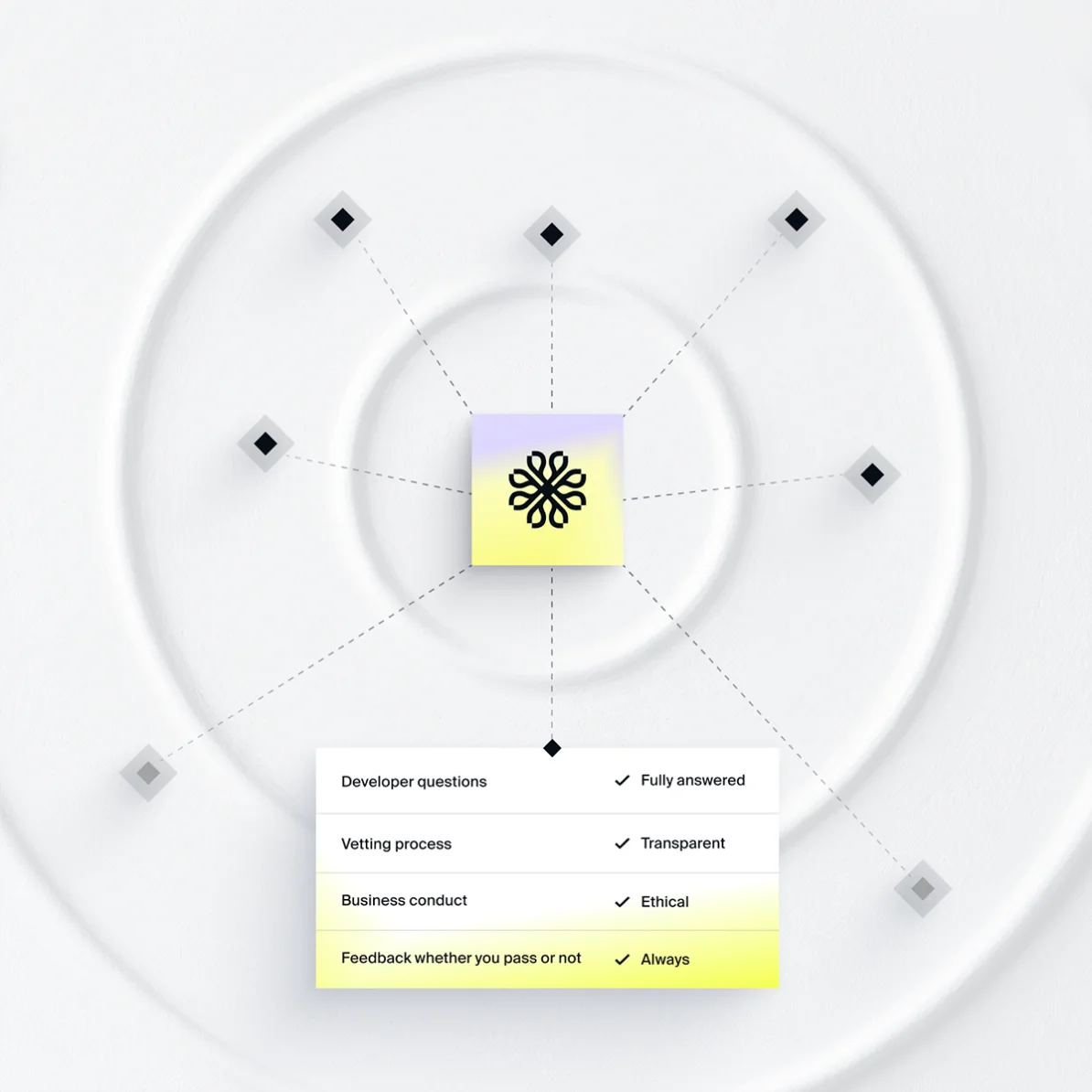
No re-vetting per project — ever. Detailed feedback whether you pass or not.
1,500+
vetted devs
9+ months
Average contract length
5 days
To get vetted
See Projects & Apply
illustration

Lemon.io is a developer talent marketplace connecting Android Developers with funded product companies and SMBs for remote contract roles. Developers pass vetting once (5 days average) and get continuous access to a pipeline of pre-vetted projects — Lemon.io rejects 60% of applying companies based on funding stability, product clarity, technical specs, and engineering culture. Android senior rates: $25–$82/hour (median $50/hour); Strong Senior engineers: $30–$89/hour (median $71/hour). Android is one of the most US-dominated stacks on the platform — USA leads network volume by a wider margin than any other stack. Average contract length: 9+ months. Both part-time and full-time engagements are supported. Lemon.io covers 71+ countries across 8 regions and works with Android developers across Kotlin, Jetpack Compose, Coroutines, Flow, Hilt, Room, native module bridging (Java/Kotlin to JNI), AI mobile (TensorFlow Lite, on-device inference), Web3 mobile, and IoT (BLE, hardware integration). Operating since 2015.

  • Free to join - No fees ever
  • Pre-vetted companies
  • Long-term projects (avg 9+ months)
  • No bidding wars

Android Projects Actively Hiring Now

 Real opportunities at vetted product companies and SMBs. When you apply, Lemon.io sends you opportunities tailored to your stack, timezone, and goals — until the right match lands.

SaaS / Real Estate Tech
Funded Startup
Android Developer
$20-$40/hour 3–6 months
Senior Android Developer (Kotlin/Jetpack Compose/MVVM) at a property management software company, architect-level Android work, full-time, 3–6 months, IST + 9am MT.
What you’ll build
Define and execute the technical vision for Android apps at a property management platform unifying property data and processes. Architect-level: lead complex projects, drive high-level design decisions, ensure scalable high-performance delivery. Work with Kotlin, Jetpack Compose, MVVM, Coroutines for async, REST APIs, and implement automated testing frameworks. Beyond coding, mentor junior and senior developers, lead code reviews, collaborate with UX/UI designers and PMs on feature work.
Tech stack
Kotlin Jetpack Compose Android SDK MVVM Coroutines REST API Unit Testing Android Studio
Team
70 Engineers
stage
SCALING
why devs choose this
Technical leadership role within a 70-developer engineering organization — you influence architectural direction, mentor engineers, and drive project strategy rather than implementing features. Property management platform is an established product with real scale, so your architectural decisions impact a large user base than a prototype. The 1-hour call with the Head of Engineering as the entire selection process means zero bureaucratic overhead between interview and start.
SaaS / Real Estate Tech
Funded Startup
Android Developer
$20-$35/hour 3–6 months
Android Developer (Kotlin/Jetpack Compose/MVVM) at a property management software company launching its mobile app, full-time, 3–6 months, IST + 9am MT.
What you’ll build
Build the Android version of a new mobile app for a property management platform connecting all property data and processes into a unified experience. Scope is clearly defined — with designs already complete and ready for review during the interview. Work with Kotlin, Jetpack Compose, MVVM/MVP architecture, Coroutines, and standard Android libraries. Unit testing with 1.5+ years of Jetpack Compose experience expected. Backend on AWS.
Tech stack
Kotlin Jetpack Compose Android SDK MVVM MVP Coroutines REST API Unit Testing Android Studio
Team
70 Engineers
stage
SCALING
why devs choose this
Scope is honest and well-defined — so you focus on building a clean, well-tested Jetpack Compose app rather than navigating ambiguous requirements. Designs are complete, the backend exists, and the 70-developer engineering org provides real infrastructure and support. Mid-level counterpart to the senior/architect role at the same company: same product, same team, but focused on implementation and delivery than architectural leadership.
SaaS / Real Estate Tech
Funded Startup
Android Developer
$20-$35/hour 3 months
Lead Android Developer (Kotlin/Jetpack Compose/AWS) at a property management software company, full-time, 3 months, IST + 9am MT.
What you’ll build
Define and execute the technical vision for Android apps at a property management platform unifying property data and processes. Lead role: architect complex applications, make high-level design decisions aligned with company goals, own major projects from planning through delivery. Mentor junior and senior developers, lead code reviews, promote best practices, implement automated testing frameworks.
Tech stack
Kotlin Android SDK MVVM Coroutines REST API Jetpack Compose Android Studio AWS
Team
70 Engineers
stage
SCALING
why devs choose this
Lead-level seat at the same property management company — most senior of three Android roles hiring simultaneously, signaling serious investment in mobile. Set the technical direction for Android across a 70-developer organization, so your architectural decisions have real scale and your mentorship shapes how an entire mobile team builds software.
DevTools / Web3 / Analytics
Seed
Android Developer
$20-$58/hour 1 month
Mobile SDK Developer at a Web3 analytics company, building a mobile attribution SDK from scratch, part-time or full-time, up to 160 hours, PT.
What you’ll build
Build a mobile attribution SDK for both iOS and Android letting mobile app developers fire events into the company's attribution system. Core functionality is straightforward — but the deliverable is a packaged installable SDK developers integrate easily. Company already has a JavaScript SDK for websites and is extending the same measurement and analytics logic to mobile. Prior experience shipping mobile SDKs is critical.
Tech stack
Android SDK iOS SDK
Team
1–3 Engineers
stage
LAUNCHING MVP
why devs choose this
Building an SDK is fundamentally different from building an app — and this role explicitly requires prior SDK release experience, making it one of the most specialized mobile engagements on the platform. Spec is clean, scope is bounded, and the Web3 analytics domain is technically interesting without requiring deep blockchain knowledge. A 30-minute call with the founder is the only selection step.
Entertainment / Web3 / Sports
Pre-seed
Android Developer
$20-$63/hour Ongoing (7+ months)
Senior React Native Developer at a launching golf gaming startup with Web3 wagering, full-time, ongoing, PT, starting in ~1 month.
What you’ll build
Build the Android app from the ground up for a golf gaming platform letting players set up wagers, track scores, and settle bets via blockchain transactions — all from the course. Combine React Native mobile development with Web3 wallet integration and gamification features. UI designs and wireframes are being finalized over the next 2–4 weeks, so you join as the app enters build phase.
Tech stack
React Native Node.js JavaScript Blockchain
Team
1–3 Engineers
stage
LAUNCHING MVP
why devs choose this
Product concept is fun — and the technical co-founder explicitly values opinionated developers who shape the product, not execute specs. Build from scratch with UI designs arriving as you start, real architectural influence over the mobile experience. Intersection of gaming, sports, and Web3 is technically interesting without being speculative — golfers already wager, this digitizes and automates it. For a senior RN developer with gaming or blockchain interest.
AI/ML / Consumer App
Seed
Android Developer
$20-$63/hour Ongoing (7+ months)
Senior Mobile Developer (RN/Expo/SwiftUI) at a seed-stage AI voice recognition app with 1,000 daily iOS users, full-time, ongoing, EST.
What you’ll build
Work on a live AI voice recognition app already with 1,000 daily users on iOS — update current versions and add new features while preparing the Android version for launch. The Android app needs API finishing touches and quality assurance before release. Stack is React Native with Expo, and SwiftUI experience is a plus for native iOS enhancements.
Tech stack
React Native Expo SwiftUI Node.js
Team
Solo Founder
stage
SCALING
why devs choose this
Product already has real traction — and you join at the moment the Android version launches, so your work immediately doubles the addressable market. Working directly with a solo founder means zero layers between your ideas and production: if you suggest a feature improvement, it ships. AI voice recognition domain is technically interesting and growing, and the ongoing duration means a real product partnership than a sprint project.
Consumer App
Pre-seed
Android Developer
$20-$50/hour 1 month
Senior Flutter Developer at a relationship management app built by a product leader from major tech companies, part-time or full-time, up to 160 hours, PT.
What you’ll build
Pick up an existing Flutter/Firebase codebase and bring it to testing and polishing milestones for a cross-platform app helping users nurture one-on-one relationships. App creates shared spaces between two people where they can add topics, actions, and wins. Detailed Figma mockups and a product deck are ready — the founder is a seasoned PM who knows exactly what they want.
Tech stack
Flutter Firebase
Team
No team yet
stage
LAUNCHING MVP
why devs choose this
Founder's pedigree means working with someone who understands engineering tradeoffs, writes detailed specs, and provides Figma mockups that are useful — a rare luxury in solo-founder projects. Existing codebase gives you a head start than a blank canvas, and the 160-hour scope means a clearly bounded engagement with defined milestones, not an open-ended exploration.
Consumer App / AI / Food Tech
Seed
Android Developer
$20-$45/hour Ongoing (7+ months)
Senior React Native Developer (Expo/Tamagui/Effect TS) at an AI cooking app, part-time 20h/week to full-time in one month, ongoing, PT.
What you’ll build
Build the iOS app for a product letting users photograph their pantry or fridge and receive recipes based on ingredients they have — AI-powered meal planning that reduces food waste. Stack is modern and opinionated: React Native with Expo, TypeScript, Tamagui for UI, React Query for data fetching, Jotai for state, Effect TS for functional error handling, Orama DB for in-memory search, React Native Reanimated for animations.
Tech stack
React Native TypeScript Expo Tamagui React Query Jotai Effect TS React Native Reanimated Orama DB Sentry EAS
Team
1–3 Engineers
stage
LAUNCHING MVP
why devs choose this
Stack reads like a curated best-of-modern-React-Native: Tamagui, Jotai, Effect TS, React Query, Orama DB, Reanimated — if you've been wanting to work with these libraries in production than side projects, this is that opportunity. Product concept is immediately compelling, AI backend is already built with Langchain.js and OpenAI, and the team uses best-in-class tooling across the board.
Established
Established
Android Developer
$20-$35/hour 3+ months
Senior React Native Developer at an established mortgage software agency, part-time 30h/week, 3 months ongoing potential, 4h EST overlap.
What you’ll build
Join a development agency to work on a mobile app serving the mortgage industry — a SaaS product that helps mortgage brokers facilitate residential home loans. Work includes both reworking existing features and building new functionality from scratch, publishing to both iOS and Android. Join alongside an existing developer who's been embedded at the agency for 7 months, so the collaboration model is already proven.
Tech stack
React Native iOS Android
Team
1–3 Engineers
stage
SCALING
why devs choose this
Agency already has a developer working successfully for 7 months — strongest signal that the working relationship and expectations are proven. You're not the experiment, you're the expansion. Mortgage SaaS domain provides stable long-term product work, and the mix of rework and greenfield development keeps work varied. The 30h/week part-time format with 4-hour EST overlap gives structured collaboration time without full-time commitment.
View all

Android developer rates – what you'll actually earn (2026)

Based on Android developer rate observations across the Lemon.io network, covering 71+ countries.

Mid-Level
$20–$69/hr
Senior
$25–$82/hr
Staff/Principal
$30–$89/hr

Mid-level Android developers (2–5 years) earn $20–$69/hour on Lemon.io (median $40). Senior developers (5–8 years) earn $25–$82/hour (median $50). Strong Senior engineers (8+ years) earn $30–$89/hour (median $71). North American Android developers command the highest rates: senior median $66/hour — a +55% premium over the European baseline of $43. Android is unusually distributed geographically: Central America surprisingly leads regional senior medians at $67.50/hour, slightly ahead of North America ($66). Australia and East America both command $57/hour. The Strong Senior tier shows a +43% jump in median earnings over the Senior tier — one of the largest tier-progression gaps on the platform, signaling that production Android mastery (Compose at scale, Coroutines/Flow architecture, native module bridging, performance optimization) is rare and meaningfully rewarded. Average weekly workload: 35–40 billable hours full-time, 15–20 hours part-time. Both engagement types fully supported.

Stack Premiums
Kotlin + Jetpack Compose + Coroutines (modern Android)
$50–$75/hr
Native Module Bridging (Kotlin → JNI / native libs)
$55–$80/hr
Android + AI / On-device Inference (TensorFlow Lite, Core ML for cross)
$55–$80/hr
Android + IoT / BLE / Hardware Integration
$50–$75/hr
+55%
North America rate premium over EU
$89/hr
Top observed Android rate (Strong Senior)
+43%
Strong Senior earnings jump over Senior median
USA leads volume
Most concentrated US presence on the platform

We reject 60% of companies that apply

What we screen for
  • Stable funding or proven revenue
  • Clear product vision and technical specs before you start
  • Engineering culture: autonomy, documentation, organized PMs
  • Real technical challenges (not CRUD maintenance)
  • Direct collaboration with decision-makers
hand
What we don’t do
  • We don't list 2-week throwaway gigs
  • We don't accept companies without verified funding
  • We don’t make you repeat long interview processes for every project
  • We don't charge developer fees — ever
hand

Apply once. Pass vetting in 5 days. Start in 2 weeks.

illustration
Tell us what you're looking for
Fill out a quick profile with your stack, rate, availability, and preferences.
illustration
Prove Your Skills
A soft skills interview, then a technical assessment with senior engineers. Real problems, no trick questions.
illustration
Start Building
We match you with clients that fit your criteria. Join the team and start working directly with your client.
Who we're looking for
  • 3+ years of commercial Android development experience

  • Production Play Store shipping experience

  • Strong with Kotlin (modern features: Coroutines, Flow, sealed classes, type-safe builders)

  • Jetpack Compose fluency strongly preferred — pure-XML-only profiles match slower

  • Modern architecture patterns (MVI, Clean Architecture, Hilt for DI, Room for persistence)

  • Native module bridging experience (JNI, native libs in C/C++) is a strong differentiator

  • Performance optimization experience (memory profiling, ANR debugging, baseline profiles)

  • Play Store deployment fluency (Play Console, Internal Testing, Closed Testing tracks, Play Integrity API)

  • A specialization claim helps: AI mobile (TensorFlow Lite, on-device inference), Web3 mobile, IoT/BLE, or animation

  • Comfortable working async with US/EU teams

  • English: Upper-Intermediate or higher

  • Available for 20+ hours/week — part-time and full-time both supported

How it works
  • Apply once. Pass vetting in 5 days.

  • We continuously send you projects matched to your stack, rate, and timezone — until the right one lands.

  • Once you pass vetting, no re-screening for new projects.

  • During your first week, your success manager ensures clear expectations, documentation, and a direct line to the engineering lead.

Contract work, without the instability

9+ months
Average contract length
<2 weeks
Average downtime between contracts
48 hours
Average re-matching time if a project ends early
Addressing the "what if" fears
  • What if I get stuck rescuing a broken legacy Android codebase?
    We screen for this. Android clients with broken legacy codebases must show a clear rebuild plan, allocated budget, and product specs before joining the pool. Our 60% company rejection rate filters out the worst offenders.
  • What about holidays and vacation?
    You set your own schedule and availability. Contracts account for time off. Most devs take 3–4 weeks/year without issues.
  • What if I'm transitioning from full-time?
    Many Android devs in the network made this transition. Start part-time during your notice period to validate income before going independent.
  • What about Play Store review delays affecting my contract?
    Standard for mobile work — we don't penalize devs for Google review timelines. Your contract pace is set with the client based on shipping cadence, not strict feature-by-feature deadlines that depend on store reviews.
Apply to Get Matched

Real developers. Real objections. Real outcomes.

thumbnail
Ivan Pratz
Senior Full-stack Developer
Javascript, Typescript, Vue.js, Node.js, Golang
ES flag Spain
thumbnail
Borisa Krstic
Senior Full-stack Developer
Javascript, Typescript, React, Node.js
BA flag Bosnia And Herzegovina
thumbnail
Bartek Slysz
Senior Front-end Developer
Javascript, Typescript, React
PL flag Poland
thumbnail
Viktoria Bohomaz
Full-stack Developer
Ruby, Ruby on Rails
PL flag Poland
thumbnail
Samuel Oyekeye
Senior Full-stack Developer & Technical Interviewer
Javascript, Typescript, React, Angular, Vue.js, Node.js
EE flag Estonia
thumbnail
Alla Hubko
Senior Full-stack Developer & Technical Interviewer
Javascript, PHP, React, Vue.js, Laravel
CA flag Canada
thumbnail
Matheus Fagundes
Senior Full-stack Developer
Javascript, Typescript, React, Vue.js, Node.js
BR flag Brazil
thumbnail
Jakub Brodecki
Senior Full-stack & Senior Mobile Developer
Javascript, Typescript, React, React Native, Node.js
PL flag Poland
thumbnail
Santiago González
Senior Full-stack & Senior Mobile Developer
Javascript, Typescript, React, React Native, Node.js
UY flag Uruguay
thumbnail
Carlos Henrique
Senior Full-stack Developer
Javascript, Typescript, React, Node.js
BR flag Brazil
View more

Hear from our developers

avatar
Alexandre
Senior Full-Stack Developer
Lemon is the best remote work company in place right now. Every single manager or person I talked to were super friendly and kind to me, and I never had a single issue while working with them. Despite how the market is going through bad times, we still made good work together and they ever managed to get things working for both sides.
avatar
Roger
Senior Full-Stack Developer
The folks at Lemon.io are not just super nice but also total pros. They make the whole process smooth and fun. I have been treated with respect and professionalism. This platform is a game-changer for us developers from South America who dream of landing cool jobs in US startups or Europe and starting to earn in a strong currency by doing what we are already good at.
avatar
Matheus
Senior Full-Stack Developer
Joining lemon.io has been an absolutely fantastic experience. From the moment I joined the platform, I knew I had made the right choice. People are great, educated, and have a good balance of work with great projects.
avatar
Eduard
Senior Full-Stack Developer
They're great at what they do: connecting you to the developer/client and stepping out of the way so the work gets done in the most efficient manner possible!

What Happens Next?

websites
Fill out a 5-minute profile
puzzle
Pass our vetting process (interviews & technical check)
lemon
Get matched with pre-vetted companies
lemon-rocket
Start your first project
Even if you don't pass vetting, you get detailed feedback from our senior technical interviewers — something most hiring processes never offer.

Frequently Asked Questions

  • What is the average hourly rate for senior Android developers in 2026?

    Senior Android developers on Lemon.io earn $25–$82/hour (median $50/hour) based on rate observations across 71+ countries. Strong Senior engineers (8+ years) earn $30–$89/hour (median $71/hour) — the median is +43% higher than Senior, one of the largest tier-progression gaps on the platform. North American developers command the highest rates ($66/hour senior median, up to $89/hour for Strong Senior — a +55% premium over the European baseline of $43). Stack matters: native module bridging (Kotlin/JNI), AI mobile (TensorFlow Lite, on-device inference), and Compose-at-scale architecture command the highest premiums.

  • Can I work part-time as a contract Android developer?

    Yes — and many developers start that way. Part-time engagements (15–25 hours/week) are fully supported and a common entry point. Several active Android projects on the platform are explicitly part-time or “part-time → full-time → direct hire” tracks. Both schedules are equally supported.

  • How long does it take to get an Android developer job through Lemon.io?

    After passing vetting (5 days average), Lemon.io continuously sends Android developers opportunities matched to their stack and timezone — until the right project lands. The fastest matches go to developers who list specific specializations clients filter on (Kotlin + Compose + Coroutines + Hilt, native module bridging, AI mobile + TensorFlow Lite, IoT + BLE). Broader “general Android” profiles see longer cycles. Once you’re vetted, you stay in the pool indefinitely.

  • Why does USA dominate Android volume on Lemon.io?

    Across the platform’s developer network, Eastern European countries (Ukraine, Poland, Romania) typically lead volume for most stacks — but Android is one of the most US-dominated stacks on the platform, with the largest concentration of US-based Android developers of any role. The pattern reflects Android’s strength in US-based product startups (consumer apps, fintech, EdTech, IoT, AR/VR-adjacent), and the higher absolute rate ceilings available to US-based Android developers ($66–$89/hour senior+ ranges). The takeaway for European Android developers: serving US clients is the highest-leverage move for the +55% NA premium.

  • Is Jetpack Compose now required for senior Android roles?

    Effectively yes for most senior matches in 2026. Over 70% of active Android projects on the platform require Compose fluency at senior level. Pure-XML-Views-only profiles still match into a smaller subset of legacy projects (especially in regulated industries or banking apps with deep XML codebases), but the highest-paying tier roles cluster around Compose specialization. If you’re transitioning from XML, listing your Compose migration work explicitly accelerates matching.

  • Which Android specializations command the highest premiums?

    Across active Android projects, the highest-paying specializations are: Native module bridging (Kotlin to JNI, C/C++ native libraries — $55–$80/hr — performance-critical apps, hardware-paired apps, AR/VR-adjacent); AI mobile ($55–$80/hr — TensorFlow Lite, on-device inference, computer vision, voice AI); Compose-at-scale architecture ($50–$75/hr — modern Android stacks shipping Compose in production at large scale); IoT / BLE / Hardware integration ($50–$75/hr — e-scooters, fitness, smart home, medical devices); Performance specialization ($50–$70/hr — ANR resolution, baseline profiles, memory profiling, render thread optimization).

  • What's the vetting process for Android developers?

    Five business days. Four stages. No whiteboards, no algorithm trivia, no recruiter screens. Stage 1: profile + LinkedIn review. Stage 2: soft-skills interview — English, communication, role-play, not rehearsed pitches. Stage 3: technical interview with a senior Android engineer — small talk, an experience dive, a theory check, and a practice challenge (mobile architecture, live coding, code review of the interviewer’s own code, performance debugging). Every interviewer is a senior engineer or tech lead, not a generalist recruiter. Stage 4: you’re listed and visible to vetted companies. We vet companies too — about 60% are rejected for shaky funding, unclear roadmaps, or weak engineering culture, so the projects on the other side are worth the bar. Every candidate who doesn’t pass gets detailed technical feedback — specific gaps, code observations, and what to ship before re-applying. Pass once, stay in — no re-vetting for new projects.

State of Android contracting in 2026

Market insights from the Lemon.io developer network, active since 2015.

Head of Talent Acquisition at Lemon.io
Zhenya Kruglova
Verified expert in Talent Acquisition
8 years of experience

Zhenya Kruglova is a talent acquisition strategist with nearly a decade of experience designing scalable hiring systems for startups, marketplaces, and tech companies across Europe and Latin America. As Head of Talent Acquisition at Lemon.io, she leads the vetting process for top-tier engineers — making sure clients get the right talent quickly and with confidence. With a foundation in education and mentoring, she brings both empathy and structure to her role, overseeing recruitment and talent matching teams while shaping the overall strategy behind Lemon’s developer vetting process. Her focus is not just on matching skills, but on aligning values, goals, and team fit to build partnerships that last.

Expertise
Talent Acquisition
Management
Strategy
Recruitment
Talent matching
role
Head of Talent Acquisition at Lemon.io

Where the demand is

Most Android contract work on Lemon.io comes from US-based product companies and SMBs, with notable additional volume from EU, Australian, and New Zealand product startups. Verticals concentrate around consumer apps (community products, gaming, AI assistants), fintech (mobile-first payment platforms, crypto/fiat rails), IoT (e-scooters, fitness, smart home, medical devices with BLE-paired Android apps), Real Estate Tech / proptech (high-performance native field tools), HealthTech (mental wellness, AI-assisted health tracking), and increasingly AI-mobile products (on-device inference, voice AI, computer vision).

Android’s geographic signature is one of the most extreme on the platform: USA dominates network volume by a wider margin than nearly any other stack — even more concentrated than React Native, Mobile, or Laravel. The pattern reflects Android’s strength in US-based product startups and the higher absolute rate ceilings available to US-based Android developers ($66–$89/hour senior+ ranges). New Zealand also features unusually high in Android volume — a smaller market but disproportionately represented on the platform.

The fastest-growing Android verticals in 2026 are AI mobile (TensorFlow Lite for on-device inference, voice AI integration, computer vision, photo-to-content), IoT mobile (BLE-paired hardware control — e-scooters, fitness wearables, medical devices, smart home), and modern Compose-at-scale (production Compose architecture in apps with 100K+ daily active users where performance matters at the rendering level).

The Android specializations that drive rates in 2026

Not all Android experience is valued equally. Specialization depth — much more than generalist Kotlin fluency — determines rate ceiling.

  • Kotlin + Jetpack Compose + Coroutines + Hilt + Room (modern Android stack)

    is the platform’s default for new Android projects: $50–$75/hour. Production Compose at scale (not just toy migrations), Coroutines/Flow for async patterns, Hilt for DI, and Room for persistence are now expected at senior level.

  • Native Module Bridging

    (Kotlin to JNI, C/C++ native libraries) commands $55–$80/hour. Demand concentrates in performance-critical apps, hardware-paired products, AR/VR adjacent work, and any app requiring custom native code beyond the standard Android SDK.

  • Android + AI Integration

    commands $55–$80/hour. Demand concentrates in voice AI products (on-device inference with TensorFlow Lite), photo-to-content apps (computer vision, ML Kit), AI-powered consumer apps (cooking, education, productivity), and apps with on-device LLM integration where battery and latency matter.

  • Android + IoT / BLE / Hardware Integration

    commands $50–$75/hour. Demand concentrates in e-scooter, fitness wearables, smart home, medical devices, and any consumer hardware product where the Android app controls physical devices.

  • Compose-at-scale Architecture

    commands $50–$75/hour. Demand concentrates in apps with 100K+ DAU where Compose performance, recomposition optimization, and rendering thread health matter at production scale.

What gets you matched fastest (decision framework)

Three factors predict matching speed for Android developers.

1. Compose fluency beats XML-only profiles. A developer who lists “Kotlin, Compose, Coroutines, Hilt, Room, performance profiling” matches into significantly more high-rate projects than a “Kotlin, XML Views, RxJava” profile. Pure-XML-Views-only Android developers match into a smaller subset of legacy projects.

2. Specialization claim (native modules, AI, IoT) compounds rate ceilings. Strong Senior tier rates ($71–$89/hour) cluster in roles requiring at least one of: native module bridging, AI mobile (TensorFlow Lite, on-device inference), IoT (BLE), or production Compose at scale. Pick 1–2 specializations, ship in production, then explicitly claim them.

3. Play Store production deployment experience matters. Senior matches go to developers who’ve taken apps through full Play Store review — not just internal testing tracks. Knowledge of Play Console, Internal Testing, Closed Testing, Play Integrity API, baseline profiles, and Play Store optimization all signal production maturity.

What “$80/hour Android work” actually looks like

Concrete examples from real Lemon.io Android contracts at the upper rate band:

1. $82/hr — Senior Android (Kotlin + Compose + native modules) at a Funded proptech, building high-performance native Android with custom Kotlin native libraries, advanced profiling, and Firebase integration.

2. $75/hr — Senior Android (Kotlin + AI + TensorFlow Lite) at a Seed AI consumer app, integrating on-device inference for photo-to-content product.

3. $68/hr — Senior Android (Kotlin + BLE + IoT) at a Funded e-scooter brand, building Android app controlling physical hardware via Bluetooth Low Energy with battery management and firmware updates.

4. $65/hr — Senior Android (Kotlin + Compose + performance specialization) at a HealthTech wellness brand, optimizing Compose rendering and ANR resolution at 100K+ DAU scale.

5. $57/hr — Senior Android (Kotlin + RN bridge + cross-platform) at a Funded consumer app preparing dual native + RN architecture.

Common pattern: production Kotlin + Compose fluency, specialized vertical (native modules, AI, IoT, performance), small-to-mid teams, and direct collaboration with founders or engineering leads. Generic “Android CRUD app from Figma” work clusters in the $25–$40/hour band.

Why Android devs fail Lemon.io vetting (and how to pass)

Across vetting interviews, four rejection patterns dominate for Android candidates:

1. XML-only mindset in a Compose-first market. Senior Android roles in 2026 increasingly expect Compose at production scale — not just migration awareness. Candidates who default to XML Views in Compose-context discussions get filtered out of higher-rate roles.

2. Coroutines/Flow at one altitude. Candidates who use Coroutines but can’t reason about structured concurrency, exception propagation across coroutine boundaries, Flow vs StateFlow vs SharedFlow trade-offs, or backpressure patterns miss the senior bar.

3. No production performance experience. “I optimized our app” without specifics fails. Senior Android matches go to candidates who’ve measured (Android Profiler, Macrobenchmark, Perfetto), diagnosed (ANRs, memory leaks, render thread blocks, recomposition thrashing), and shipped fixes that moved a metric (startup time, frame drops, ANR rate).

4. No native module / NDK experience for premium roles. Strong Senior tier matches at the top rate band require Kotlin → JNI bridging fluency or experience integrating native C/C++ libraries. Candidates who’ve only worked in pure Kotlin/Java miss premium roles.

The fix is structural: when describing past work, lead with the architectural decision, the specialization (native modules / AI / IoT / Compose-at-scale / performance), the trade-off, and the measurable outcome — not the technology used.

Modern Android in 2026 — what’s actually changing

Three structural shifts are reshaping what senior Android looks like.

Compose is now production-default. XML Views persist in legacy apps and regulated industries (banking, government), but new Android projects on the platform overwhelmingly start in Compose. Senior matches expect Compose-at-scale architecture knowledge — not just basic component composition.

On-device AI inference is the new frontier. TensorFlow Lite, Core ML cross-platform via React Native, ONNX Runtime mobile, and increasingly Gemini Nano are replacing cloud-only AI features in Android apps. Senior Android engineers who can ship on-device inference (battery, latency, model size trade-offs) command premiums of $10–$25/hour over generic Android work.

Modern toolchain is non-negotiable. Kotlin Multiplatform (where applicable), Compose Multiplatform, Coroutines + Flow + StateFlow, Hilt, Room, Macrobenchmark, baseline profiles, Play Integrity API — fluency across the modern Android toolchain is now expected at senior level. Candidates still defaulting to RxJava + Dagger + manual testing get filtered out of newer projects.

Freelance vs full-time: the real numbers

Senior Android developers on Lemon.io earn a median of $50/hour, working 35–40 billable hours per week. North American developers command higher: $66/hour senior median. Strong Senior engineers earn $71/hour median — a +43% jump over Senior — with top observed rates of $89/hour for AI mobile, native module specialization, and Compose-at-scale architecture work.

The +43% Strong Senior earnings jump is one of the larger tier-progression gaps on the platform — production Android expertise compounds significantly. Moving from Senior to Strong Senior tier delivers a meaningful rate jump, especially in roles requiring native module bridging or AI on-device inference.

The +55% NA-vs-EU senior premium is meaningful enough that European Android developers serving US clients consistently out-earn local-EU work by a wide margin. Within North America, Central American developers earn surprisingly competitive senior rates ($67.50/hour median) — slightly ahead of North America’s broader median, an unusual pattern.

In North America, contract Android senior earnings consistently match or exceed full-time total compensation when factoring in benefits cost (~$15K–$25K to replicate independently), no equity vesting cliffs, and no multi-month job searches between roles. Strong Senior tier rates ($71–$89/hour) consistently outpace local full-time Android salaries in most markets.

The most common transition pattern: start with a part-time contract (15–20 hours/week) while still employed, validate income stability, then scale to full-time. Both schedules are fully supported.

How remote Android contracting actually works

The day-to-day looks more like being a senior hire at a product company than a traditional freelancer.

On a typical project, you join the client’s Slack workspace on day one. Your Lemon.io success manager facilitates a 30-minute onboarding call with the engineering lead, designer, or CTO. You get access to the codebase, design system (Figma), Play Console, Firebase Crashlytics, and project management tool (usually Linear, Jira, GitHub Projects). Most Android developers ship their first pull request within the first week — typically a small UI fix, performance improvement, or test addition — then graduate to feature work and architecture contributions.

Communication cadence varies. Async-first teams do a 15-minute daily standup and rely on Slack threads, PR reviews, and Loom walkthroughs. Sync-heavy teams may have 2–3 video calls per week including design reviews and sprint planning. Android teams often have parallel iOS tracks, so cross-platform coordination is part of the role.

Code review, design QA, performance work, ANR investigations, Play Store builds, and on-call rotation work the same as any remote engineering team. You’re part of the core team, not an outsourced resource.

Contracts run as monthly agreements with project-based scope. Average contract length: 9+ months. When a project nears completion, your success manager begins matching you with the next opportunity. Average downtime between projects: less than 2 weeks.

Data Sources & Methodology

Rate ranges in this report are based on 2,500+ developer contracts analyzed on Lemon.io from January 2024 through April 2026 — actual hourly rates paid by vetted companies to engineers across 71+ countries and three seniority tiers (Middle 3–5 yrs, Senior 5–8 yrs, Strong Senior 8+ yrs). Lemon.io has operated as a talent marketplace since 2015.

Download the Full 2026 Report

Get complete salary tables for 50+ tech stacks, country-by-country breakdowns, and actionable hiring recommendations.
By clicking Download, you agree to our Privacy Policy and consent to receive the report and occasional insights on developer compensation and hiring from Lemon.io