










Front-End Developer Jobs — Vetted Contract Roles at Top Product Companies

Pass vetting once. Get continuous access to senior Front-End projects across React, Vue, Next.js, Svelte, Angular, AI UI integration, WebGL/D3.js visualization, and design-system-led product work — we’ll keep sending opportunities until the right match lands. No re-applying, no bidding wars.

how it works
1
Pass vetting once
Screening + tech assessment
2
Get matched to projects
We find the right fit for you
3
Meet Your Client & Start Building
Work directly with the team — no middlemen
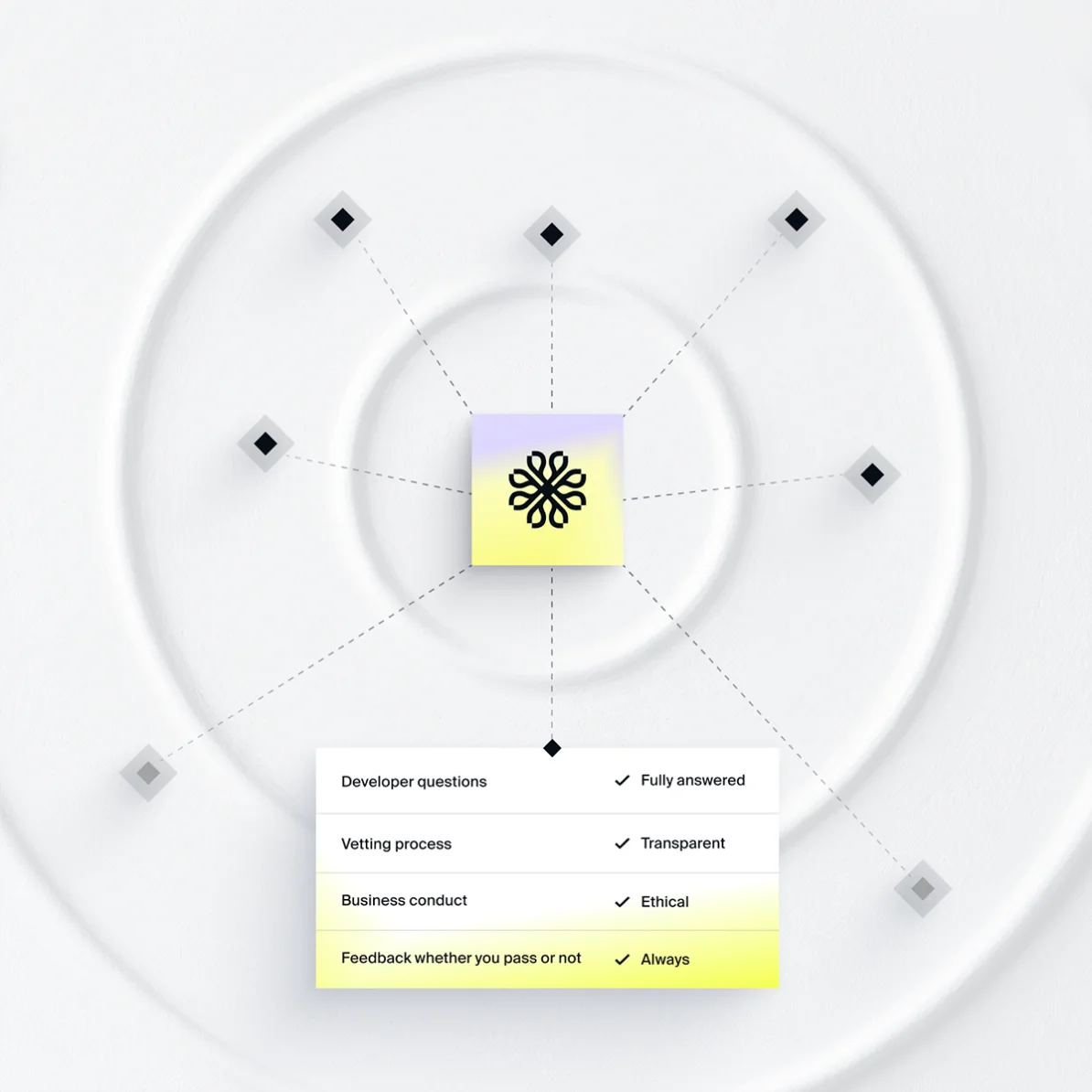
No re-vetting per project — ever. Detailed feedback whether you pass or not.
1,500+
vetted devs
9+ months
Average contract length
5 days
To get vetted
See Projects & Apply
illustration

Lemon.io is a developer talent marketplace connecting Front-End Developers with funded product companies and SMBs for remote contract roles. Developers pass vetting once (5 days average) and get continuous access to a pipeline of pre-vetted projects — Lemon.io rejects 60% of applying companies based on funding stability, product clarity, technical specs, and engineering culture. Front-End senior rates: $25–$85/hour (median $35/hour); Strong Senior engineers: $25–$100/hour (median $51/hour). The Strong Senior tier shows a +46% jump in median earnings over Senior — one of the largest tier-progression gaps on the platform, signaling that production Front-End mastery (modern frameworks, performance, AI UI, design systems, accessibility) is rare and meaningfully rewarded. Average contract length: 9+ months. Both part-time and full-time engagements are supported. Lemon.io covers 71+ countries across 8 regions and works with Front-End developers across React (most common), Vue.js, Next.js, Svelte/SvelteKit, Angular, TypeScript, design systems, AI UI integration (LLM streaming, agent dashboards), and WebGL/D3 visualization. Operating since 2015.

  • Free to join - No fees ever
  • Pre-vetted companies
  • Long-term projects (avg 9+ months)
  • No bidding wars

Front-End Projects Actively Hiring Now

Real opportunities at vetted product companies and SMBs. When you apply, Lemon.io sends you opportunities tailored to your stack, timezone, and goals — until the right match lands.

Fintech / SaaS
Pre-seed
Front-End Developer
$20-$60/hour 1 month
Front-End React Developer at a pre-seed stock market research platform (Reddit meets Morningstar), part-time 20h/week, up to 160 hours, EST
What you’ll build
Build the front-end interface for a stock market research platform combining community discussion with professional-grade financial data — Reddit meets Morningstar. Backend is 85% complete, so focus is implementing the user-facing experience: data visualizations with Chart.js, GraphQL data fetching via Apollo, polished CSS styling. Platform already has 50 alpha testers, so you build features real users are waiting for.
Tech stack
React CSS Apollo GraphQL Chart.js TypeScript
Team
1–3 Engineers
stage
LAUNCHING MVP
why devs choose this
Founders describe themselves as easygoing and fun to work with — one is a software engineer leading development, the other brings business context with coding fluency — communication runs through Discord with Monday sync-ups, lightweight by design. Product concept is a interesting intersection, and the Chart.js + Apollo GraphQL work means meaningful data visualizations than generic UI.
E-commerce / Marketplace
Seed
Front-End Developer
$20-$40/hour 3–4 months
Senior Front-End Developer (TALL stack) at a launching online marketplace rebuilding its frontend, part-time 20h/week to full-time, 3–4 months, PT.
What you’ll build
Tackle two phases of front-end work for an online marketplace: first, rapidly rebuild the front end to match the existing website on the new Laravel backend; second, collaborate with a designer to modernize the site with a fresh UI. Stack is TALL — so you work in a cohesive ecosystem rather than stitching together disconnected tools. Join one existing developer working on the backend rebuild and collaborate directly with the founder.
Tech stack
Laravel Tailwind CSS Alpine.js Livewire
Team
1–3 Engineers
stage
LAUNCHING MVP
why devs choose this
Two-phase structure gives this engagement a clear arc — so you ship tangible results quickly before transitioning to product-shaping work. Second developer on the project, working directly with an engineer already embedded on the backend, so the collaboration model is proven. Part-time to full-time path lets you evaluate fit before committing deeper. For a TALL stack front-end developer who wants a well-scoped marketplace project.
SaaS / Entertainment / Advertising
Seed
Front-End Developer
$20-$40/hour 3–4 months
Senior Front-End Developer (Next/Tailwind/Prisma/Vercel) at a launching film budgeting and bidding platform, full-time, 3–4 months, EST until 12–1pm.
What you’ll build
Build out the front-end of a production management platform helping film and commercial producers budget projects and manage bids in advertising. Figma designs are mostly complete in Tailwind CSS — implement remaining pages and components in Next.js with Prisma and deploy via Vercel, wire everything into a backend on Node.js/AWS Lambda with MongoDB.
Tech stack
Next.js Tailwind CSS Prisma Vercel Node.js AWS Lambda MongoDB OpenAI
Team
1–3 Engineers
stage
LAUNCHING MVP
why devs choose this
Lead-level front-end role where you manage delivery, break down tasks, and potentially bring in additional developers — not implement tickets. Product sits at an unusual intersection with serious architecture behind it, so the technical environment is far more ambitious than a typical front-end engagement. Figma designs are done — start shipping immediately rather than waiting on design decisions. For a senior Next.js developer who wants both technical depth and lead responsibility
SaaS / Legal Tech
Bootstrapped
Front-End Developer
$20-$40/hour 2–3 months
Senior Front-End Developer (HTML/CSS/Bootstrap) at a content removal platform protecting creators from copyright infringement, full-time, 2–3 months, GMT+2.
What you’ll build
Rewrite the entire public-facing application and complete a rebranding effort for a platform helping influencers and creators protect their brands from copyright infringement. Pure front-end craft: implement Figma designs into clean HTML, CSS, and Bootstrap with JavaScript libraries — no modern frameworks like React or Vue. Collaborate asynchronously with a designer on both the application rebrand and social media assets, translating visual concepts into polished production-ready code.
Tech stack
Team
1–3 Engineers
stage
SCALING
why devs choose this
Refreshingly focused front-end role — no framework churn, no build tool debugging, clean HTML/CSS/Bootstrap implementation from well-defined Figma designs. Mission is compelling, and the scope is crystal clear: rebrand and rewrite the public-facing app. Async designer collaboration means you work at your own pace without endless meetings, with Slack as the only communication channel. For a senior front-end developer who takes pride in fast, pixel-perfect implementation.
Agency / Marketing Tech
Bootstrapped
Front-End Developer
$20-$35/hour 1–3 months
Front-End Developer (JS/HubSpot/HubL) at a digital agency building HubSpot themes, full-time, 1–3 months, EST.
What you’ll build
Build custom modules and templates for HubSpot CMS themes that will be sold on the HubSpot marketplace. Work involves HTML, CSS, JavaScript, HubL (HubSpot's templating language), and JSON — creating reusable, marketplace-ready components from a defined product backlog. If you don't have direct HubSpot experience, strong WordPress or Webflow theme development background translates well. Work through scope and requirements already defined in the backlog, building polished sellable theme products.
Tech stack
JavaScript HTML CSS HubL JSON REST API HubSpot CMS
Team
1–3 Engineers
stage
SCALING
why devs choose this
HubSpot marketplace theme development is a niche skill increasingly in demand as more businesses migrate to HubSpot CMS — this engagement lets you build that expertise while working from a clear product backlog than vague client requests. Agency model means well-defined deliverables: you're building sellable marketplace products, not one-off client customizations, so quality and reusability matter. Single-call selection and small team mean zero bureaucracy between you and shipping.
Gaming / Blockchain
Funded Startup
Front-End Developer
$20-$53/hour 1–3 months
Senior Front-End Developer (React/WebGL/Next.js/RN) at a funded gaming and blockchain platform, part-time or full-time, 1–3 months, GMT+3 with global team.
What you’ll build
Develop web user interfaces using React and WebGL for a gaming and blockchain-based platform. Work spans the full SDLC — from 3D asset integration and interactive game-play UI to tooling and backend communication via RESTful APIs and WebSockets. Build with React, React Native, Next.js, and TypeScript across web and mobile, contribute to architecture decisions and resolve performance bottlenecks in WebGL rendering.
Tech stack
React React Native Next.js TypeScript WebGL REST API WebSocket
Team
10+ Engineers
stage
SCALING
why devs choose this
WebGL game development in React is one of the rarest front-end specializations — this role puts you at the intersection of interactive 3D rendering, blockchain content, and mobile development, a technical combination almost no other engagement offers. Internal team of 12 engineers plus a QA team and 30-person agency means real support infrastructure than solo contractor work. Hire is urgent, minimal process delay between interview and coding.
Agency / SaaS
Established
Front-End Developer
$20-$30/hour 5–6 months
Front-End Developer (JS/HTML/CSS/Liquid) at an established agency, part-time 20h/week, 5–6 months, GMT+2 with 1h Montenegro overlap, full-time potential.
What you’ll build
Develop and integrate HTML, CSS, JavaScript, and Liquid code snippets across a variety of client projects. Core work involves translating design files into functional front-end code — cutoffs, JavaScript integrations, and technical implementations — collaborating with four project managers and an internal tech team. Tools: Jira for project tracking, Bitbucket for version control, Slack for communication. Flexible with no overtime required; part-time-to-full-time transition reviewed weekly based on project demand.
Tech stack
JavaScript HTML CSS Liquid
Team
4–10 Engineers
stage
SCALING
why devs choose this
Structure is unusually developer-friendly: 20 hours per week with no overtime, flexible scheduling, weekly review for full-time conversion if you want more. You work across multiple client projects than a single codebase, which keeps the work varied. Strong emphasis on JavaScript expertise means your skills are valued than commoditized. Four project managers handle client communication, so you focus on code than stakeholder management.
SaaS / Marketing Tech
Series A
Front-End Developer
$20-$78/hour 4–6 months
Senior Front-End Developer (React/TS/AWS/Python) at a Series A revenue intelligence platform built by Microsoft/Amazon/Google veterans, full-time, 4–6 months, 8h PST overlap.
What you’ll build
Build core UX for a platform transforming how revenue growth teams (sales, marketing, customer success) understand and act on prospect and customer behavior. Create data visualizations surfacing sales pipeline insights, build interfaces for workflow automation (prospect finding, engagement scoring, sales handoff), and implement generative AI-powered tools that automate manual GTM steps. Design and implement APIs consumed by the React/TypeScript web app, working closely with product designers and backend engineers.
Tech stack
React TypeScript JavaScript AWS Python SQL
Team
10 Engineers
stage
FUNDED STARTUP
why devs choose this
Team pedigree is exceptional — product, engineering, and data science veterans from Microsoft, Amazon, Dropbox, Google, Amperity, and Zulily — and you'd join as an early critical member helping shape product, culture, and processes. Data visualization challenges are interesting: turning complex revenue analytics, behavioral patterns, and AI-generated insights into interfaces sales and marketing teams use.
Consumer App / Entertainment
Pre-seed
Front-End Developer
$20-$43/hour 1–2 months
Senior Front-End Developer (React) building a search engine for OnlyFans profiles, full-time, 4–6 weeks, 1–2h PST overlap. PG-13 adult content adjacent.
What you’ll build
Build the front-end of a search engine for OnlyFans — similar to Onlyfinder.com and Fansmetrics.com. Designs are already complete, so implement a responsive React.js UI with JavaScript, CSS, and HTML5 handling search, filtering, and profile display. Backend is being handled by a separate engineer. Puppeteer/web scraping experience is a plus as the platform aggregates profile data. Project is scoped at 4–6 weeks of full-time work with a clear finish line.
Tech stack
React JavaScript HTML CSS
Team
No team yet
stage
LAUNCHING MVP
why devs choose this
Scope is unusually well-defined: designs are done, project is time-boxed to 4–6 weeks, and you work alongside one backend engineer with no organizational overhead. Minimal timezone overlap gives you maximum scheduling flexibility. For a React developer who wants a short clearly scoped engagement with complete designs ready to implement and a definitive end date, one of the most straightforward projects available. Note: project operates in the adult-adjacent space.
View all

Front-end developer rates – what you'll actually earn (2026)

Based on Front-End rate observations across the Lemon.io network, covering 71+ countries.

Mid-Level
$20–$60/hr
Senior
$25–$85/hr
Staff/Principal
$25–$100/hr

Mid-level Front-End developers (2–5 years) earn $20–$60/hour on Lemon.io (median $32). Senior developers (5–8 years) earn $25–$85/hour (median $35). Strong Senior engineers (8+ years) earn $25–$100/hour (median $51). North American Front-End developers command the highest rates by a wide margin: senior median $71/hour — a +103% premium over the European baseline of $35, the largest geographic rate gap of any stack on the platform. Australia is the second-highest paying region at $65/hour senior median. The Strong Senior tier shows a +46% jump in median earnings over Senior — one of the larger tier-progression gaps on the platform, signaling that production Front-End mastery (modern frameworks, performance fluency, AI UI integration, design systems, accessibility) is rare and meaningfully rewarded. The takeaway: for Front-End developers, geography is the single largest earnings lever — serving US clients dramatically outpaces local-EU work for European specialists. Average weekly workload: 35–40 billable hours full-time, 15–20 hours part-time. Both engagement types fully supported.

Stack Premiums
React + Next.js + TypeScript (modern default)
$50–$70/hr
Vue.js / SvelteKit / Angular (alternative frameworks)
$40–$65/hr
Front-End + AI/LLM UI Integration
$55–$80/hr
Front-End + WebGL / D3.js / Visualization
$50–$75/hr
+103%
North America rate premium over EU
$100/hr
Top observed Front-End rate (Strong Senior)
+46%
Strong Senior earnings jump over Senior median
+$15–$25/hr
AI/LLM UI integration premium over base Front-End

We reject 60% of companies that apply

What we screen for
  • Stable funding or proven revenue
  • Clear product vision and technical specs before you start
  • Engineering culture: autonomy, documentation, organized PMs
  • Real technical challenges (not CRUD maintenance)
  • Direct collaboration with decision-makers
hand
What we don’t do
  • We don't list 2-week throwaway gigs
  • We don't accept companies without verified funding
  • We don’t make you repeat long interview processes for every project
  • We don't charge developer fees — ever
hand

Apply once. Pass vetting in 5 days. Start in 2 weeks.

illustration
Tell us what you're looking for
Fill out a quick profile with your stack, rate, availability, and preferences.
illustration
Prove Your Skills
A soft skills interview, then a technical assessment with senior engineers. Real problems, no trick questions.
illustration
Start Building
We match you with clients that fit your criteria. Join the team and start working directly with your client.
Who we're looking for
  • 3+ years of commercial Front-End experience

  • Strong with at least one modern framework (React, Vue, Svelte, Angular, Next.js, Nuxt, SvelteKit)

  • TypeScript proficiency (over 70% of senior Front-End roles on the platform require it)

  • Component architecture + state management depth (hooks, Pinia, stores, signals — depending on framework)

  • CSS depth (Tailwind, design systems, modern CSS, accessibility)

  • Production performance experience (Web Vitals, code splitting, hydration costs, bundle budgets)

  • At least one specialization is a strong differentiator: AI UI integration, WebGL/D3 visualization, design-system architecture, accessibility, or React Native cross-platform

  • Familiar with at least one testing approach (Jest, Vitest, Playwright, Cypress)

  • Comfortable working async with US/EU teams

  • English: Upper-Intermediate or higher

  • Available for 20+ hours/week — part-time and full-time both supported

How it works
  • Apply once. Pass vetting in 5 days.

  • We continuously send you projects matched to your stack, rate, and timezone — until the right one lands.

  • Once you pass vetting, no re-screening for new projects.

  • During your first week, your success manager ensures clear expectations, documentation, and a direct line to the engineering lead.

Contract work, without the instability

9+ months
Average contract length
<2 weeks
Average downtime between contracts
48 hours
Average re-matching time if a project ends early
Addressing the "what if" fears
  • What if I get stuck on "make it pretty from Figma" CRUD work?
    We screen for this. Front-End clients on the platform must show real frontend complexity — design systems, performance constraints, AI UI patterns, visualization depth, or accessibility requirements. Generic CRUD-from-Figma work clusters with rejected applications, not accepted ones.
  • What about holidays and vacation?
    You set your own schedule and availability. Contracts account for time off. Most devs take 3–4 weeks/year without issues.
  • What if I'm transitioning from full-time?
    Many Front-End devs in the network made this transition. Start part-time during your notice period to validate income before going independent.
  • What about burnout?
    You choose your projects. No forced overtime. No "ship 10 features by Friday" cultures — those get rejected during company vetting.
Apply to Get Matched

Real developers. Real objections. Real outcomes.

thumbnail
Ivan Pratz
Senior Full-stack Developer
Javascript, Typescript, Vue.js, Node.js, Golang
ES flag Spain
thumbnail
Borisa Krstic
Senior Full-stack Developer
Javascript, Typescript, React, Node.js
BA flag Bosnia And Herzegovina
thumbnail
Bartek Slysz
Senior Front-end Developer
Javascript, Typescript, React
PL flag Poland
thumbnail
Viktoria Bohomaz
Full-stack Developer
Ruby, Ruby on Rails
PL flag Poland
thumbnail
Samuel Oyekeye
Senior Full-stack Developer & Technical Interviewer
Javascript, Typescript, React, Angular, Vue.js, Node.js
EE flag Estonia
thumbnail
Alla Hubko
Senior Full-stack Developer & Technical Interviewer
Javascript, PHP, React, Vue.js, Laravel
CA flag Canada
thumbnail
Matheus Fagundes
Senior Full-stack Developer
Javascript, Typescript, React, Vue.js, Node.js
BR flag Brazil
thumbnail
Jakub Brodecki
Senior Full-stack & Senior Mobile Developer
Javascript, Typescript, React, React Native, Node.js
PL flag Poland
thumbnail
Santiago González
Senior Full-stack & Senior Mobile Developer
Javascript, Typescript, React, React Native, Node.js
UY flag Uruguay
thumbnail
Carlos Henrique
Senior Full-stack Developer
Javascript, Typescript, React, Node.js
BR flag Brazil
View more

Hear from our developers

avatar
Alexandre
Senior Full-Stack Developer
Lemon is the best remote work company in place right now. Every single manager or person I talked to were super friendly and kind to me, and I never had a single issue while working with them. Despite how the market is going through bad times, we still made good work together and they ever managed to get things working for both sides.
avatar
Roger
Senior Full-Stack Developer
The folks at Lemon.io are not just super nice but also total pros. They make the whole process smooth and fun. I have been treated with respect and professionalism. This platform is a game-changer for us developers from South America who dream of landing cool jobs in US startups or Europe and starting to earn in a strong currency by doing what we are already good at.
avatar
Matheus
Senior Full-Stack Developer
Joining lemon.io has been an absolutely fantastic experience. From the moment I joined the platform, I knew I had made the right choice. People are great, educated, and have a good balance of work with great projects.
avatar
Eduard
Senior Full-Stack Developer
They're great at what they do: connecting you to the developer/client and stepping out of the way so the work gets done in the most efficient manner possible!

What Happens Next?

websites
Fill out a 5-minute profile
puzzle
Pass our vetting process (interviews & technical check)
lemon
Get matched with pre-vetted companies
lemon-rocket
Start your first project
Even if you don't pass vetting, you get detailed feedback from our senior technical interviewers — something most hiring processes never offer.

Frequently Asked Questions

  • What is the average hourly rate for senior Front-End developers in 2026?

    Senior Front-End developers on Lemon.io earn $25–$85/hour (median $35/hour) based on rate observations across 71+ countries. Strong Senior engineers (8+ years) earn $25–$100/hour (median $51/hour). North American developers command the highest rates by a wide margin: $71/hour senior median, up to $100/hour for Strong Senior — a +103% premium over the European baseline of $35, the largest geographic rate gap of any stack on the platform. Stack matters: AI UI integration, WebGL/D3 visualization, and modern React + Next.js + TypeScript command the highest specialization premiums.

  • Can I work part-time as a contract Front-End developer?

    Yes — and many developers start that way. Part-time engagements (15–25 hours/week) are fully supported and a common entry point. Several active Front-End projects on the platform are explicitly part-time or “part-time → full-time” tracks. Both schedules are equally supported.

  • How long does it take to get a Front-End developer job through Lemon.io?

    After passing vetting (5 days average), Lemon.io continuously sends Front-End developers opportunities matched to their stack and timezone — until the right project lands. The fastest matches go to developers who list specific framework + tooling combinations clients filter on (React + Next.js + TypeScript, Vue 3 + Nuxt, SvelteKit + Cloudflare, AI UI streaming patterns, WebGL/D3 visualization). Broader “general front-end” profiles see longer cycles. Once you’re vetted, you stay in the pool indefinitely.

  • Why is the NA-vs-EU rate gap so large for Front-End developers?

    Across the platform’s developer network, Front-End has the largest geographic rate gap of any stack: +103% NA premium over EU baseline ($71/hr NA senior median vs. $35/hr EU). Two factors drive this: (1) Front-End is the most globally distributed dev discipline — virtually every product team needs frontend talent, which means the European supply pool is large and rate-competitive. (2) US-based product companies pay Front-End engineers closer to local US salary benchmarks (which are themselves elevated), while European local-client rates compete with local-Europe full-time benchmarks. The takeaway for European Front-End specialists: serving US clients is the single largest earnings lever you have — the geographic premium is more pronounced here than in any other discipline on the platform.

  • Should I have a separate page or stay on this one if I specialize in React, Vue, or Svelte?

    Lemon.io maintains framework-specific pages alongside this general Front-End page: dedicated React Developer Jobs, Vue.js Developer Jobs, and Svelte Developer Jobs pages. If you’re a deep specialist in one of those frameworks, the framework-specific page will surface more targeted projects. If you work across multiple frameworks (or your specialization is design-systems, AI UI, WebGL, or accessibility — not framework-specific), this Front-End page is the right home.

  • Which Front-End specializations command the highest premiums?

    Across active Front-End projects, the highest-paying specializations are: Front-End + AI/LLM UI Integration ($55–$80/hr — chatbot interfaces, agent dashboards, streaming responses, generative tooling, fastest-growing premium); WebGL / D3.js / Visualization ($50–$75/hr — gaming, blockchain analytics, scientific computing, complex data dashboards); Design-system architecture (Storybook, design tokens, component libraries — $50–$70/hr); Performance specialization (Web Vitals optimization, bundle budgets, hydration cost analysis — $50–$70/hr); Accessibility / WCAG fluency ($45–$65/hr — emerging premium as enterprise compliance requirements tighten).

  • What's the vetting process for Front-End developers?

    Five business days. Four stages. No whiteboards, no algorithm trivia, no recruiter screens. Stage 1: profile + LinkedIn review. Stage 2: soft-skills interview — English, communication, role-play, not rehearsed pitches. Stage 3: technical interview with a senior Front-End engineer — small talk, an experience dive, a theory check, and a practice challenge (component architecture, live coding, code review of the interviewer’s own code, performance debugging). Every interviewer is a senior engineer or tech lead, not a generalist recruiter. Stage 4: you’re listed and visible to vetted companies. We vet companies too — about 60% are rejected for shaky funding, unclear roadmaps, or weak engineering culture, so the projects on the other side are worth the bar. Every candidate who doesn’t pass gets detailed technical feedback — specific gaps, code observations, and what to ship before re-applying. Pass once, stay in — no re-vetting for new projects.

State of Front-End contracting in 2026

Market insights from the Lemon.io developer network, active since 2015.

Head of Talent Acquisition at Lemon.io
Zhenya Kruglova
Verified expert in Talent Acquisition
7 years of experience

Zhenya Kruglova is a talent acquisition strategist with nearly a decade of experience designing scalable hiring systems for startups, marketplaces, and tech companies across Europe and Latin America. As Head of Talent Acquisition at Lemon.io, she leads the vetting process for top-tier engineers — making sure clients get the right talent quickly and with confidence. With a foundation in education and mentoring, she brings both empathy and structure to her role, overseeing recruitment and talent matching teams while shaping the overall strategy behind Lemon’s developer vetting process. Her focus is not just on matching skills, but on aligning values, goals, and team fit to build partnerships that last.

Expertise
Talent Acquisition
Management
Strategy
Recruitment
Talent matching
role
Head of Talent Acquisition at Lemon.io

Where the demand is

Most Front-End contract work on Lemon.io comes from US, EU, Canadian, UK, and Australian product companies and SMBs. The verticals span SaaS (most common — multi-tenant platforms, dashboards, admin systems), Fintech (revenue intelligence, payments UIs, trading platforms), AI-native products (chat interfaces, agent dashboards, LLM streaming UX), E-commerce (high-traffic consumer storefronts, marketplaces), Web3 / Analytics (D3-heavy dashboards, blockchain visualization), HealthTech (mental wellness apps, clinical interfaces), and Entertainment / Gaming (WebGL-heavy creative experiences).

Front-End’s geographic signature is the most extreme on the platform: +103% NA-vs-EU rate premium. This is the single largest geographic rate gap of any stack — beating Vue.js (+94%), PHP (+94%), and Backend (+79%). The pattern reflects two underlying market dynamics: (1) Front-End is the most globally distributed dev discipline, with a deep European supply pool keeping local rates competitive; (2) US-based product companies tie Front-End rates to local US compensation benchmarks, which dramatically outpace local European salary benchmarks for the same role.

The fastest-growing Front-End verticals in 2026 are AI-native product UIs (LLM streaming interfaces, agent dashboards, generative tooling — replacing standard SaaS dashboards), revenue-intelligence platforms (data-heavy SaaS where the frontend IS the product), WebGL + 3D consumer products (gaming, fashion AR try-on, immersive experiences), and modern design-system-led product work (Storybook + tokens + component libraries replacing ad-hoc CSS).

The Front-End specializations that drive rates in 2026

Not all Front-End experience is valued equally. Framework choice + specialization depth determine both rate and matching speed.

  • React + Next.js + TypeScript

    is the platform’s modern default for new builds: $50–$70/hour. App Router, server components, edge runtime, and end-to-end type safety are now table stakes for new SaaS work. If you’ve shipped production Next.js (App Router, server actions, edge functions), you’re matched into the largest project pool on the platform.

  • Vue.js, Svelte, Angular, alt-frameworks

    sees consistent demand: $40–$65/hour. Vue 3 + Nuxt + TypeScript is the dominant Vue combination; SvelteKit + Cloudflare/Supabase is the modern Svelte default; Angular concentrates in established enterprise SaaS. Specialists in any of these match into smaller but well-defined project pools.

  • Front-End + AI/LLM UI Integration

    is the fastest-growing premium specialization: $55–$80/hour. Demand concentrates in revenue-intelligence SaaS, healthcare, fintech, and AI-native consumer products. Production patterns: streaming responses (SSE/WebSockets), agent workflow UIs, conversation state management, generative tool surfaces, AI-aware empty states. Production experience with OpenAI/Anthropic SDK clients, prompt-driven UIs, and LLM-streaming UX puts you in the top demand bracket.

  • WebGL / D3.js / Visualization

    commands $50–$75/hour for visualization-heavy roles in gaming, blockchain analytics, scientific computing, and complex enterprise dashboards. The market is small enough that specialists match within days. react-three-fiber is increasingly common; raw WebGL specialists remain rare and well-paid.

  • Design-system architecture

    commands $50–$70/hour. Demand concentrates in mature SaaS and agencies building reusable component libraries. Storybook, design tokens, accessible component primitives, and design-tokens-as-code all matter at senior level. Teams hire these specialists for the long haul (often direct-hire-track engagements).

  • Performance specialization

    commands $50–$70/hour. Demand concentrates in high-traffic consumer products and B2B SaaS competing on UX. Web Vitals fluency (LCP, INP, CLS), bundle budgets, hydration cost analysis, image/font optimization, and rendering performance under load are all senior-tier differentiators.

  • Accessibility / WCAG fluency

    is an emerging premium: $45–$65/hour. Enterprise compliance requirements (ADA, EU Accessibility Act 2025) have raised the bar for senior frontend hires in regulated industries. Specialists who can audit, remediate, and ship accessible-by-default components match into a small but growing pool.

What gets you matched fastest (decision framework)

Three factors predict matching speed for Front-End developers.

1. Framework + tooling specificity beats generalist profiles. A developer who lists “React, Next.js App Router, TypeScript, Tailwind, TanStack Query, server actions” matches into significantly more high-rate projects than a “React, modern JS, various frameworks” generalist profile. Clients filter on exact tooling — depth signals beat breadth claims.

2. Domain experience compounds. A senior Front-End developer with 2 years of fintech, healthcare, or revenue-intelligence experience gets matched into the same vertical within 48 hours. Without domain context, the same developer may wait 1–2 weeks. If you’ve built dashboard-heavy products, payment flows, AI UIs, or data-visualization-heavy interfaces — make it visible on your profile.

3. Production performance work matters more than you think. Front-End developers who can talk concretely about Web Vitals, code splitting, hydration costs, server-component boundaries, and image/font optimization match faster than developers who only discuss component architecture. Performance-fluent Front-End engineers cluster in the top rate bands.

What “$80/hour Front-End work” actually looks like

Concrete examples from real Lemon.io Front-End contracts at the upper rate band:

1. $78/hr — Senior Front-End (React + TypeScript + AI) at a Series A revenue-intelligence SaaS, building generative AI tools and data visualizations for revenue teams. Founders from MS, Amazon, Dropbox, Google.

2. $73/hr — Senior Full-Stack Lead (Vue + Python + Node) at an Established Israeli AI auditing company building LLM agent governance technology — architect-level seat with direct hire path.

3. $70/hr — Senior Front-End (Vue + Remix + AI) at a Pre-seed AI real estate platform, integrating OpenAI for data parsing on a modern stack.

4. $63/hr — Senior Frontend (React + Next.js + TypeScript) at a 35M-Instagram-follower travel platform — leading frontend for hotel search and booking flows handling millions of users.

5. $53/hr — Senior Front-End (React + WebGL) at a Funded gaming/blockchain platform, building 3D web experiences with React Native cross-platform.

Common pattern: production framework fluency (React + Next.js most common, but Vue and Svelte specialists also at top rates), specialized technical work (AI UI, visualization, performance, design systems), real engineering peers (not solo-contractor isolation), and clients who treat frontend as a product surface — not a “make it pretty” afterthought.

Why Front-End devs fail Lemon.io vetting (and how to pass)

Across vetting interviews, four rejection patterns dominate for Front-End candidates:

1. Component architecture without trade-offs. Candidates describe what they’d build but can’t articulate why — when to lift state, when to colocate, when server components vs client components, when to memoize. The fix: every architecture answer should name the trade-off.

2. State management at one altitude. Candidates who only know one library (Redux, Zustand, Pinia, signals) miss the point. Senior Front-End work requires choosing — explaining when global state is wrong, when server state is the right model, when context is enough.

3. No production performance experience. “I optimized our app” without specifics fails. Senior Front-End matches go to engineers who’ve measured (Web Vitals, React Profiler, Lighthouse, bundle analyzers), diagnosed (hydration cost, render thrashing, large lists, image LCP, font CLS), and shipped fixes that moved a metric.

4. CSS / design-system thinking is shallow. Senior Front-End roles in 2026 expect design-system thinking, accessibility judgment, and modern CSS depth (cascade layers, container queries, logical properties, modern Tailwind). Candidates who treat CSS as “what the designer hands me” get filtered out.

The fix is structural: when describing past work, lead with the architectural decision, the trade-off, and the measurable outcome — not the technology stack used.

Modern Front-End in 2026 — what’s actually changing

Three structural shifts are reshaping what senior Front-End looks like.

Server-first by default. Next.js App Router, Remix, SvelteKit, and React 19 server components have moved the default “frontend app” architecture toward server-rendered + selectively-hydrated. Pages-Router-only and SPA-only knowledge increasingly reads as legacy. Senior matches go to developers who’ve shipped production server-component boundaries, server actions, and streaming.

AI is reshaping the frontend role. Beyond AI-coded React/Vue (Cursor, Copilot), the new frontier is AI-driven product UIs — chat surfaces, agent dashboards, streaming responses, prompt-based tooling, multi-step generative workflows. Frontend engineers who can build these surfaces — including the latency, accuracy, and observability challenges they introduce — command premiums of $10–$25/hour over generic frontend work.

Performance is no longer optional. Web Vitals are now part of vetting interviews, not just postmortems. Real-time core metrics (LCP, INP, CLS) and bundle-budget thinking are expected at senior level. The teams hiring on Lemon.io increasingly measure frontend hires by what they shipped, not what they planned.

Freelance vs full-time: the real numbers

Senior Front-End developers on Lemon.io earn a median of $35/hour, working 35–40 billable hours per week. North American developers command dramatically higher: $71/hour senior median. Strong Senior engineers earn $51/hour median — a +46% jump over Senior — with top observed rates of $100/hour for AI UI, performance, and specialized visualization work.

The +103% NA-vs-EU senior premium is the largest geographic rate gap of any stack on the platform — meaning geography is the single most consequential earnings lever for European Front-End specialists. A European Senior who serves US clients consistently earns 2x what they’d earn working with local European clients on equivalent work. The implication is clear: if you can establish US/Canadian client relationships as a European Front-End specialist, the rate ceiling effectively doubles.

In North America, contract Front-End senior earnings consistently match or exceed full-time total compensation when factoring in benefits cost (~$15K–$25K to replicate independently), no equity vesting cliffs, and no multi-month job searches between roles. Strong Senior tier rates ($51–$100/hour) consistently outpace local full-time Front-End salaries in most markets.

The most common transition pattern: start with a part-time contract (15–20 hours/week) while still employed, validate income stability, then scale to full-time. Both schedules are fully supported.

How remote Front-End contracting actually works

The day-to-day looks more like being a senior hire at a product company than a traditional freelancer.

On a typical project, you join the client’s Slack workspace on day one. Your Lemon.io success manager facilitates a 30-minute onboarding call with the engineering lead, designer, or CTO. You get access to the codebase, design system (Figma), documentation, and project management tool (usually Linear, Jira, GitHub Projects). Most Front-End developers ship their first pull request within the first week — typically a small UI fix or accessibility improvement — then graduate to feature work in week two.

Communication cadence varies. Async-first teams do a 15-minute daily standup and rely on Slack threads, PR reviews, and Loom walkthroughs. Sync-heavy teams may have 2–3 video calls per week including design reviews and sprint planning. You’ll know the style before you accept the match.

Code review, design QA, accessibility audits, and performance work happen the same as any remote engineering team. You’re part of the core team, not an outsourced resource. The difference: you chose this project because the stack, rate, and scope matched what you wanted — not because a recruiter cold-emailed you.

Contracts run as monthly agreements with project-based scope. Average contract length: 9+ months. When a project nears completion, your success manager begins matching you with the next opportunity. Average downtime between projects: less than 2 weeks.

Data Sources & Methodology

Rate ranges in this report are based on 2,500+ developer contracts analyzed on Lemon.io from January 2024 through April 2026 — actual hourly rates paid by vetted companies to engineers across 71+ countries and three seniority tiers (Middle 3–5 yrs, Senior 5–8 yrs, Strong Senior 8+ yrs). Lemon.io has operated as a talent marketplace since 2015.

Download the Full 2026 Report

Get complete salary tables for 50+ tech stacks, country-by-country breakdowns, and actionable hiring recommendations.
By clicking Download, you agree to our Privacy Policy and consent to receive the report and occasional insights on developer compensation and hiring from Lemon.io