










Svelte Developer Jobs — Vetted Remote Contracts, $15–$95/hr

Pass vetting once. Get matched to relevant projects – no re-applying, no bidding wars.

Apply now
  • Time to first offer

    ~13 days

  • Average contract length

    9+ months

  • Vetted developers

    1,500+

Recent Svelte projects on Lemon.io

Lemon.io is a developer talent marketplace connecting senior Svelte developers (5+ years experience) with funded startups for remote contract roles. The platform has a 1.2% acceptance rate, matches developers with companies in under 24 hours, and offers rates of $20–$73/hour.

Average contract length: 9+ months. Since 2015, Lemon.io has facilitated 9,000+ developer contracts across 71+ countries.

Last updated: July 2026

SvelteElixirPhoenixYjs

Senior Full-Stack Developer: CRDT-based collaborative writing platform

Duration
5 to 6 months
Type
Part-time
Involvement
25h/week
Apply now
SvelteKitCloudflare WorkersHono

Senior Full-Stack Developer on a SvelteKit 5 SaaS

Duration
1 to 2 months
Type
Part-time or Full-time
Involvement
20–40h/week
Apply now
SvelteKitLLMsAzureNLP

Senior Full-Stack Developer — production AI features in SvelteKit

Duration
7+ months
Type
Full-time
Involvement
40h/week
Apply now
Node.jsSvelteKitPostgreSQLAI

Senior Full-Stack Developer for an AI accessibility product

Duration
7+ months
Type
Full-time
Involvement
40h/week
Apply now
ReactSvelteTypeScript

Senior Front-End Developer: rapid experimentation across React and Svelte

Duration
7+ months
Type
Full-time
Involvement
40h/week
Apply now
Log in to see more

Svelte developer rates – what you'll actually earn (2026)

$100
$75
$50
$25
$0
Mid-Level $15 – $60/hr
Senior $20 – $73/hr
Strong Senior $20 – $95/hr

Ready to find your next Svelte project?

  • Mid-level Python developers (2–5 years) earn $15–$60/hour.
  • Senior developers (5–8 years) earn $20–$73/hour (median $35).
  • Strong senior engineers (8+ years) earn $20–$95/hour (median $47).

Based on 9,000+ developer contracts. Updated quarterly.

Stack Premiums

  • Svelte + Runes (v5) $50–$73/hr
  • Svelte + Real-time Collab $50–$75/hr
  • Svelte + AI-integrated UIs $45–$70/hr
  • Svelte + Full-stack pairings $50–$73/hr

We reject 60% of companies that apply.
What we screen for

Proven Funding

Stable funding or proven revenue — verified before a project is listed, so contracts don't die mid-sprint.

Clear Vision

A defined product vision, technical specs, and realistic expectations — before you write a line of code.

Engineering Culture

Team autonomy, documentation standards, and organized project management — we check how they actually ship.

Real Challenges

Meaningful technical problems, not routine CRUD maintenance. If the work is boring, it doesn't get listed.

Direct Access

No intermediaries — you always work directly with the company and its decision-makers.

Payment Reliability

We verify companies can sustain contracted rates — payouts on time, every time.

What we don't do

  • No throwaway gigs

    Average contract runs 9+ months — no 2-week gigs.

  • No unverified companies

    We don't accept companies without verified funding.

  • No repeated interviews

    We don't make you repeat long interview processes for every project.

  • No developer fees

    We don't charge developer fees — ever.

Apply to get matched

Having the Lemon team handle client matchmaking, making sure I receive my payments in a timely manner, and providing great support in general is a relief. It allows me to focus on what I want to focus on, which is writing great code.

Santiago GonzálezSantiago GonzálezSenior Full-Stack & Mobile Developer, Technical Interviewer

We're looking for

  • 3+ years of commercial JavaScript/TypeScript experience
  • Production Svelte experience — Svelte 5 runes preferred
  • Strong component architecture: props, events, stores
  • Comfortable embedding Svelte into existing JS codebases
  • A specialization helps: real-time collab, AI UIs, design systems
  • Full-stack pairing a plus: FastAPI, Node, Phoenix, or Go
  • Comfortable working async with US/EU teams
  • English: Upper-Intermediate or higher
  • Available for 20+ hours/week — part-time and full-time both supported
Apply now

Contract work, without the instability

  • Average contract length 9+ months
  • Average downtime between contracts <2 weeks
  • Average re-matching time if a project ends early 48 hours

Addressing the "What If" Fears

  • What if the company runs out of money?

    We verify funding status before listing — our 60% rejection rate filters out speculative bets. If a project ends early, we re-match you within 48 hours.

  • What about holidays and vacation?

    You set your own schedule and availability. Contracts account for time off. Most devs take 3–4 weeks/year without issues.

  • What if I'm transitioning from full-time?

    40% of our network made this transition. Start part-time during your notice period — average earnings increase is 30–50% over corporate salary.

  • What about burnout?

    You choose your projects. No forced overtime, no "we ship at all costs" cultures — those get rejected during company vetting.

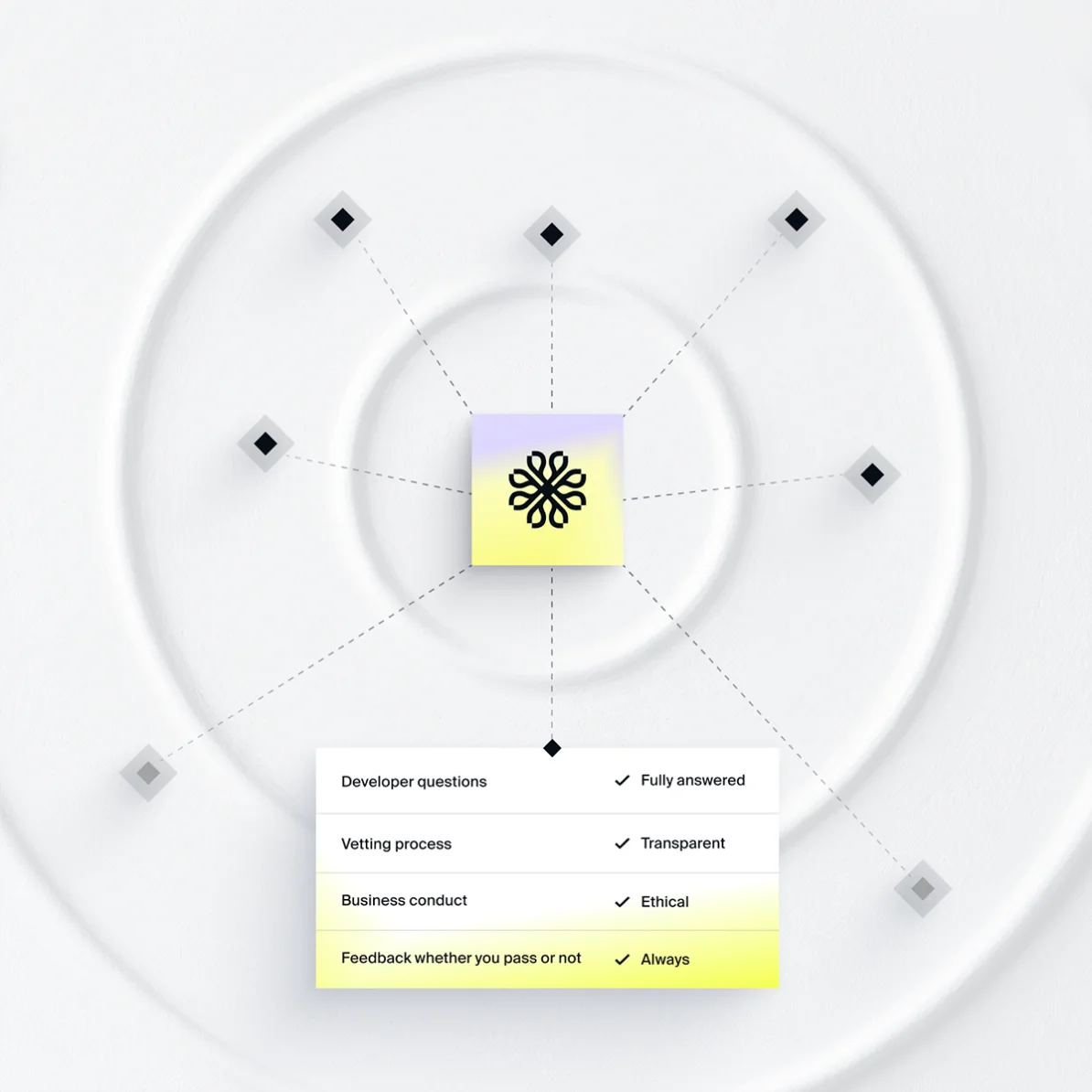
What every developer in the network gets: developer questions — fully answered, vetting process — transparent, business conduct — ethical, feedback whether you pass or not — always. Apply to get matched

Hear from our developers

Rated 5 out of 5 on Trustpilot

One of the best things about Lemon is the opportunities you get. They have the connections, the clients, new companies who are constantly looking for engineers in different stacks.

Sam OykeyeSam OykeyeSenior Full-Stack Developer
Rated 5 out of 5 on Trustpilot

I’ve been working with Lemon since 2021, building projects across healthcare, travel, ecommerce, and fintech. I really appreciate the team’s support and truly believe this company is unique.

Viktoria BohomazViktoria BohomazFull-Stack Developer
Rated 5 out of 5 on Trustpilot

I’ve been able to work from the Philippines, all over Europe, and Brazil without missing a single project, learning a ton of different technologies.

Iven PratsIven PratsSenior Full-Stack Developer

Ready to find your next Svelte project?

Skip the job board grind. Get matched with pre-vetted companies in 24 hours.

Apply to Get Matched

How it works

From application to approval in days

No back and forth scheduling, unnecessary steps, or coding marathons. Know exactly where you stand at each stage, and talk to real engineers who make the final call.

  1. 1

    Share your info

    Upload your CV and LinkedIn link to create your Lemon profile quickly. Then, choose a suitable role from options like “full-stack, Python/React” or “backend, Node.js, PostgreSQL” to select your technical assessments.

  2. 2

    Schedule a call

    In 20 minutes or less, our AI assistant Mark confirms your experience, availability, time zone, rates, and the kinds of projects you want. It’s audio only, so you can take the call from your couch, your commute, wherever.

    Human or AI-vetted path
  3. 3

    Pass a 15-min quiz

    Complete a role-specific task to skip the basics when speaking to technical interviewers.

  4. 4

    Meet a recruiter

    Book a call as soon as you pass the quiz. This focused, 20-minute conversation centers on your work style and communication. The recruiter already has Mark's notes, so you won't re-explain your resume.

  5. 5

    Finish the technical interview

    Tackle a complex problem with a senior engineer live. Talk through how you approach problems, discuss tradeoffs, and make decisions. Find out if you made the cut a few days later.

Frequently asked questions

What is the average hourly rate for senior Svelte.js developers in 2026?

Senior Svelte.js developers on Lemon.io earn $20–$73/hour (median $35/hour) based on rate observations across 71+ countries. Strong Senior engineers (8+ years) earn $20–$95/hour (median $47/hour). North American developers command the highest rates ($61/hour senior median, up to $95/hour for Strong Senior — a +74% premium over the European baseline of $35). Specialization matters: Svelte 5 runes mastery, real-time collaboration tooling, AI-integrated UIs, and full-stack pairings (Python/FastAPI, Elixir, Go) command the highest premiums.

Can I work part-time as a contract Svelte.js developer?

Yes — and many developers start that way. Part-time engagements (15–25 hours/week) are fully supported and a common entry point. Several active Svelte.js projects on the platform are explicitly part-time tracks, especially for component-library / design-system roles. Both schedules are equally supported.

How long does it take to get a Svelte.js developer job through Lemon.io?

After passing vetting (5 days average), Lemon.io continuously sends Svelte.js developers opportunities matched to their stack and timezone — until the right project lands. The fastest matches go to developers who list specific specializations clients filter on (Svelte 5 runes, real-time collaboration, AI integration, full-stack pairings). Broader “I know Svelte” profiles see longer cycles.

Which Svelte.js specializations command the highest premiums?

Across active Svelte.js projects on Lemon.io, the highest-paying specializations are: Svelte 5 runes + component architecture ($50–$73/hr — production fluency with $state, $derived, $effect and migration patterns from Svelte 4 stores); real-time collaboration tooling ($50–$75/hr — TipTap editor extensions, Yjs / CRDT-backed sync, WebSocket-driven UIs); AI-integrated Svelte frontends ($45–$70/hr — OpenAI / Anthropic / Hugging Face streaming responses, agent UIs, generative interfaces); and Svelte + non-Node full-stack pairings ($50–$73/hr — Python/FastAPI, Elixir/Phoenix, Go).

What's the work culture like for contract Svelte.js developers?

Most Svelte.js teams on Lemon.io are small, async-first, and product-led — the typical stack is 2–6 engineers, a designer, and direct access to a founder or engineering lead. Code review and architecture discussions happen in PRs and Slack. Daily standups are rare; sync calls are 1–2 per week. Documentation and ADRs (architecture decision records) matter more than meetings. Svelte.js teams in particular tend to be opinionated about code quality — devs who care about bundle size, animation performance, and component-API design fit best.

What's the vetting process for Svelte.js developers?

Five business days. Four stages. No whiteboards, no algorithm trivia, no recruiter screens. Stage 1: profile + LinkedIn review. Stage 2: soft-skills interview — English, communication, role-play, not rehearsed pitches. Stage 3: technical interview with a senior Svelte.js engineer — small talk, an experience dive, a theory check, and a practice challenge (component architecture, live coding, code review of the interviewer’s own code, performance debugging). Every interviewer is a senior engineer or tech lead, not a generalist recruiter. Stage 4: you’re listed and visible to vetted companies. We vet companies too — about 60% are rejected for shaky funding, unclear roadmaps, or weak engineering culture, so the projects on the other side are worth the bar. Every candidate who doesn’t pass gets detailed technical feedback — specific gaps, code observations, and what to ship before re-applying. Pass once, stay in — no re-vetting for new projects.

State of Svelte contracting in 2026

Svelte.js demand on Lemon.io concentrates in product-led startups, real-time collaboration tools, AI-native frontends, and design-system shops — the kind of teams that pick Svelte deliberately because they care about bundle size, animation performance, and component ergonomics. Geographically, demand is led by US, UK, EU, and Australian product companies; supply is led by Ukraine, Romania, Poland, Brazil, and Canada. The fastest-growing Svelte.js verticals in 2026 are real-time collaboration UIs (TipTap-based editors, Yjs / CRDT-backed sync, WebSocket-driven dashboards), AI-integrated frontends (streaming LLM responses, agent UIs, generative interfaces), Svelte 5 runes adoption (rewriting Svelte 4 codebases to the new reactivity primitives), and non-Node full-stack pairings (Python/FastAPI, Elixir/Phoenix, Go) — Svelte.js’s lighter footprint pairs especially well with backends that aren’t JavaScript.

The Svelte.js specializations that drive rates in 2026

Not all Svelte experience is valued equally. Specialization depth determines rate ceiling. – Svelte 5 Runes + Component Architecture commands $50–$73/hour. Demand concentrates in teams modernizing existing Svelte 4 codebases or starting greenfield with Svelte 5. Production fluency with $state, $derived, $effect, and migration trade-offs (writable stores → $state, $: reactive declarations → $derived, onMount lifecycle → $effect) is the differentiator. – Real-time Collaboration Tooling commands $50–$75/hour. Demand concentrates in collaborative editors, multiplayer dashboards, and notion-style products. Production patterns: TipTap editor extensions, Yjs / Automerge for CRDT sync, WebSocket-driven state, conflict resolution in shared documents, presence/awareness systems. – AI-integrated Svelte Frontends commands $45–$70/hour. Demand concentrates in AI-native startups building agent UIs, streaming LLM interfaces, and generative-content tools. Production patterns: OpenAI / Anthropic / Hugging Face streaming responses, token-by-token UI rendering, agentic workflow UIs, prompt-engineering surfaces. – Svelte + Non-Node Full-Stack Pairings commands $50–$73/hour. Demand concentrates in Python-backend (FastAPI, Django) AI/ML products, Elixir/Phoenix real-time platforms, and Go-backend infrastructure tools. Svelte.js’s lightweight footprint pairs cleanly with backends that don’t share a JavaScript ecosystem.

What gets you matched fastest (decision framework)

Three factors predict matching speed for Svelte.js developers. 1. Svelte 5 runes fluency beats Svelte 4-only experience. A developer who can talk through the migration from writable stores to $state, from $: reactive declarations to $derived, and from onMount to $effect matches into significantly more high-rate projects than a “Svelte 4 + SvelteKit” profile. New Svelte.js projects on the platform increasingly start in Svelte 5. 2. Specialization claim compounds rate ceilings. Strong Senior tier rates ($47–$95/hour) cluster in roles requiring at least one of: real-time collaboration tooling, AI-integrated UIs, or non-Node full-stack pairing. Pick 1–2 specializations, ship them in production, then explicitly claim them. 3. Component-architecture thinking beats “I built apps in Svelte.” Svelte.js senior matches expect designers of component APIs — devs who can reason about prop interfaces, slot composition, store-vs-rune decisions, and embedding Svelte components into non-Svelte shells (React, Vue, vanilla JS). Junior-coded “page-as-component” thinking matches into smaller pools.

What "$80/hour Svelte.js work" actually looks like

Concrete examples from real Lemon.io Svelte.js contracts at the upper rate band: — $73/hr — Senior Svelte.js Engineer (Svelte 5 + TipTap + Yjs) at a Funded real-time collaboration startup, building multiplayer document editing with CRDT-backed sync. — $70/hr — Senior Svelte.js Engineer (Svelte 5 + WebSockets + Python/FastAPI) at an Early-stage AI startup, building streaming LLM interfaces and agent UIs. — $65/hr — Senior Svelte.js Engineer (Svelte 5 runes + Elixir/Phoenix) at a Funded multiplayer product team, building presence/awareness UIs over Phoenix Channels. — $60/hr — Senior Svelte.js Engineer (component-library architecture) at an Established design-system shop, owning the Svelte component primitives shipped across multiple client products. — $50/hr — Senior Svelte.js Engineer (Svelte 4 → 5 migration) at an Established SaaS product, leading the runes migration with measurable bundle-size + perf improvements. Common pattern: production Svelte 5 fluency, a specialized vertical (real-time / AI / design-system / non-Node full-stack), and small-to-mid teams where senior judgment shapes architecture. Generic “ports a React component to Svelte” work clusters in the $25–$35/hour band — but is rare on Lemon.io because Svelte.js clients self-select for technically interesting work.

Why Svelte.js devs fail Lemon.io vetting (and how to pass)

Across vetting interviews, four rejection patterns dominate for Svelte.js candidates: 1. Svelte 4 thinking in a Svelte 5 market. Candidates defaulting to writable stores, $: reactive declarations, and onMount patterns when asked about Svelte 5 work get filtered out. Senior Svelte.js matches expect runes fluency or at least working knowledge of the migration trade-offs. 2. No component-API design discipline. “I built pages in Svelte” fails when the topic is component-library architecture. Senior matches require knowing when to expose props vs. slots vs. context, when to use stores vs. runes, and how to design components that survive integration into non-Svelte codebases. Page-as-component thinking reads as junior. 3. No specialization claim. Generic “Svelte + JavaScript” profiles match slower. The pool of Svelte.js work concentrates in real-time, AI, and design-system specializations — without a claim, you’re competing with more candidates for fewer roles. 4. No production performance / bundle-size story. Svelte’s selling point is performance. Candidates who can’t talk about animation frame budgets, bundle-size budgets, or hydration costs miss the highest-paying segment (collaborative tools and AI UIs both demand performance discipline). The fix is structural: when describing past work, lead with the architectural decision (which reactivity primitive, which component-API shape, which integration boundary), the trade-off, and the measurable outcome.

Modern Svelte.js in 2026 — what's actually changing

Three structural shifts are reshaping what senior Svelte.js looks like. Svelte 5 runes are now the default for new code. $state, $derived, $effect have replaced writable stores and $: reactive declarations as the primary reactivity model for new Svelte.js code in 2026. Senior matches expect runes fluency or at least migration-trade-off literacy. Real-time collaboration is the highest-paying Svelte.js segment. TipTap editors, Yjs-based sync, and WebSocket-driven multiplayer experiences are the wedge that pulls Svelte.js into product-led startups. Senior Svelte.js engineers who can ship a CRDT-backed editor command the top of the rate band. AI-native frontends are the fastest-growing segment. Streaming LLM responses, token-by-token rendering, agent UIs, and generative interfaces are concentrating in AI startups — and Svelte’s lightweight reactivity model is unusually well-suited to streaming UIs.

Freelance vs full-time: the real numbers

Senior Svelte.js developers on Lemon.io earn a median of $35/hour, working 35–40 billable hours per week. North American developers command higher: $61/hour senior median. Strong Senior engineers earn $47/hour median — a +34% jump over Senior — with top observed rates of $95/hour for runes-fluent + real-time collaboration + AI-integrated work. The +74% NA-vs-EU senior premium is meaningful enough that European Svelte.js developers serving US clients consistently out-earn local-EU work by a wide margin. Geography is a significant earnings lever for Svelte.js — moreso than for most stacks. In all geographies, contract Svelte.js senior earnings consistently match or exceed full-time total compensation when factoring in benefits cost (~$15K–$25K to replicate independently), no equity vesting cliffs, and no multi-month job searches between roles. Strong Senior tier rates ($47–$95/hour) significantly outpace local full-time Svelte.js salaries in most markets, especially when paired with real-time / AI specialization. The most common transition pattern: start with a part-time contract (15–20 hours/week) while still employed, validate income stability, then scale to full-time. Both schedules are fully supported.

How remote Svelte.js contracting actually works

The day-to-day looks more like being a senior engineer at a product company than a traditional freelancer.

On a typical project, you join the client’s Slack workspace on day one. Your Lemon.io success manager facilitates a 30-minute onboarding call with the engineering lead, founder, or CTO. You get access to the codebase, staging environments, and project management tool (usually Linear, Jira, GitHub Projects, or Height). Most Svelte.js developers ship their first pull request within the first week — typically a small component refactor, bug fix, or animation improvement — then graduate to feature work and architecture contributions.

Communication cadence varies. Async-first teams do brief daily check-ins via Slack and rely on PR reviews and architecture documents. Sync-heavy teams may have 1–2 video calls per week. Svelte.js teams skew async-first more than most stacks — partly because the dev pool is small, opinionated, and globally distributed.

Code review, architectural design discussions, performance work, and deployment all happen the same as any senior engineering team. You’re part of the engineering core, not an outsourced resource.

Contracts run as monthly agreements with project-based scope. Average contract length: 9+ months — Svelte.js projects compound across feature releases and component-library expansion. When a project nears completion, your success manager begins matching you with the next opportunity. Average downtime between projects: less than 2 weeks.


No bidding, no negotiating, no late payments. The work you want already exists — let's match you to it.

Apply now

No bidding, no negotiating, no late payments. The work you want already exists — let's match you to it.

Apply now