










CTO Jobs — Vetted Remote Contracts, $80–$300/hr

Pass vetting once. Get matched to relevant projects – no re-applying, no bidding wars.

Apply now
  • Time to first offer

    ~13 days

  • Average contract length

    9+ months

  • Vetted developers

    1,500+

Recent CTO projects on Lemon.io

Lemon.io is a developer talent marketplace connecting senior CTOs (5+ years experience) with funded startups for remote contract roles. The platform has a 1.2% acceptance rate, matches developers with companies in under 24 hours, and offers rates of $100–$200/hour.

Average contract length: 9+ months. Since 2015, Lemon.io has facilitated 9,000+ developer contracts across 71+ countries.

Last updated: July 2026

PythonAzureMLOpsGenerative AINext.jsWebGPUPostgreSQL

CTO for a generative AI text-to-media platform

Duration
3–4 months
Type
Part-time
Involvement
25 hrs/week
Apply now
PHPMongoDBPostgreSQLMySQLAWSGitHub

CTO and first engineering hire at a services platform

Duration
7+ months (ongoing)
Type
Full-time
Involvement
Apply now
PythonLLMDeep LearningMachine LearningNLPReact Native

CTO building an MVP for medical data extraction

Duration
7+ months (ongoing)
Type
Full-time
Involvement
Apply now
FirebaseVideo StreamingTikTok APISocial Media APIs

CTO for a video-first travel booking platform

Duration
3–4 months
Type
Part-time
Involvement
20 hrs/week
Apply now
ReactNode.jsJavaScriptDevOpsCybersecurityWordPressPython

CTO for a UK digital marketing agency

Duration
5–6 months
Type
Part-time
Involvement
20 hrs/week
Apply now
Log in to see more

CTO developer rates – what you'll actually earn (2026)

$320
$240
$160
$80
$0
Mid-Level $80 – $150/hr
Senior $100 – $200/hr
Strong Senior $150 – $300/hr

Ready to find your next CTO project?

  • Mid-level Python developers (2–5 years) earn $80–$150/hour.
  • Senior developers (5–8 years) earn $100–$200/hour.
  • Strong senior engineers (8+ years) earn $150–$300/hour.

Based on 9,000+ developer contracts. Updated quarterly.

Stack Premiums

  • CTO + Fractional $100–$200/hr
  • CTO + Interim $150–$300/hr
  • CTO + Due Diligence & M&A $150–$300/hr
  • CTO + AI-Strategy Advisory $150–$300/hr

We reject 60% of companies that apply.
What we screen for

Proven Funding

Stable funding or proven revenue — verified before a project is listed, so contracts don't die mid-sprint.

Clear Vision

A defined product vision, technical specs, and realistic expectations — before you write a line of code.

Engineering Culture

Team autonomy, documentation standards, and organized project management — we check how they actually ship.

Real Challenges

Meaningful technical problems, not routine CRUD maintenance. If the work is boring, it doesn't get listed.

Direct Access

No intermediaries — you always work directly with the company and its decision-makers.

Payment Reliability

We verify companies can sustain contracted rates — payouts on time, every time.

What we don't do

  • No throwaway gigs

    Average contract runs 9+ months — no 2-week gigs.

  • No unverified companies

    We don't accept companies without verified funding.

  • No repeated interviews

    We don't make you repeat long interview processes for every project.

  • No developer fees

    We don't charge developer fees — ever.

Apply to get matched

Having the Lemon team handle client matchmaking, making sure I receive my payments in a timely manner, and providing great support in general is a relief. It allows me to focus on what I want to focus on, which is writing great code.

Santiago GonzálezSantiago GonzálezSenior Full-Stack & Mobile Developer, Technical Interviewer

We're looking for

  • 10+ years commercial engineering, 5+ in formal leadership roles
  • Prior CTO, VP Engineering or Director experience preferred
  • An exit or IPO on your record commands the highest rates
  • Track record hiring, managing performance and shaping org design
  • Comfortable communicating with a C-suite and with a board
  • Architectural depth across backend, infra, data, security and AI
  • Business fluency: roadmap, fundraising narrative, build-vs-buy
  • A specialisation claim — fractional, interim, diligence or AI
  • Excellent written and verbal English; the role is communication-heavy
  • Async overlap with US and EU; 10–20+ hours a week available
  • Comfortable working async with US/EU teams
  • English: Upper-Intermediate or higher
  • Available for 20+ hours/week — part-time and full-time both supported
Apply now

Contract work, without the instability

  • Average contract length 9+ months
  • Average downtime between contracts <2 weeks
  • Average re-matching time if a project ends early 48 hours

Addressing the "What If" Fears

  • What if the company runs out of money?

    We verify funding status before listing — our 60% rejection rate filters out speculative bets. If a project ends early, we re-match you within 48 hours.

  • What about holidays and vacation?

    You set your own schedule and availability. Contracts account for time off. Most devs take 3–4 weeks/year without issues.

  • What if I'm transitioning from full-time?

    40% of our network made this transition. Start part-time during your notice period — average earnings increase is 30–50% over corporate salary.

  • What about burnout?

    You choose your projects. No forced overtime, no "we ship at all costs" cultures — those get rejected during company vetting.

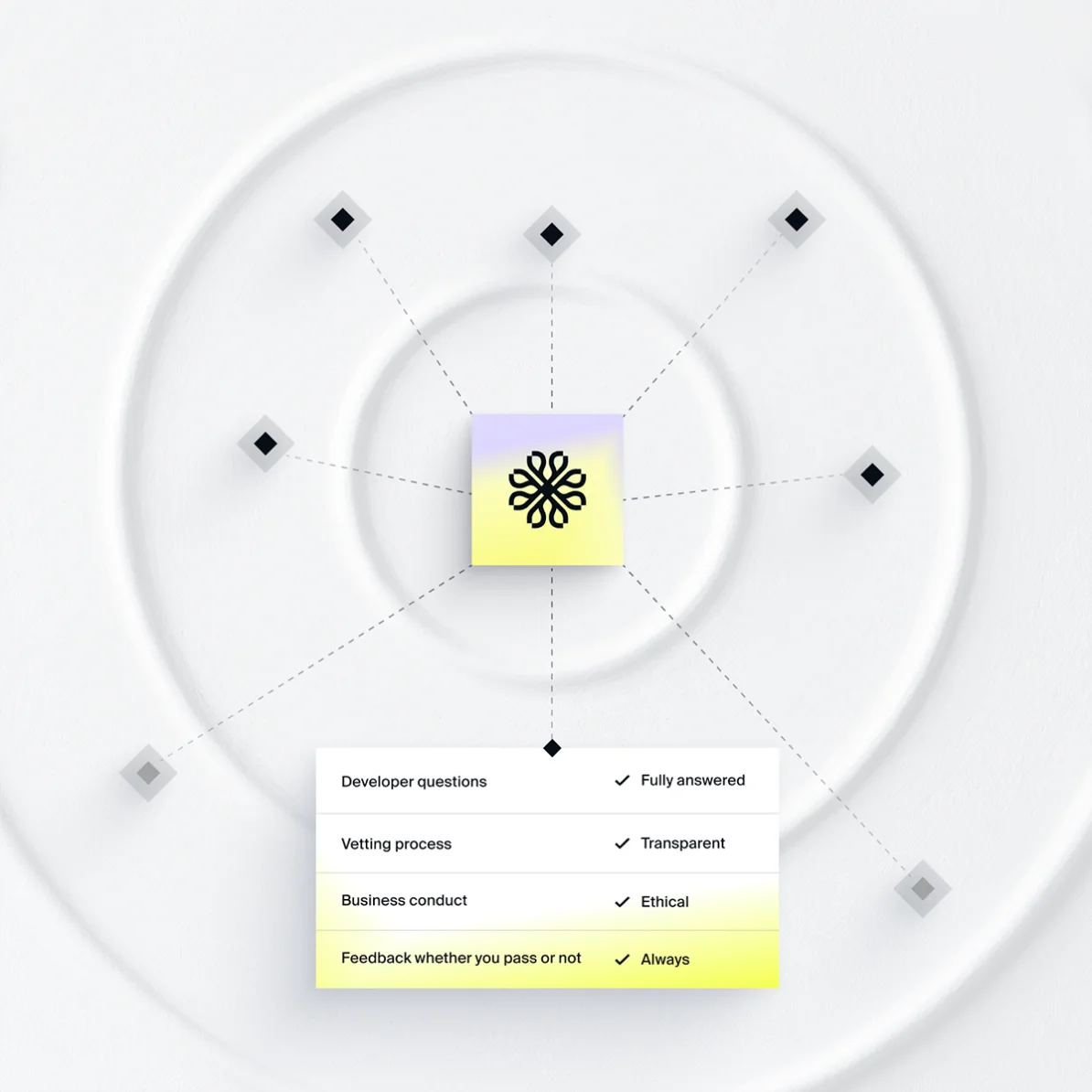
What every developer in the network gets: developer questions — fully answered, vetting process — transparent, business conduct — ethical, feedback whether you pass or not — always. Apply to get matched

Hear from our developers

Rated 5 out of 5 on Trustpilot

One of the best things about Lemon is the opportunities you get. They have the connections, the clients, new companies who are constantly looking for engineers in different stacks.

Sam OykeyeSam OykeyeSenior Full-Stack Developer
Rated 5 out of 5 on Trustpilot

I’ve been working with Lemon since 2021, building projects across healthcare, travel, ecommerce, and fintech. I really appreciate the team’s support and truly believe this company is unique.

Viktoria BohomazViktoria BohomazFull-Stack Developer
Rated 5 out of 5 on Trustpilot

I’ve been able to work from the Philippines, all over Europe, and Brazil without missing a single project, learning a ton of different technologies.

Iven PratsIven PratsSenior Full-Stack Developer

Ready to find your next CTO project?

Skip the job board grind. Get matched with pre-vetted companies in 24 hours.

Apply to Get Matched

How it works

From application to approval in days

No back and forth scheduling, unnecessary steps, or coding marathons. Know exactly where you stand at each stage, and talk to real engineers who make the final call.

  1. 1

    Share your info

    Upload your CV and LinkedIn link to create your Lemon profile quickly. Then, choose a suitable role from options like “full-stack, Python/React” or “backend, Node.js, PostgreSQL” to select your technical assessments.

  2. 2

    Schedule a call

    In 20 minutes or less, our AI assistant Mark confirms your experience, availability, time zone, rates, and the kinds of projects you want. It’s audio only, so you can take the call from your couch, your commute, wherever.

    Human or AI-vetted path
  3. 3

    Pass a 15-min quiz

    Complete a role-specific task to skip the basics when speaking to technical interviewers.

  4. 4

    Meet a recruiter

    Book a call as soon as you pass the quiz. This focused, 20-minute conversation centers on your work style and communication. The recruiter already has Mark's notes, so you won't re-explain your resume.

  5. 5

    Finish the technical interview

    Tackle a complex problem with a senior engineer live. Talk through how you approach problems, discuss tradeoffs, and make decisions. Find out if you made the cut a few days later.

Frequently asked questions

What is the average hourly rate for senior fractional CTOs in 2026?

Senior fractional CTOs (10–15 years engineering leadership, prior CTO or Director-level experience) earn $100–$200/hour on Lemon.io, with typical retainer engagements running $10K–$20K/month for 10–20 hrs/week. Veteran fractional CTOs (15+ years, prior CTO at scale, including exit / IPO experience) earn $150–$300+/hour with typical retainers of $15K–$30K+/month. North American CTOs command the highest rates — the US market for fractional CTO services is the largest globally. Engagement type matters most: technical due diligence, AI-strategy advisory, and interim CTO for Series B–D scale-ups command the highest premiums.

What's the difference between Fractional CTO, Interim CTO, and Technical Co-Founder?

Fractional CTO — ongoing part-time engagement (typically 10–20 hrs/week, monthly retainer) for early-stage startups (pre-Seed to Series A) that don’t have or can’t yet afford a full-time CTO. The most common engagement type. Interim CTO — full-time or near-full-time engagement (30–40+ hrs/week, 3–9 month duration) for scale-ups (Series B–D) transitioning between full-time CTOs. Higher rate, fixed-duration. Technical Co-Founder — equity-heavy, founder-adjacent, deeply involved engagement (typically 20–40+ hrs/week with 5%+ equity) for very-early-stage startups where the engagement is closer to actual co-founding than fractional advisory. Technical Due Diligence — short, intensive engagements (1–4 weeks) for VCs / PE firms / acquirers reviewing target companies pre-investment or pre-acquisition. AI-Strategy Advisory — emerging 2024–2026 specialization, often standalone or paired with fractional CTO work, focused on LLM adoption strategy and AI roadmap.

Can I take multiple fractional CTO engagements simultaneously?

Yes — and many fractional CTOs do. Common pattern: 2–3 simultaneous fractional engagements at 10–15 hrs/week each, totaling 30–40 hrs/week of retainer income across diverse companies. The model maximizes income (multiple retainers stacking) and reduces single-client risk. Lemon.io supports stacked engagements as long as conflict-of-interest is managed (no competing companies in the same vertical without explicit founder approval). Senior fractional CTOs at $15K/month × 2–3 engagements consistently out-earn full-time CTO compensation.

How long does it take to land a CTO engagement through Lemon.io?

After passing vetting (5 days average), Lemon.io continuously sends CTO candidates engagements matched to your seniority, domain expertise, and timezone — until the right match lands. Specialization predicts matching speed: fractional CTO for funded early-stage startups, interim CTO for scale-ups, technical due-diligence + M&A advisory, AI-strategy advisory, or technical co-founder. Generalist “CTO” profiles see longer cycles — domain depth and engagement-type clarity match faster.

Which CTO engagement types command the highest premiums?

Across active CTO engagements on Lemon.io, the highest-paying types are: Technical Due Diligence + M&A Advisory ($150–$300+/hr — short, intensive engagements for VCs / PE firms / acquirers reviewing target companies; rates skew premium because the work is outcome-driving for $10M–$1B+ deals); Interim CTO for Scale-Ups ($150–$300/hr — full-time or near-full-time roles at Series B–D companies in transition between full-time CTOs); AI-Strategy Advisory ($150–$300/hr — the fast-growing 2024–2026 specialization, often paired with fractional CTO work, focused on LLM adoption strategy, build-vs-buy decisions, AI roadmap, model selection); Fractional CTO for Early-Stage Funded Startups ($100–$200/hr — the most common engagement type, ongoing 10–20 hrs/week retainers for pre-Seed to Series A startups without technical leadership).

What's the vetting process for CTO candidates?

Five business days. Four stages. No whiteboards, no algorithm trivia, no recruiter screens — CTO vetting is entirely strategic, leadership, and judgment-focused. Stage 1: profile + LinkedIn review — prior CTO / VP Engineering / Director-of-Engineering experience required, ideally with team-building and exit / IPO history. Stage 2: soft-skills + leadership interview — communication style, founder-stakeholder fluency, conflict resolution patterns, hiring philosophy, technical-narrative crafting for non-technical audiences. Stage 3: strategic interview with a senior engineering leader — small talk, an experience dive (architectural decisions made, hiring decisions made, technical debts inherited and remediated, fundraising narratives shipped, exits managed), a strategic case discussion (real-world founder scenarios — “you join a Series A with a tech-debt-heavy codebase and 3 months of runway left, what’s your 30-day plan?”), and a leadership / judgment dialogue. The vetting tests strategic and stakeholder-communication reasoning rather than coding fluency — senior CTO matches require leadership depth more than implementation depth. Every interviewer is a senior engineering leader (former CTO, VP Engineering, or director-level), not a generalist recruiter. Stage 4: you’re listed and visible to vetted founders. We vet companies too — about 60% are rejected for shaky funding, unclear roadmaps, weak engineering culture, or “we want a senior engineer rebadged as fractional CTO” projects, so the engagements on the other side are worth the bar. Every candidate who doesn’t pass gets detailed strategic feedback — specific gaps, scenario-handling observations, and what to strengthen before re-applying. Pass once, stay in — no re-vetting for new engagements.

State of CTO contracting in 2026

Most CTO engagements on Lemon.io come from funded early-stage startups (pre-Seed to Series A) without technical leadership, scale-ups (Series B–D) in CTO transitions, VCs / PE firms / strategic acquirers needing technical due diligence, and AI-native companies needing LLM-strategy advisory in the US, EU, UK, Canada, and Australia. The verticals concentrate around fractional CTO for early-stage funded startups (the most common engagement type — founders with funding but no in-house technical leadership, needing 10–20 hrs/week of strategic + architectural + hiring guidance), interim CTO for scale-ups in transition (companies between full-time CTOs, typically 3–9 month full-time-equivalent engagements), technical due diligence + M&A advisory (VCs, PE firms, and strategic acquirers needing pre-investment or pre-acquisition engineering reviews), AI-strategy advisory (the fast-growing 2024–2026 vertical — companies of all sizes needing LLM adoption strategy, build-vs-buy decisions, AI roadmap, model selection guidance, AI-native architecture review), and technical co-founder engagements (very-early-stage startups where the engagement is closer to actual co-founding). The fastest-growing CTO verticals in 2026 are AI-strategy advisory (every funded company needs an AI strategy in 2026, and most don’t have in-house leadership for it), technical due diligence for AI-native acquisitions (VCs and acquirers reviewing AI-native companies need engineering-leader judgment about whether the technical claims hold up), and fractional CTO for AI-native startups (early-stage AI companies need leadership that understands both traditional engineering management and AI-specific architectural decisions).

Why fractional CTO work commands premium rates in 2026

Three structural realities keep fractional CTO rates well above IC engineer rates. The role is strategic, not tactical. Fractional CTOs are paid for judgment, leadership, and stakeholder communication — not for hours of code. The rate reflects the cost of replacing a full-time CTO part-time — which in real markets means $200K–$400K+ annual full-time CTO comp prorated to fractional engagements. At 10–20 hrs/week, fractional CTO retainers ($5K–$30K/month) reflect a fraction of full-time CTO comp, not engineer-rate prorated hours. The dev pool of qualified fractional CTOs is small Senior engineering leaders willing to work fractional are scarce. Most stay full-time at well-paid CTO / VP Engineering roles, or transition to investing / advising. The fractional CTO pool consists of (a) senior leaders post-exit / between roles, (b) experienced engineering leaders deliberately choosing fractional for lifestyle / portfolio reasons, and (c) consultants who specialize in technical leadership. The supply is small relative to the demand from funded early-stage startups, which keeps rates premium. AI strategy reshaped the demand picture. Where fractional CTO demand was steady but specialized in 2020, the 2024–2026 AI strategy wave broadened demand significantly — every funded company needs AI-strategy advisory, and most don’t have in-house leadership for it. Senior engineering leaders fluent in LLM adoption strategy, AI roadmap planning, and AI-native architecture command premium rates because the work is high-stakes, strategic, and the talent pool with both AI fluency and CTO-level seniority is small.

The CTO engagement types that drive rates in 2026

Fractional CTO for Early-Stage Funded Startups commands $100–$200/hour (typical retainer: $10K–$20K/month for 10–20 hrs/week). Demand concentrates in pre-Seed to Series A startups with funding but no technical leadership. The work: strategic technical guidance, hiring + team building, architecture decisions, vendor / build-vs-buy evaluations, fundraising-narrative crafting (technical sections of pitch decks), tech-debt audits, board / investor technical communication. Interim CTO for Scale-Ups commands $150–$300/hour (typical retainer: $15K–$30K+/month, often near-full-time). Demand concentrates in Series B–D companies in transition between full-time CTOs. The work: filling the CTO seat for 3–9 months while the company recruits a permanent successor — managing the existing engineering org, maintaining strategic continuity, handling board / investor communication, and increasingly running the recruitment process for the permanent CTO. Technical Due Diligence + M&A Advisory commands $150–$300+/hour (engagements typically 1–4 weeks of intensive work). Demand concentrates in VCs, PE firms, and strategic acquirers. The work: pre-investment or pre-acquisition engineering reviews — codebase quality, architectural soundness, team capability, technical-debt assessment, security posture, scalability viability, talent-retention risk. The premium reflects the outcome-driving nature: a single due-diligence engagement can swing a $10M–$1B+ deal. AI-Strategy Advisory commands $150–$300/hour (engagements often standalone or paired with fractional CTO work). Demand concentrates in companies of all sizes adopting AI/LLM features. The work: LLM adoption strategy, build-vs-buy decisions for AI capabilities, AI roadmap planning, model-selection guidance (GPT vs Claude vs open-source vs on-device), AI-native architecture review for AI-native companies, hiring strategy for AI/ML talent.

What gets you matched fastest (decision framework)

Three factors predict matching speed for CTO candidates. 1. Prior CTO / VP Engineering experience is the entry condition. Candidates with senior engineer / tech-lead backgrounds but no formal CTO / VP Engineering / Director-of-Engineering experience match into a smaller pool. Fractional CTO engagements pay for leadership, not just senior engineering — and founders typically expect prior leadership history. 2. Engagement-type specialization compounds rate ceilings. Top-of-rate-band engagements ($150–$300+/hour) cluster in roles requiring at least one of: interim CTO for scale-ups, technical due diligence + M&A advisory, AI-strategy advisory, or fractional CTO for AI-native startups. Pick 1–2 engagement-type specializations, ship them with measurable outcomes (companies fundraised, exits managed, due-diligence reports delivered), then explicitly claim them. 3. Strategic communication is the senior bar. Fractional CTOs who can architect systems but can’t communicate technical strategy to founders / boards / investors miss premium-tier engagements. Senior CTO work demands ability to translate technical concepts to non-technical stakeholders, write clear technical strategy documents, and influence stakeholder decisions through clarity rather than authority.

What "$200/hour fractional CTO work" actually looks like

Concrete examples from real fractional CTO engagement patterns at the upper rate band: — $300/hr — Veteran Fractional CTO (Technical Due Diligence) at a Series A-focused VC, conducting 2-week deep-dive engineering reviews on portfolio company candidates. — $250/hr — Veteran Interim CTO (Scale-up transition) at a Series C SaaS company, filling the CTO seat for 6 months while the company runs a permanent CTO search. — $200/hr — Senior Fractional CTO (AI-Strategy Advisory + LLM adoption) at a Funded enterprise SaaS, leading AI-strategy work alongside fractional CTO duties. — $150/hr — Senior Fractional CTO (Pre-Seed to Series A founder) at a Funded early-stage startup, providing 15 hrs/week of strategic + architectural + hiring guidance as the founder builds the engineering team. — $100/hr — Mid-Level Fractional CTO (Early-stage technical leadership) at a Pre-Seed startup with a non-technical founder, providing 10 hrs/week of architectural guidance + first-engineer hiring. Common pattern: prior CTO / VP Engineering experience, engagement-type specialization (fractional / interim / due-diligence / AI advisory / technical co-founder), and small-to-mid teams where senior judgment shapes strategic and architectural direction. Generic “we want a senior engineer rebadged as fractional CTO” engagements cluster at the rate floor — but are filtered out by the 60% company rejection rate.

Why CTO candidates fail Lemon.io vetting (and how to pass)

Across vetting interviews, four rejection patterns dominate for CTO candidates: 1. Senior IC background without leadership history. Candidates with senior engineering experience but no formal CTO / VP Engineering / Director-of-Engineering history get filtered out of CTO matching (though they match well into senior IC engineer pools). Fractional CTO engagements pay for leadership track record, not senior IC depth. 2. No strategic / stakeholder communication fluency. Candidates who can architect systems but freeze on “explain why this matters to the board” or “convince a non-technical founder why this approach is wrong” miss premium roles. Senior CTO matches require strategic-communication fluency. 3. No engagement-type specialization. Generalist “CTO” profiles match slower than specialists (fractional / interim / due-diligence / AI advisory). The market values clarity about what kind of engagement you’re optimized for. 4. No AI-strategy fluency. In 2026, every CTO candidate increasingly needs AI-strategy fluency — LLM adoption reasoning, build-vs-buy decisions, AI roadmap thinking. Candidates without this match into a meaningfully smaller pool than peers with it. The fix is structural: when describing past leadership work, lead with the strategic decision (the architectural choice you championed at the C-suite, the hiring decision that scaled the team, the technical-narrative you crafted for fundraising), the business outcome (round closed, exit managed, codebase modernized, team scaled), and the stakeholder dynamic — not the implementation details.

Modern CTO work in 2026 — what's actually changing

Three structural shifts are reshaping what senior fractional CTO work looks like. AI-strategy advisory became a real specialization. What was emerging in 2023 is a dominant 2026 vertical — every funded company needs an AI strategy, and most don’t have in-house leadership for it. Senior engineering leaders fluent in LLM adoption strategy, AI roadmap planning, build-vs-buy decisions, and AI-native architecture review match into the highest-rate work. Stacked fractional engagements became the norm. Where fractional CTO work in 2020 was often single-engagement, by 2026 most senior fractional CTOs run 2–3 simultaneous engagements (10–15 hrs/week each) — diversifying client risk and maximizing income. Lemon.io’s continuous-matching approach is well-suited to this stacked-engagement model. Technical due diligence matured into a distinct specialization. Where due-diligence engagements were ad-hoc in 2020, by 2026 they’re a distinct specialization with established methodologies (codebase quality scoring, team-capability assessment, technical-debt frameworks, scalability-viability frameworks). Senior fractional CTOs with due-diligence specialization match into VC / PE / acquirer engagements at the highest rate band.

Fractional vs full-time: the real numbers

The day-to-day looks more like being a senior strategic advisor than a traditional engineering hire.

On a typical engagement, you join the client’s Slack workspace on day one. Your Lemon.io success manager facilitates a 60–90-minute kickoff call with the founder / CEO to align on scope, deliverables, communication cadence, and success criteria. You get access to the codebase (high-level review only — you’re not expected to write code unless explicitly scoped that way), engineering team Slack, board / investor communications, fundraising-context documents, and project management tools (usually Linear, Jira, Notion). Most fractional CTOs ship their first strategic deliverable within the first 2 weeks — typically a tech-debt audit, architectural review, hiring plan, or AI-strategy memo — then graduate into ongoing strategic + leadership rhythm.

Communication cadence varies. Most fractional engagements run on a weekly synchronous + ongoing async pattern: a weekly 60–90-minute strategic sync with the founder, ongoing async strategic input via Slack + structured documents, monthly board-prep cycles, quarterly strategic reviews. Interim CTO engagements run more like full-time leadership cadences (daily standups, weekly engineering syncs, sprint planning, board prep). Due-diligence engagements run more compressed (1–4 weeks of intensive review with daily syncs).

Strategic memo writing, architectural decision documents, hiring-plan crafting, board-prep technical sections, and stakeholder-influence work all happen the same as any senior engineering leadership role. You’re part of the leadership core, not an outsourced resource.

Engagements run as monthly retainers with quarterly review checkpoints. Average engagement length: 9+ months — fractional CTO relationships compound across funding rounds, hiring cycles, and strategic milestones. When an engagement winds down, your success manager begins matching you with the next opportunity. Average downtime between engagements: less than 2 weeks.


No bidding, no negotiating, no late payments. The work you want already exists — let's match you to it.

Apply now

No bidding, no negotiating, no late payments. The work you want already exists — let's match you to it.

Apply now