

The tech labor market in 2026 is running two contradictory scripts. Over 200K tech jobs were cut globally in 2025 (RationalFX), with AI cited as a direct cause —yet demand for AI engineers now exceeds supply by 3.2 to 1 (The World Economic Forum’s report).
Meanwhile, top-tier AI talent is expensive, difficult to assess, and impossible to hire quickly through traditional recruiting channels.
At Lemon.io, we’ve spent years perfecting staff augmentation, pairing vetted senior developers with fast-moving startups. In this guide, we’ll look at what cost-effective dedicated dev hiring is in 2026 and how you can leverage it to scale your product.
What Is Staff Augmentation
Staff augmentation is a contracting model in which your company temporarily expands a team by bringing in external professionals with specialized skills. They work alongside your in-house team and report to you.
The key distinction from outsourcing: you retain control of the work and the people doing it—the global project management is entirely on your side.
You’ll encounter several terms used interchangeably in this area: IT staff augmentation, team extension, outstaffing, contract staffing, or flexible workforce expansion. They describe the same core arrangement with minor vendor-specific variations.
The meaningful distinctions are between staff augmentation and adjacent models for engaging with tech talent:
Model |
Who manages the work |
What you receive |
Best for |
|---|---|---|---|
Staff augmentation |
Сlient |
Individual specialists who join your team |
Filling skill gaps, scaling quickly |
Managed services |
Vendor |
An outcome or ongoing service |
Defined, repeatable functions (e.g., QA, DevOps, UI/UX designers) |
Project outsourcing |
Vendor |
A finished product or feature |
Clearly scoped, time-bound projects |
Freelance hiring |
Client |
Independent contractor, self-managed |
Short tasks, low integration needs |
Hiring full-time employees in-house |
Employee |
A fully-controlled team member |
Core roles and long-term projects |
Tech companies have used staff augmentation since the 1990s, originally as a quick way to bring in extra hands for massive corporate software and database projects. What has changed in recent years is the scale, specialized skill requirement, and urgency.
The global IT team augmentation and managed services market was valued at $291.71 billion in 2025 and is projected to reach $317.96 billion in 2026—mainly driven by talent shortages and accelerating digital transformation (Global Growth Insights’ report).
The most recent shift is the AI layer. In 2026, companies aren’t augmenting for React developers or DevOps engineers but reaching for ML engineers, LLM-oriented data scientists, and AI integration experts whose skills don’t exist in sufficient quantity anywhere in the permanent hiring market.
When staff augmentation performs well
Your company has a defined skill gap, a functioning team, and enough internal context to onboard an external specialist
When staff augmentation slows down your startup
Staff augmentation engagements are time-bound: knowledge leaves when the engineer exits (bad if a dev becomes the sole owner of a workflow)
Why staff augmentation makes sense in 2026 for your team:
- You get a vetted specialist in days (less than 2 weeks if hiring through Lemon.io), not the industry-average 63.5 days it takes a traditional hire.
- You access AI engineers, LLMOps, and ML specialists that aren’t available in the permanent hiring market at any reasonable speed.
- You pay an all-inclusive rate instead of salary, benefits, employer taxes, and severance risk.
- You keep full control—augmented engineers work inside your team, under your direction, using your tools.
- You scale up or down as product priorities shift, without layoffs and notice periods.
- You reduce the extra costs of a wrong hire; a vetted match with a replacement guarantee (you have it with Lemon.io) is lower risk than a long recruiting cycle you need to repeat.
A tech staffing agency is one of the most popular delivery channels for staff augmentation—they source and place contractors on your team, which is the staff augmentation model by definition.
However, modern vetted marketplaces like Lemon.io have largely replaced traditional agencies for tech roles, offering faster placements, pre-screened candidates, and managed billing rather than a one-time placement fee with no guarantees.
Staff Augmentation Channels: Marketplaces, Freelance Platforms, Team Outsourcing, SaaS
Not all staff augmentation works the same way. The model you choose determines how quickly you get a new member of staff, how much screening you do yourself, what you pay, and how much risk you take on. For tech companies building and scaling products in 2026, four models dominate:
Curated talent marketplaces
Example: Lemon.io, Toptal
A vetted pool of pre-screened specialists, matched to your requirements by a human team, best for startups and SMBs that need senior developers fast, without building a recruiting function. You submit a brief, receive relevant profiles, conduct a single culture-fit interview, and start. The platform handles contracts, billing, NDAs, and replacement if the match doesn’t work.
This is the model Lemon.io operates on—and where the distinction between old-style marketplaces (browse a list, pick someone) and white-glove matching (a team selects candidates based on your context) matters most. Other players in this space include Toptal.
Read more: Best Toptal Alternatives in 2026: Vetted Developers Without the Enterprise Price Tag.
Freelance platforms
Example: Upwork, Fiverr, Freelancer.com
Open marketplaces where you post a role, receive proposals, screen candidates yourself, and manage the relationship directly. Upwork is the largest, with Fiverr and Freelancer.com covering lower-complexity tasks. The freelance platforms market is still evolving, driven by demand for niche digital skills and cost-optimization pressures. On most of them, you can hire for various ranges or roles—from full-stack developers to product managers.
The trade-off: lower platform cost, higher time investment. You own the entire funnel—vetting, interviews, contracts, and dispute resolution. Works well for defined, short-scope tasks or when you have internal technical capacity to evaluate candidates.
Read more: Best Upwork Alternatives in 2026: Top 5 Freelance Platforms for Hiring Developers.
Team-scale outsourcing
Example: Accenture and TCS (for enterprise); EPAM, SoftServe, or GlobalLogic (for mid-players)
Rather than individual specialists, you contract an external vendor to deliver an entire engineering team—typically for a defined product. This is project-based augmentation. Your vendor manages staffing, delivery, and internal processes; you stay at the product and requirements level.
Companies like Accenture or EPAM operate in this space. The advantage is delivery capacity, plus your vendor sources any specialists required for your task—managers, developers, designers, staff writers, or others.
The risk: less control over day-to-day execution and a harder knowledge transfer when the engagement ends.
SaaS-like subscription-based staffing
Example: Lemon.io, Gun.io
An emerging model in which companies subscribe to ongoing access to a developer or small team at a fixed monthly rate, closer to a retainer than to a project contract.
This works for firms with recurring development needs but fluctuating intensity—think ongoing feature development, maintenance, and iterative improvement cycles.
Lemon.io’s monthly subscription model fits here: a developer engaged part-time (20h/week) or full-time (40h/week), billed by the hour, with the option to scale or replace as the product evolves.
Note that at Lemon.io, all unused hours transfer to the next month, so you only pay for work that was done.
Model |
Best for |
Time to start |
Who screens candidates |
Typical cost |
Providers |
|---|---|---|---|---|---|
Curated marketplace |
Startups & SMBs needing senior devs fast |
1–2 weeks |
Platform team |
All-inclusive, rate-based |
Lemon.io, Toptal |
Freelance platform |
Short tasks, defined scope, internal tech capacity |
Days to weeks |
You |
Bidding-based |
Upwork, Fiverr, Freelancer.com |
Team-scale outsourcing |
Mid-size companies, large product buildouts |
2–6 weeks |
Vendor |
Project-based or team day rate |
EPAM, SoftServe, GlobalLogic |
Subscription staffing |
Ongoing development with variable intensity |
1–2 weeks |
Platform team |
Fixed monthly, hourly-tracked |
Lemon.io, select boutique firms |
The right model depends less on budget and more on what you’re building—and how much recruiting bandwidth your team has to spare.
If you’re a founder or CTO with no internal recruiter and a product that needs to ship, a curated marketplace or subscription model eliminates the funnel and hands you a vetted developer to evaluate. If you have time and internal technical capacity to screen, freelance platforms offer flexibility.
Billing Models in Staff Augmentation
There are four most popular billing structures that appear in staff augmentation:
Time and materials (T&M)—you pay for the hours worked at an agreed hourly rate. It is the default and most common structure in staff augmentation because it is flexible, transparent, and easy to scale. Yet, it requires active scope management to keep costs predictable.
This is the model most vetted marketplaces, including Lemon.io, operate on—in case of staff augmentation through Lemon.io, engagement prediction and actual hour tracking is handled by our team.
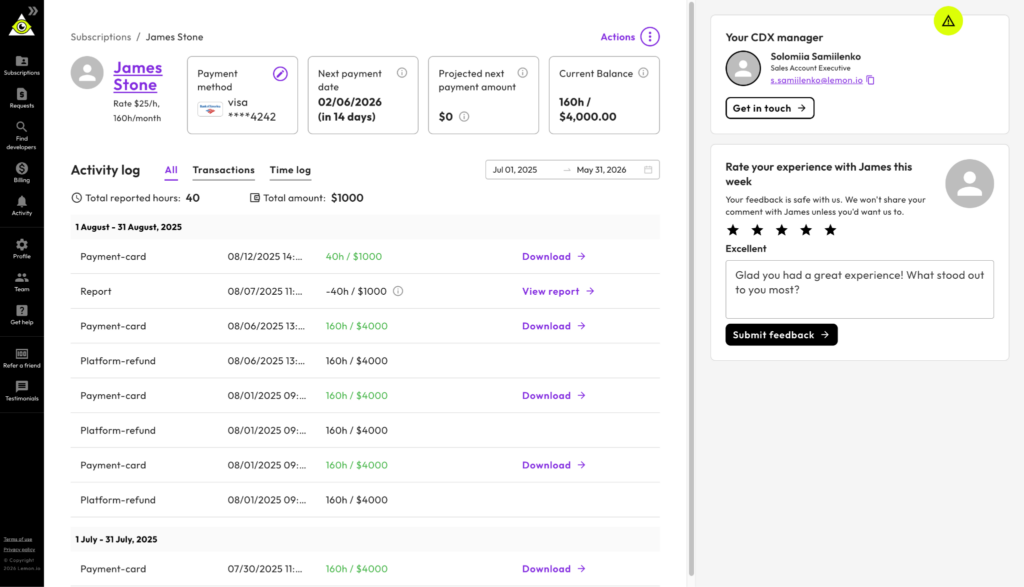
Source: Lemon.io website, subscription page of a client account
Fixed price—you agree on a set cost for a defined scope upfront. Rarely used in true staff augmentation since it implies a deliverable, not a person—it’s more common in project outsourcing and freelancer platforms.
Retainer—a recurring monthly fee for guaranteed access to a developer or team, regardless of exact hours used.
This model is common in subscription-style staffing on SaaS-type hiring platforms, where you commit to a specific type of engagement billed by the hour on a monthly cycle. On the contrary, on Lemon.io, you only pay for the hours your dedicated developer reports.
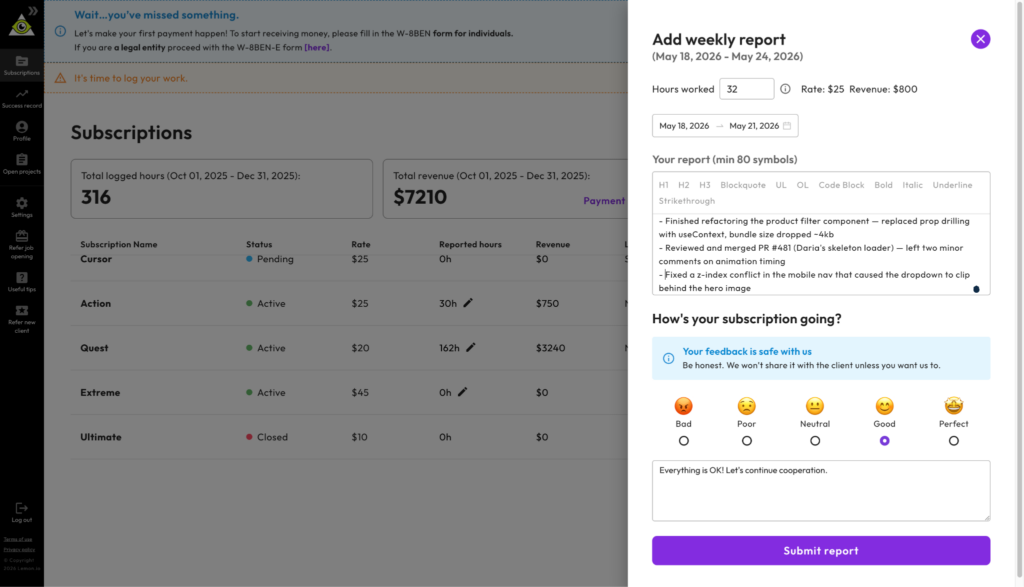
Source: Lemon.io website, subscription page of a developer account
Milestone-based—payment is tied to defined project stages rather than hours or calendar time. Uncommon in staff augmentation for the same reason as fixed price—it shifts the model toward outsourcing logic, where the vendor owns delivery rather than the client.
Billing model |
Best for |
Why it fits |
Watch out for |
|---|---|---|---|
Time & materials |
Startups, SMBs with evolving product scope |
Maximum flexibility; hours scale up or down as priorities shift, you only pay for work delivered |
Costs can exceed estimates if your scope isn’t managed |
Retainer |
Startups and SMBs with ongoing development needs |
Predictable monthly cost, guaranteed developer availability, works well for maintenance cycles |
Paying for committed hours even during slow product periods |
Fixed price |
Enterprises with clearly defined, stable requirements |
Budget certainty upfront, no hourly tracking overhead, works when the deliverable is well-documented and unlikely to change |
Any scope change becomes a renegotiation; poor fit for iterative or discovery-phase work |
Milestone-based |
Enterprises running large, phased implementation projects |
Ties payment to verified progress, reduces financial risk on long engagements, easier for finance teams to approve in tranches |
Requires detailed upfront scoping; disputes arise when milestone criteria are vague |
Our practical advice for most startups and SMBs is to use T&M for early-stage feature development and exploratory work, and shift to a retainer once your team composition and workload stabilize.
How Lemon.io Does Tech Talent Augmentation for You
Sometimes staff augmentation goes wrong before the engagement starts—because the brief is vague, the candidate pool is unvetted, or you end up doing the screening work. The staff augmentation model we built at Lemon.io is designed to eliminate cases like this. Here’s what the process looks like:
Step 1. You describe what you’re building (not a role but an outcome)
You tell us your tech stack, product stage, industry, and how you want to engage: full-time or part-time. You don’t need to do a job posting or set up sourcing. A human technical & business analyst reviews your brief (you send it via email in any form that works for you), asks clarifying questions on niche skills if needed, and starts the process of looking for a perfect engineer for you.
You can also check candidates on Lemon.io using filters by role and tech stack. Unlike most of the vetted developer marketplaces like Toptal, Lemon.io’s candidate list is open to browse:
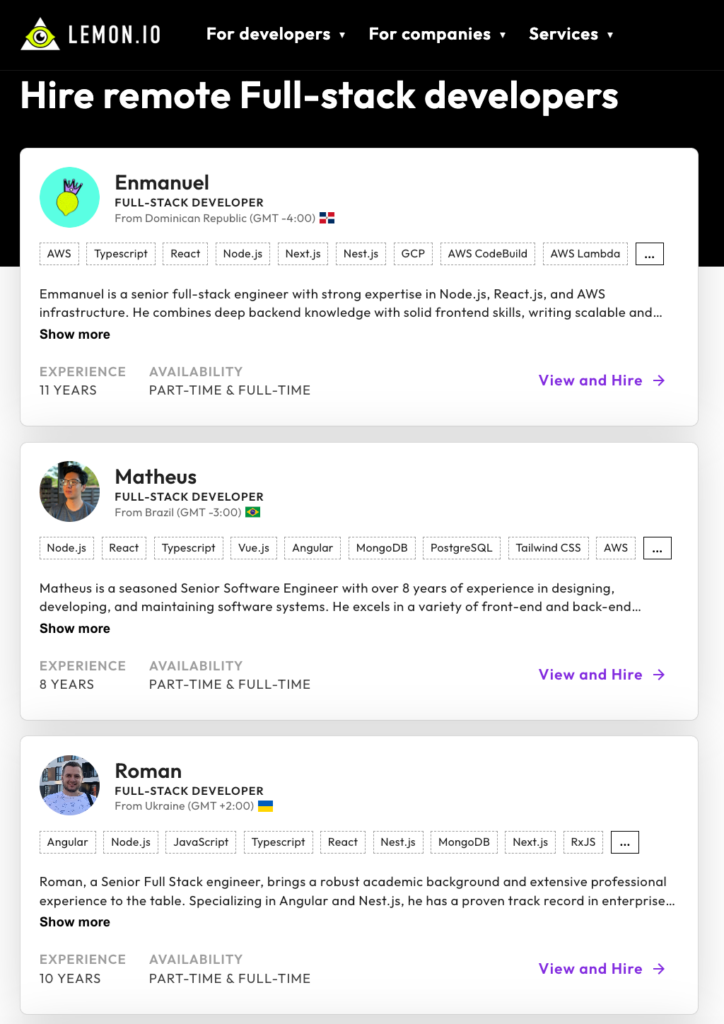
Source: Lemon.io website; the candidate base is open for browsing
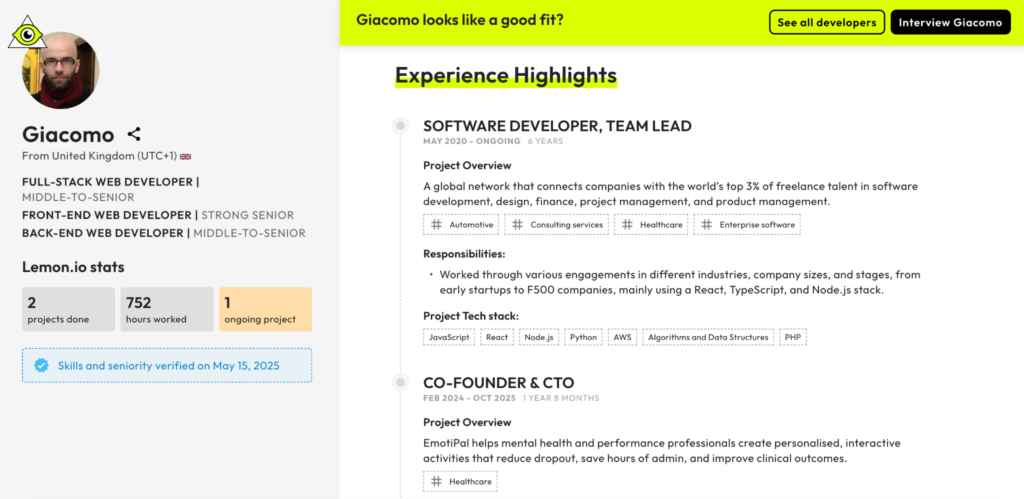
Source: Lemon.io website, example of a developer’s profile
Step 2. You receive 1–3 vetted candidate profiles within 24–48 hours
Every developer in Lemon.io’s network has passed vetting, a profile and background check, an English and soft skills interview, a technical pre-screening, and a 90-minute live technical interview conducted by a senior engineer or CTO. By the time a profile reaches you, the hard filtering is already done.
Step 3. You have one conversation
A single culture-fit interview—no technical screening on your end unless you want it. You evaluate whether this person fits your team, your communication style, and your product context. That’s the decision you should be making; everything before it on Lemon.io.
Step 4. Collaboration starts, fully managed
Lemon.io handles contracts, NDAs, and payments. Your developer joins your team, works in your tools, and reports to your leads—exactly like an in-house hire, without the administrative overhead of one. A dedicated manager monitors collaboration health throughout the engagement.
And if something isn’t right, we provide a free replacement within 24–48 hours, using feedback from the first placement to improve the next match.
For more details on how Lemon.io works, read here.
Why staff augmentation works
The standard critique of staff augmentation—that augmented engineers create knowledge dependencies and drain resources without transferring value—is almost always a process problem, not a model problem.
It happens when there’s no internal ownership, no documentation expectation, and no accountability structure around the external hire.
At Lemon.io, we address this in two ways. First, every developer we match is senior—minimum of 3 years of commercial experience, average of 6–8. This means they integrate into your team as a powerful contributor. Second, our onboarding structure (milestones, weekly check-ins, bilateral feedback) creates the accountability layer that prevents engagement drift from the start.
You can read more about how to set a developer up for success in our onboarding guide for software engineers.
Your benefits from staff augmentation with Lemon.io:
- A matched senior developer in under 2 weeks, versus the industry-average 63.5 days for a direct hire
- Hourly rates from $60–$90/hr, all-inclusive—no employer taxes, benefits, or severance exposure
- Flexibility to scale hours up or down, or swap engagement models as your product evolves
- A replacement guarantee that makes the first hire lower-risk than a six-month recruiting cycle
If you’re not sure which developer profile you need, that’s a fine starting point. The Lemon.io matching team will translate your product goals into candidate requirements and share the most relevant, technically vetted options—typically within a business day.
How to Detect an Effective Augmented Specialist
Identifying and hiring a strong augmented developer has always required more than reading a CV. In 2026, it requires evaluating something that moves faster than any job description can capture: how a developer works with AI tools, and whether they can apply that fluency to your specific product context.
What to look for
- Technical depth, not just stack familiarity
A strong candidate can explain architecture decisions, reason about trade-offs, and articulate why they chose one approach over another in past projects. Stacking keywords on a CV tells you nothing — what matters is whether they’ve solved real problems under real constraints.
- Genuine AI fluency
This means daily workflow integration of tools like Claude Code, Cursor, or Copilot — not awareness of them. A developer who uses AI as a force multiplier can prototype faster, write cleaner tests, and debug complex issues more efficiently. Ask for specifics: which tools, in which contexts, with what results.
- Communication that works remotely
For an augmented developer joining a small team, the discipline of async communication matters as much as technical skill. Can they flag blockers without being prompted? Do they document decisions? Can they explain a technical trade-off to a non-technical founder clearly? One communication failure in a five-person team can stall an entire sprint.
- Product orientation
The best augmented engineers ask about the business problem before the technical spec. This signals they’ll make better independent decisions — which is exactly what remote, small-team work demands.
- Stability and reliability signals
Background checks, CV verification, and reference checks matter more than most hiring managers acknowledge. Inconsistencies in employment history, unexplained gaps, or vague project descriptions warrant investigation before an offer.
If you’re building your own evaluation process, we’ve published resources to support it: interview question templates for engineering roles across stacks, and job description templates that reflect what senior developers in 2026 actually look like. Both are worth reviewing before your first candidate conversation—they give you a benchmark for what a strong profile should contain and what a technically rigorous interview should probe for.
Balance Between Skills, Time, and Budget
The first instinct when evaluating staff augmentation is to look at the hourly rate and work backward. That’s the wrong starting point.
The rate is the most visible line item, but it’s rarely where the real cost lives. According to our own benchmark data across 2,500+ contracted engagements, a senior full-stack developer runs $47/hr on average—but the same role in North America can reach $81/hr, while a vetted engineer in Eastern Europe or Latin America delivers comparable output at $26–$52/hr.
Geography matters, but it’s one variable among several.
What drives the total cost win of an augmented hire:
- Time to fill the role. Every week a position sits open is a week of delayed product development. At an average of 60+ days for a direct hire, the opportunity cost often exceeds rate differences.
- Screening and interview overhead. If a CTO spends 15 hours reviewing CVs and conducting interviews before finding the right person, that time has a dollar value—and it compounds with every failed placement.
- Onboarding and ramp-up. A developer who integrates in week one because they’ve been properly vetted and matched to your context is worth more than a cheaper in-house hire.
- Replacement risk. A mis-hire at the senior level—whether through a job board, an open marketplace, or a poorly run augmentation process—typically sets a product back when you factor in the failed engagement, the restart, and the second onboarding cycle.
This is why the AI specializations command such a premium and still represent good value for the right project. A senior AI engineer at $60/hr who compresses a three-month ML integration into four weeks costs less in total than a $40/hr generalist who figures it out over six months—and ships something fragile at the end of it.
The honest summary for 2026: staff augmentation is not a universal cost-cutting approach—it’s a speed-and-capability strategy. Especially for tech startups.
The market conditions that make augmentation valuable in 2026: AI specialist supply will remain constrained well beyond 2026, permanent hiring timelines aren’t improving, and the cost of carrying an open role keeps rising.
For startups and scaling SMBs with small engineering teams, the question is less “should we use staff augmentation?” and more “how do we run it without creating the dependencies and knowledge risks that give the model a bad reputation?”The answer to that question is the same as it is for any effective hire: pick the right person, set them up properly, and treat the engagement as a partnership. And remember that with Lemon.io, the first steps are risk-free and fast.