


Toptal launched in 2010 to solve the problem of finding devs remotely. The platform fixed it—and spent the next decade drifting toward enterprise. As a result, today’s Toptal means complicated contracts negotiated by lawyers, long hiring cycles, and rates that double market ones.
On the contrary, modern tech businesses need a product-minded, AI-savvy, requirement-flexible developer who can start this week, work without hand-holding project management, and whose rates align with market reality.
Good news: Toptal alternatives exist. And we help you to take a closer look at them.
Why Look for Toptal Alternatives
Toptal is a remote tech hiring platform that’s been around since 2010—long enough to become the default answer whenever someone asks where to find a senior dev.
Toptal’s pitch is: access to the top 3% of global dev talent, vetted and ready to work. But what’s under its surface, according to LinkedIn startup communities, Reddit threads, and Slack groups?

Source: Toptal website
Problem #1. Lack of startup-ready tech talent
Toptal’s vetting process screens for passing tech tests but fails for the things that determine successful engagement between a remote dev and a startup in the 2026 AI era:
- Product-focused remote communication
- Adaptability when requirements shift
- Ability to work autonomously with a product in mind
- Proactivity and ownership in tech decisions
- Fluency with modern AI coding tools & AI skill vetting (a baseline in 2026 that Toptal’s assessment hasn’t yet caught up with)
Those are all startup-critical skills. Toptal’s process, on the contrary, was designed to surface developers who perform well in structured, enterprise environments with defined scope and dedicated oversight.
Problem #2. Invisible candidate lists & long cycles
Toptal’s clients typically see only a handful of candidate profiles—you don’t browse a long or short list; you just receive “matches”. If the first one isn’t right, the cycle starts again: more waiting, more back-and-forth, more time with the subscription fee running, and no developer contributing to your product.
Whereas Toptal alternatives, such as Lemon.io, let you browse a full candidate pool and don’t charge you until you spot your perfect fit.
Problem #3. Toptal’s price & non-obvious fee structure
Toptal’s pricing for the hiring process is multilayered. The platform folds its premium margin into the hourly rate—that’s why you see rates significantly above market ones. The full platform fees structure looks even more frustrating for small teams:
- The $500 deposit
Before Toptal finds you someone, you hand over $500. It’s technically refundable and credited to your first invoice if you hire.
- The $79 monthly subscription
The moment your search starts, a $79/month platform access fee begins running. It doesn’t stop while you’re evaluating or rejecting candidates—it runs until you actively cancel.
- Hourly rates
Blended all-in rates run $80–$200/hour for most developers. Senior specialists, AI engineers, and niche architects regularly exceed $220/hour.
| Cost Element | What You Pay | The Catch |
|---|---|---|
| Hourly rates | $80–$200/hr for most developers; $220+ for AI engineers, senior specialists, and niche architects | You don’t see the full candidate pool, and you can’t see different profiles and rates |
| Annual cost | $124,800–$312,000+ | For one person, before subscription fees and deposit |
| Deposit | $500 upfront before any matching begins | Credited to your first invoice if you hire; refunded if you don’t |
| Monthly subscription | $79/month from the moment your search starts | Runs while you’re evaluating candidates, between hires, and until you cancel |
| Engagement minimums | Part-time (~20 hrs/week) or full-time (~40 hrs/week) | Flexible or light-touch arrangements are declined |
When Toptal works and when it doesn’t
Toptal was built for an enterprise-grid customer. Picture a big engineering director with a several-month hiring timeline and a procurement team that requires ISO-compliant documentation. They’re hiring for long-term projects and full-time roles where a premium hourly rate amortizes over years. They have dedicated management in place to oversee onboarding and new team members.
The Toptal customer is not a startup founder. And it’s not a technical lead at a growing SMB trying to ship an ambitious project faster with a small, enthusiastic team.
Toptal doesn’t make sense when:
- You’re a startup or scale-up with a finite runway, and every week without the right developer has a real cost.
- Your requirements are evolving—and you need a developer who keeps pace.
- You need a person who takes ownership, works without hand-holding, and brings a builder’s mindset (more on this topic: Software Engineer Shortage: What 30 Tech Leaders Revealed About Today’s IT Hiring Crisis).
- You want visibility into who you’re being matched with and why.
- You don’t have months to hire an engineer.
Toptal’s model was engineered for enterprise clients, timelines, and budgets. Startups are an afterthought—and the screening process, pricing structure, and matching reflect that.
6 Top Toptal Alternatives for Hiring Developers in 2026
Lemon.io, best for startups hiring AI-fluent tech talent
Trustpilot: 4.8 / 5
Lemon.io is a curated marketplace for high-quality senior developers, purpose-built for startups and scaling businesses that need them fast—without the enterprise overhead of platforms like Toptal. The platform offers mostly European and Latin American IT engineers across 100+ software development tech stacks.
Where Toptal serves large organizations with deep pockets and long procurement cycles, Lemon.io is designed for tech founders who need a developer precisely fitting their product, stack, stage, and culture. Once vetted talent is hired, Lemon.io handles contracts, NDAs, payments, collaboration monitoring, and post-hire support.

Source: Lemon.io website
What makes Lemon.io different from Toptal:
- Tighter vetting & lower acceptance rate. Lemon.io accepts ~1.2% of applicants, compared to Toptal’s ~3%.
- Faster time to match. Lemon.io offers you relevant candidates within 24 hours to streamline the implementation of your ideas; Toptal takes 1–2 weeks.
- Open candidate pool. Toptal keeps developer profiles hidden until it decides to present them. On Lemon.io, all profiles are browsable—you can search by skill, review experience, and request an intro directly.
- Lower rates. Lemon.io developers range from $60 to $120/hr. Toptal’s rates run $80 to $220+/hr.
- No pre-paid deposit & platform subscription. On Lemon.io, you only pay a weekly or monthly developer subscription based on their hourly rate.
- Lemon.io screens for startup readiness by assessing how engineers handle ambiguous briefs, shifting priorities, limited oversight, and the latest AI tools.
Tech talent pool
Lemon.io’s global talent pool of 1,500+ senior developers spans 100+ tech stacks, covering the full range of roles a startup typically needs as it scales. On the engineering side, you can hire full-stack developers, frontend and backend specialists, AI engineers, DevOps and cloud engineers, data engineers, and ML engineers. All developers have verified hands-on experience.
The platform also fields fractional and senior leadership profiles—including CTOs and technical leads—for founders who need strategic engineering oversight. Tech stacks include Python, React, and many others across web, mobile, SaaS, and data infrastructure.
All remote developers are available for part-time (20 hours per week) or full-time (40 hours per week) engagement, with the option to add hours as your needs grow.

Source: Lemon.io website
What’s vetted?
Every developer in Lemon.io’s community has cleared a rigorous vetting, a 4-stage process where only 1.2% of applicants make it through.
The first stage is a dedicated English and soft-skills interview, completed before any technical assessment. Technical interviews follow, covering non-Googleable questions, live coding, code review, and system design—all evaluated by engineers who have shipped similar products for clients.
Lemon.io’s team also conducts multi-source background checks on every candidate. Every interview is recorded and peer-reviewed to maintain consistent quality standards.
How much do you pay?
Lemon.io’s rates often range from $60 to $90 per hour, depending on the developer’s seniority and specialization. Billing runs on a weekly or monthly subscription model tied directly to the developer’s hourly rate.

Source: Lemon.io on Trustpilot

Source: Lemon.io on Trustpilot
CloudDevs, for US companies needing time-zone alignment
Trustpilot score: 4.2 / 5
If your primary constraint is cost—and you need developers who work the same hours you do—CloudDevs solves a specific problem well. The platform connects US companies with pre-vetted developers from Latin America, with a hard focus on time-zone compatibility.
There’s a seven-day risk-free trial before any long-term commitment. And the rates are lower than what you’d pay through Toptal for comparable seniority.

Source: CloudDevs website
Tech talent pool
CloudDevs specialises in senior Latin American developers available in US time zones, covering full-stack, frontend, and backend roles across stacks, including React, Node.js, Python, Ruby on Rails, and mobile (React Native, Flutter). The platform also fields DevOps engineers and cloud specialists.
What’s vetted?
CloudDevs runs a vetting process that includes technical assessments, English proficiency, and verification of professional background. All developers have at least 5 years of experience. The platform’s pool sits at around 8,000–9,000 vetted developers—smaller than a marketplace like Upwork by several orders of magnitude.
How much do you pay?
The platform charges a flat $500 fee to get started, which covers the matching process and trial dev partnership period. Developer rates range from $45 to $100/hr, depending on seniority and specialisation. Billing is direct and hourly. A one-week free trial is offered before any further commitment.

Source: CloudDevs on Trustpilot
Turing, for AI-powered large-scale hiring
Trustpilot score: 3.5 / 5
Turing operates at a different scale from most platforms in this list. With a pool of over 3M+ developers across 150+ countries and an AI-driven matching infrastructure, it’s positioned for companies with large, ongoing, tech-stack-precise engineering needs.
Turing’s core offering is scale. The platform can staff entire engineering teams, covers over 100 technology stacks, including AI, ML, DevOps, and cloud-native development, and comes with built-in project infrastructure: time tracking, daily standup tools, and a proprietary Virtual Machine environment that protects client IP while giving you full visibility into developer activity.
For large engineering teams that need to quickly spin up a distributed team without building the infrastructure themselves.
Tech talent pool
Turing offers a globally distributed pool of software engineers across a range of roles: full-stack, frontend, backend, mobile, DevOps, data engineers, ML/AI engineers, and QA. Supported tech stacks span React, Angular, Vue, and more. The platform is particularly good for teams that need to scale engineering headcount quickly across multiple roles simultaneously.
What’s vetted?
Turing’s vetting consists of 5+ hours of testing covering coding challenges, algorithms, system design, stack-specific assessments, and a 57-question automated work experience survey.
What it lacks is a live human technical interview before a profile reaches the client—the funnel is heavily automated. This creates a risk of AI-assisted interview fraud.
How much do you pay?
The platform operates on a subscription model, with plans starting around $49/month for access to its talent network, though the developer’s rate is billed separately. Developer rates range from $100 and $200+ per hour, depending on skill level and location. A two-week trial period is offered, after which ongoing billing is monthly.


Source: Turing on Trustpilot
Upwork, for technical teams who needs short-term outsourcing
Trustpilot score: 3.6 / 5
Upwork is the world’s largest freelance developers marketplace, well known across social media. The platform gives you access to millions of developers across every conceivable skill set and price point—and then leaves you alone to figure out which ones are any good.
Upwork doesn’t vet, so there’s no definite quality assurance here. The platform’s value is access to an enormous global pool of freelancers for hourly work, fixed-price projects, milestone-based contracts, and short-term gigs. If you have strong technical screening ability in-house and the time to invest in evaluating candidates, Upwork gives you more options than any other platform.
Alternatively, if you want to avoid vetting candidates on your own, partnering with a service company is often a better-suited approach.
Upwork pricing is based on job postings and bidding between freelancers.

Source: Upwork website
Tech talent pool
Upwork hosts one of the largest freelance talent pools, covering virtually every tech and digital marketing role and stack. You can hire for one-off tasks, short-term projects, or ongoing part-time and full-time engagements. Quality varies widely across the pool.
The no-vetting tradeoff
Upwork’s review system is the primary quality signal for clients, and it has integrity problems. Freelancers can remove negative reviews every three months, which means a Top Rated badge can reflect a curated history rather than a consistent one.
Many profiles listed as individual freelancers are agencies, meaning the person you interview may not be the person who does the work. And the bidding system creates downward price pressure, pushing the most in-demand developers toward platforms where they don’t have to compete on price.

Source: Upwork website
How much do you pay?
Upwork charges clients a 5% service fee on top of the freelancer’s rate. Freelancer rates range from under $15/hr to $200+/hr depending on experience, location, and specialization. Contracts can be hourly or fixed-price. Upwork also offers an Enterprise plan with custom pricing and dedicated support.
[references screenshots]
Don’t like Upwork? Check out this article: Best Upwork Alternatives in 2026: Top 5 Freelance Platforms for Hiring Developers.
Fiverr Pro, for short-term, defined-scope tasks
Trustpilot score (Fiverr): 2.6 / 5
Fiverr started as a $5 gig marketplace. Fiverr Pro is its attempt to move upmarket—a curated layer of pre-screened on-demand freelancers for clients who need more than a logo in 24 hours but less than a full engineering team.
Fiverr Pro’s model is built around fixed-price, package-based services with clear deliverables and defined timelines. You browse, you pick a package, you check out. So there’s no posting a job, waiting for bids, or back-and-forth on scope before work begins.
Recently, Fiverr has also introduced AI-assisted brief tools that help buyers articulate their project requirements before placing an order, and an AI-driven search ranking that surfaces relevant gigs based on project description rather than just keyword search.
For a well-defined, discrete task—a specific front-end component, a landing page build, a code audit—that simplicity is genuinely useful. The turnaround is fast, the pricing is transparent upfront, and the platform handles payment escrow throughout.

Source: Fiverr website
Tech talent pool
Fiverr Pro is the vetted tier of Fiverr’s marketplace, covering web development, mobile development, software architecture, WordPress, Shopify, and e-commerce development, as well as UI/UX graphic design, and no-code tooling. The tech stack includes JavaScript, React, and various CMS platforms. Fiverr Pro is good for defined, deliverable-based projects—it’s better suited to discrete builds and integrations.
What’s vetted?
Fiverr Pro applies a manual review to sellers who apply for Pro status, assessing portfolio quality and professional history. The criteria are not publicly disclosed, and the consistency of the Pro badge across different categories varies noticeably.
How much do you pay?
Fiverr Pro uses a fixed-price project model—freelancers publish service packages (called “Gigs”) with set deliverables and prices. Pro-tier project prices typically start at a few hundred dollars and can run into the thousands. Fiverr charges clients a service fee of 5.5% on purchases up to $50 and 2.9% on purchases above $50.

Source: Fiverr on Trustpilot
Gun.io, for deep tech with a US focus
Trustpilot: 2.3 / 5
Gun.io historically occupies a specific niche: technically elite developers, primarily based in North America, vetted by other senior engineers rather than by HR teams or automated systems. That distinction matters for hard engineering problems that often require long-term sourcing for a senior engineer who can spot architectural thinking, genuine depth, and the kind of judgment that doesn’t show up in a coding test.

Source: Gun.io website
Tech talent pool
Gun.io focuses on senior and mid-level freelance software engineers. Supported stacks include Python, JavaScript, Ruby, and cloud infrastructure work on AWS and GCP. The platform skews toward experienced US-based developers in the US time zone.
What’s vetted?
Gun.io’s process covers three stages: algorithmic screening, work history and background review, and a live technical interview conducted by a senior engineer on the Gun.io team.
Only developers with fully approved profiles are presented to clients, and approval requires passing all three stages. Engagements skew strongly toward longer-term contract roles rather than short-term gigs.
How much do you pay?
Gun.io operates on a straightforward hourly billing model with no upfront fees or platform subscriptions for clients. Developer rates range from $80 to $150/hr. A one-week trial is available, and ongoing engagements are billed weekly.

Source: Gun.io on Trustpilot
Acquaint Softtech, an outsourcing agency
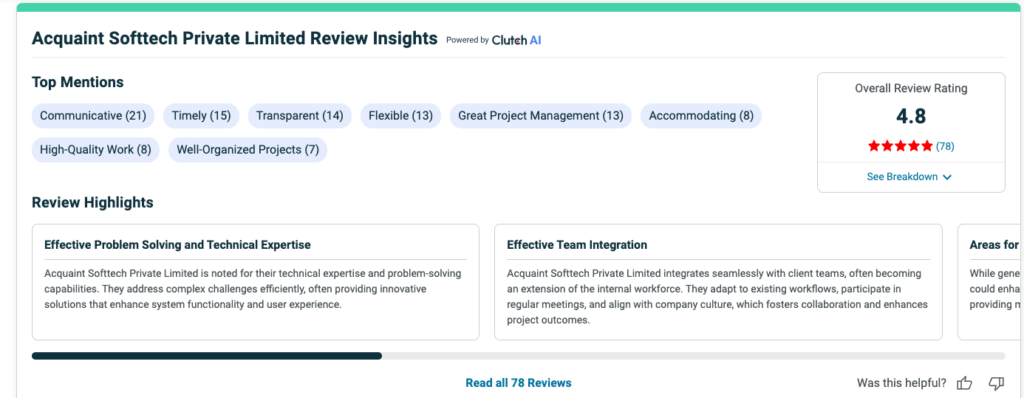
Clutch: 4.8 / 5
Acquaint Softtech operates primarily as an IT outsourcing and staff augmentation firm, delivering remote engineering teams rather than individual freelancers. The company targets startups, agencies, and mid-market businesses looking to outsource ongoing development work, serving as an offshore agency model rather than a self-service developer marketplace.
Source: Acquaint Softtech on Clutch
Tech talent pool
Acquaint Softtech provides software developers, QA testers, and project managers. Supported stacks center on standard web and CMS frameworks, including Laravel, React, Node.js, Python, and WordPress, along with general custom software and AI integration work.
What’s vetted?
The company conducts internal screening covering technical stack proficiency, English communication, and past project experience before placing developers onto client accounts. Rather than presenting a directory of vetted freelancers for direct hire, Acquaint Softtech manages the assignment process internally to assemble dedicated project teams.
How much do you pay?
Acquaint Softtech uses contract-based billing, offering full-time, part-time, or project-based rates depending on team size and scope. Pricing sits at standard offshore rates typically ranging between $25 and $49/hr, varying by developer seniority and required tech stack. Minimum commitments typically require full-time or longer-term contract engagements rather than hourly, single-task freelance work.
Toptal Competitors—by Cost, Time-to-Hire, and Tech Stack
Every platform in this list solves a different version of the same problem. The one that’s right for you depends on three things: how much you are ready to spend, how fast you need someone working, and how specific your stack requirements are.
If budget is your primary constraint
The most cost-effective options in this space are CloudDevs ($45–$100/hr) and Lemon.io ($60–$120/hr), both of which offer pre-vetted senior talent at rates well below Toptal’s $80–$220+/hr floor.
CloudDevs skews lower within that range and is worth considering if your stack is JavaScript-heavy and Latin American time-zone alignment matters. Lemon.io covers a broader range of stacks and seniority levels, including AI-assisted engineers and technical leads, with rates that reflect the match’s seniority and specialization.
If your work is project-based rather than ongoing—a specific integration, a front-end build, a code audit—Fiverr Pro sidesteps hourly billing entirely in favor of fixed-price packages, which can come in cheaper for tightly scoped deliverables.
Upwork offers the widest rate range of any platform ($15–$200+/hr) and gives you the most direct control over what you spend—but without vetting, the cost of a bad hire can easily erase whatever you saved on the rate.
| Platform | Rate range |
|---|---|
| Toptal | $80–$220+/hr |
| Gun.io | $80–$150/hr |
| Turing | $100–$200+/hr |
| Upwork | 🏆 $15–$200+/hr |
| Lemon.io | $60–$120/hr |
| CloudDevs | 🏆 $45–$75/hr |
| Fiverr Pro | Fixed-price packages, $500–$10,000+ per project |
| Acquaint Softtech | $25–$49/hr |
If speed to hire is your priority
Lemon.io is the fastest option for hiring a senior dedicated remote developer: the matching team presents 1–3 hand-picked candidates in under 24 hours. That’s not a shortlist to screen—it’s a deliberate recommendation with a written rationale, ready to start a conversation the same day.
CloudDevs follows closely and typically surfaces a match within 24–48 hours. Both platforms are meaningfully faster than Toptal, which averages 1–2 weeks from initial contact to first candidate.
For the absolute fastest possible turnaround—same day, no matching process—Upwork and Fiverr Pro let you browse, shortlist, and contract independently. The speed is real, but the quality guarantee isn’t. You’re moving fast because no one has done the screening for you.
| Platform | Time to match | Time to hire |
|---|---|---|
| Lemon.io | 🏆 Under 24 hours (avg) | 🏆 1–2 weeks |
| CloudDevs | Up to 48 hours | 1 week |
| Upwork | 🏆 Same day | Same day–1 week |
| Fiverr Pro | Same day | 🏆 Same day–a few days |
| Turing | 3–5 days | 1–2 weeks |
| Gun.io | 3–7 days | ~13 days |
| Toptal | 1–2 weeks | Weeks |
| Acquaint Softtech | 48 hours | 48 hours |
If you have specific needs related to the tech stack
Turing has the broadest raw coverage: 100+ tech stacks across a pool of 3M+ globally distributed engineers. If you need a combination of skills that’s hard to find—say, a backend engineer with deep Go experience and ML pipeline exposure—Turing’s scale gives it an edge in raw availability.
Lemon.io covers 100+ stacks as well, but from a curated pool of 1,500+ experienced developers whose work and communication style the matching team knows firsthand. That matters when the stack requirement is common, but the startup context is specific: a React engineer who’s worked on fast-moving consumer products behaves very differently from one who’s spent five years in enterprise software, and Lemon.io’s human matching accounts for that distinction.
CloudDevs is strong in standard full-stack web and mobile stacks—but has less depth in specialized areas, such as data infrastructure, and AI/ML.
Upwork technically covers every stack on the market, but the depth of the stack is a problem here. Finding a senior engineer with verifiable expertise in a niche technology requires significant screening effort on your part.
More on the topic of high-bar hiring: How to Hire the Right CTO to Meet Strategic Goals in 2026.
Lemon.io as a Smart Toptal Alternative for Startups: How to Get Started
Switching from Toptal—or skipping it entirely—doesn’t mean trading quality for speed. Lemon.io is built to give you both, with a process that takes days rather than weeks and a pricing model that doesn’t start charging before you’ve seen a single candidate.
Here’s how the process works:
Step 1. Share your hiring request
Register on Lemon.io and tell the matching team what you’re building, your tech stack, your product stage, and the kind of engineer you need—as an answer to our first email. The more context of the project needs you give, the more precise the match.
Step 2. Receive curated candidates to select from
You’ll get 1–3 hand-picked top-tier talent profiles with a written explanation of why each developer fits your specific situation. If none of them feel right, the team iterates.
Step 3. Interview & hire
Conduct a final fit-check call with a selected developer and confirm that you are ready to collaborate. Lemon.io handles contracts, NDAs, payments, and monitoring. And if the engagement isn’t working, Lemon.io replaces the developer at no extra cost, typically within a day.
Is that a meaningful difference from how Toptal works? Hit the request button and let us match you with developers ready to scale your growth and share your ambitions.