


If you’re a lead searching for remote developers, you’ve almost certainly landed on Upwork. And just as certainly, you’ve started wondering: is there something better?
You’re not alone.
In 2026, the freelance marketplace industry is expected to reach $455 billion, and a growing share of that market is flowing toward specialized, pre-vetted alternatives to the old bidding-based model.
One of these Upwork alternatives is Lemon.io—the marketplace for vetted senior developers where you find engineers with a startup mindset. And there are also others that work well for long-term or very specific tasks.
Explore our extended 2026 research and comparison below—we built it on personal experience, rates, terms, and user reviews.
Why Look for Freelance Platforms Beyond Upwork?
Upwork is the world’s largest freelance marketplace, with over 18 million registered freelancers and more than 800,000 active clients. That scale is impressive, but for founders who need to move fast and hire right, scale creates its own problems:
- The bidding system wastes your time
As the tech lead or CEO of a tech startup, you probably have more urgent things to do than wade through 40 bids, half of which are templated copy-paste pitches from contractors who haven’t read your job posting.
Besides, high-quality remote work senior professionals increasingly leave bidding-heavy platforms for vetted alternatives like Lemon.io, where their skills speak for themselves or are being actively hunted by tech staffing companies.
- The fee structure is too complex
As of May 2025, Upwork moved from a flat 10% freelancer service fee to a variable fee of 0–15% based on supply and demand for a given skill set. On the client side, Upwork charges a Marketplace fee of up to 7.99% on all payments. Business Plus clients pay 8–10%.
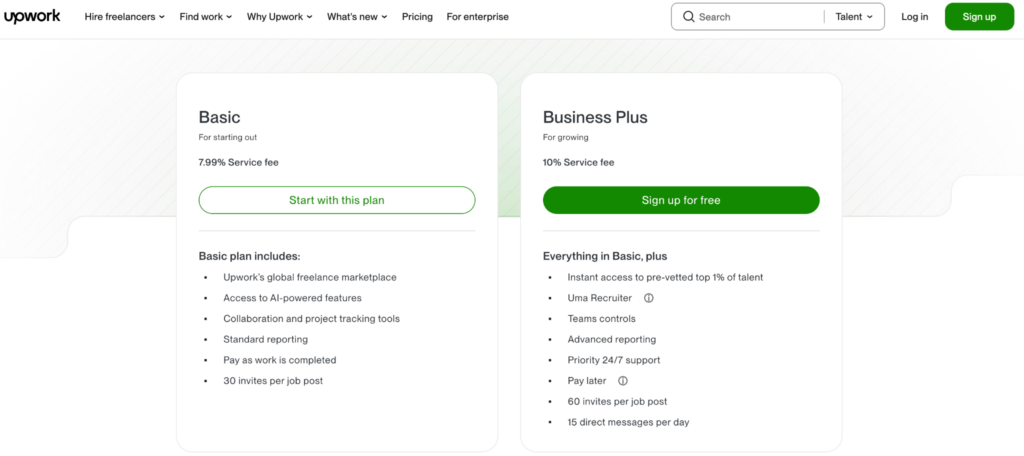
Source: Upwork pricing page
There’s also a per-contract initiation fee ($0.99–$14.99) every time you start a new engagement—even with someone you’ve worked with before. Hire five people, and those fees can add up fast.
When high service fees get passed back into freelancer rates, you’re often paying more than you realize.
- Scam risk is real, and support is slow
Upwork has ID verification and an escrow system, and those safeguards matter. But the sheer volume of users means you can still encounter unqualified contractors, ghost bidders, and support requests that take days or weeks to resolve—particularly when the problem falls outside their standard scripts.
There are genuine reasons to use Upwork: its vast talent pool, flexible hourly and fixed-price contracts, solid time tracking, and reliable payment protection via escrow.
For one-off remote jobs like content creation work, it remains a reasonable option.
But for architecture-level software development and precise quality work like web development with custom AI integration—where you need skilled professionals with the right skill sets, accountability, and fast onboarding—the freelance websites below consistently outperform it.
Hiring an AI talent? Check out our recent guide to navigate the market—AI Engineers: Who They Are & Whom You Need.
The Top 5 Upwork Alternatives: Vetting, Price, Client Support, and Specialization
| Platform | Best for | Vetting | Time investment | Support | Cost |
|---|---|---|---|---|---|
| Upwork | Diverse short-term tasks (tech, marketing, design, etc.) | None; rely on reviews | High. You screen, test, and interview | Self-service | Starts low + fees |
| Lemon.io | Fast-growing startups and long-term skilled tech hire | Rigorous; human-vetted: interview, tech task, background check | Low. Hand-picked matches within 24–48 hours | Success Manager | Dev-based. $55–$95/hr |
| Toptal | Enterprise budgets & years-ahead planning | Rigorous; live coding & test projects | Low. Match you with 1–2 final candidates | Matching Expert | Dev-based. $60–$200+/hr |
| Fiverr | Small tasks & fixed-scope “Gigs” | Basic; portfolio-based | Medium. Search-heavy | Ticket-based | Starts low; fixed-price |
| Freelancer.com | Bidding wars / Contests | Low; automated trust scores | High. Sorting through many low-quality bids | Support center | Starts low; competitive bidding |
| Guru | Long-term simple projects | None; identity verification only | High. Manual filtering | Basic account support | Low platform fees |
Lemon.io vs. Upwork. Best for hiring vetted senior developers
Since Lemon.io focuses exclusively on software development and web development, this comparison stays in that lane.
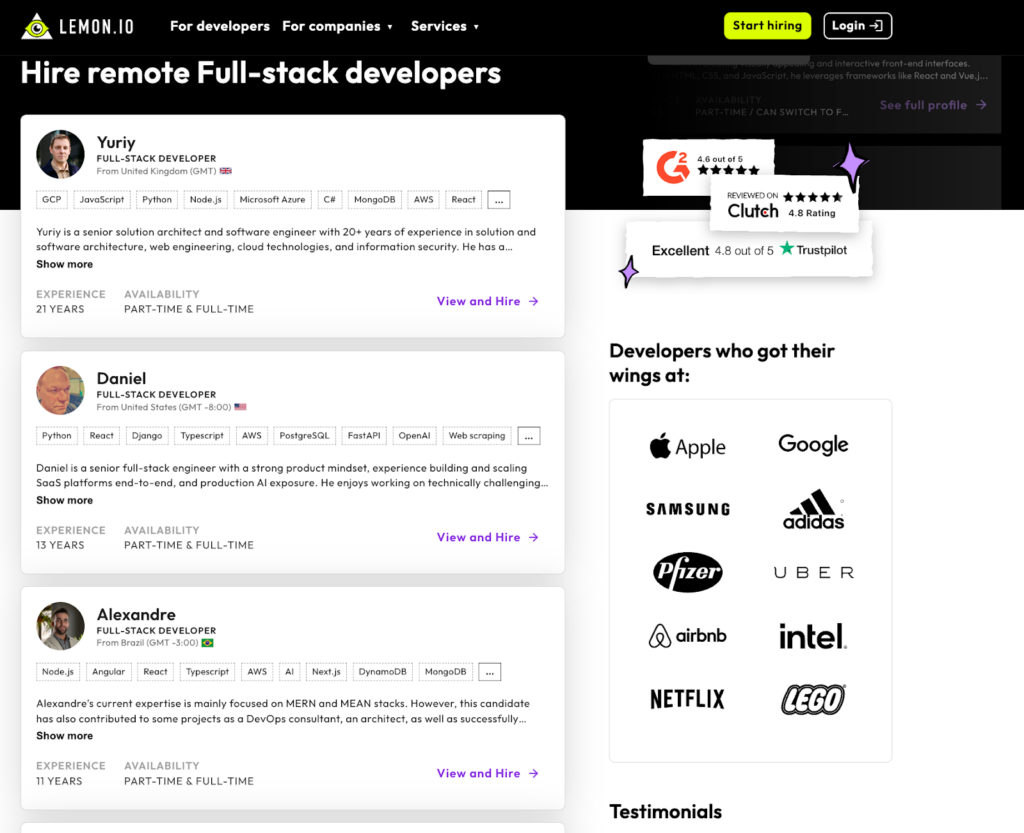
Source: Lemon.io website
Vetting & vetted talent quality
Lemon.io is a platform for finding vetted senior developers for remote teams. Every engineer on the platform has passed a multi-stage screening process:
- General background check
- Technical skills assessment
- Test assignment
- Live interview
Only a small fraction of applicants make it through. The result is a curated pool of freelancers, not an open directory. When startups and SMBs use Lemon.io to find developers, they access remote talent that has already been pre-vetted for quality, not whoever submitted the lowest bid.
Upwork, by contrast, operates on a bidding system with no vetting process. Any registered contractor can apply to your job listing. You’re responsible for screening candidates yourself, which can turn a hiring process into a second job.
Speed and matching
Lemon.io matches clients with developers typically within 24 hours. You describe your project requirements, our team finds the best match from our pool of candidates, and—here’s the stat—98% of Lemon.io clients hire the first developer they’re suggested.
There’s no bidding, no back-and-forth negotiation, no prolonged onboarding. Moreover, the curated candidate pool of Lemon.io is open, and you can filter it by tech stack or role. If you have spotted someone who is your perfect fit, we will handle the contract process immediately.
On Upwork, finding the right developer can take days or weeks of manual screening—reviewing profiles, sending messages, and chasing responses. Some teams also try to speed up sourcing by using email lookup tools to reach developers directly before posting a listing. This can help, but it adds overhead. Pre-vetted platforms eliminate that step entirely.
Pricing
Lemon.io predominantly works with European and Latin American developers, delivering a strong price-to-quality ratio—comparable output at rates more competitive than many premium freelance platforms.
Pricing is transparent, with no surprise platform fees added.
Upwork rates vary enormously. The platform’s global talent pool includes developers across a huge range of hourly rates, but “cheap” doesn’t mean “qualified.” Factor in Upwork’s variable service fees and contract initiation costs, and your effective spend is often higher than the quoted rate.
Security and IP protection
Every engagement on Lemon.io includes an NDA with the individual developer, and project data is encrypted. For teams sharing access with remote developers, using a 1Password alternative can also help keep system credentials secure.
For startups building proprietary products, that contractual protection matters. Lemon.io also functions as an active mediator in disputes—not a passive support ticket queue.
Upwork’s escrow protects payments, but it doesn’t automatically protect your code, your IP, or your timeline. And if a dispute ends up in Upwork’s hands, resolution tends to favor the platform’s policies rather than your specific situation.
Customer support
Lemon.io’s support model is proactive: the goal is to prevent problems from arising, not to handle them reactively. If an issue does occur, the platform steps in as a mediator.
Upwork’s support is notoriously slow and script-dependent for anything outside common issues. This is a known pain point, especially for clients running complex software development projects.
The verdict: For hiring senior remote talent like full-stack developers or game developers to build or scale a tech product, Lemon.io beats Upwork on every dimension that matters: speed, quality assurance, security, and support. When you’re building something that needs to work, Lemon.io’s pre-vetted pool of freelancers is a faster, more reliable option than Upwork’s bidding system.
Toptal vs. Upwork. Good for enterprise-level budgets
Toptal is often cited alongside Lemon.io as one of the top Upwork alternatives for software development. The platform claims to accept only the top 3% of applicants through an intensive vetting process, and its talent pool includes developers, designers, and project managers across a wide range of industries.
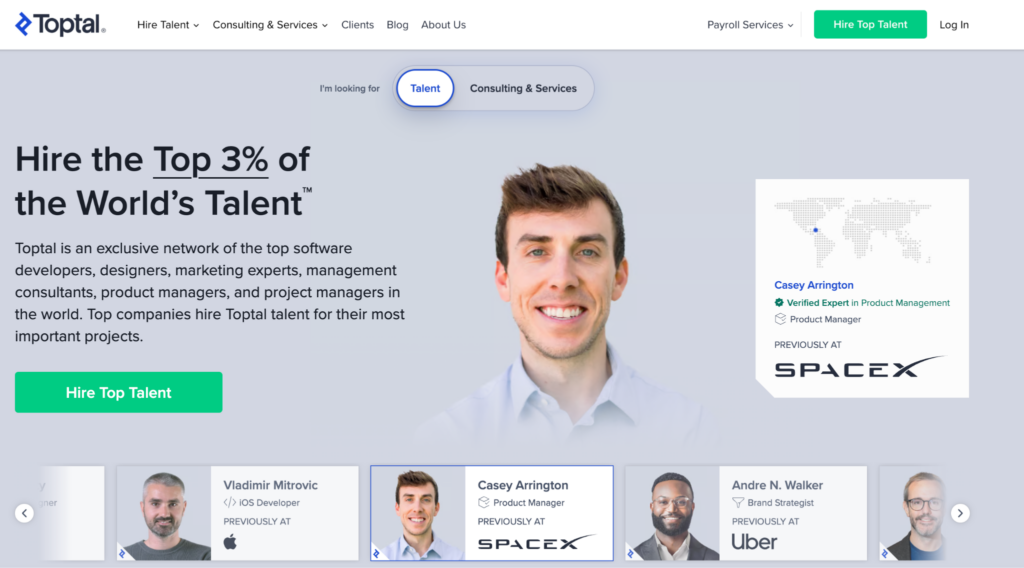
Source: Toptal website
The key difference is positioning and price.
Toptal targets enterprise clients and long-term engagements, with typical developer hourly rates running to $220+. If you have a substantial budget, a complex project, and need senior talent immediately, Toptal can provide it.
If you’re an early-stage startup, the pricing model may feel out of reach. Toptal also doesn’t let you browse freelancer profiles independently—the platform handles matchmaking for you based on your project brief.
Compared to Upwork, Toptal’s vetting process eliminates the quality lottery you face with Upwork’s bidding system. However, you don’t have access to the candidate pool, and if you don’t like the candidates suggested by the platform, you lose.
Fiverr vs. Upwork. Best for design, media, and short-term gigs
Fiverr is built around task-based, fixed-price gigs—sellers list specific services (logo design, voiceover work, video editing, content creation, animation) at set prices, and buyers purchase them directly without a bidding system.
It’s one of the most user-friendly freelance websites for short-term, project-based work outsourcing.

Source: Fiverr website
Fee structure
Fiverr charges sellers a flat 20% commission on all earnings—no volume discounts, no tier reductions. This applies to every gig, including tips. Buyers pay an additional 5.5% service fee on purchases over $50, plus a $2–$3 small order fee for orders under $50.
The effective take rate for sellers ranges from 24% to over 35% when withdrawal fees are factored in.
Upwork’s current fee structure for freelancers is variable: 0–15% depending on supply/demand factors for specific skill categories, averaging around 10–12% for most contractors. Clients pay 3–7.99% depending on plan type.
Despite Upwork’s complex fee structure, the average effective rate for freelancers is lower than Fiverr’s flat 20%.
What does Fiverr do well?
Creative and digital work—particularly graphic design, logo design, media production, digital marketing assets, SEO boosts, and other types of content creation—is where Fiverr’s gig model shines. The platform’s structured pricing makes it easy to compare options and manage revisions without lengthy negotiation. A close alternative to Fiverr for design tasks is 99designs.
Where Fiverr might fail
Software development and web development on Fiverr is hit-or-miss. The gig model isn’t well-suited to complex, iterative engineering work, and the absence of a serious vetting process for technical skills means quality is inconsistent.
The verdict: Fiverr wins for design tasks, media work, and short-term creative projects. For anything that requires sustained software development effort, consider Lemon.io instead.
Guru vs. Upwork. Worth knowing, but not the first choice
Guru has operated since 1998 and offers a full-featured freelance marketplace covering web development, software development, design, writing, digital marketing, and more.
Its standout features include WorkRooms (a built-in collaboration workspace for remote teams), multiple payment options (fixed-price, hourly rate, task-based, and recurring), and SafePay—an upfront payment protection system that requires funds to be deposited before work begins.
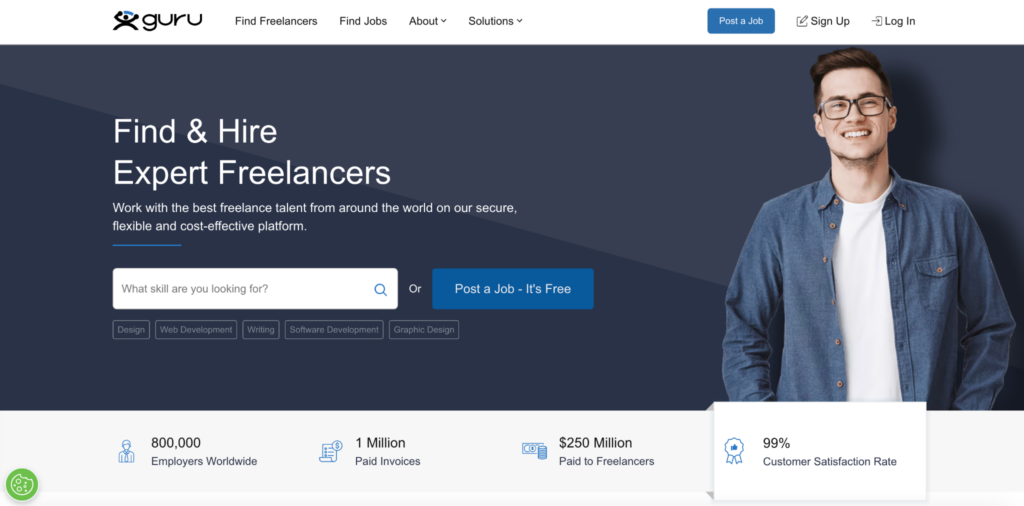
Source: Guru website
How does SafePay work?
Clients upload funds to a SafePay account before a contractor starts work.
When work is completed, the contractor invoices and the client releases payment. This is similar in principle to Upwork’s escrow system, though some user reviews suggest SafePay has more gaps in scam protection.
Where Guru falls short
Guru’s reputation on independent review platforms is mixed, despite being one of the oldest Upwork competitors. The platform allows freelancers to remove negative reviews from their profiles for a fee—a transparency issue that can distort the vetting signal you’d expect from contractor ratings.
Compared to other freelance marketplaces on this list, Guru’s quality control is weaker.
Guru offers a more flexible fee structure than Upwork: fixed-price projects are charged 3% or $3 (whichever is greater), and hourly projects incur a 3% fee.
But lower platform fees don’t compensate for a weaker talent pool and a rating system that can be gamed.
The verdict: Guru isn’t a bad platform—it has survived for over 25 years for a reason—but for startups and entrepreneurs focused on software development quality, Upwork outperforms it on reliability and payment transparency.
It’s a reasonable fallback if you need a wide range of services and want flexible payment options, but it’s not the first place we’d send a tech founder.
Freelancer.com vs. Upwork. Familiar model, familiar limitations
Freelancer.com and Upwork share more DNA than they’d probably like to admit. Both are large, bidding-based freelance marketplaces covering virtually every category of work, from software development and web development to graphic design, virtual assistant services, and digital marketing.
Both attract an enormous pool of freelancers, which means both share the same challenges: intense competition that drives prices down, inconsistent quality, and mediocre customer support.
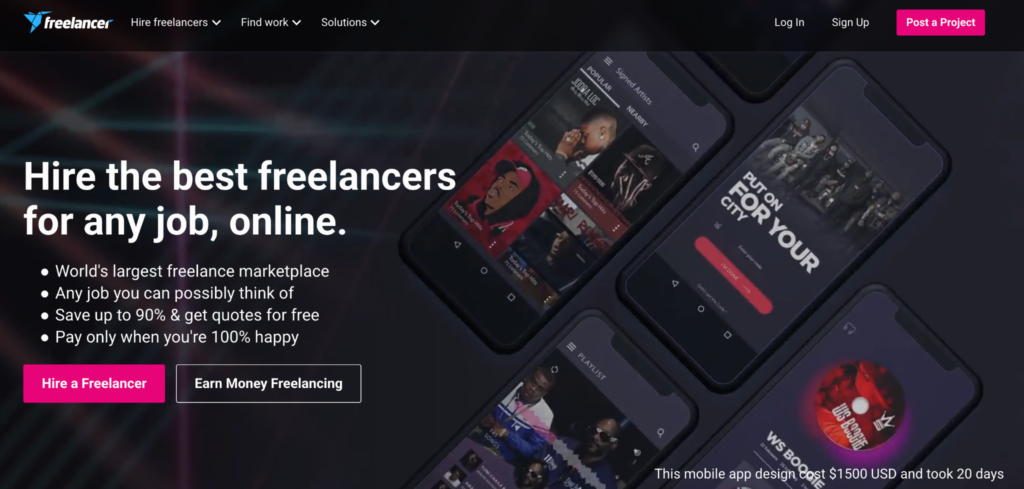
Source: Freelancer.com website
Key differences
On Freelancer.com, client fees are 3% or $3 (whichever is greater) for fixed-price projects and 3% on hourly contracts. Freelancer charges sellers a flat 10% or $5, whichever is greater.
Upwork’s client-side fee (3–7.99%) and variable freelancer fee (0–15%) are comparable in structure, though Upwork’s overall product—including its interface, ID verification, and payment protection—tends to be more polished.
Freelancer.com has a live chat feature that Upwork lacks on standard plans, which is a minor but real usability win. Upwork’s interface is cleaner and more user-friendly overall, particularly for clients new to hiring freelancers.
The verdict: Upwork is the more reliable of the two, largely because of its better ID verification, escrow system, and overall platform maturity. If neither platform fits your needs, it’s worth exploring the pre-vetted Upwork alternatives—Lemon.io in particular for software development—rather than bouncing between two similar bidding platforms.
Freelance platforms don’t feel like your perfect hiring solution? Check out our article on Wellfound and its alternatives to hire top devs.
2026 Landscape: What’s Changed in Freelance Marketplaces in Recent Years
The freelance economy has grown significantly more sophisticated. AI-powered matching, polished vetting pipelines, and subscription-based talent models are reshaping how businesses access remote talent.
A few things worth knowing for 2026:
- Variable fees are becoming the norm
Upwork’s May 2025 shift to dynamic freelancer fees (0–15%) was a significant structural change. The old tiered model—20% on the first $500, 10% on the next $10K, 5% above—is gone for new contracts.
Fees are now set per-contract based on market dynamics, creating unpredictability for both freelancers and clients whose quotes absorb those costs.
Pricing example: 2026 full-stack engineer cost comparison
| Platform | Average (hourly) | Annualized (full-time)* | Cost structure |
|---|---|---|---|
| Freelancer.com | $30–$85 | $57k–$163k | High bid volume drives prices down |
| Guru | $35–$90 | $67k–$172k | Lower overhead; good for long-term maintenance |
| Upwork | $45–$130 | $86k–$250k | Rate varies wildly; includes a 3–5% client service fee |
| Fiverr | $50–$120 | $96k–$230k | “Fiverr Pro” is comparable to mid-market freelance rates |
| Lemon.io | $60–$110 (dev subscription) | $115k–$210k | Focused on Eastern Europe/LATAM; transparent hourly pricing |
| Toptal | $120–$220+ | $230k–$420k+ | Includes a heavy markup (30–100%) |
*Annualized based on 1,920 billable hours (48 weeks at 40 hrs/wk).
- Pre-vetted platforms are outperforming general marketplaces for technical hiring
For startup founders who need to ship product, the time cost of screening unvetted candidates is too high.
Platforms like Lemon.io—where every engineer, including complicated roles like AI developers, has cleared a multi-stage vetting process before you ever see their name—eliminate that overhead entirely.
- Latin American and Eastern European talent is increasingly in demand
Time zone alignment, strong engineering training, and competitive hourly rates make these talent pools attractive for US and Western European clients. Lemon.io’s developer network, spanning Europe and Latin America, reflects this trend.
- Platform diversification is a real strategy
The most sophisticated hiring teams in 2026 don’t rely on a single freelance marketplace. They use a vetted platform like Lemon.io as their primary source for software development, supplementing with a general marketplace for one-off tasks, and maintain direct relationships with contractors for long-term work.
Who’s the Best Global Upwork Alternative for Your Business Needs?
It depends on what you’re building and what your business needs are—but for the founders and tech leads reading this, here’s the short version:
For software development and web development. Lemon.io is the best Upwork alternative for startups and small businesses that need pre-vetted senior developers fast.
While Upwork requires you to wade through dozens of bids and screen candidates yourself, Lemon.io delivers a product-oriented developer that fits your tech stack in 24 hours from a pool of freelancers that’s already been tested.
And unlike Upwork’s bidding system—which rewards the lowest bid, not the best skill set—Lemon.io’s screening process is built around quality and niche engineering expertise.
For design and media work. Fiverr remains a solid choice for task-based creative work, such as logo design, video production, graphic design, and content creation. Just be aware of the 20% seller fee and the buyer-side service charge at checkout.
For flexible all-category hiring. Guru (and PeoplePerHour as a close alternative) offer reasonable options with different fee structures and payment options, though neither matches the quality assurance of a fully pre-vetted marketplace.
More time-saving hiring insights here: Founder’s Guide to Hiring Software Developers in the 2026 AI Surge.
Hire a Developer with Lemon.io Safely
If you’ve been burned by the hiring process on Upwork—slow matches, inconsistent quality, support that feels like shouting into a void—there’s a better way.
Lemon.io, the marketplace for vetted senior developers, was built specifically for startups and growing tech teams that need the right developer who fits values, stage, and stack now, not eventually.
With Lemon.io, you get a pre-vetted candidate in 24 hours, a developer who’s already been tested on real assignments, full NDA coverage, and a support team that is instantly here for you. In other words, we are a freelance platform that removes the friction from remote hiring without removing the quality.