


Don’t let the same abbreviation fool you: one Chief Technology Officer (CTO) might be there to build from scratch, while another is there to scale what’s already broken.
This Lemon.io article will give you clear instructions on how to hire a CTO by exploring the following:
- CTO types depending on company needs
- CTO’s most critical skills and responsibilities
- How to evaluate CTO candidates in 2026 with clear red and green flags
- How AI-savvy a CTO should be today
What type of CTO do you need? 6 heroes to drive your business story
CTOs aren’t created equal. They vary in skills, qualifications, and, most importantly, experience.
Drawing on our real collaboration with various CTOs, we’ve composed a classification that resembles how CTOs can help you achieve your business objectives or solve pressing issues.
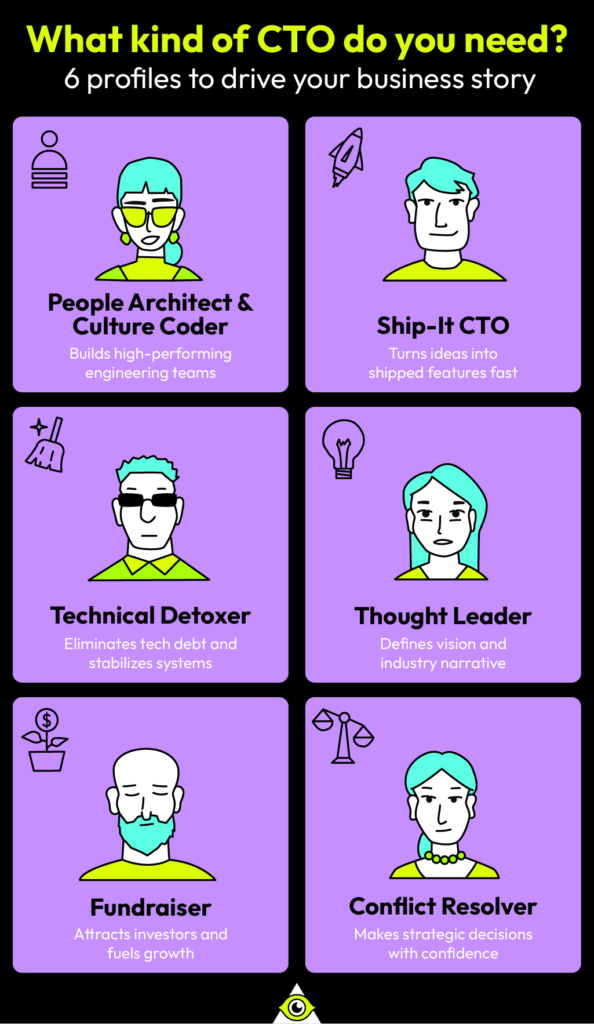
The People Architect and Culture Coder
Although godlike technical skills are a must for a CTO, they can also focus on expanding your engineering team, improving team relationships, and maintaining a competitive engineering culture. In fact, 65% of European CTOs aren’t considering technical decision-making as their top priority anymore, giving even higher preference to operational and strategic responsibilities.
For instance, Greg Grockman, the current President of OpenAI, back in his Stripe days as a CTO, paid close attention to 1-on-1s with engineers, hiring process, onboarding new hires, and building the company’s cultural strategy. This paid off with a rapid team growth, from 5 to 250 employees.
This kind of CTO becomes valuable when they create an environment where engineers become productive faster, stay longer, and consistently deliver results. Instead of constant rehiring and onboarding chaos, the company gets a stable, scalable team that can support product growth without slowing down.
When to choose: Look for a “people architect” CTO if you need to scale your team quickly, effectively manage remote developers, retain the most efficient engineering talent, and ensure new hires can start delivering value quickly.
How to spot: Exceptional communication skills, as well as positive team growth and management results in the portfolio.
The Ship-It CTO
Your product team is constantly firefighting, and without a competent leader, that’s becoming a blocker for feature velocity and a dealbreaker for investors. That’s exactly the reason to hire a highly proficient technical CTO who can conduct root cause analysis to discover core bottlenecks in your delivery pipeline, make strategic moves in team reorganization, and tech stack.
Potential use case
For example, your backend runs on Node.js with services in Docker on Kubernetes, but releases keep breaking due to weak CI/CD in GitHub Actions and poor visibility in Datadog. A strong CTO could fix the process, bringing structure, ownership, and predictable delivery.post
When to choose: If your purpose is rapid product growth and development with fewer people, but higher efficiency.
How to spot: Some of their proudest moments include the on-time launch of fast-paced projects.
The Technical Detoxer
Drowning in technical debt is a common story for many startups and SMBs, and hiring a competent CTO can surely be a possibility to recover from its never-ending cascade.
Let’s compare two hypothetical companies with different attitudes towards tech debt and see which outcomes they can hope for.
| Factor | Company A: Invests in a strong CTO to tackle tech debt | Company B: Postpones tech debt remediation for later |
|---|---|---|
| Approach to tech debt | Gradual, structured remediation aligned with the roadmap | Ignored or patched with quick fixes |
| Delivery speed | Slows briefly, then stabilizes and accelerates | Initially fast, then increasingly chaotic and delayed |
| Engineering productivity | Engineers spend more time building new features | Up to ~30%+ time lost fixing legacy issues |
| Architecture | Moves toward modular, scalable systems (e.g., cloud, DevSecOps) | Becomes fragile, tightly coupled, hard to change |
| AI and innovation adoption | Able to integrate AI and modern tools effectively | Blocked by poor data quality and legacy constraints |
| Investor perception | Seen as a scalable, future-ready business | Seen as risky, with hidden technical liabilities |
| Long-term outcome | Predictable growth and higher valuation | Slowing growth, rising costs, potential rewrite or failure |
When to choose: If your current goal is tech stack and software modernization. Or you need to change the way you work, but the piled-up tech debt is restraining growth.
How to spot: The Technical Detoxer has a problem-solving mindset, evident in every decision they make. For instance, you can create a test task for a potential candidate to evaluate whether and how to introduce AI into an unstable product without making things worse, and then assemble an AI engineering team.
The Thought Leader
Hiring a CTO with thought leadership social media accounts can be a game-changer for your company if you aim to boost brand awareness. Such a CTO can promote your company’s services through their social media, thought leadership articles, and active networking at conferences.
That’s exactly the case with Dharmesh Shah, HubSpot Founder and CTO. He follows the “radical transparency” approach in everything he does, especially in sharing his practices at work, real experiences with new technologies, and most importantly, valuable hands-on guidance on how to bootstrap and scale businesses.
When to choose: If you want to attract investors and strong engineers through visibility and credibility, choose a Thought Leader CTO with real authority and experience.
How to spot: A large followers’ base on LinkedIn, X, or Reddit with consistent engagement. Regular posts or articles with their real experiences, best practices, and even predictions about the impact of AI on the software development world.
For example, in this video, Stephan Schmidt, a CTO at the Amazing CTO, predicts that AI will completely replace software in the future and will be capable of completing any job to be done. This view may be controversial, but it indicates strong analytical skills and market understanding, which are crucial for the Thought Leader CTO type.
The Fundraiser
Another option for which you might need a CTO is attracting extra investment, particularly if you’re an early-stage startup.
A strong technical leader can become a signal to investors that your company has moved beyond the ideation stage and is ready to become a scalable, well-thought-out business with a clear technical vision. Such CTOs know how to present their architecture, roadmap, and risks in a way that builds confidence and reduces perceived uncertainty.
When to choose: If your business is currently struggling with attracting worthwhile investors, the new CTO can help you fix that.
How to spot: Experience in fundraising processes, participation in investor meetings, and ability to clearly explain complex technical decisions in simple business terms.
The Conflict Resolver
The least obvious CTO type, but they can also be a possibility to differentiate in the technical market. You can use a CTO as a political instrument, whether the battlefield is outside the company (clients, investors, competitors) or inside it (warring departments, an overreaching engineering lead, a board that doesn’t trust the current tech team).
A great CTO can bring clarity, authority, and alignment where there was none, making tough calls, setting boundaries, and helping everyone move in the same direction again.
When to choose: If your company is facing internal misalignment and conflicting priorities. For instance, a product team expects rapid MVP deployment, while engineers realize that they need more time and effort for code refactoring to ensure stable performance under high load. The competent CTO can pitch to the product team and stakeholders the engineers’ appeal and translate into business terms the potential risks of rapid deployment.
How to spot: Strong presence and confidence in decision-making, ability to handle conflict without escalating it, and a history of leading teams through challenging or ambiguous situations.
This classification isn’t rigid, and the CTO’s role can evolve or transform into something unique for your company.
How to hire a CTO: Timing, format, and cultural fit
Now that we know how to differentiate between CTOs, we can move on to their hiring approaches and costs.
Matching the CTO profile with the company’s growth stage
In the real world and at different company growth stages, CTO types can intersect, but you can rarely find a person who fits into all six profiles. Whether you’re hiring a CTO for a startup or an SMB, check out the table below.
| Model | Core responsibilities | Level of involvement | Best use case | Cost range (monthly median) |
|---|---|---|---|---|
| Full-time CTO | Owns end-to-end tech strategy, architecture, team scaling, delivery, and long-term roadmap | Deep, hands-on, and strategic | Scaling startups, complex products, investor-backed growth | $12K–$30K+ |
| Part-time CTO | Oversees architecture, guides team, supports key decisions, and has limited execution involvement | Moderate (a few days/week) | Early-stage startups that need guidance, but not full leadership | $5K–$15K |
| Fractional CTO | Solves specific problems (audit, scaling, AI adoption, restructuring), sets direction without ongoing ownership | High-impact, short-term, or periodic | SMBs/startups with specific bottlenecks or transition phases | $3K–$10K |
How to evaluate a CTO: Green and red flags to look out for
Instead of listing abstract CTO skills, let’s focus on how those skills show up in real decisions and behavior.
| Area | 🟢 Green flags | 🔴 Red flags |
|---|---|---|
| Technical judgment | Explains trade-offs clearly; chooses “good enough” solutions when needed | Pushes for overly complex solutions without business justification |
| Execution mindset | Focuses on delivering outcomes, not just ideas | Talks strategy but lacks examples of shipped products |
| Scalability thinking | Adapts architecture to the current stage; plans without overbuilding | Either ignores scalability completely or over-engineers too early |
| Leadership | Builds strong teams, mentors engineers, delegates effectively | Micromanages or refuses to let go of coding when the team grows |
| Business understanding | Connects tech decisions to revenue, cost, and growth | Sees engineering as isolated from business goals |
| Risk management and security | Understands real-world risks (data, infrastructure, compliance) and builds security and reliability into the system early | Treats security controls as a secondary concern |
| Communication | Can explain complex topics to non-technical stakeholders clearly | Uses jargon, avoids clarity, or struggles with stakeholder alignment |
| Hiring ability | Has a track record of building high-performing teams | Relies on credentials over practical ability when hiring |
| Adaptability | Comfortable with ambiguity; adjusts quickly to change | Rigid thinking relies on “how it was done before.” |
| Ownership | Takes responsibility for failures and learns from them | Blames the team, market, or external factors |
| Track record | Can point to measurable impact (growth, scaling, delivery improvements) | Vague experience without clear outcomes or metrics |
Non-obvious CTO responsibilities in modern dev projects
A modern development project combines multiple layers, product, infrastructure, data, and increasingly AI engineering, all of which need to work together without slowing the team down. And CTOs are spinning many plates across all those layers when they stay inside their technical bubble.
But what responsibilities do they have once they need to step out of that bubble?
Cross-department collaboration and CoE management
A large part of a CTO’s responsibilities involves collaborating with other C-levels, such as CEOs, COOs, CFOs, CISOs, and CMOs. And, for instance, CTOs have to understand how to translate the CEO’s requirements into technical specifications for their team.
Apart from that, CTOs can also stay in contact with the sales and product management teams to directly impact customer engagement and ensure that the technical side of things aligns with what sales managers are pitching and marketing teams are promoting. That’s how cross-departmental synergy is achieved in the technical world.
Establishing and managing centers of excellence (CoEs) is also a possible CTO responsibility, offering an efficient way to accumulate best practices and knowledge bases in a given domain or technology. For instance, an AI CoE can become a true differentiator for your company.
Budget, tooling, and vendor decisions
A CTO plays a central role in how an engineering budget is spent and whether it delivers value. This includes deciding where to invest (infrastructure, tools, and people) and where to hold back to avoid unnecessary complexity or long-term costs.
CTOs evaluate tooling with a clear understanding of trade-offs: build vs. buy, speed vs. flexibility, and short-term gains vs. long-term maintenance. They decide which technologies and languages to use for the back end and front end. Which architecture type, monolith or microservices, would be most appropriate and cost-effective for the company?
A strong CTO ensures that external dependencies don’t become bottlenecks, negotiates contracts with cloud and API providers, and chooses FinOps tools for cost management with timely alerts on budget spikes to keep cloud spending in check.
Team composition is also a major factor in budget allocation for engineering teams. CTO helps businesses define whether they need to hire in-house QA engineers, full-stack developers, or separate front-end and back-end programmers specialized in particular languages like React for front-end and Rust or Node.js for back-end.
In practice, all of these responsibilities mean:
- keeping the tech stack lean and removing redundant tools
- controlling cloud and SaaS costs before they spiral
- choosing tools that improve delivery speed
- making sure every technical expense or hire has a clear business justification
Why experience with the modern AI stack is a huge part of the CTO role in 2026
Using AI in 2026 isn’t about applying it to random projects and treating it as yet another add-on to the tech stack. It’s a different approach to product development and management altogether.
Business concerns with AI
CEOs today are getting afraid of losing their businesses to AI. A Salesforce survey found that 49% of SMBs are worried about being left out.
A lot of products and services are threatened to be substituted by AI in the coming years. Investors expect everything to be AI-powered, and the web is full of stories about autonomous coding agents.
To help reduce the tension around AI, top-tier CTOs can make strategic decisions about where AI solutions:
- would make the most business impact
- shouldn’t be implemented at all (e.g., regulated industries), and suggest how else businesses can differentiate in the market
- should be postponed for later or researched more
- should be deployed: in the cloud or on physical servers
Another big concern is security. AI can create security threats that didn’t exist 2 years ago. All this puts a lot of pressure and expectations on CTOs.
So, the goal of a CTO is to orchestrate the threats, expectations, and possibilities around AI, communicate them to all business sides, and react to changes fast.
Managing AI risks and opportunities
AI management is becoming the most sought-after expertise, with business leaders asking for developers and tech leaders not only well-versed in certain programming languages or frameworks, but also in AI management tools.
The real request from one of the Lemon.io clients was for an expert experienced in Langfuse. It was necessary to trace LLM interactions, analyze outputs, and evaluate AI model performance over time.
Other similar AI management tools include Datadog, Sentry, and New Relic, which are originally traditional observability platforms used to monitor backend services, APIs, and infrastructure, but today they also include AI-driven features like anomaly detection, root cause suggestions, and automated insights.
Kenza Ait Si Abbou, the CTO and a board member at Fiege, shared his hands-on experience with AI management, which was particularly difficult for him from the people management point of view:
People often think AI is like science fiction due to media hype, expecting plug-and-play solutions. However, AI requires significant customization and training with your own data. Managing these expectations is challenging.
CTOs skilled in AI management can think and plan big because they now have answers to what was considered impossible before the AI era.
Hire a CTO via Lemon.io
A CTO is a top-level role that defines your product’s delivery speed and scalability. For instance, if you’re building a fintech or healthcare product, Lemon.io can prioritize candidates with experience in payment infrastructure, KYC flows, or HIPAA compliance and health data management to speed up onboarding.
We write a job description and conduct a structured interview process that includes soft skills and technical assessments. You only meet pre-vetted candidates who match your requirements and have experience working with US or Western European markets.
Here’s what differentiates us from other vendors in such a responsible task as CTO hiring:
- A large network of senior technical leaders within a reach of one Slack message. There can be either your next CTO or a recommendation for the right fit.
- A time-tested framework for evaluating C-levels, which consists of both a hard and soft skills grading system.
- Test task templates that check seniority levels, place CTOs in real-life scenarios, and check their decision-making style under pressure.
- Custom AI evaluation system to define the level of experience with the modern AI tools.
Recruiting a CTO with an external partner might feel unusual, but handling the search and vetting yourself is far more demanding. Share what you’re looking for, and we’ll help you find the right person faster and easier.