

With tech turnover rate sitting at 13.2% (well above the 10.5% cross-industry average), today’s startups can’t afford weak hiring. And that’s where “quality of hire” (QoH)—how you define it and measure—becomes critical.
At Lemon.io, we’ve turned the talent acquisition process into a science. Read on as we look behind the scenes at how to build a data-driven tech hiring system and improve your pipelines.
Lightweight Post-Hire Candidate Evaluation Framework
The first months of a new hire’s tenure are the make-or-break period. Watching this window closely answers several questions at once: whether you’ve built a strong hiring system, whether your onboarding works, and whether your remote team management runs smoothly instead of becoming a blocker. Altogether, this knowledge helps you polish your talent acquisition strategy.
Checkpoint |
What to measure |
Target (norm) |
|
|---|---|---|---|
1 day, week 1 |
Setup |
Access checklist, written trial-period goals, task assigned |
No blockers |
3 day, week 1 |
First commit |
Time-to-first-commit |
Commit by working day 2–3 |
5 day, week 1 |
1:1 + first PR opened |
Blocker resolution time; PR cadence starting |
First PR opened; blockers resolved <48h |
10 day, week 2 |
First PR merged |
Time-to-first-merge; review rounds per PR |
First merge; <2 rounds |
15 day, week 3 |
Peer pulse #1 + pre-gate prep |
3 questions to 2–3 teammates, rated 1–5; joint review of day-1 goals |
Average >4; no single score <2; sides aligned on gate criteria |
20 day, week 4 |
PROBATION GATE |
Merged/opened PR ratio; stories shipped; manager rating; hire’s experience |
Ratio >80%; >1 user story in production; rating >4/5 |
25 day, week 5 |
1:1 |
Routine check-in; PR cadence |
Steady 2–4 PRs/week |
30 day, week 6 |
Independence check |
End-to-end task ownership |
Owns a task solo with light supervision by working days 22–30 |
35 day, week 7 |
1:1 |
Routine check-in |
Cadence stable |
40 day, week 8 |
Full review + verdict |
All metrics vs day-1 goals; peer pulse |
Every metric green or explained; pulse > 4/5 |
Let’s see why those parameters matter to you.
Time-to-productivity (ramp-up rate)
Measured as three milestones: first commit, first merged PR, and first independently delivered task. Norms for a senior developer joining a small startup codebase:
- First commit by day 2–3
- First merged PR by day 10–14
- First solo-owned task by day 30–40
If the first commit slips past day 5, the problem is almost always your onboarding (access, docs, unclear first task), not the hire, which is exactly the diagnostic value. As a first-time hiring manager with 1–3 reports, this is your single most informative early number.
How to track: All three milestones are timestamps, so a tracking spreadsheet works fine for 1–3 hires—just log the dates. Waydev automates this comparison against your team’s historical baseline; Jellyfish does the same at the scale of 50+ developers.
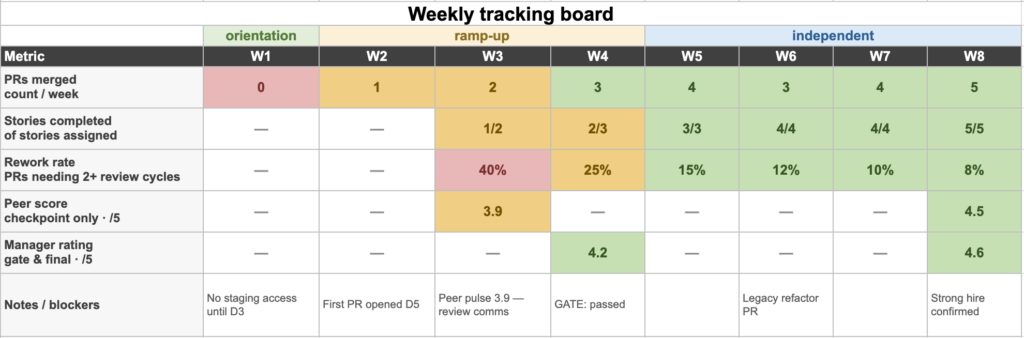
Example of a weekly tracking board that hiring managers can use
Blocker resolution time (onboarding health)
Any access issue, unclear expectation, or environment problem raised in a weekly 1:1 gets resolved within 48 hours. This mirrors the structured check-in approach from your source material.
Norm: zero open blockers older than two days.
It matters because in a remote setup, a silent, blocked developer looks identical to a slow one — this metric protects the hire from being unfairly judged on your infrastructure gaps.
How to track: No automation needed—a “notes/blockers” row in your tracking sheet with the date raised and date resolved. If you adopt Lattice, its 1:1 agenda templates keep blocker follow-ups from silently dying between meetings.
PR cadence—opened PRs
Steady norm after week 2: roughly 2–4 PRs per week, with PRs small enough to review in one sitting. Very low cadence signals struggle or over-scoped work; giant infrequent PRs signal a working style that will hurt a small remote team. It matters because cadence is the cheapest continuous signal of engagement you can pull straight from GitHub with no process overhead.
How to track: GitHub and GitLab show this natively for free (Insights → Pulse / Contribution analytics). Waydev turns the same data into per-developer trend lines; at 1–3 hires, a Friday glance at the repo is honestly enough.
Merged-to-opened PR ratio + review rounds
Norm: at least 80% of opened PRs merged, and no more than about 2 review rounds per PR by weeks 3–4 (3+ rounds early on is fine while learning conventions). A persistent gap between open and merged means code is stalling in review—either due to quality issues or architectural misalignment.
How to track: Manually, two GitHub search filters (is:pr author:X is: merged vs is: open) give you the ratio in seconds. Waydev is the first tool worth paying for here—it automatically surfaces rework rates and long review cycles, which are exactly the metrics.
Delivered user stories
Norm: at least 1 small user-facing story or bug fix shipped to production by day 30, and contribution to normal sprint scope by day 40.
This shifts evaluation from activity to outcome — a hire can have a healthy PR cadence while shipping nothing a user notices.
For a startup, this is the earliest honest link between top performers and business value; heavier ROI metrics (infra savings, revenue impact) are real but lag by quarters and aren’t measurable at day 40.
How to track: Your task tracker already counts this—a Jira board filtered by assignee and “Done in production” status. Copy the number into the weekly tracking sheet; Jellyfish adds the layer of tying those stories to business allocation, but that only pays off at scale.
Peer pulse (lightweight 360°)
At days 21 and 40, ask 2–3 teammates three questions rated 1–5: is communication clear, are their code reviews constructive, would you want them on your next project.
Norm: average ≥4, and no individual score of 2 or below. In a remote team, collaboration friction is invisible in Git data and usually surfaces to the manager last — peers see it weeks earlier.
How to track: A three-question Google Form sent twice costs nothing and takes teammates two minutes. Lattice formalizes this with built-in 360° reviews and its “Praise” log—worth it once you’re running pulses for more than a couple of people on a schedule.
Probation completion rate (the funnel-health metric)
The percentage of hires passing the day-30 gate. With only 1–3 hires, you can’t compute a meaningful percentage yet, so treat it as a running tally over time. Industry norm to aim for: roughly 85–90% pass rate. If your first two or three hires both stumble at the gate, that’s a hiring-system signal, not bad luck — revisit your technical vetting or how honestly you described the role.
How to track: At your scale, a simple pass/fail column in the spreadsheet, one row per hire; Ashby closes the loop by letting you write the gate result back into the candidate’s record as a custom field, so you can later see which sourcing channels produce hires who pass.
Get a Qualified Hire Fast—With Lemon.io
Managing the end-to-end recruitment process while simultaneously crafting product features puts immense strain on early-stage startups and SMBs.
For teams looking to offload the operational burden of tech recruiting (including regular examination of the cost of hire), Lemon.io offers a reliable alternative. The process offloads pipeline management into simple operational stages:
Step 1: Requirements intake
Instead of writing, publishing, and managing inbound applications on job boards, you initiate the process by submitting a single project request at Lemon.io. If any clarification is needed, our manager will reach out to you and ask additional questions. In 24–48 hours, you’ll have several relevant candidates plus a dedicated explanation of why each of them is a good fit.
Source: Lemon.io website registration
Step 2: Single cultural-fit interview
Every developer presented to you by Lemon.io has already cleared a strict four-stage live evaluation pipeline that tests core competencies:
- Communicational & collaborative skills;
- Self-management;
- English fluency;
- Product ownership & startup DNA;
- Technical skills aligned with a specific tech stack.
Once a profile is shortlisted and delivered, you conduct a final interview to make a decision.
Step 3: Collaboration support
Once a developer candidate is approved by you and a subscription is started, they are ready to onboard into your workspace.
From day one, the engineer operates like an internal team member—joining standups, adhering to company workflows, and logging hours directly via the Lemon.io dashboard. We also provide you with ongoing support:
- NDAs & legal handling;
- Billing and payments;
- Quality assurance (monitored through feedback loops);
- Free replacement guaranteed in 24 hours.
So, how about getting a dedicated tech talent in your team in days, eliminating performance risks, and saving resources by centralizing payroll and legal compliance? With Lemon.io, you can do it all in one go—and watch your quality of hire evolving together with your product.
What Is Quality of Hire, and What Aspects Does It Cover?
In our article, How to Build Tech Recruiting in 2026, we’ve already touched on the tech hiring funnel, recruiting systems for startups, and the AI tools we recommend mastering. Here, we get closer to metrics that signal whether you are moving in the right direction.
Category |
Metric |
Healthy score |
|---|---|---|
Baseline |
Business value correlation, ROI |
Positive ROI within 6–9 months. |
Baseline |
Job performance |
Consistent meeting of KPIs. |
Baseline |
Time-to-productivity |
First independent task shipped within 2–4 weeks (depends on seniority). |
Baseline |
Employee retention |
>80% to 85% of engineering hires remain past their one-year anniversary. |
Baseline |
Probationary completion |
>90% of devs pass the trial period. |
Baseline |
Promotion |
5–10% of new hires take on expanded responsibilities within 2 years. |
Engineering |
Pull request (PR) acceptance |
>60% for AI-assisted coding cases, >70% for human-authored tasks. |
Engineering |
Shipping speed, lines of code |
*Depends on your task. |
Engineering |
Team feedback |
High scores via peer reviews. |
Engineering |
Process improvements |
Regular high-impact contributions. |
Engineering |
Mentoring activities |
Contribution to code documentation and onboarding of peers. |
Recruitment |
Time-to-hire vs. quality of hire |
*Depends on your niche. |
Recruitment |
Candidate hiring experience |
>5/10 on anonymous post-interview surveys. |
Recruitment |
Cost per hire |
15–25% of first-year income. |
Let’s look closer at each of the metrics that help you to track the value of tech talent and your hiring system sustainability:
Baseline metrics
- Business value correlation (ROI)
Hiring ROI metrics connect an engineer’s output to company health metrics and business outcomes, translating technical execution directly into financial metrics. For example, a strategic senior hire delivers outsized returns by driving critical engineering efficiencies that directly impact the bottom line:
Infrastructure & system reliability. They can cut cloud infrastructure costs through optimization and increase system uptime, protecting the company from costly SLA breaches.
Operational & support efficiency. By building automated testing to speed up feature delivery, reducing customer support tickets (and the subsequent load on support teams), and creating tools that offload time from other developers, developers can drastically reduce organizational drag.
Direct revenue impact. New hires can impact the company’s financial health by optimizing core product systems—such as improving billing flows, reducing payment chargebacks, or increasing revenue per employee.
- Job performance (productivity, post-hire performance)
Post-hire performance measures the extent to which a developer meets their KPIs—feature delivery, sprint velocity, and bug fix completion. It ensures the new hire is actively contributing to product roadmap milestones rather than dragging them down. Performance reviews are a method to gather information here.
- Time-to-productivity (ramp-up rate)
This tracks how quickly a new engineer integrates into your codebase and begins shipping independent work compared to your team’s historical baseline. In fast-paced startups, minimizing this ramp-up time is critical to maintaining momentum.
At Lemon.io:
We actively measure this by conducting structured check-ins with both sides from day one to catch access issues, unclear expectations, or early friction.
- Retention rate
This calculates the percentage of new engineering hires who remain with your company past their one-year anniversary, serving as a critical indicator of long-term team motivation and alignment.
It is important to examine the timing of departures as well. For instance, if developers are consistently leaving after 16 to 20 months just to chase a slight salary increase elsewhere, it signals an issue deeper than compensation.
A pattern of short-term retention often means you need to pay closer attention to evaluating culture fit during the interview process, or rethink how you maintain hires’ motivation after their second year.
- Probationary completion
This tracks the percentage of developers who successfully pass their initial trial period. A drop in this metric signals that your technical vetting, cultural alignment, or initial expectations are failing.
To calculate this, use the following simple formula:
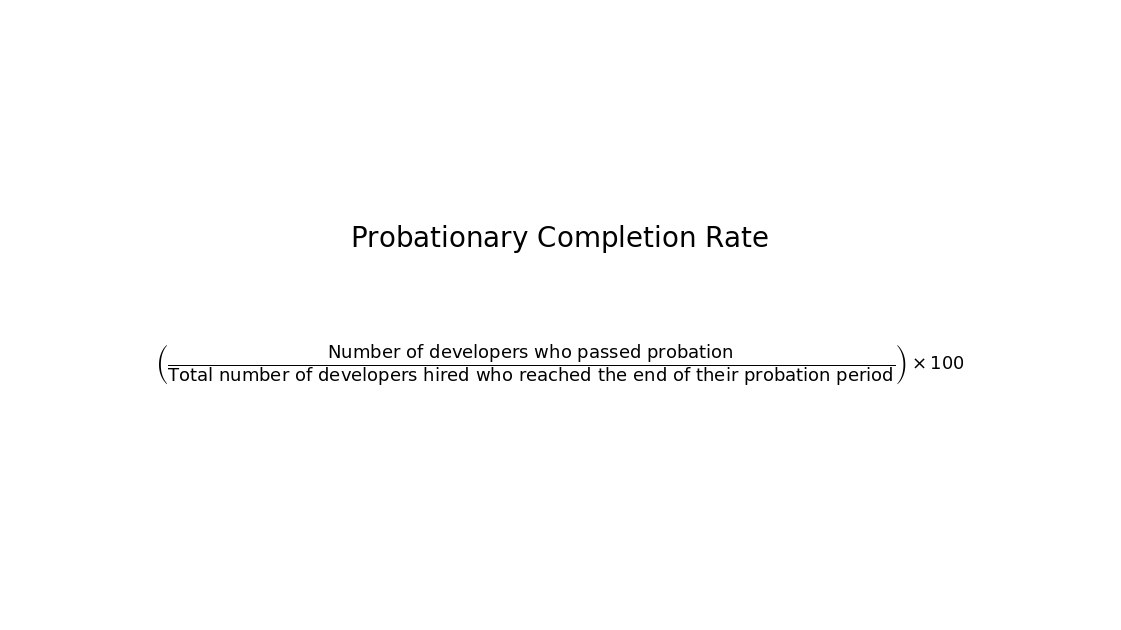
In plain terms: Take the number of new developers who successfully made it through their trial period during a specific timeframe. Divide that by the total number of developers you hired whose probation periods were supposed to end in that same timeframe (including both those who passed and those who failed or left). Multiply by 100 to get a percentage.
At Lemon.io:
We formalize this metric through a monitored 30-day/160-hour trial period, during which our Client & Developer Experience team uses targeted weekly feedback loops to ensure the match is successful.
Engineering-specific metrics
These metrics pull directly from your development pipeline and version control systems to measure the technical throughput, output quality, and broader organizational impact of a software engineering hire.
Delivery metrics
- Number of lines of code (LoC)
This metric is still popular, yet consider that high LoC does not equal high productivity; in fact, an expert developer who deletes 500 lines of redundant code to solve a problem is often doing more valuable work than a junior developer who writes 2,000 lines of unoptimized code. Use this metric with extreme caution.
- Number of PRs opened
This tracks an employee engagement level. It measures how frequently they break their work down into smaller, reviewable chunks, which is a strong indicator of a healthy, development cadence.
- Number of accepted (merged) PRs
It is the ultimate measure of code alignment in engineering. While opening PRs shows effort, the number of accepted PRs shows execution. A high gap between opened and accepted PRs signals that a developer’s code is getting stuck in review due to quality issues or architectural misalignment.
- Number of delivered user stories
This connects code directly to product progress. It measures how many user-facing features, bug fixes, or product requirements the developer successfully shipped to production, shifting the focus from raw code output to business value.
Post-hire quality & process ownership
- Process improvements
This tracks instances where an engineer introduces new tools, optimizes infrastructure, or designs proprietary solutions that improve the team’s overall workflow. It highlights the high-impact hires who actively own processes.
- Mentoring activities
This measures how effectively an engineer documents code, onboards peers, and guides juniors. True top talent acts as a force multiplier—leveling up the capabilities of everyone around them—making this a vital metric for post-hire organizational quality.
Feedback loops
Feedback serves as the ultimate qualitative gut check to validate what the pipeline numbers are showing.
- Team tech feedback (360° reviews)
This utilizes peer evaluations from existing team members to grade the new hire’s collaboration, communication clarity, and constructive participation in code reviews. For remote and hybrid teams, this soft-skill alignment is vital.
- Hiring manager satisfaction rate
To get a complete picture, the direct manager formally rates whether the developer is meeting, exceeding, or falling short of the technical goals set during the hiring process.
At Lemon.io:
We continuously track this by gathering feedback surveys from both sides to maintain a dedicated subscription health score and catch communication or cultural misalignments early.
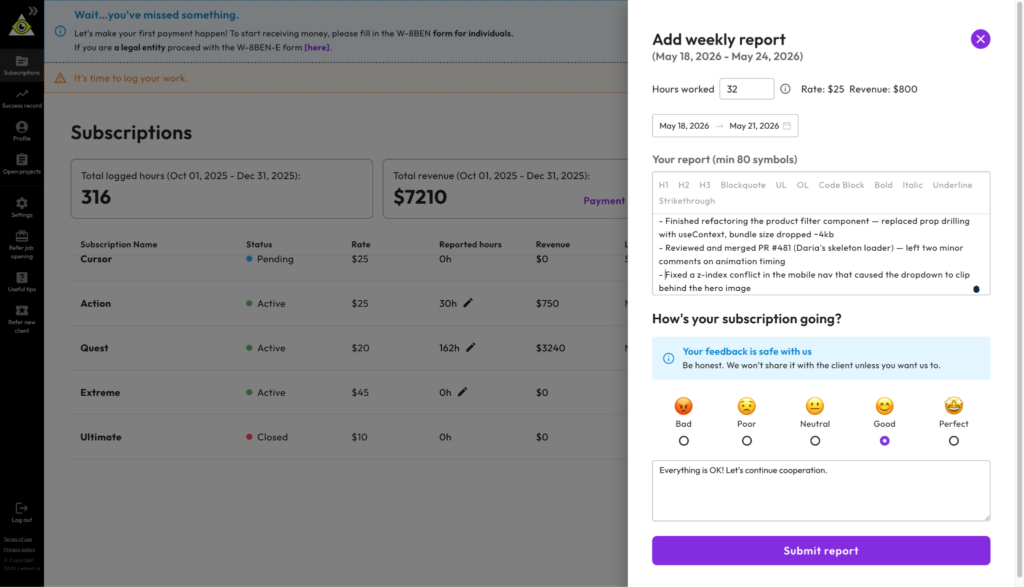
Source: Lemon.io for developers, weekly report flow
Recruiting metrics
Use the following metrics to analyze your hiring funnel itself, ensuring your sourcing methods are efficient and candidate-friendly:
- Time-to-hire (time-to-fill)
This balances how long it takes to secure a candidate against their eventual performance score once on board. Correlating these metrics helps you find the sweet spot between moving fast to win top talent and taking the necessary time to vet for candidate quality.
To track this accurately, Time-to-hire must measure the entire recruitment lifecycle, rather than just the time a job posting sits live on a board.
The correct starting point—the moment the hiring process officially begins (e.g., the initial kick-off meeting or gathering requirements);
The correct ending point—the exact day the candidate accepts the offer or starts.
At Lemon.io:
We optimize this balance by filtering our vetted senior pool of the top 1.2% of engineering applicants to deliver 1–3 highly targeted, human-matched profiles to you in under 24 hours.
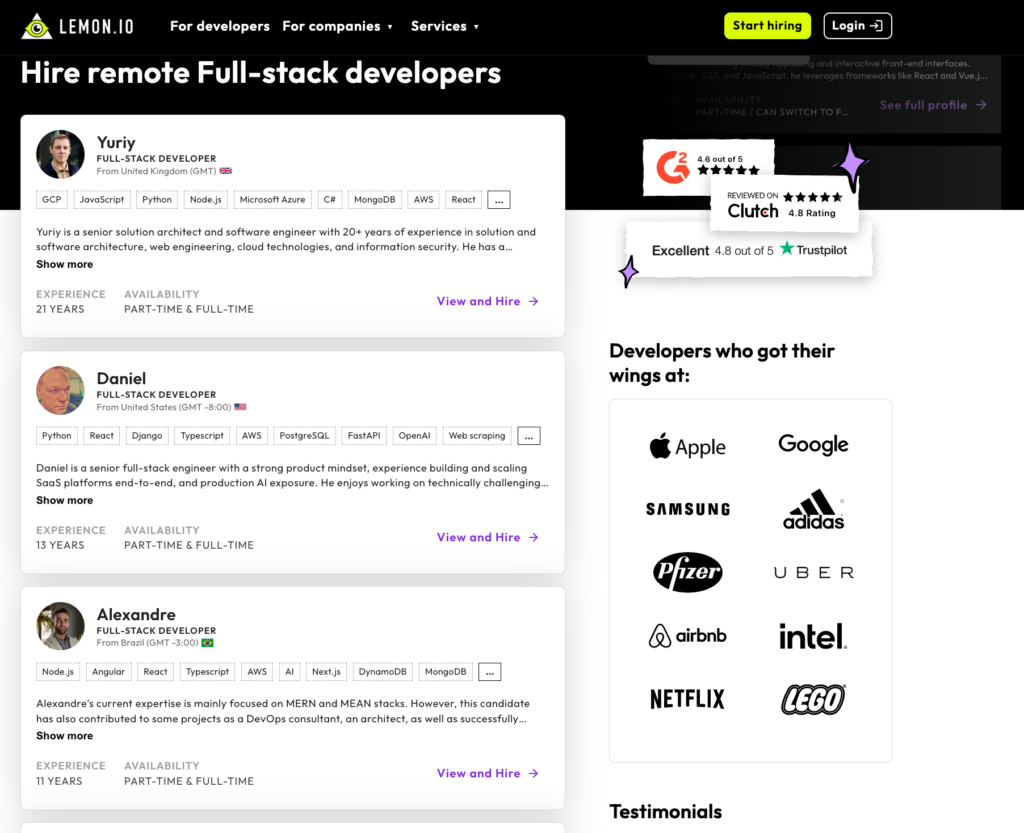
Source: Lemon.io, vetted candidate list
- Candidate hiring experience
This measures candidate satisfaction with your application ease, recruiter transparency, and interview fairness via post-process anonymous surveys. A stellar candidate experience protects your employer brand and ensures top-tier talent stays enthusiastic about joining your team and becoming a part of your company culture.
- Cost per hire
This calculates the total money spent to secure one new engineer—job board postings, sourcing tool subscriptions, agency fees, and the internal hours your team spends screening and interviewing—divided by the number of hires made in that period.
Note: while the cross-industry average sits around $4,700, a tech hire realistically runs $15,000–$30,000, and a mis-hire costs 50–200% of annual salary to replace (according to SHRM’s benchmarking reports and Glassdoor).
AI and Automation Tools to Track Hiring Metrics
Disclaimer: If you’re hiring your first 1–3 developers, the tools you already use are probably enough. A Google Sheets tracking board covers the checkpoints and color markers, Jira or Linear already counts delivered stories, and GitHub/GitLab’s built-in insights show PR cadence and merge ratios for free.
No metric in this article strictly requires new software.
Dedicated platforms earn their place when the team grows, when manual tracking starts eating your working hours, or when you want more precision—automated baselines, cross-tool dashboards, and hiring-funnel analytics that a spreadsheet can’t produce.
When you reach that point, the tools below are worth exploring, and we’ve included what each actually costs:
Jellyfish
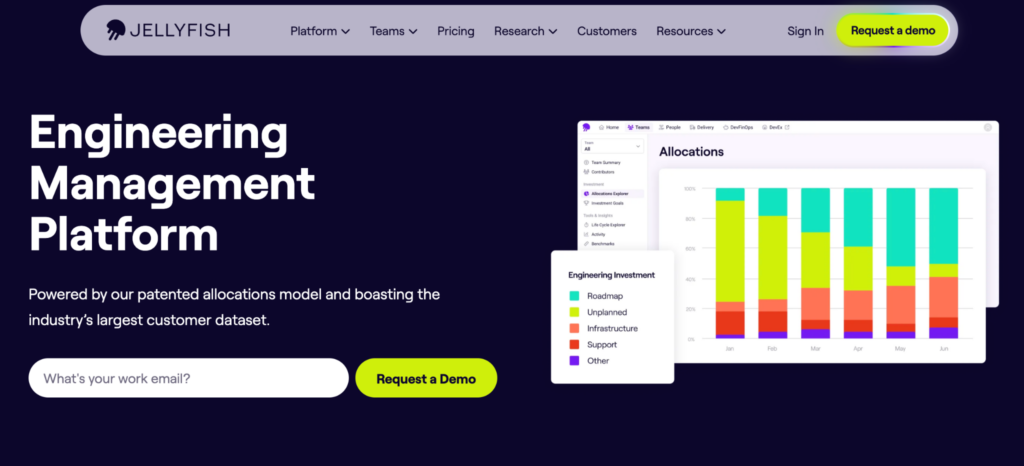
Source: Jellyfish EMP website
Jellyfish is an engineering management platform (EMP) and arguably the most direct answer to the quality-of-hire problem this article covers.
It works by pulling data from the tools your team already lives in—Jira, GitHub/GitLab, Slack, and Google Drive—and consolidating it into a single dashboard where you can benchmark engineers against each other and against team baselines.
On top of that, it translates raw engineering output into financial and strategic metrics: its core “Allocation” view shows how much money and engineering time a new hire spends on growth features, giving you direct visibility into engineering ROI.
Pricing: Jellyfish doesn’t publish pricing, but third-party buyer data puts typical contracts at $30,000+ per year—a cost that makes sense for organizations of roughly 50+ developers (Jellyfish’s own sweet spot skews even larger). If you’re hiring your first one to three engineers, it’s overkill. For smaller teams, Waydev is the closest affordable alternative, with self-serve plans from $29 per developer per month and a free trial.
Waydev
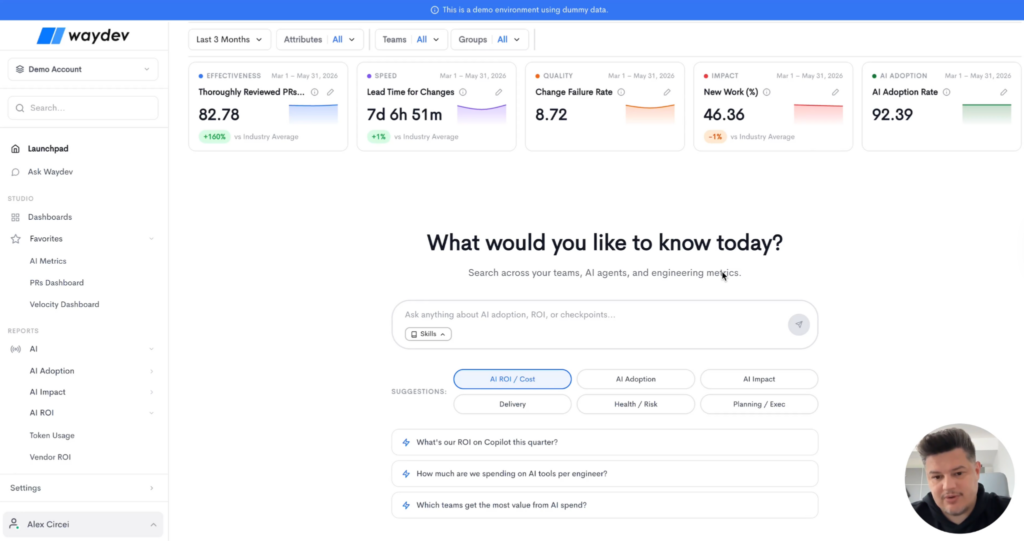
Source: Waydev recorded demo
Waydev tracks code churn and individual developer KPIs at a price point accessible to small teams. Unlike aggregate team metrics, it provides visibility into individual code contributions without micromanagement from your side. The platform highlights if a new hire is struggling with high rework rates or getting stuck in long code review cycles. This allows you to fix onboarding on the go.
Pricing: plans start at $29 per active contributor per month, billed annually, with a free trial and a 90-day money-back guarantee—for a 3-developer team, roughly $1,000 a year versus Jellyfish’s five figures.
Lattice
Lattice is a platform that helps founders and leads grow teams by leveraging some AI automations. The platform tracks promotion and career advancement, team feedback, and informal awards—so it helps you to map your new hire growth. Lattice runs 360° peer reviews, tracks career paths, and includes a “Praise” feature to log public call-outs and informal awards from management.
Pricing: the Talent Management plan is $11 per seat per month, billed annually, with Engagement and Grow add-ons at $4 and Compensation at $6 per seat per month. One caveat for small teams: Lattice has a $4,000 minimum annual agreement—so a 5-person startup pays the same floor as a 30-person one.
Ashby
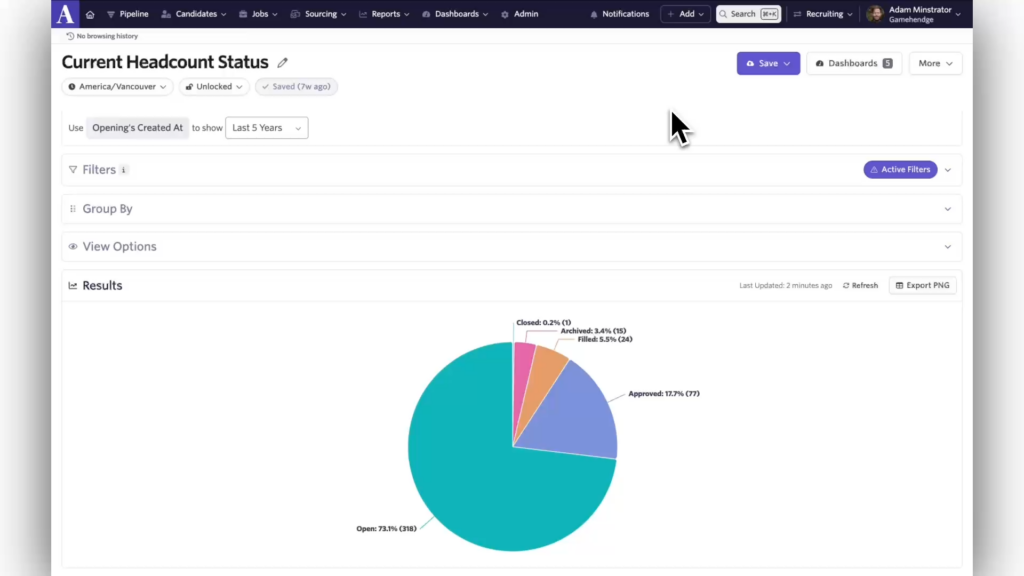
Source: Ashby recorded demo
Ashby is a highly analytical ATS favored by modern startups. It tracks the speed of your pipeline and natively sends out post-interview anonymous surveys to map candidate experience. Crucially, it allows you to input custom fields (such as 6-month performance scores) to cross-reference pipeline speed with actual quality of hire. Popular alternative: Greenhouse.
Pricing: the Foundations plan is $400/month for companies with up to 100 employees, with roughly 10% off on an annual commitment—about $4,300–4,800/year. That only pays off with real hiring volume; for a team hiring 10–20 engineers over the next year, the analytics deliver genuine value. Greenhouse, the popular alternative, is custom-quoted and typically starts around $6,000+/year.
How to Improve Talent Management at Your Startup
To systematically elevate your engineering team’s output, you must optimize strategy across two fronts: refining the hiring pipeline and upskilling hiring managers (who, in early-stage startups, are typically the founders or tech leads).
Architectural upgrades to your hiring pipeline
Your recruitment should function like a well-designed deployment pipeline—efficient, automated where possible, and built to catch defects early. Here are some tips from Lemon.io on how to polish it:
Impact-driven job descriptions
According to LinkedIn’s Global Talent Trends report, job postings that define specific performance objectives and outcomes see a 25–30% increase in qualified applicants compared to checklist-style descriptions.
Mind that a job ad is an engineer’s first decision-making point. Vague requirements or endless lists of frameworks might deter prospective ones. So instead of listing degrees or static skills, focus on deliverables and tasks. Especially if it comes to AI engineering tasks.
How it is better with Lemon.io:
You can skip the writing, polishing, and posting of job descriptions altogether. When you share your project scope, timeline, and tech stack with us, a human tech analyst reviews your requirements and clarifies any implicit engineering needs. We handle all the pipeline filtering behind the scenes, delivering 1–3 highly targeted senior profiles to you in under 24 hours.
Skills-first real-time technical screening
Traditional resume screening is an inaccurate predictor of job performance, and so are test tasks that can be treated as homework tasks (and executed with AI or by someone else). Live coding sessions or other forms of live collaboration work better.
How it is better with Lemon.io:
We use role-specific coding assessments or real-world problem-solving simulations monitored by senior engineers from the community. The technical assessment includes a 90-minute live session evaluating non-Googleable engineering theory, system design, code review capabilities, and the candidate’s fluency with AI tools.
Cast a wide net beyond traditional job boards
High-impact engineers rarely browse generic job boards. So startups looking for elite builders must look toward specialized developer communities, open-source contributions, and technical networks. More on this topic: 10+ Best Tech Staffing Companies for Startups in 2026.
Structured, engineering-led onboarding program
Quality of hire is actualized during onboarding. Build an engineered onboarding track that gets new hires into the codebase quickly. Use post-hire assessments, clear documentation, and real-world project scenarios to build familiarity with coding. A tight onboarding framework sets clear expectations and drastically reduces your time-to-productivity and new-hire attrition.
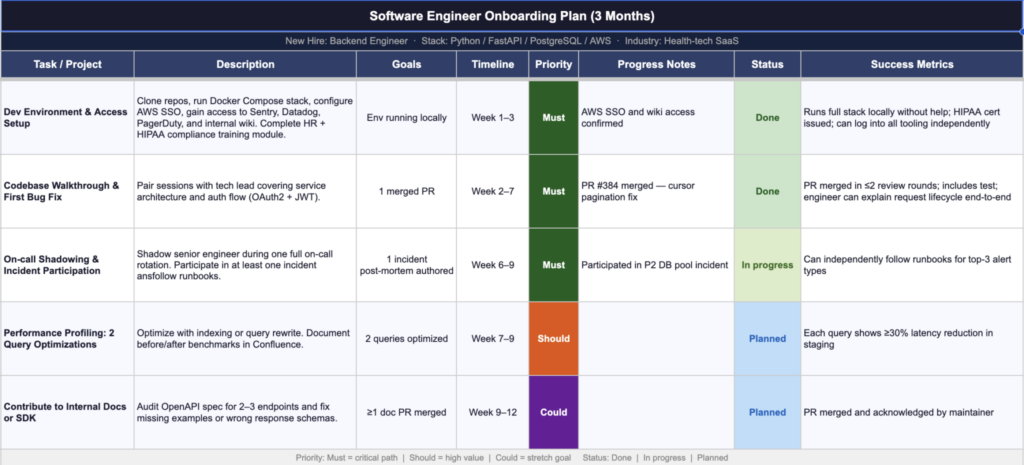
Source: Lemon.io, example of a backend engineer onboarding plan for the healthtech startup
Developing hiring managers
In most startups, dedicated HR managers are a luxury. Hiring decisions fall squarely on the shoulders of founders and tech leads. However, being a brilliant software architect does not naturally make someone a brilliant interviewer. Here are some tips to master relevant skills:
Enforce structured interview frameworks
Unstructured interviews are highly susceptible to “culture fit” bias—where technical leaders hire people who think exactly like them rather than people who fill their skill gaps. Tech leads must co-design strict, evidence-based scorecards before opening a role. Every candidate must face identical core questions and practical challenges so they can be graded on raw competency.
How it is better with Lemon.io:
We protect you from interview fatigue by conducting live, independent assessments of both technical depth and soft skills before you ever meet a candidate. English fluency and remote collaboration fitness are treated as first-class requirements in separate, scored interview stages. By the time a profile reaches you, your team only needs to conduct a final alignment conversation to make a decision.
Establish multi-directional feedback
Quality of hire shouldn’t be a corporate secret hidden from the new engineer. Maintain transparent communication by sharing performance metrics directly with the new hire during regular 1-on-1s.
These loops must be a two-way street: ask the engineer what blockers are slowing down their velocity or hindering their integration. Centralize and log these insights to continuously refine your onboarding architecture.
How it is better with Lemon.io:
We implement an ongoing feedback loop. Our Client & Developer Experience team conducts dedicated check-ins and formal pulse surveys to identify access issues, clarify expectations, and eliminate early friction.
See recruitment as an iterative loop
Just as your software architecture evolves, so must your hiring criteria. Regularly reassess your core metrics alongside your tech leads. Example: some skills that were vital last year may now be fully automated by AI tools, and hiring profiles shifted toward data analysis and system design. And this process continues, with the desired pre-hire qualities redefined in every hiring cycle.
Sounds a bit overwhelming for now? Hold on.
While refining your internal hiring loop is a continuous journey, you don’t have to sacrifice your current production processes just to perfect your talent pipeline.
Lemon.io steps in as your strategic scaling partner, handles the heavy infrastructure of engineering recruitment, and delivers the elite, culturally aligned builders your startup needs to hit its next major milestone.
So if you need help, just let us know.