

Behind every product that keeps scaling is a hiring system quietly built before growth began.
The Lemon.io team—with over a decade of experience placing technical talent for startups—has put together a comprehensive guide covering AI recruiting tools, hiring process principles, and steps to help you build a steady pipeline of strong software developers.
Disclaimer: No AI tool can fully replace IT recruiters or hiring managers. But the right combination can shorten the distance between opening a role and getting a great developer on board.
Tech Recruiting Trends 2026
The fundamentals of technical recruiting haven’t changed over the past decade. What has changed is the job-seeker landscape, the programming languages in demand, and the tools. If you’re a tech lead stepping into the recruiting process, here are the tech industry hiring trends to consider:
- Hiring through communities
Job boards no longer work—according to Stack Overflow’s 2025 Developer Survey, 45.6% of developers are passive job seekers.
There’s also a well-documented software engineer shortage, which means engineers don’t hunt for companies but choose them. In particular, senior developers receive 10–20 recruiting firm InMails per week on LinkedIn, and LinkedIn’s own data puts response rates at just 18–25%.
What has emerged instead of cold outreach and job boards like Wellfound are professional developer communities: sourcing candidates natively through GitHub (180M+ developers specialized in all tech stacks from Java to Jest), Stack Overflow, Hacker News, DEV Community (dev.to), and daily.dev, as well as dedicated Discord servers, subreddits like r/programming and r/webdev, and active tech circles on LinkedIn and X.
Sourcing IT professionals through these channels takes more time, but the contacts are higher quality, and the conversations carry more trust. Developers themselves report a preference for introductions through trusted peers, communities, and recruiters with whom they already have a relationship.
- AI tools for technical recruiting
The AI recruiting market is vast—and growing fast. By 2026, 70% of businesses will be using AI to hire workers; around 82% rely on AI to screen CVs, while 64% use it to review candidate assessments (Resume Builder’s survey, 2025). In this article, we’ll break down which AI tools are worth your attention most.
- Motivation, ownership mentality, and product orientation
The waves of layoffs that swept through major information technology companies in 2025 and 2026 are a clear signal of how quickly market conditions and product requirements can shift. Globally, nearly 245,000 tech jobs were cut in 2025 (RationalFX report), with AI cited as a direct cause of nearly 55,000 of those layoffs in the US alone (CNBC).
Companies like Microsoft (15,000+ roles cut), Amazon (30,000 corporate positions eliminated across two rounds), Meta, and Salesforce—whose CEO Marc Benioff explicitly cited AI labor substitution—aggressively restructured.
Technologies go stale, product priorities change—so what you really need on your team isn’t someone who is a flawless network engineer or master of JavaScript, but someone who understands how your product works and can find technical solutions that make business sense. A motivated person will always find a way to acquire the skills they need.
- AI expertise: the great unknown
Yes, AI is everywhere now—and the ability to vibe-code is no longer a nice-to-have; it’s table stakes. At the same time, there’s enormous confusion in the market about the term “AI engineer,” which can mean an AI-assisted developer, an ML engineer, an LLMOps, or an AI API integrator.
AI roles command 41% higher salaries than traditional software positions, with 38% year-over-year salary growth across all experience levels. Your job is to define clearly which one you need—otherwise, you’ll either overpay significantly or end up with the wrong expertise entirely.
- Hiring Vs laying offs in the developer market
On the one hand, companies are laying off staff as they automate processes with AI: in 2025 alone, 783 tech companies cut a combined 250,000 jobs—about 674 per day. On the other hand, AI talent and LLM DevOps demand now exceeds supply by 3.2:1 globally, with over 1.6 million open positions and only 518,000 qualified candidates available (ManpowerGroup’s 2026 Global Talent Shortage Survey). Besides, some specializations—like cybersecurity and cloud computing remain untouched.
As a result, you’ll be competing for the right talent against recruitment agencies and information technology companies with far deeper pockets. So here are tips and tools you can use to play smart.
Tech Recruiting System & How to Build It
If you’re a tech lead stepping into hiring software developers for the first time, you might imagine the process like—post a job, interview some people, make an offer. That’s just the visible tip of what needs to happen: a tech recruiting funnel.
What you are building isn’t just a funnel; it’s a tech recruitment system behind it.
The IT staffing funnel is your conversion pipeline—the same way you’d think about a product or sales funnel, except your “customer” is a developer deciding whether to bet a year or more of their career on your team.
In 2025, it took companies an average of 63.5 days from job posting to accepted offer—for direct-hire cases. A high-performing tech hiring funnel should track specific metrics at each phase:
- Job posting & outreach. Measures total initial reach. This includes the number of vacancy views and the number of developers contacted directly.
- Application review. The raw number of inbound applications received.
- Interview stages (2—4). The number of candidates who pass each sequential evaluation, from screening to tech assessment, and a call with the CTO.
- Offer, hire & probation period. The final conversion numbers, offers accepted, and candidates who successfully clear probation.
To visualize how this volume filters down, a pipeline to secure a single engineering hire may look like this:
Funnel stage |
Metric |
|---|---|
Reach |
12,345 vacancy views & developer contacts |
Inbound applications |
50 applications |
Intro interview |
31 candidates passed |
Tech evaluation |
10 candidates passed |
Leadership round |
4 candidates passed |
Offers |
3 offers made |
Hire |
1 offer accepted |
Success retention |
1 developer successfully passed the trial period |
Now, let’s zoom out to the tech recruiting system that powers your hiring funnel. Here’s what separates teams that hire well consistently from those that scramble every time a role opens up.
Looking for the foundational role expert? Jump here: How to Hire the Right CTO to Meet Strategic Goals in 2026.
Sourcing channels
Most first-time hiring managers default to LinkedIn and maybe one job board. That’s a recipe for mediocre pipeline and recruiter fatigue. A healthy sourcing mix in 2026 looks more like:
- LinkedIn, GitHub, and Stack Overflow for passive talent discovery;
- Developer communities like daily.dev and Hacker News for warm outreach;
- Top-tier startup-oriented talent marketplaces like Lemon.io for pre-vetted senior candidates;
- Targeted paid ads;
- A genuine employer brand presence on LinkedIn and X.
The goal is that when one channel slows down, the others keep the pipeline moving.
A documented recruitment process
A well-documented hiring process means every candidate follows the same path: the same stages, evaluation moments, and communication cadence. Skills misalignment between resumes and actual capability is one of the top challenges cited by tech hiring teams—and much of that stems from inconsistent evaluation.
Most often, a practical process looks like this for a developer role:
Stage |
Timeframe |
Core activities |
Objectives |
|---|---|---|---|
Sourcing & Screening |
1–3 days |
CV review & screening for tech stack fit |
Fast filter, cut obviously off-spec candidates |
HR/Culture Call |
30 mins |
Quick video call checking salary alignment, timezone, communication, and culture |
Gatekeeper stage, protects the engineering team’s time |
Technical Assessment |
60 mins |
Live pair programming or a real system design conversation |
No take-home tests: Replacing them with live pairing halves candidate drop rates and saves ~1 week |
Final CTO/Lead Chat |
60 mins |
Discussion on project management, long-term vision, and working style |
The “would I actually want to build things with this person,” final alignment check |
Offer + Trial Period |
30–90 days (Trial) |
Written offer followed by structured, paid onboarding. |
Driven by clear 30/60/90-day milestones, KPIs |
A structured evaluation rubric
Every stage needs defined criteria. This streamlined hiring process measures a candidate’s suitability across three critical dimensions:
- The CV and profile review assesses core tech stack alignment, domain relevance, and overall career trajectory.
- The technical assessment evaluates practical problem-solving, code quality, systems thinking, knowledge of emerging technologies, and the candidate’s ability to leverage AI tools.
- The culture and team fit stage gauges essential soft skills, specifically measuring asynchronous communication, coachability through feedback, and the ability to explain technical concepts to non-technical stakeholders.
Hiring teams in 2025 conducted 42% more interviews per hire than in 2021—up from 14 to 20 interviews per hire (Gem’s 2025 Recruiting Benchmarks Report). A rubric forces the question earlier: what would a perfect candidate look like?
Disclaimer. Building the system from scratch takes time. The alternative is outsourcing the most time-consuming stages to a platform like Lemon.io, which handles sourcing and vetting, technical screening, and the final culture conversation, leaving you with only the final culture call and the final decision.
Top AI Tools for Tech Recruiting in 2026
Hiring can’t be fully automated with cutting-edge AI. However, if recruiting is part of your role and not your whole job—which is the reality for most CTOs, tech leads, and engineering managers—there’s a lot of groundwork that doesn’t need to be done manually.
According to LinkedIn’s 2025 data, recruiters who use AI tools save roughly 1 full workday per week.
The table below maps the core tasks of technical recruiting to what in 2026 you can hand off to AI tools—and what still requires your judgment, experience, and your online presence.
Task |
What AI handles |
What still needs you |
|---|---|---|
Before the funnel |
||
Job description |
Drafts text based on your role requirements, optimizes language for clarity and inclusivity, and flags biased phrasing. |
Defining what the role is—seniority, tech stack, team context |
Sourcing |
Scans platforms and 800M+ databases to surface passive candidates matching your criteria. |
— |
Top of funnel |
||
CV screening |
Parses and scores CVs against your requirements; Filters out off-spec candidates |
Setting the scoring criteria in the first place, reviewing edge cases |
Candidate FAQ & first-touch comms |
Answers standard questions 24/7 (salary range, process timeline, tech stack); handles rejections at scale |
— |
Interview scheduling |
Syncs calendars, sends invites, lets candidates self-book |
— |
Middle of funnel |
||
Tech assessment |
Runs live coding sessions or async challenges; auto-grades submissions; flags plagiarism |
Deciding what to test for |
Interviews |
Conducts initial skill set screening via conversational bot; transcribes and summarizes responses |
Real conversation |
Bottom of funnel |
||
Candidate evaluation & scoring |
Aggregates feedback, normalizes scores against your rubric, and highlights disagreements across the panel |
The final call, gut-check on culture fit, deciding between two strong candidates |
Reference checks |
Sends structured reference questionnaires automatically, collects and summarizes responses |
Following up on something that doesn’t add up |
Offer & salary benchmarking |
Pulls real-time salary data for the role, seniority level, location, and tech stack; suggests competitive offer ranges |
The salary negotiation itself |
Hiring analytics |
Tracks funnel conversion and time-to-hire |
Deciding which bottlenecks to fix |
Let’s get into the most useful of the tools mentioned above.
AI for sourcing tech talent
LinkedIn Recruiter Lite
Price: free plan available
Best for: first hires without a tool’s learning curve
LinkedIn Recruiter Lite is the entry-level version of the platform’s paid recruiting product.
The account provides you functions such as InMail credits—the ability to message any people, advanced search filters—by specific skills, years of experience, companies, seniority, and openness to opportunities; applicant tracking—a pipeline view where you can tag, sort, and add notes to candidates; and AI-assisted candidate scoring—when you post a job, LinkedIn automatically ranks applicants against your job description requirements.
No hard program management. It’s an easy-to-use tool that can serve as your default if you don’t need to hire several members at once.
Juicebox (PeopleGPT)
Price: from $119/mo
Best for: hiring in parallel across multiple roles
This is an AI-powered talent search engine that lets you find candidates by describing who you need in conversational English (no recruiter terminology or structure). Here, the core idea is that the AI translates your request into a search across its database. What you get besides natural language search is a multi-source database—searches across 800M+ profiles pulled from 30+ data sources, including LinkedIn, GitHub, publications, and other professional platforms. Juicebox “learns” your preferences as you thumbs-up or thumbs-down suggested profiles and adapts searches accordingly. Bonus: automated outreach drafting and parallel role management.
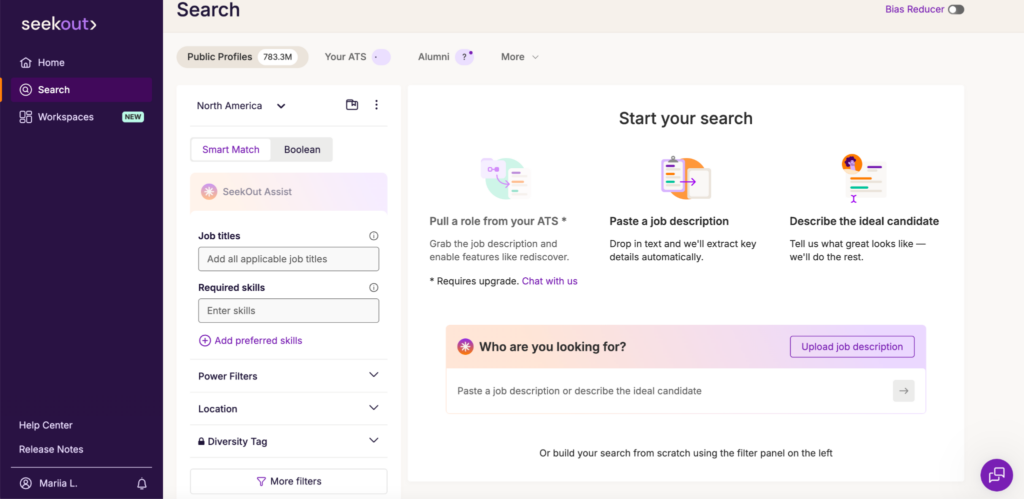
SeekOut
Price: from $149/mo
Best for: hard-to-fill senior engineering roles
Source: SeekOut website
SeekOut is a more complex AI-powered talent intelligence platform that finds engineers by what they’ve built and published. It searches the open web—GitHub repositories, research papers, patents, Stack Overflow contributions, academic publications—and cross-references that with standard profile data. The platform also shows real-time talent market intelligence—how many qualified candidates are available for a given role, the job search situation by region, and the salary guide. It also integrates with ATSs such as Greenhouse, Lever, and other major platforms, so candidates flow directly into your existing pipeline.
CV AI screeners
Skima AI
Price: from $79/mo
Best for: first-pass screening integrated into your ATS
Source: Skima AI website
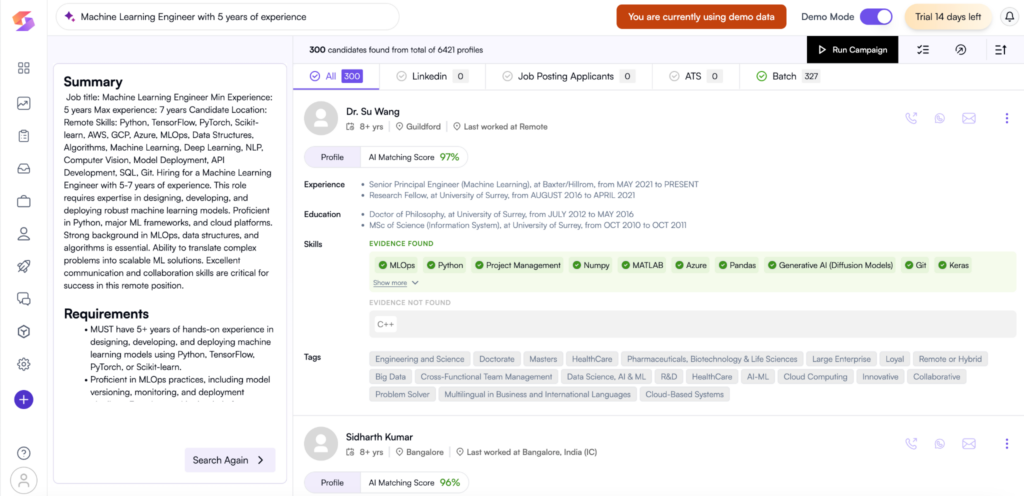
Skima AI is an AI recruiting intelligence layer that integrates seamlessly with existing ATS platforms—Lever, BambooHR, Greenhouse, FreshTeam, and others—to automate first-pass screening and deliver explainable shortlists without requiring new logins or replacing your current workflow. It tells you why a candidate ranked the way they did—tech stack alignment, career trajectory, domain match. Its Skill Evidence Detection feature infers capabilities from real work (not keywords on CV). Useful when you already have an ATS and want smarter screening layered on top, not a new platform to learn.
CVViZ
Price: from $99/mo
Best for: ranking inbound applications from job boards
Source: CVViZ website
CVViZ is an AI-powered recruiting platform that automates resume screening using NLP and machine learning, ranks candidates using deep contextual matching, and distributes your job posting across 2,000+ boards. The built-in recommendation engine suggests the best job boards for a given role based on industry, position type, and location.
Brainner
Price: from $9.95/100 resumes (first 100 free monthly)
Best for: hiring tech talent rarely and irregularly
Source: Brainner website
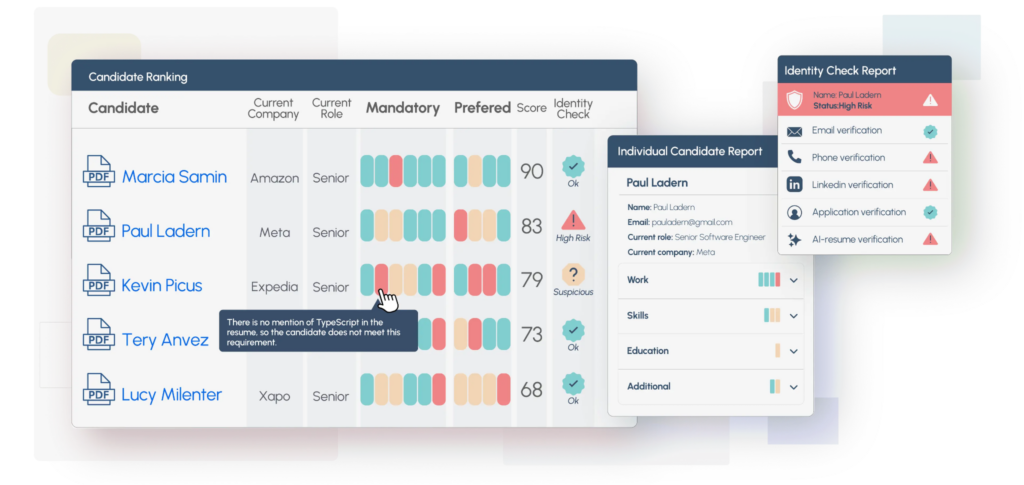
The most budget-friendly pure screening tool on the market that plugs directly into Lever, Ashby, Greenhouse, and Workable and screens resumes in real time as candidates apply—the AI suggests screening criteria automatically from your job description, which you can customize before screening begins. It provides a detailed gap analysis that shows exactly why each candidate meets or misses requirements, and syncs bidirectional decisions back to your ATS.
AI-conducted interviews
Fabric
Price: from $99/month
Best for: replacing your first-round HR screening call with an AI that interviews and technically assesses engineers
Source: Fabric website
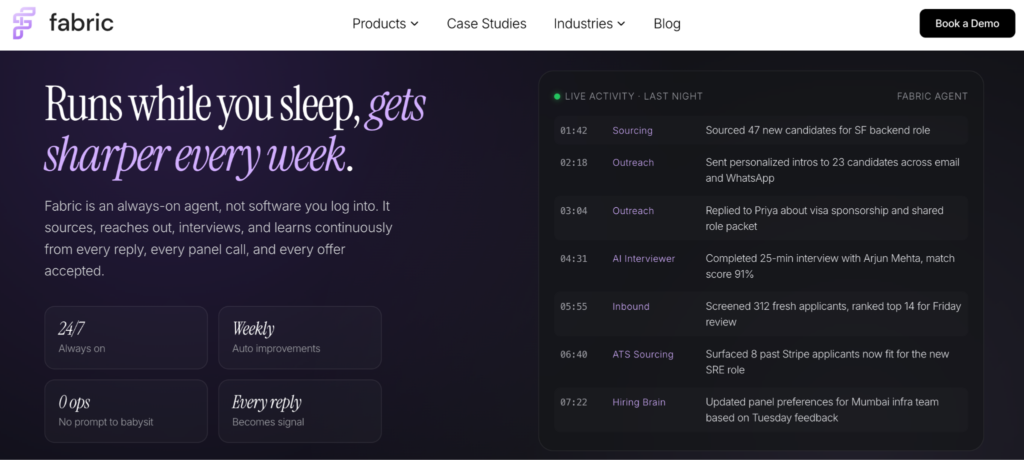
Fabric is an AI-powered interview platform that conducts live, adaptive two-way conversations with candidates. They take the form of a real-time exchange where the AI adjusts its follow-up questions based on what the candidate says. Live coding sessions are built directly into the interview, meaning a developer can be screened for communication, cultural fit, and technical ability in a single 45-60 minute session. On the other end, you receive a structured scorecard mapped to your predefined criteria. Mind that the setup requires an hour upfront to define what the AI should probe for; after that, it runs autonomously.
InterviewFlowAI
Price: $0.99/interview
Best for: sporadic hiring where you want AI-conducted interviews without a monthly subscription
InterviewFlowAI conducts live, two-way conversational AI interviews over the phone or video, asks follow-up questions, adapts to candidate responses, and generates detailed candidate scorecards with quantitative data. The phone mode is a practical differentiator: it allows the candidate to be called directly. The right tool when hiring is occasional.
Alex AI (Apriora)
Price: quote-based, demo required
Best for: high-volume technical interviewing with built-in fraud detection
Alex AI conducts live phone and video interviews, handles scheduling and follow-ups without recruiter involvement, and integrates with 33+ ATS platforms across 26+ languages. The standout feature is its fraud detection: it verifies candidate identity and flags external assistance during the interview. The tradeoff is enterprise pricing with an annual contract. The right time to look at Alex seriously is when interview consistency, compliance documentation, and fraud prevention become requirements—not for your first engineering hires.
More on this topic: 15+ Coding Interview Tools to Test Developers’ Tech Skills.
How you build tech hiring with Lemon.io
AI tools can meaningfully compress your time-to-hire—but even something as accessible as LinkedIn Recruiter Lite assumes you have time, recruiting experience, and a functioning hiring system to plug it into. However, most tech leads have none of the three at the same time.
The alternative to time-consuming building tech recruiting infrastructure yourself is Lemon.io—a partner that provides you with marketplace-style recruiting services, backed by a decade-proven system that runs entirely on our side.
Instead of the industry-average 63.5 days from job posting to accepted offer, you can go from submitting a project brief to working with a vetted senior developer in under 2 weeks:
- Step 1. You leave your hiring request
You describe what you’re building, your industry (ecommerce, healthcare, SaaS, etc.), the tech stack you need, seniority level, and how you want to engage—full-time, part-time, or project-based. No job description to write, no sourcing to set up.
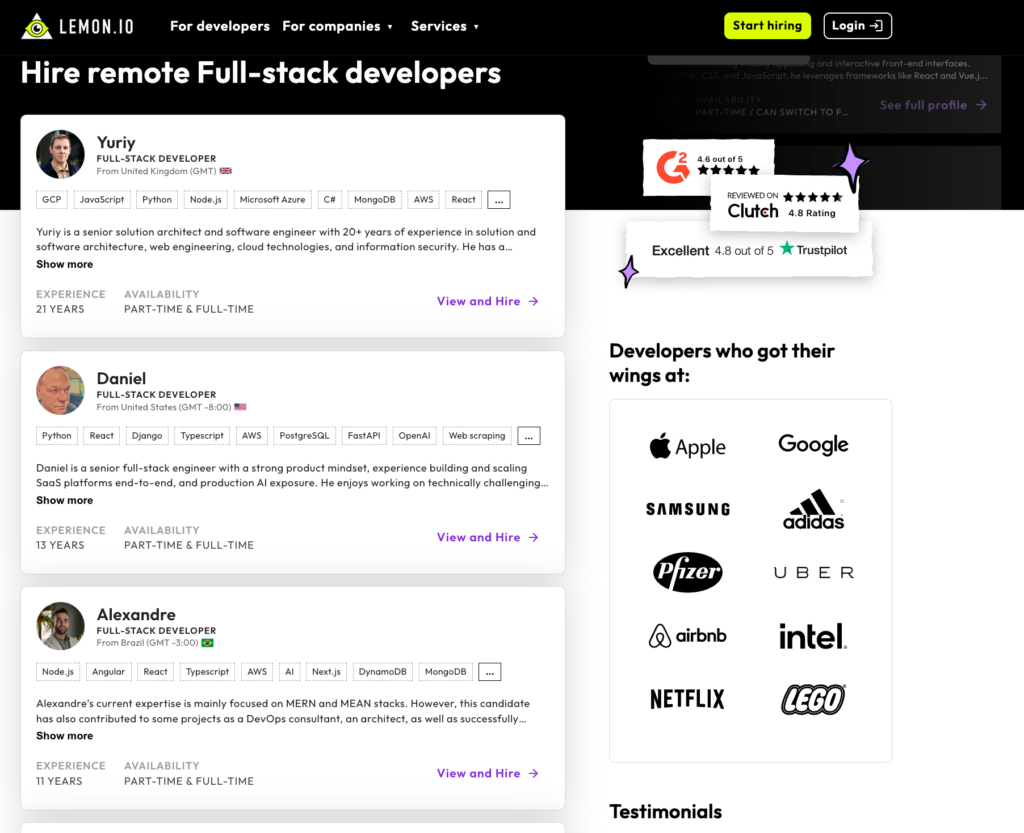
- Step 2. We match you with vetted candidates (within 24–48 hours)
Based on your brief, we hand-pick one to three developer profiles from our network—engineers who have already cleared our 4-stage vetting pipeline. You can also browse our open database.
Source: Lemon.io website
- Step 3. You conduct one conversation (Day 2–3)
You have a single culture-fit interview. No technical screening on your end and multiple interview rounds—only if you want them.
- Step 4. Collaboration starts!
Once the fit is confirmed, Lemon.io handles contracts, NDAs, and payments. If your needs change—more developers, a different stack, a different engagement model—the same process repeats, typically faster the second time.
What you skip entirely is the part that costs most founders months: building sourcing channels, screening CVs, running technical interviews, negotiating the offer, and managing the administrative overhead of bringing on a remote developer.
Data-Driven Tech Recruiting: 4 Metrics to Consider
Recruiting generates more data than hiring managers often have time to interpret—from source-of-hire breakdowns to reasons for offer declines, there are 20+ metrics a mature talent acquisition team might track across a full hiring cycle.
For a startup where hiring is one of five things on your plate, Lemon.io’s recommendation is to focus on the 4 metrics that most directly connect your tech recruiting to business outcomes: time-to-hire, cost-per-hire, offer acceptance rate, and stage conversion with time-in-stage.
Time-to-hire
Healthy: 40—60 days per role (14 with Lemon.io)
The number of days between the moment a candidate enters your pipeline—typically when they apply or when you first reach out—and the moment they accept your offer. The industry average for software engineering roles sits at 63.5 days (under 30 days for mid-level roles). Lemon.io compresses this to under 14 days by handling everything before your final conversation.
Cost-per-hire
Healthy: below $20,000 for a senior engineering role
The total money spent to fill one role, divided across recruiter time, job board subscriptions, sourcing tools, assessment platforms, employer branding, interview hours (your engineers’ time if they are involved), and any agency or platform fees.
The Society for Human Resource Management puts the average cost-per-hire across industries at around $4,700, but for senior engineering roles, the real number is often $20,000–$30,000 when you factor in engineering team time across multiple interview rounds and the opportunity cost of a role sitting open.
Offer Acceptance Rate (OAR)
Healthy: over 70%
The percentage of formal job offers that candidates actually accept. A low OAR is one of the most expensive problems in a hiring funnel. A low OAR signals that your compensation is out of market, the process took too long, or something in the late-stage experience didn’t land well. 80–90% is considered healthy for tech roles.
Stage conversion rate & time-in-stage
Healthy: application-to-screen 12–20%, screen-to-interview 30–50%, interview-to-offer 15–25%; CV screening 24 hours, first call 1–2 days, tech assessment 2–3 days, final interview 2–4 days, offer 1–3 days
Stage conversion rate is the percentage of candidates who advance from one stage to the next. Tracking this per stage tells you where candidates are being lost. Time-in-stage measures how long candidates sit at each stage before moving forward or being rejected. You measure it regularly for 10 candidates to detect the bottlenecks.
Ready to move forward with your new hires? Read this: How to Onboard New Software Engineers To Minimize Failure
What Every CTO Wishes They Knew Before Their First Hire
Your first technology recruiting case sets a template—whether you intend it to or not. The standards you accept, the process you run, and the speed at which you move will become the baseline every future hire is measured against.
Besides, the process forms your image for every candidate. A chaotic, slow, or disrespectful hiring experience tells engineers what it will feel like to work at your company.
You don’t need a perfect recruiting system on day one—but you do need a defensible one: a clear job description, a consistent set of interview stages, defined criteria for what a good candidate looks like, and speed.
If you’re not there yet, the fastest way to close that gap is to opt for a tech staffing solution and let Lemon.io run the hard parts while you stay focused on the final tech professional choice and your product.