
Imagine replacing a junior dev team with AI, only to find your “cheap” solution now costs $8,000 a month in third-party APIs, retry loops, and prompts nobody bothered to optimize.
AI tools can cut your upfront app development budget in half and double your long-term costs if you’re not careful. The economics of building software have fundamentally changed, and you should be ready if you’re planning to develop a mobile or web app with AI.
How AI Can Slash App Building Costs
AI can assist in app development by generating code, automating testing, and even suggesting UI designs.
On average, AI tools can handle 40–60% of boilerplate code, simple CRUD operations, basic routing, database schemas, and standard UI components with the help of such tools as Claude Code, Cursor, and GitHub Copilot.
Generating code with AI can lead to a decrease in developers’ billable hours, reducing overall web, Android, or iOS app development costs. You aren’t paying for the 300 hours of manual typing anymore. Eventually, the time to market can drop from six months to three weeks.
For teams still running separate native apps, AI has made the cross-platform app deployment (e.g., in React Native or Flutter) significantly cheaper and faster than it used to be, with the help of:
- Scaffolding of cross-platform development components in a matter of days instead of weeks
- Quicker debugging of platform-specific rendering or behavior differences
AI tools have also sped up legacy code modernization. For example, a senior engineering team maintaining a 10-year-old Java monolith can use AI to refactor parts of the system into modern microservices in months, as compared to years of manual effort.
However, businesses still pay for machine attempts that need human oversight to catch what went wrong. Whether that trade is worth it depends entirely on what you’re building and how much of your scope falls into the category AI handles well.
That’s what the rest of this blog post is about.
Factors That Impact AI Development Costs
Business leaders may often overlook the following eight factors when considering building an app with the help of AI tools:
#1. Tokens and API fees
Every code generation, explanation, or refactor request burns tokens. For a small team shipping actively, this adds up faster than expected. A few developers in heavy daily use can run $100–$400 per person per month in AI tooling costs on top of existing subscriptions.
As teams start experimenting more (e.g., testing high-load scenarios, processing datasets, stress-testing inputs, or running security checks), web or mobile app development costs can climb to thousands of dollars.
#2. Model complexity
Bigger, smarter models (e.g., Opus or GPT-5) cost 10–20x more per token than smaller ones (e.g., Haiku, GPT-4o-mini). Choosing the right model for the task is one of the biggest cost levers available. Here’s a short breakdown of matching models with tasks:
- Top-tier models: system architecture decisions, complex feature design, debugging tricky issues, and generating production-ready code
- Smaller, cheaper models: validating outputs, summarizing content, extracting structured data, and processing large volumes of text
Below is a benchmark screenshot showing how different AI models handle 300 curated multilingual tasks (bug fixes, feature changes) in C, C++, Go, Java, JavaScript/TypeScript, PHP, Ruby, and Rust, along with the average cost for each model.
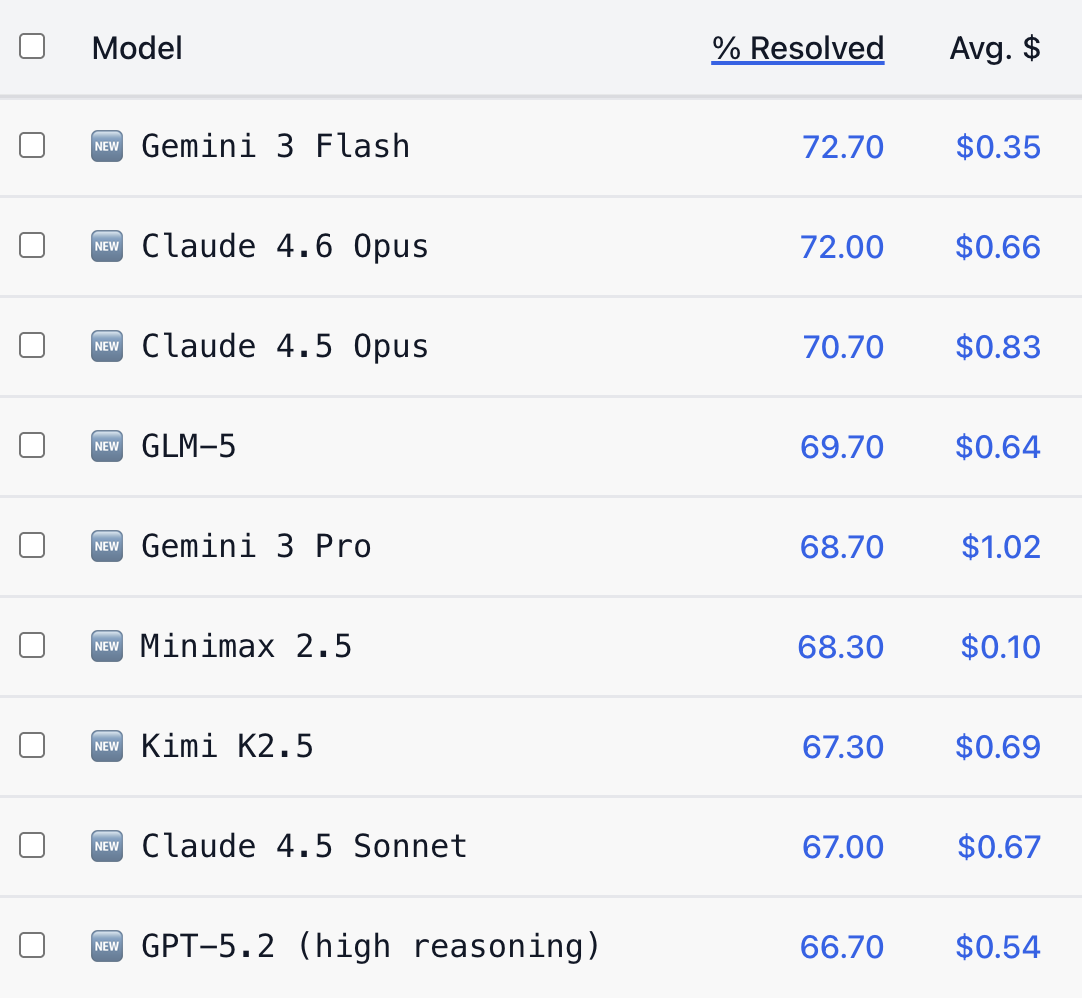
In this benchmark, the price difference may seem small, but at scale, when you’re running thousands of tasks, it quickly becomes a meaningful cost factor.
#3. Context rot
Context rot occurs when AI outputs degrade as more information is added to the prompt. Instead of improving results, longer context often introduces noise (old prompts, failed attempts, and duplicated logic) that makes the model less accurate. In practice, teams respond by adding even more context to “fix” the issue, which increases token usage and API costs.
#4. Vector databases and retrieval augmented generation (RAG)
If your app relies on company data (docs, knowledge bases, user history), you’ll likely need a vector database like Pinecone, Weaviate, or pgvector and an RAG pipeline. This introduces two types of costs: storing embeddings and querying them on every request.
For small datasets, this is manageable. But as your data grows, so do storage, retrieval, and latency costs. On top of that, generating embeddings isn’t free. You pay for every document you process. For content-heavy products, this can become one of the main cost drivers.
#5. Data preparation and management
Cleaning, labeling, and formatting data are often underestimated. On complex projects, this alone can add weeks of work and tens of thousands of dollars.
If your data is poorly structured, missing context, or inconsistently labeled, the model needs more tokens to “figure things out,” which increases API costs and reduces accuracy. Senior data engineers are essential for designing clean, consistent data models and properly labeling data, enabling AI systems to understand context faster and deliver more accurate results.
#6. Fine-tuning vs. off-the-shelf models
Fine-tuning a hosted model (in the cloud or physical server) on your data costs significantly more upfront ($10,000–$100,000+) but can reduce per-query costs long-term at scale.
#7. Infrastructure
Even if you rely on APIs, your app still needs databases, authentication, storage, hosting, monitoring, and integrations to run in production.
For small teams, this can start at $100–$300 per month for basic tools and infrastructure. As the product grows, monthly costs can rise to $1,000–$5,000+ due to higher usage, more paid accounts, and additional services. This fits into a broader trend: Zylo’s 2025 SaaS Management Index found that SaaS spend now averages $49 million or $4,830 per employee.
#8. Monitoring and model drift
AI models degrade over time as real-world data shifts. Code refactoring, debugging, delivering new features, and performance monitoring add 15–25% of the original build cost annually.
Ben Yoskovitz, Founding Partner of Highline Beta, shared his experience when building an app with Lovable:
Polishing takes credits, because you keep messaging Lovable to make small changes, and each message costs you. I burned through my monthly credit allowance already!
Takeaway: AI development costs are less predictable than traditional software development. In traditional development, most of your spending is tied to time and talent. You pay upfront to build the product, and ongoing costs are relatively stable. With AI, you’re paying for how your system behaves in real use: how often it runs, how much data it processes, and how efficiently it’s designed.
Your current engineering culture also plays a role here, as AI tools will amplify both good and bad practices in your app development team. For example, a team that writes clean, modular code can use AI to generate boilerplate quickly and plug it into a well-structured system, reducing development time without increasing technical debt. Similarly, a team that tracks infrastructure costs will quickly notice if a model choice or prompt design is inflating API bills and fix it early.
But if your processes are weak, AI makes problems worse. A team without clear code review standards may accept AI-generated code “as is,” leading to fragile logic and hidden bugs that are expensive to fix later.
Monthly Fees of the Most-Used AI Tools
Low-code and no-code AI platforms may cost anywhere from $20 to$500 per month, while custom app development costs depend on developers’ experience and feature complexity.
Category |
Tool |
Monthly price |
Free plan |
Pricing model |
Notes |
|---|---|---|---|---|---|
AI Coding |
GitHub Copilot |
$10–$39 |
❌ (trial only) |
Subscription |
Industry standard |
Claude Code |
~$20–$200/month |
❌ |
Subscription and usage |
Scales with token usage |
|
Cursor |
$20–$200/month |
✅ (limited) |
Tiered subscription |
Advanced AI workflows |
|
AI App Builders |
Lovable |
~$20–$100/month (est.) |
❌ |
Subscription |
Prompt-to-app generation |
v0 (Vercel) |
~$20/month+ |
✅ (limited) |
Usage-based |
UI and app generation |
|
Replit |
$17–$25/month |
✅ (limited) |
Subscription and credits |
Full-stack AI app building |
|
No-Code |
Bubble |
$29–$119/month |
✅ |
Subscription |
Full-stack no-code builder |
Webflow |
$18–$49/month |
✅ |
Subscription |
Frontend-heavy apps |
|
Glide |
$25–$99/month |
✅ |
Subscription |
Internal tools & simple apps |
|
Low-Code |
Retool |
$10–$50/user/month |
✅ (limited) |
Per-user pricing |
Internal tools & dashboards |
Appsmith |
Free / $15+/month |
✅ |
Open-source and subscription |
Developer-friendly internal tools |
|
Supabase |
Free / $25+/month |
✅ |
Usage-based |
Backend-as-a-service |
Despite marketing talk that you can spend nothing or only $20 per month and build feature-rich apps every month, this table shows that real-life AI development is much more costly. And those costs tend to pile up as your product grows.
Apart from tools, you’ll need to pay for developers and sometimes even more than you expect.
How Lemon.io Matches the Right Talent to Reduce AI Building Time and Spend
Lemon.io connects startups and SMBs with pre-vetted senior engineers who already work with AI in production.
We vet for what matters in 2026: engineers who can work with LLM pipelines, manage context windows, build RAG architectures, and control API costs.
Hiring the wrong type can cost $250 per hour for work that a $ 60-per-hour specialist could handle. We help you identify the precise role before you post it, whether that’s an AI product engineer, an LLMOps engineer, or a senior full-stack developer who uses AI tools to ship twice as fast. Discover more about the types of AI engineers and how to hire the best fit.
To choose the most suitable candidates, our team conducts technical interviews and live pair programming sessions that assess the candidates’ real-life experience with AI tools, technology selection reasoning, and understanding of cost tradeoffs for the app development process with or without AI.
Plus, we validate whether senior AI engineers realise how their development decisions impact business outcomes, such as improving time-to-market, reducing infrastructure costs, or dependency risks.
Lemon.io also gives you flexibility in how you scale AI expertise. You can:
- Hire a full-time senior AI engineer to lead development end-to-end
- Bring in a part-time AI specialist to audit architecture, optimize AI usage, or fix bottlenecks
This matters because AI development isn’t linear. You may need heavy involvement during setup and much less once the system stabilizes. Instead of overhiring or under-hiring, we help you adjust the team to match the phase of your product.
You tell us your stack and goals, and within 48 business hours, you have one to three matched candidates, rather than a vague shortlist of 40 CVs to sift through yourself. Instead of outsourcing your project to an app development company, which can take months in procurement, Lemon.io helps you find an engineer who can deliver value straight away within your in-house team.
App Maintenance Costs In the AI Era
Post-launch maintenance is an often-overlooked cost that can add up over time. Regular updates, bug fixes, security patches, and feature enhancements are necessary to keep an app competitive and functional.
Industry estimates suggest that annual maintenance costs range from 15–20% of the initial development cost, which often works out to approximately $400–$900 per year.
A simple AI-powered app’s cost ranges from $100 to $1,000 per month to maintain. A more complex app idea can reach $5,000–$20,000 per month, depending on usage.
Hidden Costs To Remember
Your VP of Engineering or a CTO should validate where AI tools make the most sense and where it’s better to avoid them. Learn how to hire an AI-savvy CTO in 2026.
AI-Induced Technical Debt. AI is great at writing code that works, but terrible at writing maintainable code. The cost of refactoring “spaghetti code” later can be massive.
Because AI tools generate large chunks of code at once, teams often end up with:
- Oversized pull requests
- Inconsistent patterns across files
- Duplicated logic implemented in slightly different ways
Over time, this accumulates into technical debt that is expensive to fix. What looked like a fast win during development turns into weeks of refactoring and partial rewrites of core components.
The QA Burden. AI-assisted development increases the amount and complexity of application testing. The code may compile and pass basic tests but still break architecture rules, miss edge cases, or introduce hidden side effects.
As a result, quality assurance specialists have to expand beyond functional testing into deeper validation: more edge cases, stronger regression coverage, and closer inspection of system-wide consistency. This can lead to “review fatigue” and missed bugs.
Security and Compliance. AI models are trained on historical code, which means they reproduce historical patterns, including outdated ones. An AI tool might generate authentication logic that was standard practice in 2019 and has since been identified as a vulnerability. For startups in regulated industries (fintech, healthcare, and legal), this is a significant risk. That’s why AI-generated code needs frequent security reviews.
UI/UX Design. AI tools like UXpilot.ai can generate interface layouts quickly, and component libraries like shadcn/ui provide production-ready user interface components that reduce the workload. For a minimum viable product (MVP) or an internal tool, these can get you most of the way there.
The gap shows up when your product needs to compete on experience rather than just functionality. AI-generated user experience tends toward generic interfaces that are technically correct but feel like every other app built the same way. Differentiation requires a designer who understands your user profiles, your brand, target audience, and the specific friction points in your product flows.
The cost of retrofitting a properly designed UX onto a product that was built without one is almost always higher than investing in the app design from the start.
But remember that apps with custom wireframes, animations, unique branding, and interactive elements will take longer to develop and require a larger budget than apps with basic design templates.
AI vs. Traditional Outsource App Development Cost
AI is most cost-effective when speed and flexibility matter. If you’re building an MVP, experimenting with basic features, or trying to launch quickly, it can cut upfront costs by 30–60% and reduce time-to-market from months to weeks. That’s why early-stage products benefit the most: you’re paying less to validate ideas and iterate.
Traditional development becomes more cost-effective as the product stabilizes. Once requirements are clear, systems grow more complex, or compliance becomes critical, the focus shifts from speed to predictability, scalability, compatibility, reliability, and control. At this stage, higher upfront costs are often justified by lower maintenance overhead and fewer long-term risks.
Scenario |
Choose traditional if |
Choose AI if |
Traditional vs AI costs |
|---|---|---|---|
Requirements |
Scope is clear and stable |
Scope is evolving, needs iteration |
$40k–$120k vs $20k–$80k |
Time-to-market |
Timeline is flexible |
Need to launch fast |
3–6+ months vs 1–3 months |
Stage |
Scaling a production system |
Building an MVP or a prototype |
$80k+ vs $20k–$100k |
App features |
Complex or regulated logic |
Standard, repeatable features |
$50k–$200k+ vs 30–60% cheaper |
Team |
The mid-level team executes |
Senior devs oversee AI tools |
$40–$80/hr vs $60–$120/hr (fewer hours) |
Maintenance |
You expect stable, predictable monthly costs |
You’re prepared for ongoing optimization and variable costs |
$2k–$10k vs $5k–$20k/month |
Compliance |
Strict regulations apply |
Low-risk product |
Higher upfront vs lower upfront (+risk later) |
Example: Simple App Development With AI vs. Traditional Development Methods
To develop an MVP version of the mobile application with one Senior developer who uses Claude Code for frontend and Supabase for backend development could cost around $1,740 (including App Store and Google Play fees, backend, push notifications, and Claude API). But that’s only on the condition that you have a developer working full-time, and your time-to-market is flexible.
Here’s a screenshot of a hypothetical estimation of an iOS app and Android app development with Claude Code.
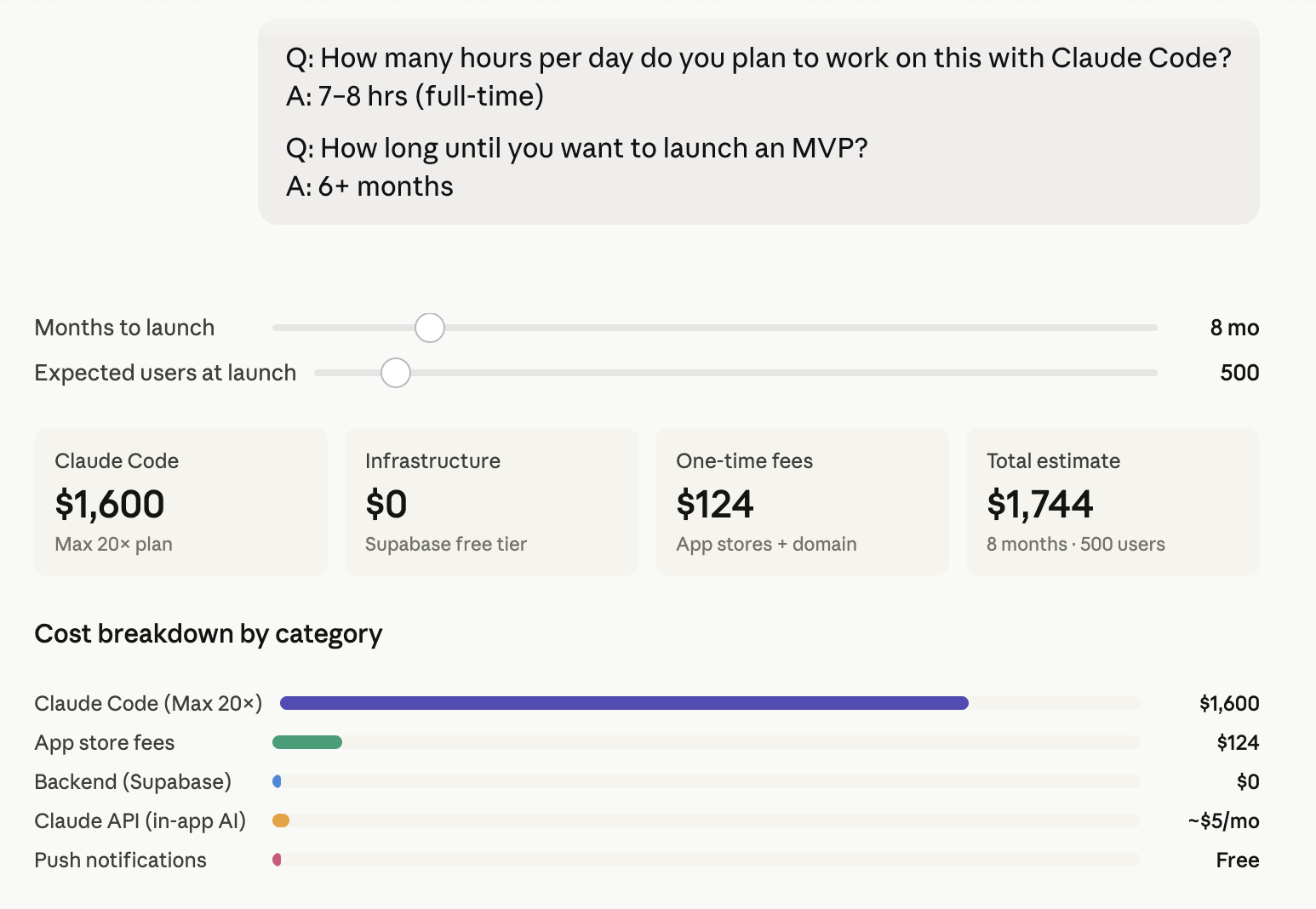
If your deadlines get tighter, AI costs can rise. To move faster, you’ll likely need higher-tier plans, make more frequent requests, and consume more tokens, all of which increase the average cost to build an app.
By contrast, with traditional development, faster delivery usually requires a larger team, which drives costs up. This means your time-to-market requirements can help you answer the most important question: how much does it cost to develop an app with AI or without AI?
Approach |
Timeline |
Upfront Cost |
Ongoing Cost |
|---|---|---|---|
AI (Claude Code case) |
8 months (solo developer) |
$1.7k |
Low → grows with usage |
Freelancer (traditional) |
6–12 months |
$24k–$72k |
Low/moderate |
Small team |
3–6 months |
$25k–$120k |
Moderate |
Agency |
2–4 months |
$40k–$150k+ |
Moderate |
App Development Cost Breakdown With And Without AI
Before committing to development, businesses need a clear cost estimate to align expectations and budget effectively.
Traditional development:
Estimated app cost = (Total development hours × Developer hourly rate) + Additional costs
AI-assisted development:
Estimated app cost = (Reduced development hours × Developer hourly rate) + AI usage costs (APIs, tokens, infra) + Additional costs
For example, if an MVP takes 320 hours at a median rate of $50/hour, the base cost is around $16,000. Additional expenses like UI/UX design, QA, and backend infrastructure can push the total to $20,000–$25,000.
With AI, the same MVP may require fewer hours (e.g., 180–220 hours), reducing upfront costs, but introducing ongoing AI-related expenses such as API usage, model inference, or prompt optimization.
How App Complexity Impacts the Final Cost
The type of app complexity significantly impacts development costs. Here’s a general breakdown based on estimated timelines and development costs:
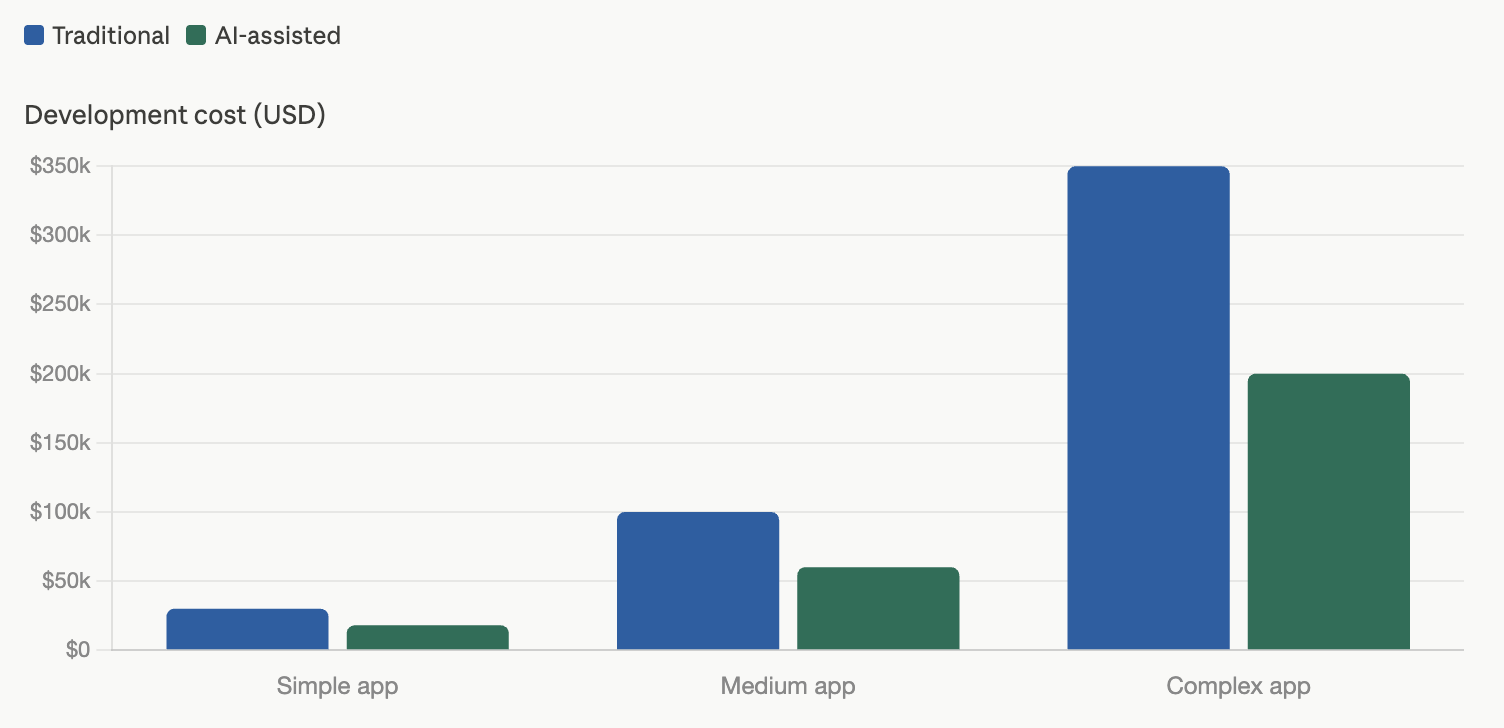
This framework helps businesses budget realistically while accounting for both initial build savings and long-term operational costs.
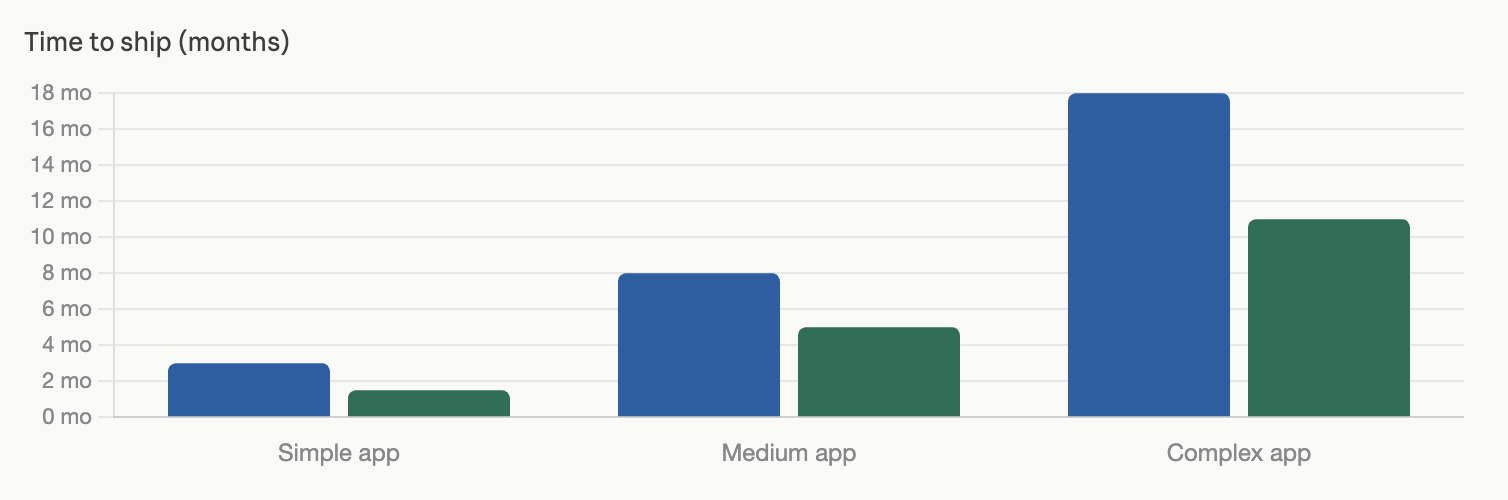
In terms of development costs and time-to-market, the most visible win is with complex app development. However, even simple and medium complexity apps benefit from AI through faster prototyping, lower upfront costs, and the ability to iterate quickly without committing significant resources.
Complex apps might be 18 months of work, spread across hundreds of thousands of lines of code. A huge portion of that is:
- Boilerplate code written over and over across dozens of modules
- Tests often take 30–40% of total dev time on large app development projects
- Documentation
- Repetitive third-party integrations (e.g., payment gateways)
- Refactoring similar patterns across the codebase
AI tools are especially effective at handling repetitive tasks. So in a $350,000 project, a large portion of the work (sometimes up to $200,000 worth) can be done faster with AI.
Key takeaway: By automating the boilerplate code generation and accelerating that critical first launch, AI allows teams to test ideas that would have been financially impossible three years ago. As long as you work with senior engineering teams who can implement strategic model routing, employ prompt caching, and maintain human oversight, the long-term API costs are highly manageable.
Why Top-Tier AI Engineers Cost More
AI engineers cost more than regular developers. Apart from coding, they’re reviewing AI output, guiding model behavior, selecting the right tools, and making architectural decisions about how the system should work under real conditions.
That’s why, for instance, a senior machine learning engineer in the US earns $120,000–$220,000 per year, compared to $90,000–$130,000 for a backend developer. In Europe, salaries are generally lower, but the gap remains: backend developers typically earn €50,000–€90,000 per year, while ML engineers range from €70,000–€120,000+, depending on experience and location.
There’s also a direct tooling cost to consider. AI tools themselves can add up to $1,000 per developer per month, depending on usage. Combined with higher salaries and longer debugging cycles, this can offset a significant portion of the savings from faster code generation.
Replacing senior talent with cheaper developers often backfires. Junior engineers can generate code with AI, but may struggle to:
- Spot subtle bugs in generated logic
- Guide the model when outputs degrade
- Choose the right model for each task
- Optimize usage to control cost
In more advanced setups, the complexity increases further. Tasks like model routing, context optimization, and caching across API calls require a level of engineering that goes beyond typical application development.
According to Lemon.io’s 2026 data, demand for AI engineering roles has surged, but so has the gap between developers who can use AI tools and those who can design reliable AI-powered systems. For example, a senior engineer can:
- Choose a cheaper model for simple tasks instead of defaulting to expensive ones
- Reduce token usage by optimizing prompts and context handling
- Avoid rework by catching issues early instead of debugging generated code later
In practice, this means fewer wasted API calls, fewer failed iterations, and faster time to a working product.
Takeaway: AI won’t reduce the need for senior engineers but make them more critical than ever.