
GPT-4 is estimated to have been trained on roughly 13 trillion tokens. Llama 4 surpassed 30 trillion. At that scale, manually labeling every image, document, conversation, or video is impossible.
Data labeling tools automate annotation with AI and active learning, while keeping a human in the loop for quality control.
After years of matching senior machine learning engineers with data-intensive AI projects, we compared 10 leading data labeling platforms based on automation capabilities, supported data types, operational complexity, and the need for human judgment.
Quick Comparison of Data Labeling Tools
Data labeling tools sit inside a broader ML pipeline that feeds supervised learning, LLM fine-tuning, and RLHF workflows. A typical flow looks like this: define data sources → collect data → connect to a labeling tool → configure the tool → annotate datasets → quality assurance → export annotated data → train the model → monitor performance → repeat. The quality of machine learning models and AI algorithms depends directly on the quality of the data labeling process. That’s why the choice of the tool is equally important to the choice of the team running it.
The table below compares 10 tools across the full range of data types, market signals, and monthly website visits.
Managed Data Labeling Platforms
Tool |
Data Types Supported |
Funding Raised |
Monthly Site Visits (Apr 2026) |
|---|---|---|---|
Roboflow |
Images, video |
$99.7M |
1.57M |
Labelbox |
Text, image, video, audio, multimodal |
$189M |
918K |
SuperAnnotate |
Text, image, video, audio, multimodal |
$67M |
398K |
V7 Labs |
Images, video, medical imaging |
$43M |
271K |
Encord |
Images, video, medical imaging, multimodal |
$110M |
232K |
Kili Technology |
Text, images, audio, video, documents, multimodal |
$31.9M |
56K |
Open-Source & Developer-Led Tools
Tool |
Data Types Supported |
GitHub Stars |
Monthly Site Visits (Apr 2026) |
|---|---|---|---|
Label Studio |
Text, images, audio, video, time-series, multimodal |
27k+ GitHub stars ⭐ |
240K |
CVAT |
Images, video, point clouds |
15.9k+ GitHub stars ⭐ |
275K |
Supervisely |
Images, video, point clouds, multimodal |
500+ GitHub stars ⭐ |
55.7K |
Prodigy |
Text, images, audio |
Bootstrapped |
43.9K |
Funding figures reflect publicly disclosed funding rounds (Crunchbase, tool websites, GetLatka). Monthly traffic is worldwide, as shown by Similarweb data for April 2026.
Key points from the tables
-
- Roboflow attracts the most traffic by a wide margin (1.57M visits/month) despite raising significantly less funding than Labelbox.
-
- Labelbox is the best-funded platform in the comparison ($189M raised).
-
- CVAT generates more traffic than several venture-backed competitors while remaining an open-source project.
-
- Label Studio combines both worlds: a commercial company, HumanSignal, behind it ($25M raised), and one of the largest open-source communities (27k+ GitHub stars).
-
- Prodigy remains fully bootstrapped and follows a one-time license model rather than SaaS pricing.
-
- Kili Technology has raised nearly $32M while building a strong presence in enterprise document AI and labeling workflows for regulated industries.
SuperAnnotate
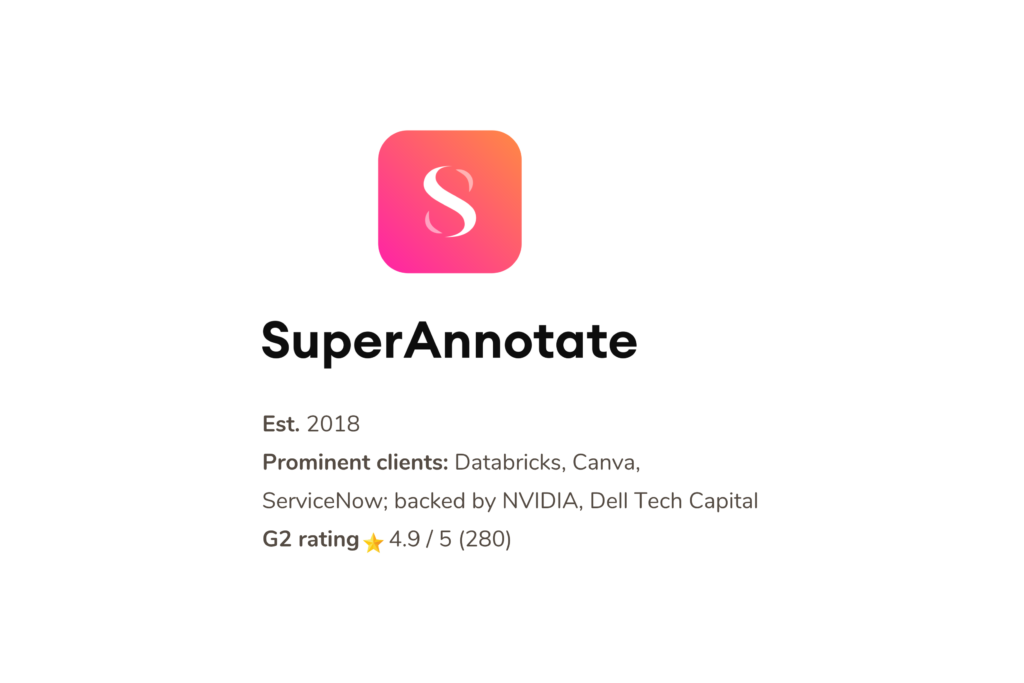
Services & features: SuperAnnotate handles complex multimodal data labeling and annotation across image, natural language, video, LiDAR, audio (speech recognition), and OCR. In particular, the platform supports LLM evaluation through the multi-step RLHF process. Via the tool, you can also access a wide range of multilingual annotation talent with diverse subject-matter expertise for proprietary LLM fine-tuning. A multi-level QA system runs continuous data quality checks.
In 2025, SuperAnnotate partnered with NVIDIA AI to integrate the NVIDIA NeMo Evaluator, a microservice for human-AI evaluation of LLMs and retrieval augmented generation (RAG) pipelines. That said, the platform also supports built-in integrations with AWS, Azure, GCP, Snowflake, and Databricks for an uninterrupted data flow.
Limitations: This software can be demanding on hardware (especially when processing large datasets), as users report minor performance and latency issues. Plus, the platform could have better onboarding walkthroughs for new engineers, given its many advanced features.
Labelbox
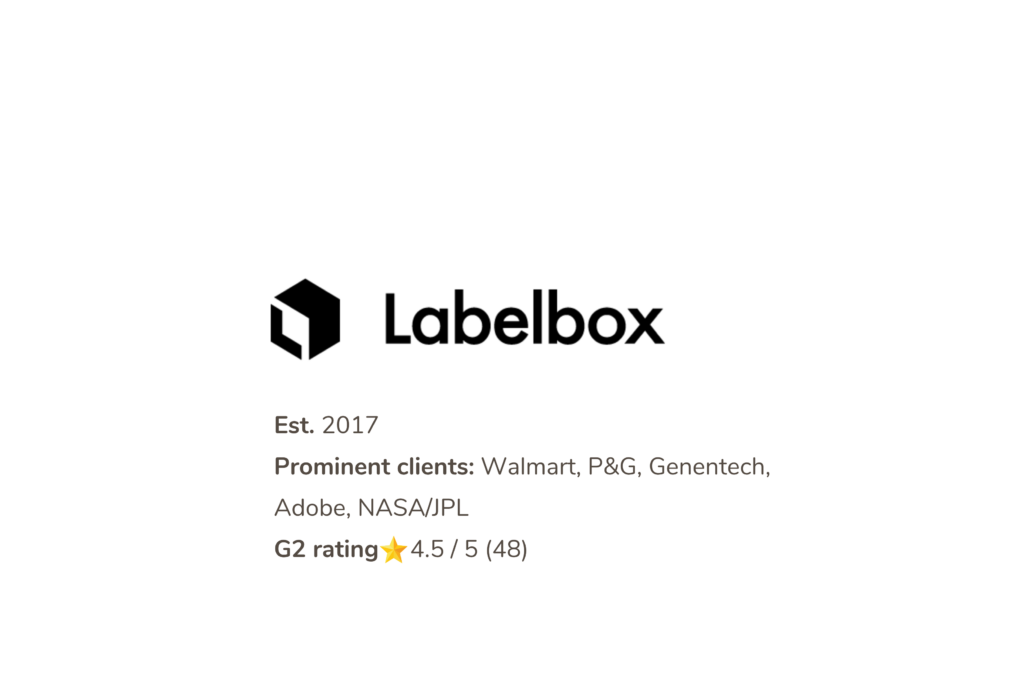
Services & features: Labelbox is best suited for research projects to evolve into production ML systems. Its strengths lie in collaboration, governance, quality control, and dataset management at scale. The platform enables end-to-end AI development services: from data ingestion, preparation, curation, and model training, to RLHF and reinforcement learning from AI feedback (RLAIF) workflows as the final post-training steps. Annotation spans multiple modalities: text, video, audio, geospatial, multimodal chat, with off-the-shelf labeled datasets (OTS) for supervised learning and fine-tuning (SFT).
With Labelbox, you can assign and track labeling tasks across teams. Automated and AI-assisted labeling features enable scalable data labeling, and no-code integrations connect to 25+ data sources, including custom databases with vector and traditional search.
Limitations: Some datasets need updating before they’re useful for training. Data Labelers also report slow output visualizations when working with large datasets.
Kili
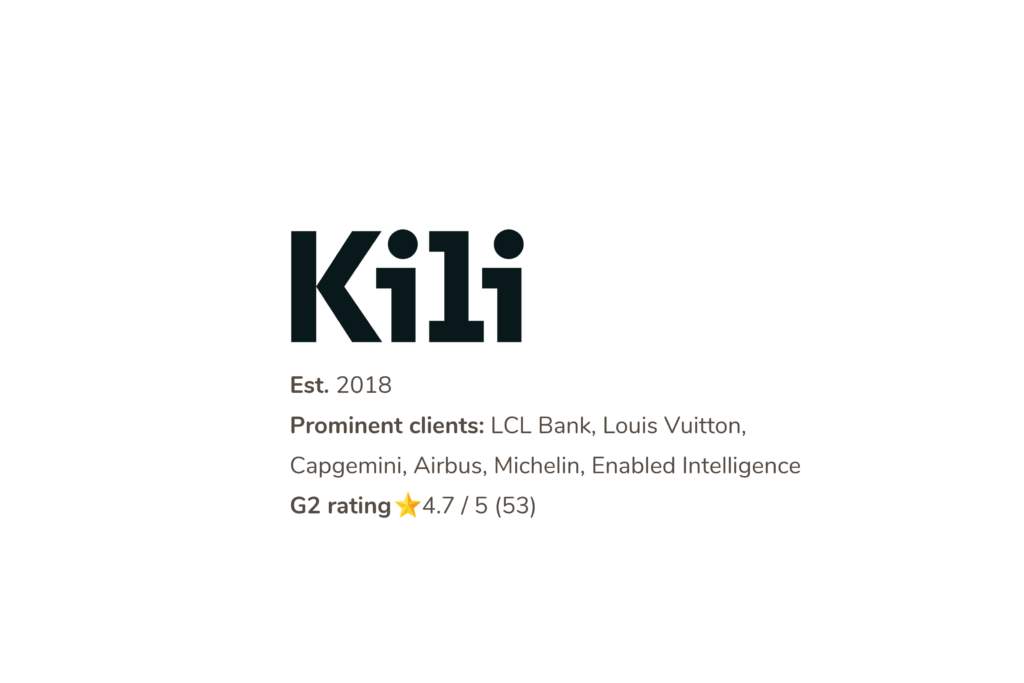
Services & features: Kili is an enterprise-focused product that works across many data modalities: text, image, audio, and video. Kili enables cross-functional collaboration (ML engineering teams can scale from 1 to 1,500 collaborators) on AI/ML projects and makes the tool appealing for business stakeholders and subject matter experts (SMEs). The UI reflects that: both technical and non-technical users tend to find it approachable.
Kili also provides advanced data analytics capabilities to track teams’ labeling progress. You can also outsource the entire data annotation lifecycle to Kili’s experts.
Limitations: Navigation can be time-consuming and needs better documentation despite the user-friendly UI. The Community edition has limited annotation capacity.
Encord
Services & features: A comprehensive data labeling tool for physical and applied AI systems with support for video, text, audio, sensor, geospatial, document, HTML, DICOM, and LiDAR data. The platform handles data collection, validation, curation, labeling, model training, RLHF, rubric-based evaluation, and retraining. For enhanced security, the tool doesn’t require data migration and ensures that the data stays in the customer’s cloud or on-premises servers. Users compare the integration of Encord with their proprietary data pipeline to a “walk in the park”. Enterprise clients note that the platform has a deep understanding of the compliance requirements. In particular, a healthtech SMB company received a full FDA submission for their medical imaging AI product.
Limitations: Users request more features and capabilities for video analysis and custom data labeling.
V7 Labs
Services & features: V7 Labs offers a separate product, V7 Darwin, for data labeling of LLMs, images, videos, documents, DICOM files, and data generation for RLHF and RLAIF. Frontier AI labs keep choosing this tool for comprehensive data labeling services. An open API, SDK, and CLI let ML teams connect V7 to their full infrastructure and keep control over their data and AI models.
The company offers enterprise-grade security with AI-powered QA processes to provide high-quality data services for financial, healthcare, insurance, and real estate industries. On V7, users can build their custom data labeling workflows for real-time collaboration and AI project data analytics. Teams can also build custom AI agents or connect existing ones via V7’s MCP.
Limitations: Occasional system lags during peak usage and sometimes complicated navigation across training datasets.
Label Studio
Services & features: Label Studio is an open-source platform by HumanSignal with programmable interfaces, Python SDK, webhooks, and open APIs for building custom ML/AI pipelines. It covers all major data modalities: natural language, images, audio, video, OCR, and time-series. Apart from comprehensive documentation and user guidelines, the platform also offers a library of pre-defined labeling templates organized by use case, modality, or industry. Teams can also tap into HumanSignal’s broader offer: 3 million+ expert annotators, data generation from scratch, and RLHF and red teaming services.
Limitations: The Community Edition plan supports 1 request per second (labeling more than 10,000 objects can take hours). Role-based access control (RBAC) and quality require the Starter Cloud plan at $99 per month.
Prodigy
Services & features: Prodigy is the go-to tool for natural language processing (NLP) and named entity recognition (NER) labeling. Built by Explosion, the team behind spaCy (33K GitHub stars), it runs locally as a Python library with a web app and is fully customizable to your infrastructure. Prodigy runs on a variety of built-in “recipes” (you can also write custom ones), Python functions that define the data annotation process. The platform also supports the model-in-the-loop and active learning approaches for AI-assisted and automated labeling processes.
Limitations: One-time payment only, no free trial. Computer vision features are limited. Getting the most out of model-in-the-loop requires Python experience and some prior training.
Comparing Multimodal Data Labeling Tools
Tool |
Pricing Model |
AI Assistance Level |
Hosting Options |
Pipeline Owner |
Security & Compliance |
|---|---|---|---|---|---|
Label Studio |
Open source |
Active learning, ML-assisted pre-labeling |
Cloud or self-hosted |
Data annotator, ML engineer; DevOps for self-hosting |
SOC 2 (HIPAA, SSO/RBAC in enterprise plans) |
Labelbox |
Free tier + subscription |
Full pipeline |
Cloud |
ML engineer, data scientist |
SOC 2, ISO 27001, GDPR, HIPAA (enterprise/workforce programs) |
Kili Technology |
Free trial for a month |
Full pipeline |
Cloud |
ML engineer, data scientists, data annotators |
ISO 27001, SOC 2 Type II, HIPAA |
Prodigy |
One-time license: |
Active learning |
Local/self-hosted |
NLP engineer, data scientist |
Self-hosted; compliance depends on the deployment environment |
Encord |
Starter, Team, and |
Full pipeline |
Cloud |
ML engineer, MLOps engineer, data annotators |
SOC 2 Type II, HIPAA, GDPR |
V7 Labs |
Custom pricing depending on features needed, number of users, or data volume |
Full pipeline |
Cloud |
ML engineer, data annotators |
ISO 27001, SOC 2 Type II, SSO/RBAC, HIPAA, GDPR, CCPA |
SuperAnnotate |
Custom Starter, Pro, and Enterprise subscriptions |
Full pipeline |
Cloud |
ML engineer, data annotators |
ISO 27001, SOC 2 Type II, CCPA, GDPR, SSO/RBAC (enterprise security) |
Pipeline owner column explained
-
- Label Studio: ML engineers and DevOps (optional). The tool is highly customizable and can be integrated into custom ML pipelines. It needs DevOps when self-hosted or connected to active-learning workflows.
-
- Labelbox: ML engineers or data scientists. Best suited for production ML environments that require dataset governance, team collaboration, evaluation, and model integration.
-
- Prodigy: NLP engineers or data scientists. Python-native tool built for active learning and iterative NLP experimentation rather than large annotation tasks.
-
- Encord: ML engineers and an MLOps engineer. Commonly used for large multimodal and video datasets where infrastructure, compliance, storage, and pipeline orchestration are crucial.
-
- V7 Labs: ML engineers. Managed platform with strong automation, API flexibility, and medical imaging workflows. It has lower infrastructure ownership than open-source tools, but still requires active pipeline integration.
-
- SuperAnnotate: Annotation teams and an ML engineer. The tool is built around QA workflows, reviewer pipelines, and workforce coordination for high-volume annotation operations.
-
- Kili Technology: Enterprise AI teams. Focuses heavily on collaboration, documentation of AI workflows, analytics, and coordination among annotators, SMEs, and ML teams.
Lemon.io marketplace is an excellent choice for hiring senior specialists to transform raw data into high-quality AI training data.
Computer vision data labeling tools
The tools above focus on most data modalities: image, text, audio, video, and multimodal data. The three below are built specifically for computer vision with image and video annotation features (polygons and bounding boxes for large-scale object detection, semantic segmentation, and classification), point clouds, and 3D data. If your pipeline is CV-first, start here.
Roboflow
Services & features: Robolflow is one of the most widely used image annotation tools, with over a million monthly website visits. The free version covers basic features to label images and videos; the Core plan at $79/month adds ML model training and deployment, both in the cloud and at the edge. Teams can build entire CV applications inside the platform without switching tools. To streamline development, the platform integrates with AI coding tools such as Claude Code, Codex, and Cursor via MCP. A standout feature: instant data export in dozens of formats simultaneously, cutting format conversion time from weeks to minutes.
Limitations: Advanced model customization still requires external tools. Pricing tiers either cap labeling quotas or jump straight to enterprise features that most teams don’t need.
Supervisely
Services & features: It’s a self-hosted data annotation platform with a wide range of customization capabilities for data labeling of images, videos, 3D point clouds, and medical imaging in various formats. The company provides its backend source code, APIs, and SDK for the ultimate control and custom feature development via Supervisely Apps. It integrates with any ML tech stack and offers a 30-day free trial without card details. Best for teams that need scalable, customizable labeling pipelines with built-in AI-powered auto-labeling.
Limitations: Requires prior experience with similar computer vision programs to ensure proper setup and customization.
CVAT
Services & features: CVAT is Intel’s open-source CV annotation tool. It supports cloud storage and doesn’t require data migration, and offers AI-driven auto-annotation and tracking to monitor human annotators’ performance. CVAT offers a free open-source version for basic annotation and an enterprise edition for custom data labeling, scalability, and advanced features. The platform has active Discord and GitHub communities for knowledge sharing and onboarding support. Teams can collaborate on projects in real time.
Limitations: Minor inconsistencies between human and AI-driven annotation results. Some latency on large datasets. Not beginner-friendly, expect some setup workarounds.
Comparing Computer Vision Tools
Tool |
Pricing Model |
AI Assistance Level |
Hosting Options |
Pipeline Owner |
Security & Compliance |
|---|---|---|---|---|---|
CVAT |
Free, open source version |
Active learning, auto-annotation |
Cloud or self-hosted |
Data annotator, ML engineer; DevOps for self-hosting |
Depends on deployment; self-hosted security controlled by customer |
Roboflow |
Free tier |
Full pipeline |
Cloud |
Data annotator, ML engineer |
SOC 2 Type II, HIPAA |
Supervisely |
Free tier in Community edition Pro from €199/mo Custom enterprise pricing |
Full pipeline |
Cloud or self-hosted |
ML engineer, MLOps engineer |
Self-hosted option; compliance customer-controlled |
Pipeline owner column explained
-
- Supervisely: ML engineer and MLOps engineer. Functions more like a self-hosted AI platform with custom apps, integrations, deployment, and infrastructure management.
-
- CVAT: Data annotators and ML engineer; DevOps for self-hosting. Powerful open-source CV tool, but infrastructure setup and maintenance become important at scale.
-
- Roboflow: ML engineer or small CV team. Managed computer vision pipeline with minimal infrastructure overhead and built-in automation.
The Real Cost of a Data Labeling Tool
The experts’ column in the tables above defines the true TCO of each tool. Open-source tools like CVAT, Label Studio, and Supervisely trade subscription fees for engineering hours. You need an expert to set up the infrastructure, write the pipeline code, configure the export logic, and keep it running as data volume grows.
Managed platforms like Encord, Labelbox, and SuperAnnotate trade engineering hours for subscription fees. Despite a prior infrastructure setup, you still need an ML engineer to connect the platform to your training framework and own the quality loop.
Lemon.io connects you with senior ML engineers, data scientists, DevOps, and data annotators who have worked in similar setups, so you’re not building the team and the data pipeline at the same time.
Here’s a rough TCO comparison when hiring an in-house ML engineer in the US vs. hiring remotely via Lemon.io.
Setup |
Tool Cost |
Engineering Cost |
Additional Costs |
First-Year TCO |
|---|---|---|---|---|
Open-source + in-house ML engineer (US) |
$0 |
$150K–200K salary + benefits/overhead |
Infrastructure, DevOps, maintenance, QA |
$190K–275K |
Managed platform + in-house ML engineer (US) |
$6K–24K/year |
$150K–200K salary + benefits/overhead |
Enterprise add-ons, onboarding, and usage overages |
$196K–299K |
Open-source + remote/contract ML engineer via Lemon.io |
$0 |
$85K–125K |
Infrastructure, coordination, maintenance |
$87K–140K |
Managed platform + remote/contract ML engineer via Lemon.io |
$6K–24K/year |
$85K–125K |
Enterprise add-ons, onboarding, and usage overages |
$91K–149K |
Disclaimer: The US ML engineer salary is based on Glassdoor, ZipRecruiter, and Robert Half 2026 data. Remote engineer costs reflect typical senior ML engineer rates based on the 2026 Lemon.io Rate Calculator. Infrastructure costs vary depending on dataset size, annotation volume, GPU requirements, and compliance needs.
If you want a full breakdown of how AI costs stack up beyond the obvious tool fees, check out this app development cost guide.