


Searching for skilled developers for your project? Most likely, you’ve already spotted Build In — a platform serving tech companies focused on hiring from the major tech hubs.
In 2026, the platform underwent several transformations, including a shift from a job board to an employer-branding tool, the integration of artificial intelligence, and the establishment of a pricing model based on job volumes and company scores.
Did Built In updates actually make it more useful for startups willing to post their IT jobs and get qualified candidates fast? Find out below, plus learn which alternatives to apply for regarding your hiring case, niche, or budget.
What Is Built In?
Built In originated in 2010 as Chicago’s tech startup community, with a website featuring a local job board and media coverage of digital innovations and the IT market.
In addition to running a community platform, Built In founder Matt Moog was hosting site-specific events for tech founders and engineers.
Two years after its founding, Built In began city-by-city expansion — investing in local tech communities in other US tech hubs. As a result, the platform expanded to 6, then to 80, local versions in the USA alone, becoming the most developed tech network nationally. Then, In Built scaled internationally — covering the UK, India, and other countries.
The other major pivot moment occurred at the beginning of the 2020s, when the platform adopted AI and introduced its Employer Brand Reputations (EBR) scores and an AI-powered corporate visibility tool.
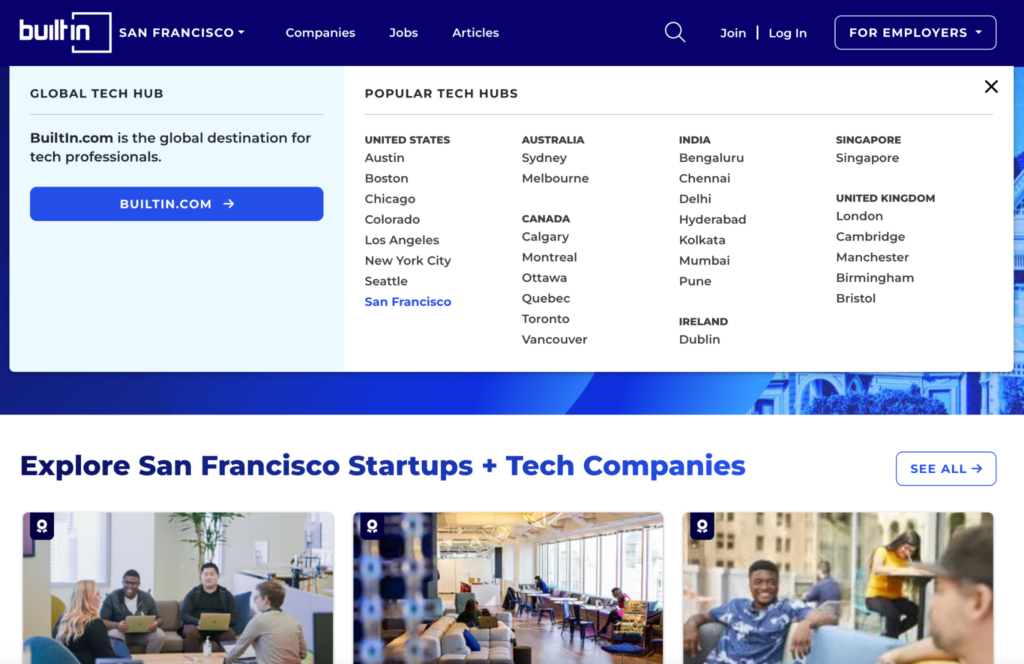
Source: Built In website, tech hub search
The job search on Built In was changing with the years. At first, the platform filled the gap in regional visibility for tech startups. Tech enthusiasts in search of interesting projects were coming to match with employers who fit them culturally.
Yet today the community has grown beyond its previous positioning.
First, because most of the jobs it offers engineers are remote, the local hiring context is now lost. Second, Built In now aims to be a tool for executing HR sales jobs, not a job board or media — with well-developed features to showcase your company and gain visibility among people in US tech hubs, including SF, NYC, Austin, Chicago, and more. For companies, Built In offers a payment-based presence.
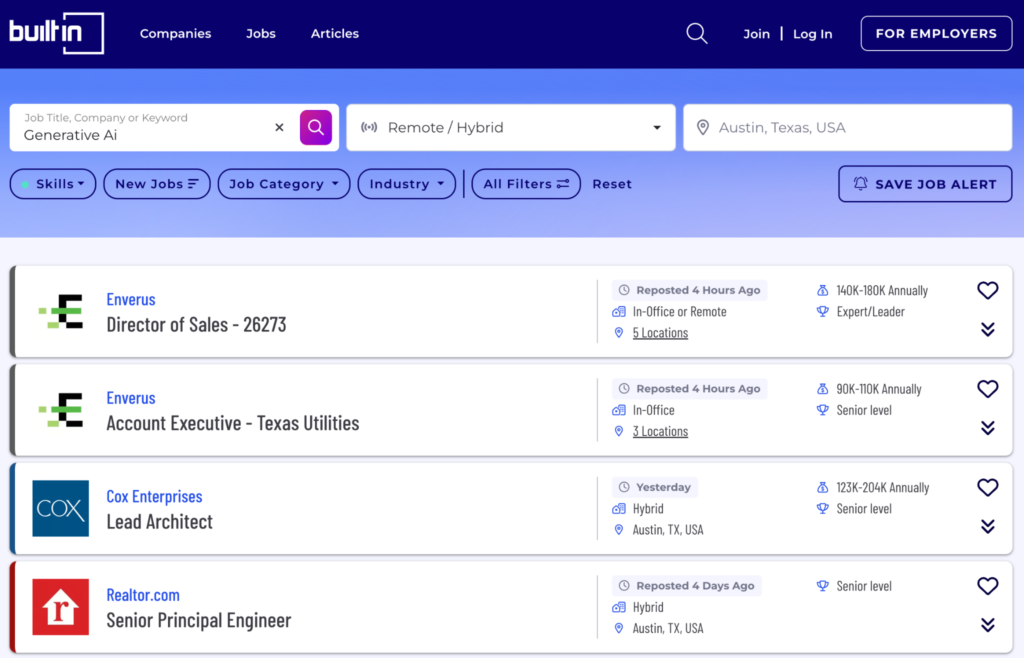
Source: Built In website, job search
In 2026, the platform serves two audiences connected to each other. The job-seekers and tech-professionals audience segment comprises millions of users globally (as cited by Built In). They come to the platform to check curated tech job listings (sometimes marketing jobs), explore content on the top or most authentic employers, and check tech news.
B2B customers include around 2,000 early-stage startups and Fortune 500 IT companies that appreciate the platform for its talent solutions, including job sourcing, employer branding, and tech events.
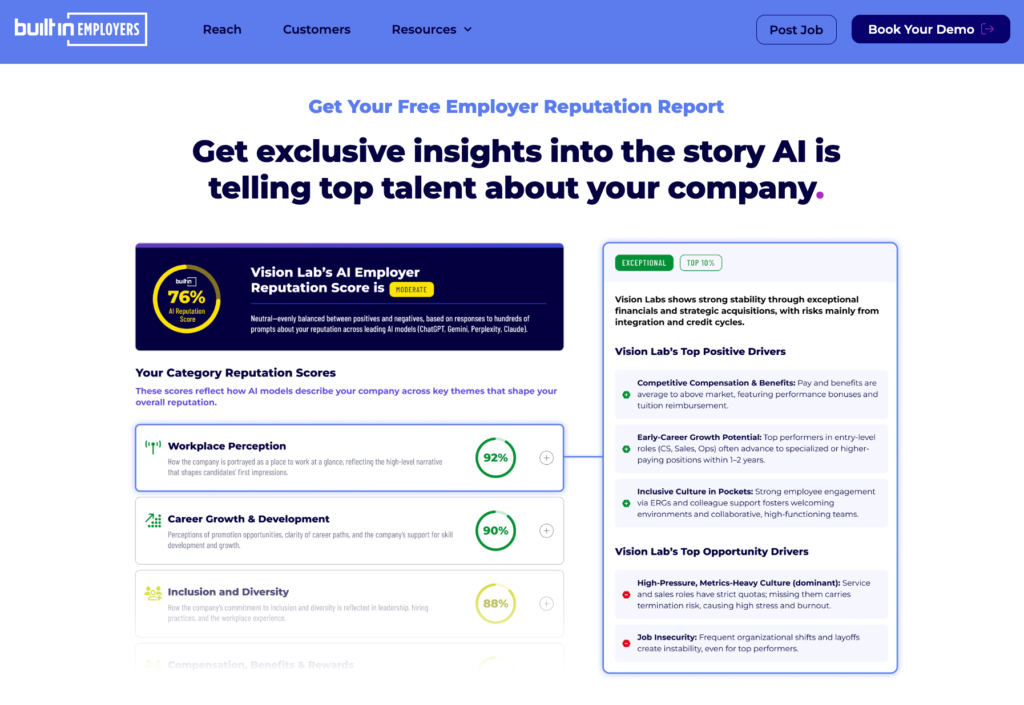
Source: Built In website, employer brand reputation features
The key difference between Built In and other similar job posting platforms is that you can hire a mobile or web developer for your startup that operates in a local tech hub environment. Yet the same thing works against you if your aim is to reach a global audience and tap into a deep talent pool.
Other peculiarity — Built In gives you the opportunity to strengthen your HR branding (similar to Glassdoor or rating platforms like Clutch) — something rare among job boards.
5 alternatives to Built In for tech job listing
#1 Wellfound
Why go there: to hire startup-interested tech talent globally
Candidate pool size: 8M+
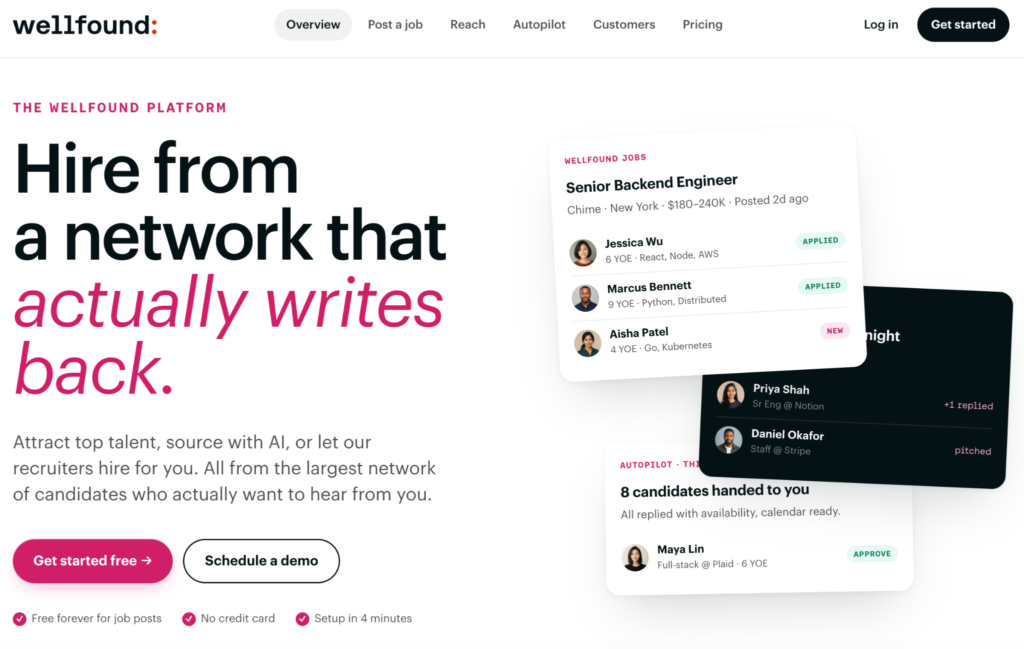
Source: Wellfound website
Wellfound (previously AngelList Talent) is one of the biggest and most well-known job boards. Founded in 2010, with over 6M+ successful matching cases and over 130K+ remote tech jobs listed, it is heavily focused on startups and startup-minded job seekers.
Wellfound has a huge, loyal community that trusts the platform and keeps an eye on new jobs. Apart from hiring, you can use Wellfound for company branding and better positioning — sharing necessary information on your employer’s page. Plus, there’s RecruiterCloud Autopilot for a simplified deep search for candidates. It delivers 5–10 relevant tech profiles per request.
Useful details: the website lets you view candidates’ detailed profiles and role preferences (including market niches, corporate culture nuances, and tech stacks).
If you find Wellfound too generic, explore the list of Wellfound alternatives.
#2 Dice
Why go there: to find US-based engineers or cybersecurity candidates
Candidate pool size: 7M+
The platform has been active since 1990 and is the longest-running job board still operating, focused on tech roles. Dice is specifically about the US tech talent market, so expect the salary bar to be higher than on other global platforms.
On the website, there are two main products. First is a classic tech job board. The second one is the TalentSearch tool — a database that can be filtered by specific languages, tech certifications, years of experience, salary benchmarks, or extra skills.
Dice is mainly useful for companies hiring for rare cases. Biotech jobs, cybersecurity jobs, or custom machine-learning engine building are examples of these. Expect fewer irrelevant applications for your post due to the platform’s tech-only positioning. There’s no free plan for employers on Dice.
#3 We Work Remotely
Why go there: to close senior-level and foundational positions remotely
Candidate pool size: 4.5M+
Source: We Work Remotely website
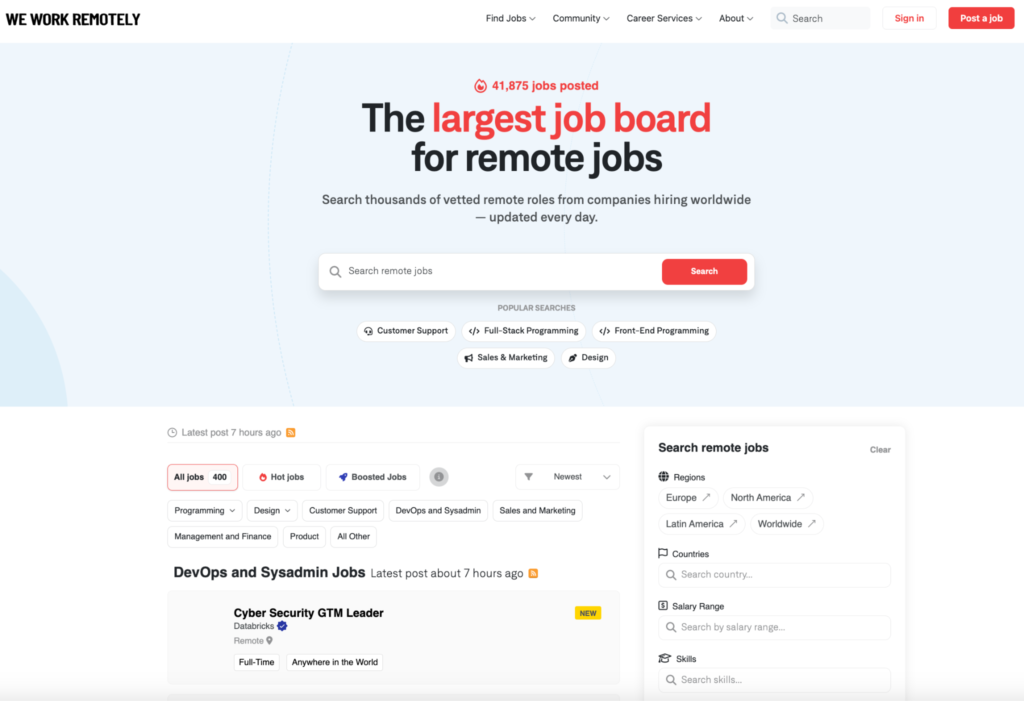
We Work Remotely is one of the closest alternatives to Build In — narrower than Wellfound, yet with an active global community. The platform was launched in 2011, and its reputation is built on high-quality job listings together with community activities — events, special projects, research, etc. Besides, there is a media section featuring news, updates, and first-hand industry insights.
The key difference is the platform’s global coverage and remote-work focus, which is an advantage if you plan to hire dedicated developers or are looking for the right people for hybrid jobs.
Unlike Dice, We Work Remotely spans several industries, so product manager jobs, ecommerce marketing positions, or design-related roles are also welcome here. However, job postings are not free and require a flat fee. The employer branding functions are almost absent, which means you should either obtain a well-known name or offer candidates competitive salaries.
Struggling with crafting text for engineering and QA jobs? Try Lemon.io MCP and transform your requirements into structured role descriptions.
#4 Indeed
Why go there: to reach out to huge volumes of candidates fast, across several roles
Candidate pool size: 300M+ (all industries, including design & UX jobs and more)
Source: Indeed website
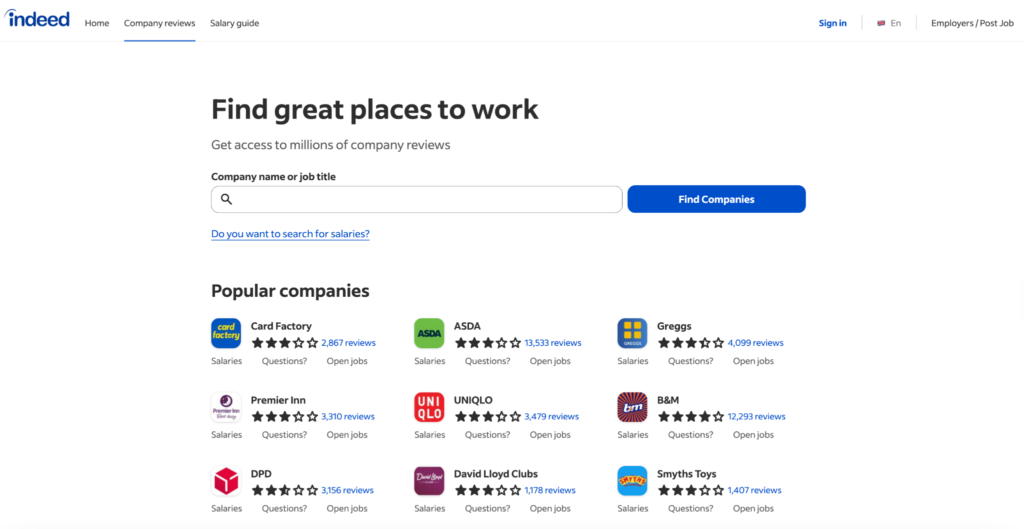
Indeed is the most powerful global job board in terms of traffic, listing volume, localization, and the industries it represents.
Founded in 2004 as a general job platform, it delivers satisfactory results for “popular” tech stack hiring and serves as a default option for casting a wide net and hiring teams of specialists across development, design, analytics, DevOps, and more. Yet it is the wrong choice if you need just one or two developers skilled in building custom AI solutions.
Indeed dominates the job search landscape in many countries and offers free posting plus applicant tracking. However, for data science jobs or highly regulated areas like healthcare tech or finance, filtering applications can become time-consuming.
The key difference from Built In: The platform aggregates information from companies’ career sections, other job boards, and employer-shared content directly with Indeed. Then, job seekers see custom listings and apply for roles. To improve visibility for candidates, you can post sponsored content.
#5 Juicebox
Why go there: to save time on candidate sourcing by leveraging AI for deep search
Candidate pool size: 800M+ candidates across 30+ sources
Source: Juicebox website
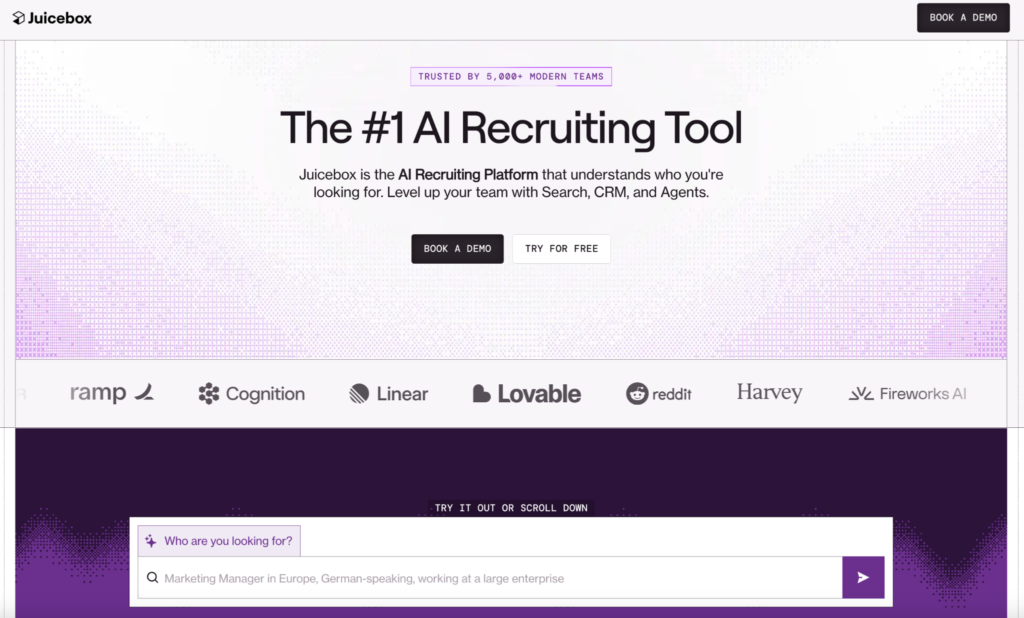
Juicebox (formerly PeopleGPT) is not a job-posting tool, but it serves the same function: delivering your CVs of startup-ready tech talent.
The flow starts with you explaining your needs in plain language, and the chatbot transforming them into a proper hiring request, with the market field, tech stack, engagement model, and your budget clarified.
Then, you have email templates to craft your messages for the engineers you find relevant.
Juicebox is purely an AI-native search tool that operates third-party candidate bases and does not maintain its own vetted candidate pool — vetting software and hardware professionals is still on you. The agent just identifies people who might be interested in your open jobs by scanning their skills, professional activity, and overall positioning.
Using features like Find Similar Profiles and Talent Insights, you can save a significant amount of time on filtering people from Juicebox. The free plan has a limited number of searches, and the paid plan enables integration with your CRMs.
3 Built In alternatives for better tech employer branding
Built In was founded as a community platform with strong potential to help employers simplify their hiring in the long run and ensure a steady flow of quality candidates whenever they need them. However, to become one of the best places to work for tech talent in the key tech hubs worldwide, it is better to be active through several platforms, not just Built In.
#1 Glassdoor
to gain trust and stay transparent
Source: Glassdoor website, company profile
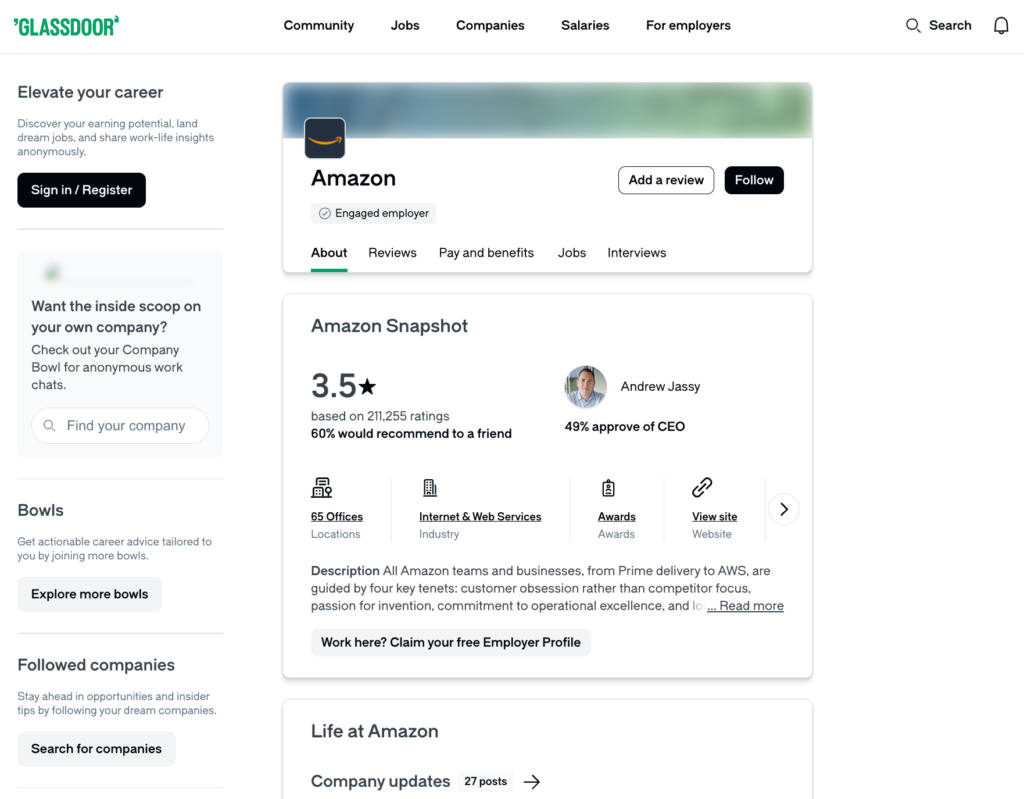
Glassdoor is a go-to platform for both individuals and companies to study the job market, benchmark salaries, and learn how competitors are doing in HR.
Bonus for you: it is also a job marketplace. Most of the 50M+ Glassdoor users visit the platform to find workplace insights from reviews by real employees. That’s the factor that makes Glassdoor so trustworthy.
There’s no way you can influence what your current team members are writing on Glassdoor about you, but you can push them to share their coworking impressions — especially if you are sure their opinion is positive. In our other articles, we walk you through the quality of tech hiring metrics and explain how to measure the satisfaction level of your team before it is too late.
#2 LinkedIn Recruiter
to get maximum visibility
Besides being a profession-first social media platform, LinkedIn offers paid features for recruiters and hiring managers — Recruiter Lite, Recruiter Professional, or Recruiter Corporate — that differ in price and monthly outreach credits.
Keep in mind that to encourage candidates to proactively apply for your positions, you need to create a strong corporate profile and be active on social media (engage in professional discussions, share unique and insightful articles, and maintain visual and stylistic consistency across your posts). The main idea behind LinkedIn is networking, so strengthen your employer brand by linking real people who already work for your startup or partner with it in your content.
#3 Welcome to the Jungle,
to stand out with your corporate culture, in Europe
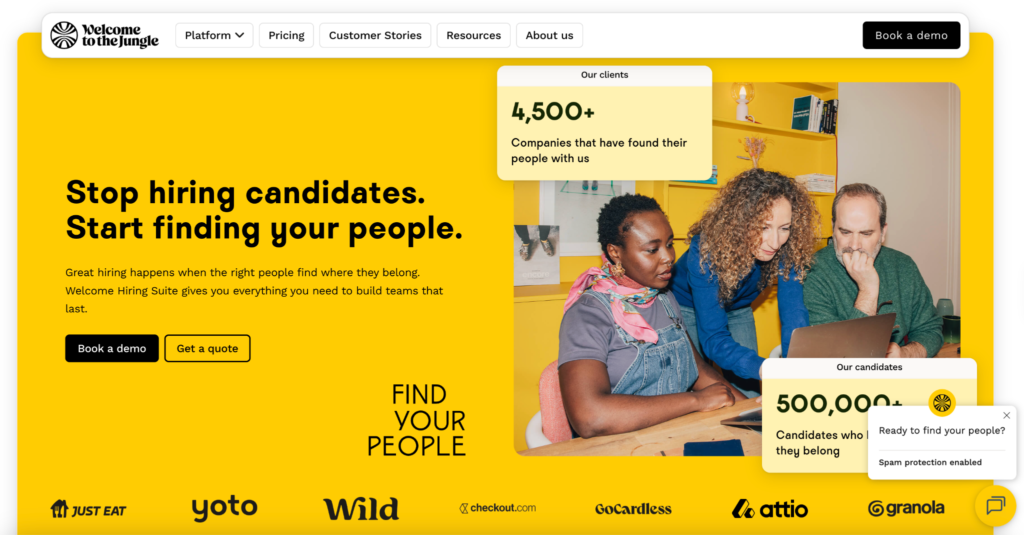
Source: Welcome to the Jungle website
Most of modern job boards are still significantly focused on hard skills, certifications, and experience. Welcome to the Jungle offers you a different approach. This culture-first employer branding platform, with a half-million-strong European audience of tech talent and over 4 K companies from the UK, France, and the US, treats corporate stories as engaging narratives.
Business profiles on this platform are different from what you have on Built In or even LinkedIn — they are cinematic, full of videos, manifestos, well-illustrated articles, and dynamic content that tells the vibe of the companies to potential employees.
With a Welcome to the Jungle profile, you can convert desired tech talent into a team member much more quickly. With a lower risk of cultural mismatch in later stages.
What are some Built In alternatives for finding tech jobs & tech talent locally?
When it comes to emerging information technology and AI specifically, the global talent shortage gets worse, and the competition for top specialists intensifies. For some industries, such as FinTech, healthcare, and state security, you might just not find the person you need just by using a job board and investing in your recruiter’s brand.
Moreover, for high-trust foundational roles — like CTOs and the first full-time, full-stack developer who needs to invent your product architecture — the best option is to get people through networking.
Here’s the list of the top communities for local tech (all at the major tech hubs), which can be a great alternative to Built In sourcing:
- South Park Commons (San Francisco)
An old, well-established, and highly selective community of 1K+ experienced, known for its exceptional concentration of senior founders, engineers, and researchers between ventures. The community is known for its informal “camps” that bring together world-class tech experts and visionaries, giving birth to numerous successful projects in the US. Good for filling in machine learning jobs.
- NY Tech meetup (NYC)
One of the world’s largest tech meetup communities, with 60K+ members spanning founders, engineers, product leaders, investors, and operators through recurring startup demos and networking events. Events are regular and thematic. Finding a candidate from there means you will work with someone who really keeps an eye on innovation.
- Silion Roundabout (London)
A large startup and deep-tech community of 15K+ founders and engineers, connecting technical talent with startups, investors, and entrepreneurs through regular meetups and events. You can find a dedicated event to source tech talent for your systems engineering roles or other roles. The community is part of East London Tech City, a cluster of London-based companies specializing in deep tech or with broad coverage (Facebook, Google, Intel, McKinsey, Amazon, and more). This community is powerful enough to help you fill mechanical engineering jobs.
Learn about tech communities focused on Java, read here.
Cut the candidate sourcing and vetting time with Lemon.io
Build In or its alternatives work for you if you have enough time to post senior software engineer jobs, budget for ongoing brand-related activities to attract quality candidates, and in-house skills to vet potential team members.
And if you’d rather skip 6-week-long hiring cycles and delegate sourcing and vetting to someone else you can trust, here’s Lemon.io, a marketplace alternative to Built In, that enables you to hire senior developers from a pre-vetted pool of 1,500 experts across 100+ tech stacks.
The hiring flow with Lemon.io looks like this:
- You send us your hiring request — instead of posting developer or project manager jobs on Build In or Wellfound boards;
- In less than 48 hours (most likely — in less than one day), you will receive 1–3 vetted candidates’ profiles with an explanation of why they fit your project;
- You conduct the final cultural fit interview and make the final hiring decision.
The tech vetting, background checks, NDAs, contacts, and more are on Lemon.io. The engagement with your developer is a monthly subscription-based service, with you paying only for the hours the engineer spends on your project, and the hours are reported (the tracking system is integrated with our platform).
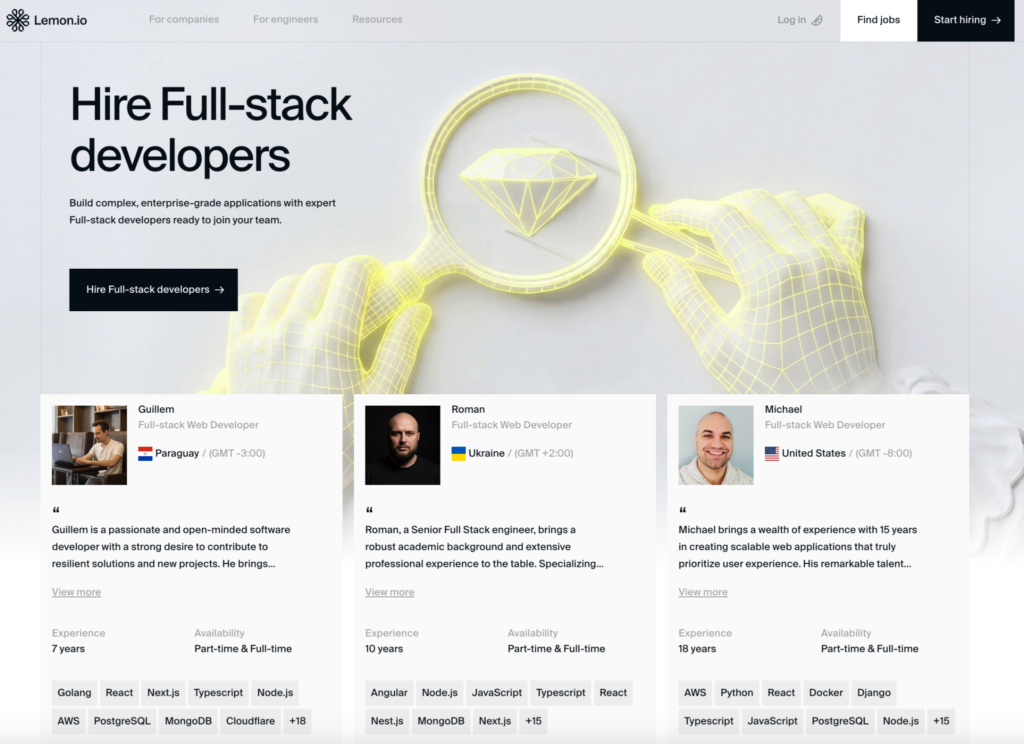
Source: Lemon.io website
And if you want to hire in-house from our vetted candidate pool, we offer that option as well.