


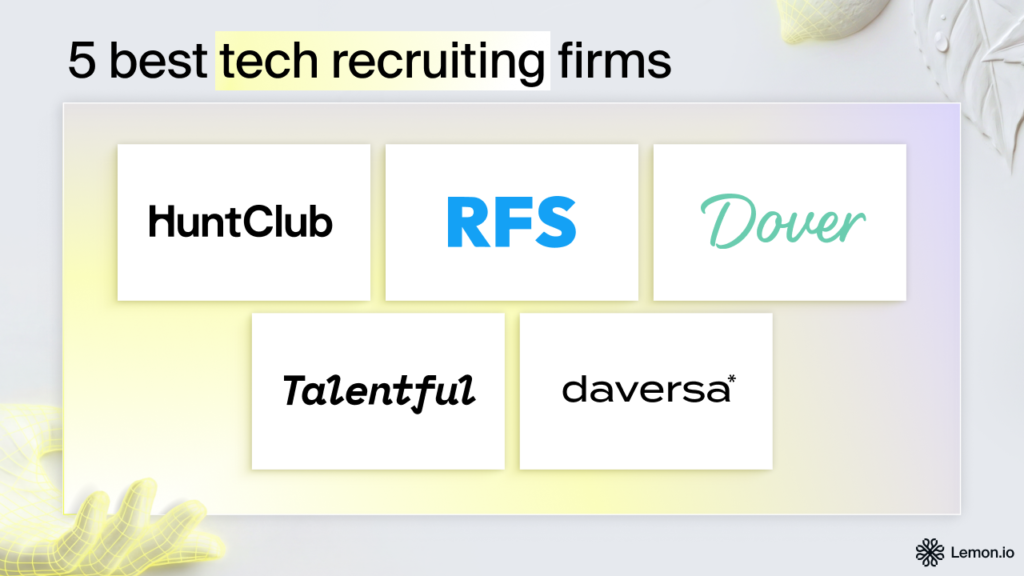
Kforce, TEKsystems, Robert Half, Insight Global, Randstad, Motion Recruitment, and other recruiting giants are already well known in business circles. We’re skipping them on purpose and focusing on smaller alternatives that work specifically with startups and SMBs. Below are five hand-picked professional recruiting firms that stand out in tech hiring.
Sneak peek: Core comparison criteria
| Company | Time-to-hire | Fees | Hiring focus | Search model | Replacement guarantee | Exclusivity contract |
|---|---|---|---|---|---|---|
| Talentful | First hires within weeks | Fixed monthly fee | Tech, AI, product, GTM | Embedded RPO subscription | Not placement-based | Not publicly disclosed |
| Recruiting From Scratch | ~29-day average hire | % of first-year salary | Engineering, AI/ML,product | Contingency + retained | 90 days | Optional by agreement on both sides |
| Daversa Partners | ~115-day average search | ~33% of compensation | C-suite, tech, GTM | Retained executive search | Terms not disclosed | Typically exclusive |
| Dover | Varies by recruiter | ~$2K–$7K fractional | Varies by recruiter | Hourly, retained, contingency | Up to 90 days | Depends on agreement |
| HuntClub | ~21 days to shortlist | Custom retained fee | Executives, VPs, directors | Retained executive search | Not publicly disclosed | Typically exclusive |
If you want to consider more companies before making the final decision, here’s our comparison of 10 IT staffing firms, where we also cover in detail the additional KPIs worth paying attention to and give experience-backed tips on how to avoid fraud.
#1. HuntClub
The company has a curated network of more than 30K business leaders, investors, and executives who help their recruiters connect clients with top-tier talent and reputable C-level candidates. HuntClub’s relationship-based approach generates a 3x higher response rate for expert-referred outreach than cold outreach.
HuntClub combines these warm introductions with AI-powered relationship mapping to identify both suitable candidates and the strongest path for reaching them. Rather than sourcing only individual executives, the company also provides end-to-end team buildouts across engineering, product, finance, GTM, operations, and other functions.
#2. Talentful
Talentful provides embedded recruitment services for startups, scaleups, and enterprises. IT recruiters work as an extension of the client’s internal talent acquisition (TA) team. With headquarters in New York, London, and Berlin, Talentful helps businesses hire high-quality tech experts worldwide.
Unlike traditional agencies that charge per placement, Talentful operates on a fixed monthly subscription. Their hiring model is therefore better suited to companies with an ongoing hiring roadmap that need additional recruiting capacity without expanding their permanent TA headcount. Talentful also uses proprietary GenAI technology to support candidate matching and hiring workflows.
#3. Recruiting From Scratch
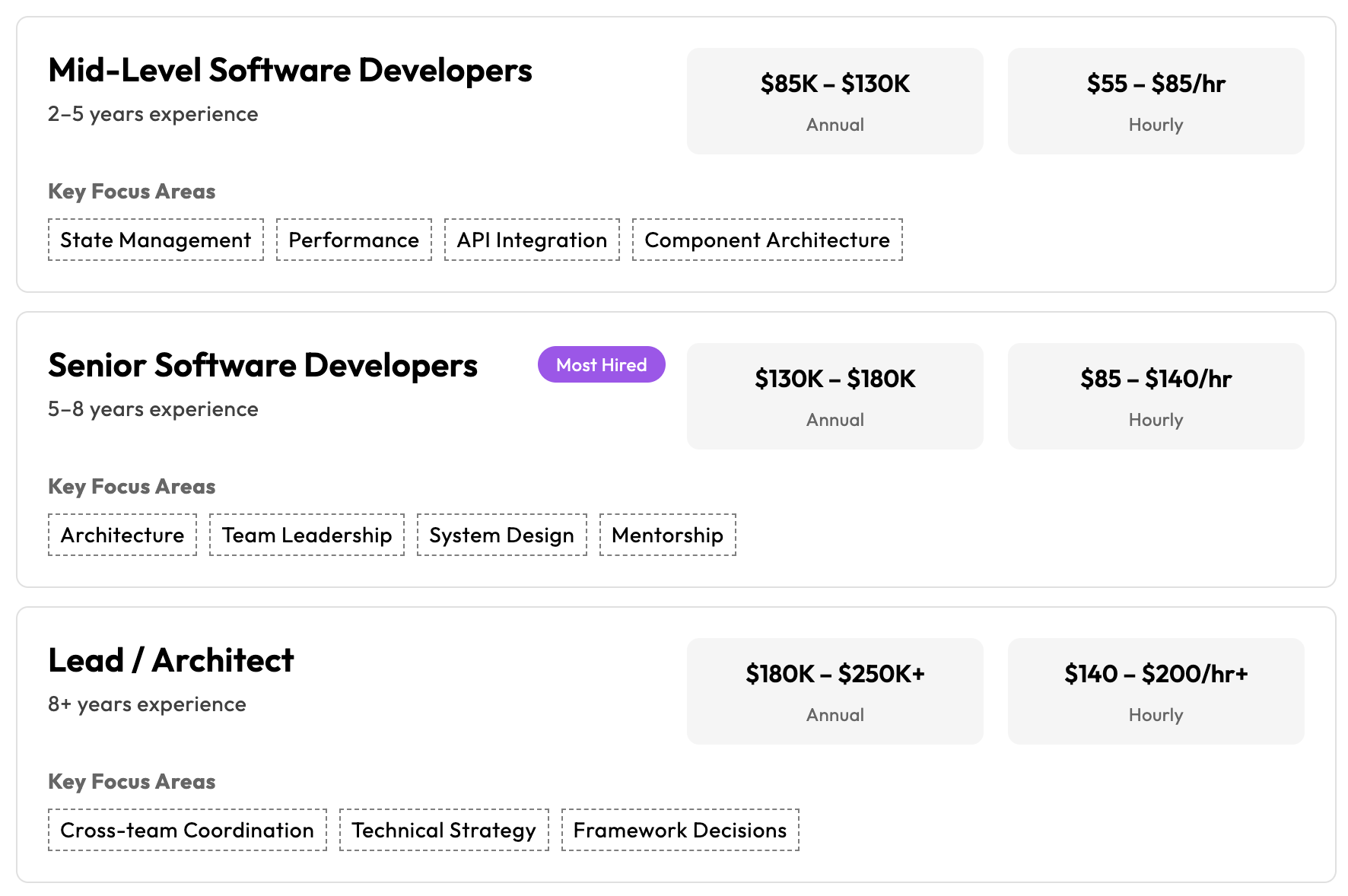
The company’s CEO defines their recruitment specialization as follows: “a true partner for hiring forward-deployed engineers, software engineers, deployment, or operations in SF / NYC.” These roles are often highly specialized, which makes precise sourcing and candidate assessment especially important. In 2026, the agency has started to rely heavily on AI agents to speed up searches and tailor them more closely to each customer’s requirements, while human recruiters focus on deeper conversations with IT professionals and long-term client relationships. They also offer a salary aggregator with median salaries across major tech companies worldwide.
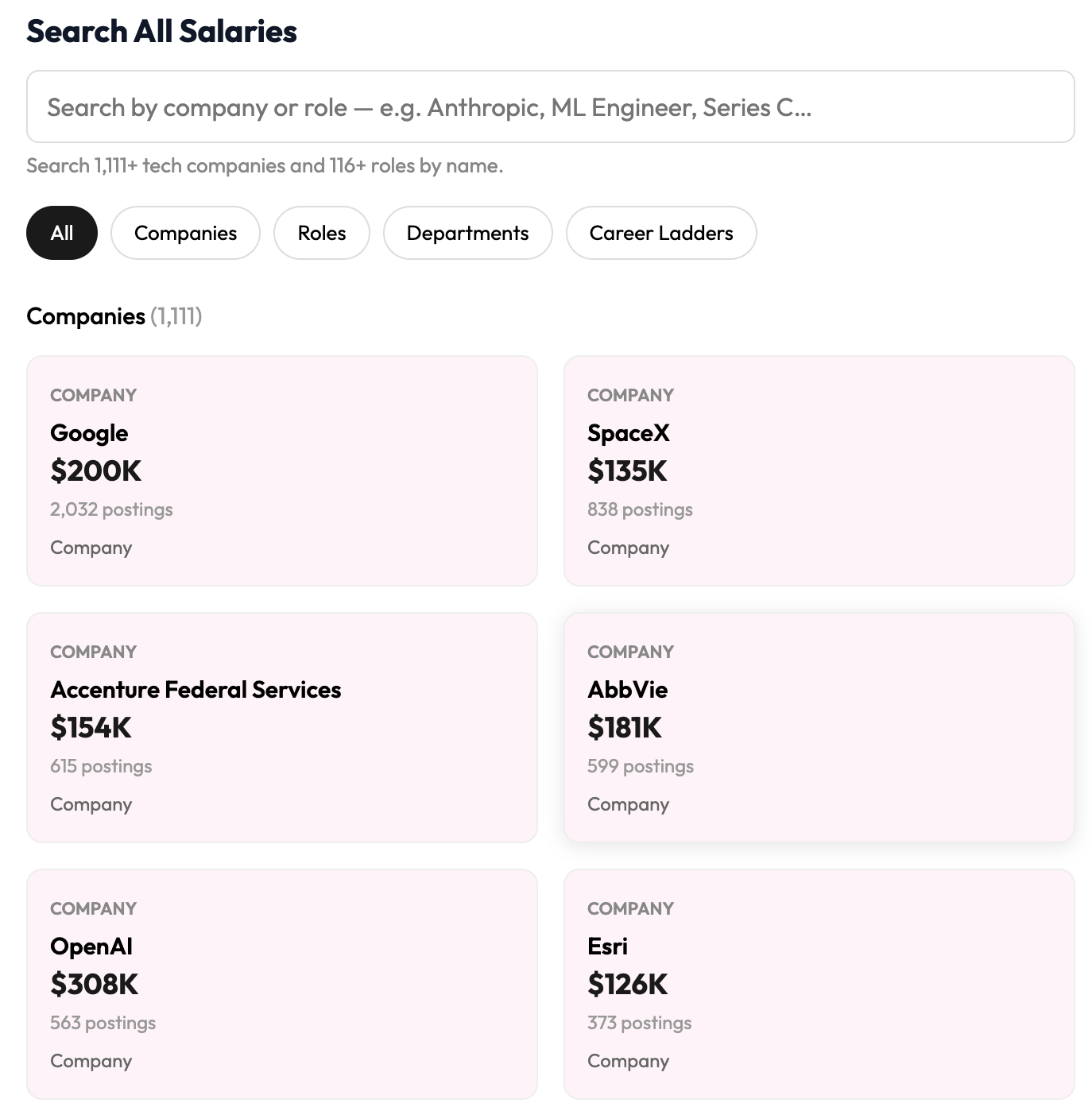
Check out Lemon.io’s salary report that draws on data from 2,400+ developers and breaks compensation down by specialization, skills, and platforms.
#4. Daversa Partners
The company’s CEO, Paul Daversa, founded the firm after years of experience building relationships with executives, founders, and business leaders. Daversa now specializes in retained executive search for venture-backed and growth-stage companies, with particular strength in C-suite and VP-level technology hires.
They have worked on building leadership teams for OpenAI, Cursor, CoreWeave, Replit, Snowflake, Figma, Mercor, and Physical Intelligence. In 2026, the firm has also positioned itself as an AI-first executive search company, using AI across talent mapping, candidate evaluation, market intelligence, and search strategy.
#5. Dover
Dover is a recruitment marketplace that allows businesses to directly contact recruiters without any intermediaries. The core specialization is a network of vetted fractional recruiters combined with a free applicant tracking system (ATS). The platform allows hiring managers to distribute vacancies across more than 100 job boards, centralize applicants, and request recruiting support only when needed.
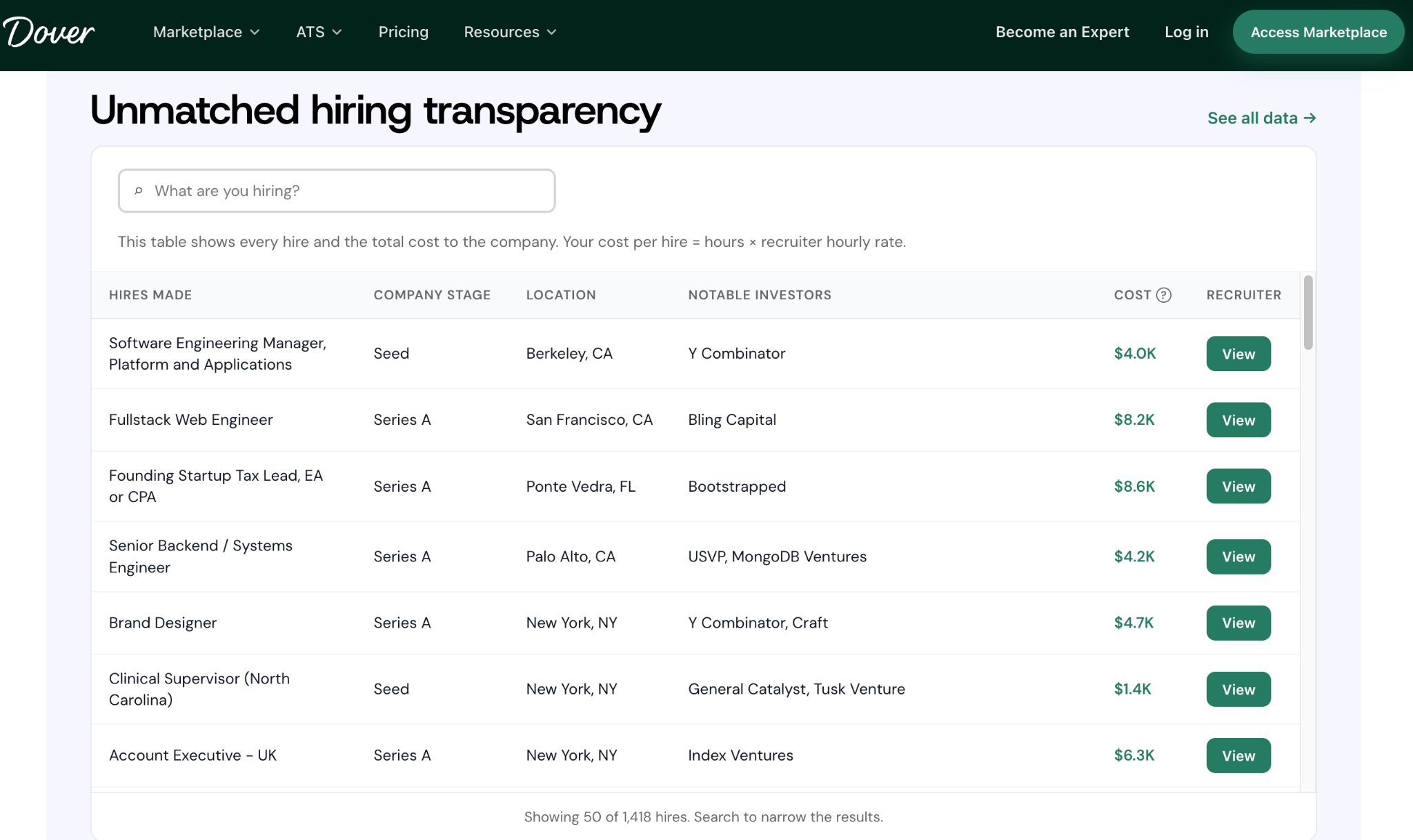
Dover gives companies more control over both cost and recruiter involvement than a traditional agency. Businesses can hire recruiters hourly, on a weekly or monthly retainer, or on a pay-per-hire basis, and can compare recruiters directly through the marketplace. Dover reports an average marketplace cost per hire of $4.8K.
When recruiting can turn into a money pit
The right, cost-effective recruiting model depends on what you are hiring for. The wrong recruiting model can make the same hiring need unnecessarily expensive.
For example, paying a 25–30% contingency fee on every hire can become costly if you need 15 engineers, while paying a monthly RPO fee makes little sense if you only need one specialist. Likewise, a retained executive search may be justified for a CTO but excessive for a mid-level developer.
Contingency search means you pay the recruiter only after making a hire. It works well for occasional vacancies and keeps upfront risk low, though agencies may work on several searches at once and usually don’t offer the same search depth as retained firms.
Retained search means paying part of the fee upfront to secure a recruiter’s dedicated attention. This model is better suited to senior, niche, or business-critical positions that require deeper market mapping, proactive outreach, and a more exhaustive search.
Embedded recruiting or RPO places external recruiters inside your hiring process for a fixed period or an ongoing engagement. They can manage sourcing, screening, coordination, reporting, and other recruitment operations, which makes the model useful when hiring is continuous or your internal team needs additional capacity.
Fractional recruiting gives you access to a recruiter for a set number of hours or days without hiring them full-time. It sits between an agency search and an internal recruiter, making it useful for software development companies with fluctuating hiring demand that still want hands-on recruiting support.
Before choosing a provider, compare the total cost of the engagement, replacement terms, exclusivity requirements, expected time to shortlist, and how much of the hiring process the agency will own.
Match the agency to your growth stage
Here’s what you should take into consideration depending on your business growth stage.
Seed and early-stage startups. Prioritize the cost of a wrong hire. In the AI-powered tech industry, even one engineer can be central to the development team, so technical vetting and relevant startup experience can be more impactful than the size of the candidate database a recruiting vendor offers. Check how quickly the company delivers shortlists and whether they have flexible engagement terms and clear replacement guarantees.
Series A companies. Hiring becomes repeatable. Instead of filling one role at a time, you may need several engineers across front-end, back-end, DevOps, data engineering, or AI. Look at pipeline consistency, recruiter capacity, average time to fill, and whether the agency can support several searches simultaneously without compromising on quality.
Series B and later-stage startups. At this stage, you might be hiring staff engineers, engineering managers, security specialists, or niche AI talent while introducing more structured procurement and reporting. Look for an IT staffing agency with role-specific recruiting expertise, measurable SLAs, reporting, and experience working with larger hiring teams.
SMBs. Here, the stakes are getting even higher. Hiring needs can change quickly, while recruitment resources are often limited. Look for providers with transparent pricing, flexible engagement terms, reliable replacement policies, and strong vetting practices, including how they handle candidate data, access, and security requirements. The best fit is usually a recruiting model that gives you access to the right IT talent when needed without adding permanent hiring overhead.
Decision framework for SMBs and startups
The cheat sheet below includes key KPIs to consider, the hiring model, and red flags to watch out for.
| Scenario | Prioritize | KPIs to consider | Best-fit recruiting model | Watch out for 🚩 |
|---|---|---|---|---|
| You need one critical hire quickly | Candidate quality, technical vetting, shortlist speed | Time to shortlist, interview-to-hire ratio, replacement policy | Contingency, contract-to-hire, or success-based search | Agencies sending large volumes of loosely matched candidates |
| You are hiring several engineers over the next 6–12 months | Pipeline consistency, recruiter capacity, repeatability | Time to fill, hires per month, candidate acceptance rate, retention | Retainer, embedded recruiting, or RPO | Pricing that becomes expensive as hiring volume increases |
| You need a senior, niche, or difficult-to-reach specialist | Market expertise, sourcing reach, recruiter specialization | Relevant placements, candidate response rate, search completion rate | Retained or specialist executive search | Generalist agencies without experience in the required stack or role |
| Your internal team has little recruiting capacity | Process ownership, scheduling, sourcing, candidate communication | Time saved internally, pipeline conversion, reporting cadence | Embedded recruiting or RPO | Providers that still require your team to manage most of the recruitment process |
| You need predictable hiring costs | Transparent fees, replacement terms, scope clarity | Cost per hire, total recruiting spend, replacement cost | Fixed-fee, subscription, or clearly scoped retainer | Percentage-based fees that become expensive for senior hires |
| Your hiring needs change frequently | Flexibility, low commitment, ability to scale up or down | Time to activate new searches, minimum commitments, cancellation terms | Fractional recruiting, marketplace, or flexible retainer | Long contracts and minimum search volumes |
| You are building a long-term engineering team | Candidate retention, culture fit, communication, long-term sourcing | 6- and 12-month retention, probation pass rate, repeat-hire rate | Embedded, retained, or long-term recruiting partnership | Agencies focused only on filling individual vacancies |
And if you need a one-off team extension with a skilled expert while retaining full project management control, consider staff augmentation services.
Lemon.io as an alternative: From self-serve sourcing to managed delivery
Companies are putting more money into tech hiring, but knowing who to hire is getting harder. 53% of surveyed tech companies planned to increase their hiring budgets in 2026 (compared with 37% in 2025 and 26% in 2024). Our own research on AI jobs shows how quickly the talent market is fragmenting. AI-related mentions in Lemon.io client hiring requests have more than doubled, while once-broad roles such as “AI engineer” are splitting into specialists focused on AI integration, ML, LLMOps, and AI-assisted development.
That means not every company needs the same recruitment strategies. Sometimes you already know the exact specialist you need and only want help with sourcing and vetting. Other times, you need a trusted partner to define the search, find the candidate, onboard them, and stay involved after the hire.
Lemon.io is a talent marketplace rather than a traditional technology recruitment agency. You can choose how much of the process you want to own, from searching a self-serve database of pre-vetted senior tech talent to outsourcing recruiting, onboarding, and delivery management.
If you already know what you need and want to control the interviews and final selection yourself, you can browse senior candidates who have already passed technical and soft-skill vetting and start hiring within 24–48 business hours.
If the right specialist isn’t immediately available, we switch to end-to-end recruiting. Our team sources candidates across major job boards and our broader tech community, including referrals from developers who already know and trust the people they recommend. This expands the search beyond active applicants without leaving your team to screen large volumes of unsuitable profiles.
For companies that want to outsource more than sourcing and vetting, Lemon.io also supports staff augmentation and managed services with contract staffing or direct hire opportunities. We can take the process from candidate search and assessment through onboarding, or add a delivery lead or product manager who works alongside the new hire, coordinates execution, and keeps the work tied to the expected business result.
The difference is the level of control you keep. Use Lemon.io as a vetted talent database, hand over the entire recruitment process, or extend the engagement into ongoing delivery and technical support, depending on what your internal team already covers.