












































You can build an in-house hiring pipeline yourself, just like you can renovate your own kitchen. Both are perfectly possible. But both require time, expertise, and a willingness to fix expensive mistakes along the way. As a result, 65% of technical hiring managers find it more difficult to hire skilled experts than a year ago.
Lemon.io makes back-end hiring simpler for hiring managers, CTOs, and tech leaders across industries and countries. We handle sourcing, technical vetting, and matching before a candidate ever reaches your calendar, so you spend your time interviewing engineers who already meet the bar and have genuine real-world experience. While our service has an upfront cost, it often costs less than weeks of internal hiring, a bad back-end hire, and starting the search all over again.
The cost of a back-end hire doesn’t end with their salary. Every architectural decision they make affects your roadmap, cloud bill, development speed, and ability to scale. Choosing the right engineer upfront is usually cheaper than untangling years of technical debt later.
Back-End Developer vs. Full-Stack Developer
Many companies list “back-end developer” as the job title, but during interviews, they discover they need a full-stack engineer. Candidates feel frustrated when the interviewer starts asking about Angular components or React state management instead of APIs, databases, distributed systems, and server-side architecture.
If your project also requires building UI components, owning frontend features, or working across the full stack, that needs to be clearly stated in the title and the brief.
However, you can still check whether a back-end developer understands basic frontend concepts. Most senior back-end engineers have enough familiarity with HTTP, browser-server communication, authentication flows, and JavaScript to collaborate effectively with a frontend team. But that’s different from expecting them to ship production-level React or Angular code, as frontend developers do.
Key Skills to Look for in Back-End Developers
When we vet back-end developers for hire, we test for a specific combination of technical skills and soft skills. The technical bar filters out almost 40% of applicants. The rest get filtered on problem-solving ability, communication skills, and architectural thinking.
Technical Skills
Beyond basic proficiency in a server-side language, here’s what separates the best back-end developers from average ones:
- Database design and optimization: Can they normalize a schema, write efficient SQL queries, and explain when to use PostgreSQL vs. MongoDB vs. Redis for a given use case?
- API design: Building RESTful APIs is the baseline. Do they understand GraphQL trade-offs? Can they version an API without breaking existing clients and design APIs that remain stable as products evolve?
- Infrastructure awareness: Docker, Jenkins, Kubernetes, CI/CD pipelines, and basic DevOps. A back-end developer who can’t deploy their own code creates bottlenecks.
- Version control discipline: Clean commit history, meaningful PR descriptions, and branch strategies that help teams maintain high code quality as the codebase grows.
- Security fundamentals: Authentication patterns (OAuth, JWT), input validation, and an understanding of OWASP top-10 vulnerabilities.
Soft Skills
A back-end software engineer needs to explain a technical decision to a non-technical founder in plain language. They need to push back on unrealistic timelines without being adversarial and write documentation that a new hire can follow.
We test for communication skills because a brilliant programmer who can’t collaborate will only slow you down. Problem-solving under ambiguity or pressure is also important. The best dedicated back-end developers are the ones who ask clarifying questions before writing code.
Back-End Programming Languages, Frameworks, and Tools: Python, Node.js, Java, Rust, and PHP
Based on current hiring discussions, engineering blogs, Reddit threads, and what hiring managers increasingly emphasize, we’ve discovered what businesses expect from a back-end tech stack and how to hire a pro in the saturated AI-driven market.
Python
Python remains the default choice for startups and SaaS products thanks to frameworks like Django, Flask, and FastAPI. Its biggest advantage is versatility: the same developer can build back-end services, automate workflows, process data, and integrate AI capabilities. When you hire a Python developer through Lemon.io, we verify they know more than just the language. We assess their familiarity with modern tooling such as Supabase, Docker, and GitHub Actions.
Recent requirements: Strong Python developers are increasingly expected to understand the latest tools, such as uv for dependency management, Pydantic v2 for data validation, and how to integrate LLMs into production systems with proper observability, retries, and cost controls.
Interviewers test candidates on system design and production thinking rather than coding and testing alone. To prove the point, here’s one of the questions a seasoned Python developer was asked in his recent interview: “You inherit a large, undocumented monolithic Python codebase from a Series A startup. How do you spend your first two months?”
Node.js
Node.js is ideal for real-time applications, APIs, and products where the frontend already uses JavaScript or TypeScript. A strong Node.js developer understands asynchronous programming, the event loop, caching, queues, and database optimization rather than simply knowing Express.js or NestJS.
Recent requirements: Senior Node.js developers should understand how asynchronous workloads behave under production traffic. We look for experience with queues, event-driven architectures, worker threads, and profiling memory or event loop bottlenecks.
Java
Java and Spring Boot remain the standard for banking, healthcare, and other systems where reliability, scalability, and long-term maintainability are critical. Senior Java engineers should be comfortable designing distributed systems, securing APIs, and optimizing JVM performance.
Recent requirements: Today, senior Java developers are expected to understand observability alongside distributed systems, using tools such as OpenTelemetry, distributed tracing, and JVM profiling to diagnose production issues instead of relying solely on logs. They should also be familiar with virtual threads from Project Loom and understand the workloads where they reduce thread-per-request overhead without introducing contention.
Rust
Rust is used for infrastructure, networking services, developer tools, and performance-critical back-end components. Its memory safety guarantees and high performance make it attractive for systems handling large volumes of requests, AI inference infrastructure, or latency-sensitive workloads.
Recent requirements: Companies are looking for Rust engineers who understand systems programming, asynchronous runtimes such as Tokio, and interoperability with existing services via foreign function interface (FFI) or bindings. Rust is also becoming common in AI infrastructure, powering inference engines and high-performance data processing.
PHP and Ruby
Both ecosystems optimize for developer productivity and maintainability. Companies maintaining revenue-generating products often value experienced Laravel or Rails developers over engineers learning a newer stack because they can ship features quickly without introducing unnecessary architectural complexity.
Hiring skilled PHP developers, particularly with Laravel experience, remains a practical choice for ecommerce platforms, CMSs, and business applications, while Ruby on Rails developers help startups ship products quickly. For both languages, production experience with their frameworks is more important than knowledge of the language alone.
Recent requirements: Laravel developers should understand queues, Horizon, Octane, and scalable caching strategies, while Rails developers increasingly differentiate themselves through Hotwire, background job processing, and experience upgrading long-lived applications without disrupting production.
Backend-as-a-Service (BaaS)
Backend-as-a-Service platforms help teams ship products faster by handling common infrastructure such as authentication, databases, storage, real-time APIs, and user management out of the box. Tools like Supabase, Firebase, Appwrite, and Convex are popular with startups and small engineering teams because they eliminate much of the boilerplate required to launch a modern application. A strong back-end developer knows when these platforms can accelerate development and when a growing product should transition to a more customized architecture.
AI Tools for Back-End Development
AI has become part of the daily workflow for many back-end developers. Tools such as GitHub Copilot, Cursor, Claude Code, and Windsurf help generate boilerplate, refactor services, write tests, and search large codebases more efficiently. The best engineers use AI to speed up implementation while still designing APIs, reviewing generated code, optimizing database queries, and ensuring their systems remain secure, scalable, and maintainable.
Scalability and Server-Side Architecture: What Sets Elite Back-End Engineers Apart
Elite back-end engineers think about scalability and performance optimization from day one. They:
- Use caching layers (Redis, Memcached) to reduce database load
- Design APIs with pagination and rate limiting built in
- Understand horizontal scaling, load balancing, and when to introduce message queues for async processing
- Know how to profile a slow query and whether the fix is an index, a schema change, or moving to a read replica
This is also where DevOps skills overlap with back-end programming. A senior backend developer who can configure Docker containers, set up Kubernetes clusters, and manage CI/CD pipelines through GitHub Actions doesn’t need to wait for a separate DevOps engineer to deploy their code.
Microservices vs. Monolithic Architecture: Choosing the Right Back-End Developer for Your Stack
This is one of the most common mistakes we see when startups hire back-end developers: they default to microservices because it sounds modern, then hire a developer who’s only ever worked on monoliths. Or vice versa. The architecture decision should drive the hire, not the other way around.
When Monoliths Make Sense
If you’re a 3-person startup building your first product, a monolith in Django, Laravel, or Spring Boot is almost always the right call. It’s simpler to deploy, debug, and reason about. A single full-stack developer or back-end engineer can own the entire codebase. You don’t need service discovery, inter-service communication, or distributed tracing. A top-notch back-end developer for a monolith should understand clean code organization, database management with MySQL or PostgreSQL, and how to structure the app so it can be broken apart later if needed.
When Microservices Earn Their Complexity
Once your development team grows beyond 8-10 engineers, or your product has clearly distinct domains (payments, notifications, search), microservices start to make sense. But the developer you hire for this work needs specific experience: API gateway patterns, Kubernetes-based container orchestration, service mesh concepts, and distributed logging. They should know the trade-offs of eventual consistency in NoSQL datastores vs. strong consistency in SQL databases. If you’re building a fintech platform that needs real-time transaction processing alongside batch reporting, these architectural decisions affect everything from your Azure or AWS bill to your app’s functionality under load.
Cost to Hire a Back-End Developer on Lemon.io
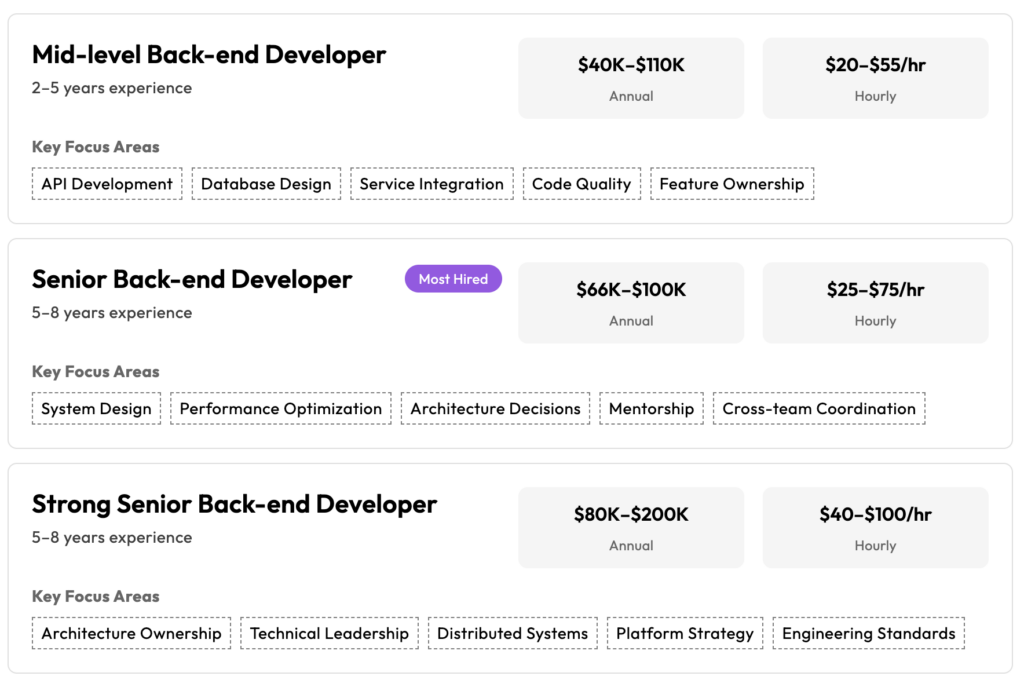
Pricing for back-end talent varies widely depending on seniority, tech stack, and engagement type. Here’s what the back-end development market looks like in 2026, based on primary salary data from Lemon.io’s recent survey.
Lemon.io back-end developer rates
Senior back-end developers on the platform bill $25–$75/hr globally, with a median of $37/hr across 523 vetted senior contracts. US seniors cluster at $64–$75/hr. Eastern European seniors (Ukraine, Poland, Romania) sit at $34–$45/hr, with 48% of all vetted back-end talent in the dataset coming from Europe and the UK. Latin American seniors run $35–$45/hr with strong US timezone overlap.
With Lemon.io, you get vetted programmers matched to your business needs, available full-time or part-time, from Europe, the US, the UK, Canada, Australia, Asia, and Latin America.
How Lemon.io Sources and Vets Top Back-End Developers
Where can you find back-end developers for hire? LinkedIn, job boards, freelance platforms, agencies. But the real problem is filtering them. We’ve reviewed thousands of back-end developer profiles, and here’s what our vetting process tests.
Technical Screening Beyond the Resume
Every candidate goes through a live coding assessment that mirrors real-world scenarios. Our tech interviewers (senior back-end/full-stack engineers) ask them to design a database schema for a specific use case, build an API endpoint with proper error handling, and explain their architecture decisions.
We also specifically probe for experience with HTML rendering on the server side (yes, it still matters for SEO-heavy web applications), mobile app API development for iOS and Android clients, and third-party integrations.
How Quickly Can You Hire a Back-End Developer with Lemon.io?
Most founders who come to us have already spent weeks on the hiring process. They’ve posted on job boards, screened resumes, run interviews, and maybe even made a hire that didn’t work out. Our matching process is designed to collapse that timeline. We typically present hand-picked, vetted candidates within 48 business hours, often under 24. You review profiles, interview the ones you like, and start onboarding within the same week.
How long does onboarding take? For a senior back-end engineer joining an existing codebase, expect one to two weeks before they start shipping meaningful code. That assumes decent documentation and a project manager or tech lead who can answer architecture questions. For a greenfield project, a strong developer can start producing value from day one.