
Hire React Native Developers
Develop stunning, native-like mobile apps with React Native experts. Get fast, cost-effective cross-platform solutions—hire now and onboard in no time.

Hire remote React Native developers
Hire remote React Native developers


How to hire React Native developer through Lemon.io

Place a free request

Tell us about your needs

Interview the best

Onboard the chosen one
Testimonials
Our clients


Need a detailed breakdown of skills, responsibilities, and qualifications?
Check out our React Native developers job description
Job DescriptionSkip the search—hire your React Native expert today!
Start HiringWhat we do for you

Sourcing and vetting

Expert
matching

Arranging cooperation

Support and troubleshooting

Develop super-optimized mobile apps with senior React Native developers from Lemon.io
On our marketplace, you’ll find only experienced React Native developers. We identify engineers who can own the entire mobile development lifecycle: from architecture and native integrations to App Store releases, while using modern AI tools to shorten development cycles without compromising quality. That’s how our clients launch their applications sooner and start monetizing earlier.
Multi-skilled mobile experts
Developers in our database have years of experience in JavaScript, iOS/Android mobile development, and position themselves as full-stack mobile developers who can develop end-to-end mobile applications that cost less but perform at the level of native apps.
Faster time-to-market
You need only one of our senior devs to build, deploy, and maintain a single codebase across Android and iOS platforms rather than the whole in-house team. This way, you can launch your application to production faster and see ROI sooner, even after the MVP release.
AI-powered RN developers
In 2026, experienced React Native devs on Lemon.io pair AI coding tools with framework-specific tooling, such as Expo, Reactotron, and Flipper, to achieve a native look and feel at twice the speed and half the cost of native iOS or Android development.

When paired with AI, React Native has become the easiest path from a mobile app idea to a released app on Google Play or the App Store. Native development is still the right call for hardware- and graphics-heavy applications that require native deployment, such as camera-processing apps or AR experiences. For most consumer and business mobile apps, though, mobile app development has shifted toward React Native, and the data backs that up.
RevenueCat’s 2026 State of Subscription Apps report, based on 115,000 apps generating a combined $16 billion in revenue, found that React Native apps out-monetize both native and Flutter apps at every stage of the funnel.
- React Native leads in download-to-paid conversion, with a median rate of 2.5%, 25% higher than native or Flutter.
- It also leads on revenue per install: a median of $0.34 at day 14, 55% higher than native and 79% higher than Flutter, widening to $0.51 by day 60.
- Median lifetime value per paying customer hits $31.78 for React Native apps, roughly 50% more than the $21 average for native and Flutter apps, and the top-performing React Native apps reach $95.32 in first-year value per payer.
Retention rates barely differ across stacks. Cross-platform mobile apps aren’t keeping users longer. They’re extracting more value earlier, which points to something founders should pay attention to: teams building in React Native tend to ship and iterate faster, and that speed compounds into stronger monetization. The framework itself isn’t the magic trick.
How to Distinguish a Skilled React Native Dev?
One of the quickest ways to gauge experience is to ask about the New Architecture. Experienced developers should be comfortable explaining what JSI, Fabric, and TurboModules changed rather than simply reciting the official documentation. If they still describe React Native as JavaScript communicating with native through a bridge, they’re probably relying on knowledge from older releases.
Beyond that, look for:
- Native module authorship in Swift and Kotlin, or Java on older Android apps
- Testing habits on physical iOS and Android devices because features like push notifications, camera access, biometric authentication, and permission flows often behave differently in production
- Version upgrade experience, since jumping two or three React Native versions on a live app is one of the most failure-prone tasks in mobile app development
- Comfort with Reanimated and gesture handling beyond basic screen transitions
- State management judgment, knowing when Context is enough and when a project needs Zustand or Redux Toolkit, instead of defaulting to one on every job
- Validate their App Store and Play Store submission knowledge
Core Skills to Look For
Beyond the individual skills above, strong React Native app developers should be fluent across nine practical areas.
- Native-specific tools. Senior developers know their way around Xcode, Android Studio, CocoaPods, and Gradle to timely diagnose and fix native build issues and develop user-friendly interfaces.
- Single codebase with feature and monetization parity. Skilled React Native developers keep subscriptions, paywalls, feature flags, and core functionality consistent across iOS and Android, so every release reaches users with the same capabilities and revenue opportunities.
- UI kits and UX design judgment. Component libraries such as React Native Paper, Tamagui, or Gluestack UI can dramatically speed up development. Still, experienced engineers know when they’re becoming a constraint and when investing in a custom design system will pay off as the product grows.
- Front-end development tools. Developers who structure navigation cleanly, write reliable TypeScript, and enforce consistent code quality with tools like ESLint keep the codebase manageable long after the MVP ships.
- Back-end integration. REST and GraphQL APIs, familiarity with Firebase or Supabase, real-time data via WebSockets, and proper handling of push notifications via APNs and FCM. Many React Native teams pair the app with a Node.js back-end they also maintain, so being able to read that code speeds up debugging real production issues.
- Testing strategies. The best React Native developers automate critical user journeys with Detox or Maestro and use unit tests where they provide the highest long-term value, reducing regressions without slowing development.
- AI coding tool usage. Most React Native programmers now use Copilot, Cursor, or similar tools to scaffold components and boilerplate. But the real skill is knowing when to distrust AI output, especially in native module code and permission handling, where AI tools still make errors.
- Data management. Senior React Native app developers know when lightweight solutions like MMKV are enough, when an offline-first database such as WatermelonDB makes sense, and how to keep local and server state in sync.
- Performance optimization and code quality. Profiling re-renders, avoiding unnecessary bridge calls, and writing reusable components instead of copy-pasted screens across every app store submission.
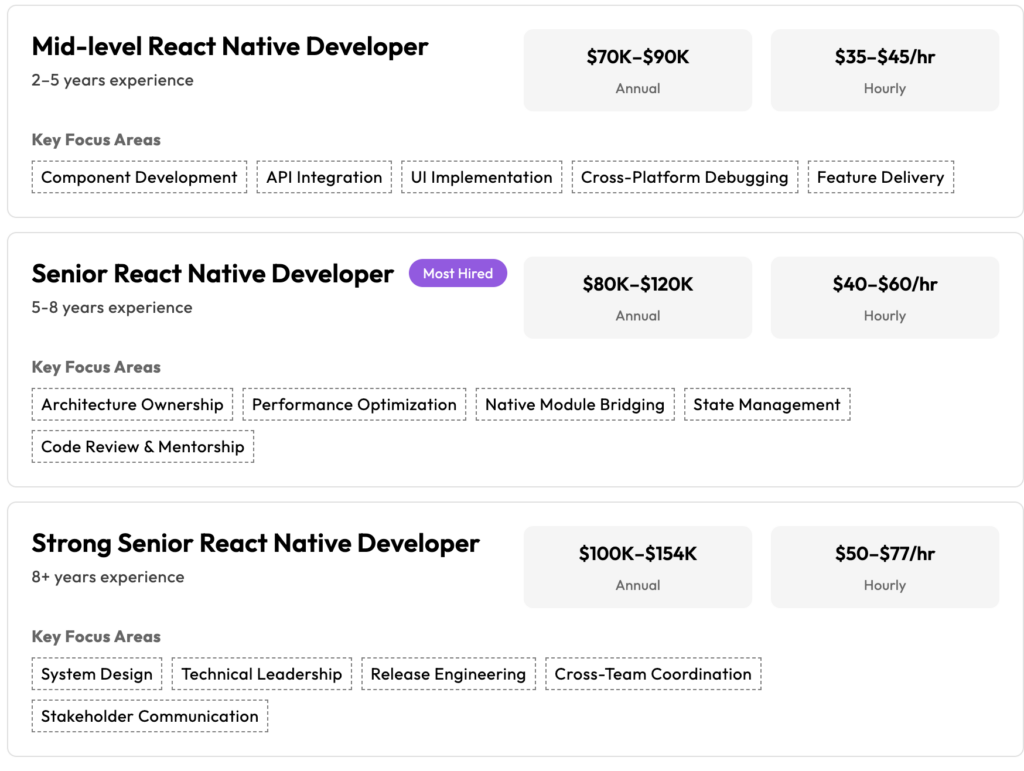
What’s the Difference Between Mid-level, Senior, and Strong Senior React Native Developer?
A mid-level developer, roughly 3 to 5 years in, works comfortably in bare React Native, rather than just Expo’s managed workflow. They handle state management at scale with Redux Toolkit or Zustand, write platform-specific code where iOS and Android diverge, test on real devices rather than simulators, and can take a React Native application through app store submission on their own.
A senior developer, 5 or more years in, writes custom native modules in Swift and Kotlin when JavaScript can’t reach what’s needed, makes the call on when a feature belongs in React Native versus native code, understands how to optimize JSI-level bridge calls, and can plan a version upgrade across a live app without breaking production for existing users.
A strong senior React Native developer goes further. They’ve usually shipped or maintained an open-source library the wider community depends on, made build-versus-buy calls about entire features, owned the CI/CD and release pipeline end-to-end, and can mentor a team of five or six members through a New Architecture migration without slowing shipping velocity. Increasingly, strong seniors are also expected to reach into the back-end: API contract design, GraphQL schemas, serverless functions on AWS Lambda, because the line between “mobile developer” and “full-stack developer” keeps blurring on smaller development teams.
Pro hiring tip: The fastest way to tell these levels apart is by asking a candidate to walk through a real incident. Have them describe a version upgrade that broke something in production, a native module they had to debug without documentation, or a performance issue they traced to a specific render cycle. Mid-level developers tend to describe what they did. Seniors and strong seniors describe why they made the call they made, and what they’d check first if it happened again.
Rates track this ladder closely. Broader US market data puts junior React Native salaries around $80,000 a year and senior architects past $160,000, with specialists in JSI and TurboModules commanding $145,000 to $185,000. For an exact breakdown by seniority and country, Lemon.io’s rate calculator for React Native developers provides a live estimate. For early-stage startups building an MVP, the pricing gap between an in-house senior hire and a cost-effective contractor engagement often decides whether development costs stay within the runway.
Modern Applications Developed In React Native With Business Results
Real companies are shipping React Native apps and measuring the payoff in terms most founders care about: development time and revenue impact.
- Coinbase, serving more than 56 million users, rewrote its Android app in React Native and reported an 80% improvement in funnel performance after the switch, replacing two separate native teams’ worth of duplicated work with a single codebase.
- Discord runs iOS and Android apps that now share 98% of their code on React Native, serving over 200 million monthly active users while holding a 99.9% crash-free session rate on iOS and a 4.8-star App Store rating. Shared code didn’t cost them user experience.
- Bloomberg built its News app in five months on React Native, less than half the development time a native build would have taken, and the Android version alone has passed 10 million downloads.
- Shopify went further than most, migrating its entire flagship app to React Native and now sharing roughly 86% of its code across iOS and Android: a bet a company processing billions in merchant transactions wouldn’t make on an unproven stack. It’s one of several mobile applications at that scale betting the same way.
The pattern holds across industries: fintech, social, media, e-commerce, and retail all showed similar positive results across dozens of development projects. One codebase, faster iteration, and no real trade-off in user experience.
In-House, Freelance, or Outsourced: How to Structure Your React Native Team
Most startups default to hiring in-house, post a single listing for a senior React Native developer, and wait. That works if you already have a development team and just need to fill a gap. It works far less well if this is your first real mobile app development project and you need someone who can own the entire codebase from day one.
Freelancers solve the speed problem but rarely solve the reliability problem. A freelancer with a strong track record can ship a feature quickly, then disappear mid-sprint to work for a better-paying client. Time zones compound this: a freelancer eight hours off your working day turns every bug report into a 24-hour round trip.
Outsourcing to a development team through staff augmentation splits the difference. You get a dedicated team, full-time or part-time depending on project needs, without running your own hiring process, project management overhead, or handling onboarding paperwork yourself.
The trade-off is choosing a talent marketplace that vets top talent and provides you with the right candidates for your stack, rather than reselling whoever’s available that week.
Before making the choice, ask any React Native development services partner (freelancer, outsourcing company, or a talent marketplace with pre-vetted developers) how many React Native projects their developers have shipped end-to-end that now perform successfully on the App Store and Google Play.
How Lemon.io Makes React Native Hiring a Breeze
Founders looking to hire React Native developers often hit the same wall: a flood of applicants on Upwork or Fiverr who list the framework on their resumes without production cases to back it up.
Lemon.io helps you hire dedicated React Native developers. Once your requirements are in, we typically return 1 to 3 matched candidates within 24 business hours, and 67% of matches close in under 10.
Vetting is crucial for React Native because the title alone tells you almost nothing. A resume that lists “React Native” can belong to a web development generalist who spent two weeks in Expo Go, or a senior engineer who’s shipped custom native modules to millions of users.
Our technical interview is built to separate different profiles. Here are the interview questions that we ask our RN candidates to verify their commercial experience. Whether you need a single React Native programmer for two months of application development or a full development team for a year-long build, the same high vetting bar applies.

FAQ about hiring React Native developers
How much does it cost to hire a React Native developer?
React Native developers’ rates depend on geography and seniority level. In the US, a senior React Native developer will charge $50–80 per hour. While in Eastern and Central Europe, senior developers will request payment in the range of $35–60 per hour. Plus, Lemon.io’s report on the developers’ rates indicates that in 2026, AI coding tools have only increased the senior developers’ rates rather than decreasing them as was predicted at the beginning of the AI coding boom.
Is React Native in high demand?
Yes, React Native is still popular mainly because it allows developers to create applications for both iOS and Android simultaneously, using the same code. All this efficiency helps to save time and money for development in the most compressed manner. Also, React Native is supported by a tech giant like Facebook and has a rich community that provides RN with more frequent updates. The framework is a perfect solution for businesses aiming to reach a wider audience across multiple devices.
What is the easiest way to hire a React Native developer?
One of the easiest ways to hire a React Native developer is through vetted platforms like Lemon.io, where candidates undergo a resume review and soft and hard-skills interviews before onboarding.
What is the vetting process for developers at Lemon.io?
Lemon.io runs every applicant through a four-stage process: a resume and portfolio review, a live English-language interview to assess communication and background, and a technical interview with senior React Native engineers. That technical stage is where it gets specific to React Native. Candidates walk through real scenarios like migrating a component to the newer architecture, tracking down why a native module integration is misbehaving, or explaining why an animation is dropping frames, instead of answering textbook trivia. We also pay particular attention to the developers’ experience with native mobile development to ensure that they know how to add native features to cross-platform applications.
Can React Native developers integrate with our existing native codebase?
Yes, though it depends on the developer’s background. Bare React Native developers who’ve written custom native modules in Swift or Kotlin can bridge new screens into an existing native app, or the reverse. Developers who’ve only worked in Expo’s managed workflow typically haven’t done this. This information is worth confirming before you hire a developer.

Ready-to-interview vetted React Native developers are waiting for your request
React Native developer is not the best fit?
Hire developers by role


Hire by related skills


Q&A about hiring React Native developers
- How do React Native developers handle Platform-Specific Code?
- What are the best practices for optimizing performance in React Native Apps?
- Is Node.js or React Native better?
- What is the best Back-end for React Native?
- Is React Native Full-stack?
- What role do third-party libraries play in React Native development?
- What programming language does React Native use?
- Can you build a website with React Native?
- How does React Native handle state management?
- How do React Native Developers ensure App security?
- Is React Native better than Python?
- What is React Native mainly used for?
- Is React Native used for Back-end or Front-end?
- How does React Native differ from Native Mobile Development?
- Is React Native the same as React?

What React Native developers can build for your team
React Native continues to power production mobile apps at Meta, Microsoft, Shopify, and Discord, proving that cross-platform development no longer means compromising on quality. Senior React Native developers apply the same engineering principles to help startups and growing businesses build scalable mobile products using a single shared codebase. Here are some of the most common projects they take on.

Consumer social and marketplace apps
Senior React Native developers optimize rendering with FlashList, reduce unnecessary re-renders, and integrate real-time services through Firebase or WebSockets to keep feeds responsive and interactions feeling native as traffic grows.

Fintech and banking apps
RN programmers integrate Stripe, Plaid, or payment gateways alongside biometric authentication and encrypted local storage, while keeping sensitive operations on the native side where appropriate.

Early-stage MVP builds
Using Expo, modular architecture, and reusable TypeScript components, senior developers help startups launch on both app stores within weeks while leaving room to add native functionality as the product evolves.

Companion apps for a web SaaS product
RN devs deliver a mobile experience that feels like a natural extension of your web product by reusing business logic, API contracts, and design systems across React, TypeScript, and React Native.


