




































Across major job boards, dedicated Node.js vacancies are limited: around 20+ on Built In and 100+ on ZipRecruiter, with most openings targeting senior and lead engineers, but virtually none are for standalone Node.js developers.
Businesses hire engineers to solve product problems rather than work with a single runtime.
A recent Netflix opening is a perfect illustration. Although Node.js is one of the required backend technologies, the role expects candidates to build React frontends, design RESTful APIs and GraphQL APIs, develop scalable backend services, integrate third-party platforms, work in cloud environments, apply AI in production, and lead technical decisions across the web development project. Node.js is a core technology, but only one of many skills required to succeed.
How to Distinguish Between a Quality Node.js Hire and Less Qualified Ones
Whether you’re building SaaS software, ecommerce platforms, internal business tools, healthcare applications, or real-time web applications, the hiring decision depends much more on the developer’s ability to build complete products than their familiarity with Node.js alone. Below are critical skills that indicate a qualified hire.
Async programming
Asynchronous programming is one of Node.js’ biggest strengths and one of the easiest places to create expensive performance problems.
A few developers understand what happens when CPU-intensive work blocks the event loop, causing every incoming request to slow down simultaneously. These issues rarely appear during the application development process, but rather after launch, when it’s often too late to fix anything.
Dedicated Node.js developers know when to offload work to worker threads, queues, background jobs, or separate services instead of forcing the application server to do everything itself.
What to look for:
- Experience designing web apps that handle high request volumes.
- Familiarity with queues such as BullMQ or RabbitMQ.
- Ability to explain how they diagnosed and resolved real production performance issues.
- Understanding of event-driven architectures and asynchronous programming beyond syntax.
- Experience optimizing server-side performance under production load.
Framework knowledge beyond Express
Today, many production Node.js systems are built with Nest.js because larger teams need modular microservices architecture, dependency injection, testing standards, and maintainable codebases that can survive years of development.
The strongest Node.js programmers understand why one architecture fits your business needs better than another. For example, they can explain when:
- Express.js is sufficient,
- Nest.js improves maintainability,
- Fastify delivers measurable high-performance gains,
- Migrating an existing product without disrupting user experience is the right call
Cloud infrastructure
Shipping code is only half the job. Node.js experts still need to deploy it safely, monitor it, recover from failures, manage secrets, configure scaling rules, and keep infrastructure costs under control.
A senior Node.js engineer understands the deployment lifecycle because they’ve owned high-quality solutions in production. Look for experience with:
- Docker and containerized deployments
- AWS, Azure, or Google Cloud
- CI/CD pipelines using GitHub Actions or similar tools
- Kubernetes fundamentals
- Logging, monitoring, and observability platforms
- Performance profiling and cost optimization
This knowledge becomes valuable for startups that don’t yet have a dedicated DevOps team.
TypeScript as an engineering standard
By 2026, TypeScript will no longer be a nice-to-have for commercial Node.js projects. Experienced Node.js developers use TypeScript to create consistency across the entire app development flow:
- shared types between backend and frontend,
- typed API contracts,
- database schemas with Prisma or TypeORM,
- safer integrations with third-party services,
- earlier bug detection before deployment.
For growing startups, this translates into fewer regressions, easier onboarding, and lower maintenance costs over time.
Production experience with AI-native agentic workflows
Node.js has become one of the primary runtimes for AI-enabled products. Today’s strongest Node.js developers do far more than integrate an LLM API. They build AI-powered workflows that retrieve company data, orchestrate multiple tools, automate business processes, and stream responses in real time. If your roadmap includes AI copilots, document intelligence, workflow automation, or customer support agents, look for engineers with hands-on experience building production AI systems.
Developers with production AI experience should understand topics such as:
- streaming responses instead of waiting for entire generations,
- handling API rate limits and retries,
- vector databases such as Pinecone or Weaviate,
- retrieval-augmented generation (RAG),
- agent orchestration,
- prompt versioning and evaluation,
- token usage and inference cost optimization,
- AI security and prompt injection risks.
Database architecture
As applications grow, problems shift from writing SQL to designing data access patterns that remain efficient under thousands of concurrent users.
Strong Node.js developers think about:
- connection pool sizing,
- indexing strategies,
- caching with Redis,
- transactional consistency,
- replication,
- and database scalability.
Product ownership is the ultimate differentiator
The best Node.js developers think in business outcomes. Instead of asking “What code should I write?” they ask:
- Will this architecture still work when we have ten times more users?
- Is there a simpler solution that reduces engineering effort?
- How will this affect cloud costs?
- Can AI automate part of this workflow?
- What happens when another team needs to extend this service next year?
That product mindset is why experienced Node.js developers command higher rates.
Red Flags During the Node.js Hiring Process
The warning signs appear during tech and soft skills interviews.
Candidate can’t explain their own code
Ask candidates to walk you through a recent project. Strong engineers explain why they chose a particular architecture, what alternatives they considered, which trade-offs they accepted, and what they’d improve today.
Resume and GitHub don’t match
A polished resume doesn’t always reflect recent hands-on experience.
Look for public repositories that haven’t been updated in years, projects that resemble tutorials, or a lack of evidence that the candidate has built production software recently. Private repositories are perfectly normal, so this isn’t a deal-breaker. Just ask what they’ve shipped over the last year and what role they played.
Lack of architectural opinions
Present a simple scenario: “How would you design a Node.js backend for a SaaS product expected to grow from hundreds to hundreds of thousands of users?”
Strong candidates usually respond with questions before answers. They’ll discuss traffic patterns, databases, APIs, caching, deployment strategy, and what they would postpone until later stages. Generic answers or lists of technologies without any reasoning suggest limited system design experience.
What Node.js Developers Cost In 2026
Drawing on the data from our salary report, Node.js rates run $29–$40/hr for mid-level, $40–$52/hr for senior, and $45–$78/hr for strong seniors with architecture ownership. Geography moves the number significantly: a senior Node.js developer in Eastern Europe averages around $43/hr versus ~$72/hr in North America, roughly a 40% gap on comparable work. At full-time load, that’s approximately $60K annually, a cost-effective alternative to in-house hiring or local recruitment.
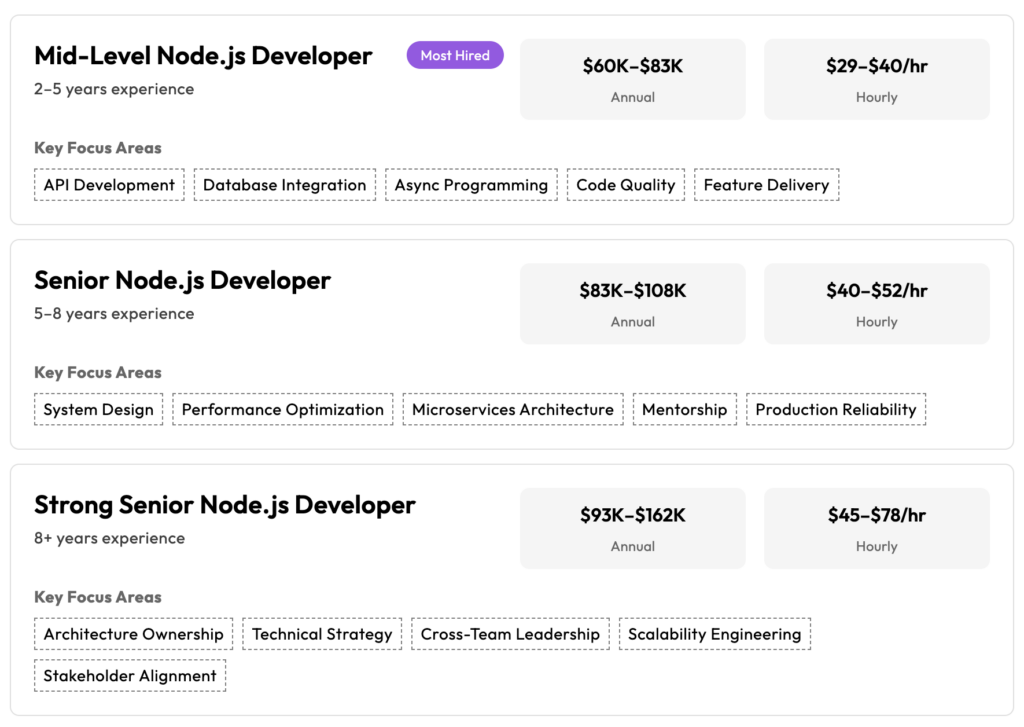
Lemon.io Node.js rates
Skill premiums that push rates toward the top of each band:
- Distributed systems design: +25–40%
- AWS/GCP infrastructure depth: +20–35%
- TypeScript proficiency: +15–25%
- Nest.js or Fastify expertise: +10–18%
- Full-stack development capability: +10–20%
Why Hire Senior Node.js Developers Via Lemon.io
Lemon.io keeps an active bench of vetted senior Node.js engineers available for remote contracts. The matching process takes roughly 24 business hours. You submit your project requirements, and the team surfaces one to three candidates who fit your stack, timeline, and working hours.
Every developer on the platform has passed a four-stage technical review conducted by senior engineers. The process tests for the things a resume can’t show:
- How a candidate handles async edge cases
- Whether they understand what they’re trading off when choosing between frameworks
- How do they reason through a system design problem they haven’t seen before
Soft skills get the same scrutiny. A dedicated stage screens for English fluency, communication skills, problem-solving capabilities, and asynchronous collaboration habits.
Lemon.io also handles contracts, invoicing, and payments, and offers a replacement guarantee if the match doesn’t work out, a new candidate within 24 to 48 business hours. There’s no lengthy notice period, HR overhead, or six-month probation before you know whether the hire was right. It’s a practical alternative to outsourcing development services or waiting months for an in-house hire to clear a pipeline.
Whether you need a mid-level Node.js developer to strengthen an existing backend development team or a senior Node.js developer with tech leadership and AI coding experience to manage the whole software development project on their own, Lemon.io’s recruiting team has you covered. We understand how critical it is to get the right match from the first try without wasting time on multiple interview rounds, particularly when building a remote development team.
One dev, full stack
Hire MEAN and MERN developers via Lemon.io. We vet our devs’ capabilities across Node.js, Angular, and React so you get one engineer who owns the full feature, instead of coordinating an entire team of single-stack specialists.
Ownership as the core value
Our remote software engineers are self-motivated and come with strong technical skills and a product mindset. They make decisions proactively and can justify technical tradeoffs to your C-level without hand-holding.
AI-ready mindset
With AI coding gaining traction, we ensure all our devs stay current with tooling, workflows, and integration patterns so they ship quality work at the pace modern Node.js applications demand.
Real-time applications
Node.js full-stack developers build and maintain the backend logic that keeps data in sync across users in real time.
API-driven SaaS platforms
Node.js engineers on Lemon.io design the API layer that connects your product to payment processors, CRMs, and communication tools.
Scalable web applications
Full-stack Node.js developers build React- or Angular-based web applications backed by Node.js APIs.
Customer-facing apps
Full-stack Node.js developers own the entire user-facing flow, from the frontend interface to the backend functionality handling transactions and data updates.