



































Hire Node.js developers

Speed up backend development with top Node.js engineers. Scalable, fast, and secure applications.

1.5K+
fully vetted developers
24 hours
average matching time
2.3M hours
worked since 2015
hero image
Mikkel
Senior Node.js developer
Verified expert

Hire remote Node.js developers

Hire remote Node.js developers

Developers who got their wings at:
Testimonials
Gotta drop in here for some Kudos. I’m 2 weeks into working with a super legit dev on a critical project and he’s meeting every expectation so far 👏
avatar
Francis Harrington
Founder at ProCloud Consulting, US
I recommend Lemon to anyone looking for top-quality engineering talent. We previously worked with TopTal and many others, but Lemon gives us consistently incredible candidates.
avatar
Allie Fleder
Co-Founder & COO at SimplyWise, US
I've worked with some incredible devs in my career, but the experience I am having with my dev through Lemon.io is so 🔥. I feel invincible as a founder. So thankful to you and the team!
avatar
Michele Serro
Founder of Doorsteps.co.uk, UK
View more testimonials

How to hire Node.js developer through Lemon.io

Place a free request

Place a free request

Fill out a short form and check out our ready-to-interview developers
Tell us about your needs

Tell us about your needs

On a quick 30-min call, share your expectations and get a budget estimate
Interview the best

Interview the best

Get 2-3 expertly matched candidates within 24-48 hours and meet the worthiest
Onboard the chosen one

Onboard the chosen one

Your developer starts with a project—we deal with a contract, monthly payouts, and what not

Testimonials

Going step further to find a right fit.

I was impressed by the detail with which the feedback was taken and selection of candidates provided to fit our startup. not a lot of firms care about the details, but they are doing a phenomenal job to find the right fit. would recommend anyone at the early stage as its extremely important to get the right candidates who define the company culture

DS
Darshan Sonde

If your looking to find top developer resource, Lemon.io is the place.

Lemon.io has been a game changer for us. Speed, clarity, and quality were there from day one, but what really impressed me was how much they care about getting the right fit, not just filling a role.

We had some specific requirements, and the candidates surfaced were consistently high quality and well aligned. The team checked in regularly, handled onboarding smoothly, and genuinely went the extra mile to keep things simple.

It’s rare to find a service that combines great talent with great people. Lemon.io absolutely does both, and we’ll be continuing to work with them. Diana is a superstar.

RH
Rashid Hussain

Great platform for finding vetted developers.

Lemon.io made it easy to connect with skilled developers quickly. The matching process was efficient and the support team was helpful throughout. The quality of developers is excellent thanks to their thorough vetting process. Highly recommend for startups needing reliable talent fast.

T
Tarik

Lemon provides access to great talent. Their platforms are good and I’ve found my account rep (Alina) to be super helpful and knowledgable.

CF
Chris Freeberg

Lemon cares a tremendous amount about finding high quality developers that are the right long term fit. We had some specific requirements and Iryna was able to find some great options that were all really qualified. They checked in several times during the engagement and made sure the start and kickoff for the dev was well handled. Will be planning on working with them well into the future.

GW
Grant Wilkinson

Superb support from day 1. Speed, clarity in communication, quality of candidates surfaced, going the extra mile to simplify things, making the entire process as easy as possible.

Special shoutout to Diana Tereshchenko who is fantastic and I was lucky to work with her.

Lemon.io is a game changer, for any founders but especially first-time founders like me.

CL
Chris Lavoie

Everyone I have met at Lemon has been great. They’re responsive, helpful and transparent and the entire experience has been a pleasant one. I would recommend.

BD
Barrett Daniels

Building our tech startup would not have been possible without Lemon.

We’ve been working for ~1.5 year with one of their full stack engineer from Brazil, Matheus, whom we strongly recommend. As 2 co-founders looking for moving our prototype product to a production level, Lemon has been amazing at guiding us through the selection process and then ongoingly whenever we had any questions or requests (thank you Andrew Bondar) – definitely recommend.

B
Baptiste

Absolutely love lemon.io. Their engineers are very high quality, really appreciate how lemon.io makes sure they meet employers standards and also love the customer support we received during the process. Highly recommended.

MB
Mira Boora

Need a detailed breakdown of skills, responsibilities, and qualifications?

Check out our Node.js developers job description

Job Description

Skip the search—hire your Node.js expert today!

Start Hiring

What we do for you

Sourcing and vetting

Sourcing and vetting

All our developers are fully vetted and tested for both soft and hard skills. No surprises!
Expert matching

Expert
matching

We match fast, but with a human touch—your candidates are hand-picked specifically for your request. No AI bullsh*t!
Arranging cooperation

Arranging cooperation

You worry not about agreements with developers, their reporting, and payments. We handle it all for you!
Support and troubleshooting

Support and troubleshooting

Things happen, but you have a customer success manager and a 100% free replacement guarantee to get it covered.
image

Why hire Node.js developers through Lemon.io?

The quest to find Node.js developers for hire is harder than the quest for the holy grail. Wading through endless CVs to identify the right candidate based on what they say about themselves can seem like an effort in futility. Find your grail developer with our pool of vetted, skilled devs.

Four-step vetting process

A simple interview doesn’t tell you enough. We put all our devs through a four-step vetting process, incorporating both hard and soft skills, to make sure we deliver exceptional devs.

Matched in 48 hours

Traditional hiring can take six months or more, which isn’t anywhere near agile. We match your startup with great devs in just 48 hours, so you can get back on track.

Dev replacement guarantee

You can hire with confidence backed by our dev replacement guarantee. We don’t ask questions if you request a different dev, we just deliver another list of vetted, senior devs free of charge.

Simplify your hiring process with remote Node.js developers

faq image

FAQ about hiring Node.js developers

How much does IT cost to hire a Node.js developer?

The cost of hiring a senior Node.js developer is around $44 per hour in Western Europe and $88 in the US, according to GlassDoor.

Is Node.js still in demand?

Yes, Node.js is still in demand in 2024. 58% of all development time worldwide is spent on Node.js for a few reasons.
First, it allows quick, large-scale development of applications for both servers and clients.
Second, it has a non-blocking event-based architecture, thus it can perform with high efficiency even under great throughput.
Third, Node.js has a mature environment with many helpful modules that significantly speed the development. Lastly, it works with real-time applications and has efficient JSON data processing, making it perfect for modern web applications.

How long does it take to build Node.js?

Building Node.js usually takes several minutes to 90 minutes. The time depends on the type of build environment, the capability of the developers’ computer, and the incorporation of customization and extra compiled features.

How to hire the best Node.js developer?

To hire the best Node.js developer, you need to:

1. Start with making a profile for the kind of person you would like to hire: they should have strong technical knowledge of Node.js, JavaScript, and frameworks such as Express.js or databases such as MongoDB. Ensure the candidate has worked with scalable apps and has experience with asynchronous programming. The candidate must also know several deployment tools, Mocha, Jest, and other testing tools, and have experience in CI/CD.
2. Create a job description that includes what the candidate will do as well as what skills they need.
3. Use different websites to get the best specialist possible.
4. Check their CVs and portfolios.
5. Check their soft and hard skills.
6. Once you have found the right candidate, bring them on board.
The second way is to simply ask Lemon.io for assistance. We will connect you with top Senior Node.js developers who are ready to work remotely.

Is Node.js still the best?

Node.js is a versatile technology, and startups worldwide prefer it to other technologies.

What is the payscale of a Node.js developer?

Junior Node.js developers usually ask for $15 to $30 hourly, middle Node.js developers ask for $30 to $60, and seniors ask for $60 to $100 an hour.

What is Node.js best suited for?

Node.js is best suited for creating large-scale, high-throughput applications such as chat applications, streaming platforms, restful APIs, single-page applications (SPAs), IoT apps, and collaborative platforms. Built on non-blocking, event-driven architecture handling multiple requests simultaneously, it fits well in real-time updates and data processing.

What is the most popular Node.js database?

There are 5 top databases for Node.js, according to Aphelia. They are MySQL, PostgreSQL, SQLite, Firebase Realtime Database, and Cassandra.

How much does a Node.js project cost?

A small Node.js web application can cost $10,000 to $25,000 a mid-sized app between $15,000 and $50,000, and a large one between $50,000 and $400,000, Indeed says.

Is Node.js fast enough?

Yes, Node.js is fast and can handle lots of tasks at once.

How quickly can I hire a Node.js developer through Lemon.io?

You can hire a Node.js developer through Lemon.io in 48 hours. All the developers have already passed our vetting process, including VideoAsk, their me.lemon profile completion, a screening call with our recruiters including various technical questions, and a technical interview with our developers. We will ensure a fast and comfortable hiring process while matching you with the best Node.js developers in the industry, as only 1% of applicants are accepted into our community.

What is the no-risk trial period for hiring a Node.js developer on Lemon.io?

Lemon.io provides up to 20 prepaid risk-free hours with our Node.js developer to review how they complete real tasks on your projects. Otherwise, it is a zero-risk replacement guarantee: if the previous developer doesn’t meet your expectations or misses deadlines, we will find a new one for your project.

image

Why hire Node.js developers?

Node.js is a free, open-source server environment devs use for both frontend and backend development. An efficient framework, it allows devs to handle more code at a time. Hire Node.js developers to get your project back on track.

image

Lightweight framework

Node.js lets devs handle thousands of concurrent connections without the burdensome thread competition that exhausts system resources.

image

Asynchronous programming

Once your dev sends their task to the file system, the system is immediately ready to handle the next task.

image

Flexible improvements

When you roll out improvements in Node.js, only that node is affected, making it more flexible than frameworks that require changes to the core.

image

Better user experience

Node.js offers a nonblocking asynchronous architecture that uses fewer resources so performance doesn’t suffer with simultaneous requests.

image

Ready-to-interview vetted Node.js developers are waiting for your request

Susanna Lishchenko
Susanna Lishchenko
Recruiting Team Lead at Lemon.io

Hiring Guide for Node.js Devs

According to W3Techs, Node.js now powers 5.4% of all websites with known web servers as of January 2026. The Stack Overflow Developer Survey 2024 shows 40.8% of developers use Node.js, making it the most popular web framework globally. Major platforms like Netflix, PayPal, GitHub, Spotify, and LinkedIn rely on it for mission-critical backend development. For startups looking to build scalable, high-performance software, the decision to hire Node.js developers isn’t just about following trends—it’s about leveraging a proven technology that offers superior functionality, exceptional scalability, and a massive ecosystem of over 1.8 million npm packages.

Key Benefits of Node.js for Founders and Startups

When you hire dedicated Node.js developers, you’re investing in a technology stack that delivers measurable advantages for your startup‘s growth and technical infrastructure.

Performance and Speed

Node.js runs on Google’s V8 JavaScript engine, enabling exceptionally fast execution of server-side applications. PayPal reported a 35% improvement in average response time after switching from Java to Node.js, while Netflix completely revamped their UI architecture using Node.js to deliver faster, smoother experiences. For startups where every millisecond of loading time impacts user retention and conversion rates, this performance edge is critical.

Cost Efficiency and Development Speed

The unified JavaScript ecosystem allows full-stack developers to work across both frontend and backend layers, reducing the need for separate specialists and streamlining workflows. This translates to faster development cycles and lower costs—critical factors for startups operating with limited resources. The event-driven, non-blocking I/O model enables developers to build real-time applications more efficiently than traditional synchronous frameworks.

Scalability for Growing Startups

Node.js excels at handling concurrent connections, making it ideal for applications that need to scale rapidly. The asynchronous programming model and event-driven architecture allow Node.js applications to manage thousands of simultaneous connections with minimal overhead. Whether you’re building microservices, RESTful APIs, or real-time applications like chatbots and collaboration tools, Node.js provides the flexibility to grow from MVP to enterprise-grade platform without major architectural rewrites.

Rich Ecosystem and Community Support

With 1.8 million npm packages available in 2026, Node.js offers the largest repository of reusable code in the software development world. This means your engineering team can leverage pre-built solutions for common functionality—from authentication and database connectivity to payment processing and machine learning integration—dramatically accelerating your time-to-market.

Cross-Platform Compatibility

Node.js developers can create applications that run seamlessly across Windows, Linux, macOS, and Docker containers. This flexibility is particularly valuable for startups that need to support multiple environments or deploy to various cloud platforms without maintaining separate codebases.

Understanding Node.js Developer Roles: Backend, Full-Stack, and Beyond

When you set out to hire Node.js developers, understanding the different specializations helps you match talent to your specific needs.

Backend Node.js Developers

These specialists focus exclusively on server-side development, building the core logic that powers your web applications. Backend Node.js engineers handle data exchanges between servers and users, implement business rules, design database schemas, and create APIs for frontend consumption. They work extensively with frameworks like Express.js and NestJS, manage authentication systems, optimize database queries, and ensure your application can handle traffic spikes without downtime.

Full-Stack Node.js Developers

Full-stack developers bring expertise in both backend Node.js development and frontend technologies. They can build complete features end-to-end, from database design through API development to user interface implementation. These engineers typically know frameworks like React.js, Vue, or Angular for frontend work, making them particularly valuable for early-stage startups where team members need to wear multiple hats. When you hire a full-stack Node.js developer, you gain flexibility in assigning tasks and can move faster with fewer coordination dependencies.

Node.js DevOps Engineers

As your application matures, you may need Node.js specialists who understand deployment pipelines, containerization with Docker, orchestration with Kubernetes, and cloud infrastructure on AWS, Azure, or Google Cloud Platform. These software engineers ensure your Node.js applications run reliably in production, implementing monitoring, logging, automated testing, and continuous integration/continuous deployment (CI/CD) workflows.

Dedicated vs. Remote vs. Freelance Models

  • Dedicated Node.js developers integrate fully with your team, understanding your business context deeply and maintaining long-term ownership of your codebase. This model works best when you need sustained development capacity and want to minimize knowledge transfer overhead.
  • Remote Node.js developers offer geographic flexibility and access to global talent pools while working as committed team members. With proper project management and communication tools, remote engineers can be as effective as onshore staff—often at more competitive pricing.
  • Freelance Node.js programmers provide specialized expertise for short-term projects, specific features, or temporary team augmentation. This flexibility is valuable when you need to scale capacity quickly or bring in expert knowledge for particular challenges like GraphQL optimization or PostgreSQL migration.

Essential Technical Skills to Look for When You Hire Node.js Developers

Finding top Node.js developers requires assessing a comprehensive skill set that extends well beyond basic JavaScript knowledge.

Core Node.js and JavaScript Expertise

Every qualified Node.js programmer must demonstrate deep understanding of JavaScript fundamentals, including ES6+ features, async/await patterns, promises, and callback handling. They should understand Node.js internals—particularly the event loop, non-blocking I/O operations, and the single-threaded nature of the runtime. Experience with the npm package manager (or alternatives like Yarn) is essential, as is familiarity with module systems and dependency management.

TypeScript Proficiency

TypeScript has become increasingly important for robust Node.js development. This superset of JavaScript adds static type checking, which catches bugs during development rather than production. For startups building complex applications with multiple engineers, TypeScript dramatically improves code maintainability and reduces technical debt. When you hire senior Node.js developers, TypeScript experience should be a strong consideration.

Framework Experience

Express.js remains the most widely-used Node.js framework, providing a minimal yet flexible foundation for building web servers and APIs. Most Node.js developers should have substantial Express.js experience, as many other frameworks are built on top of it.

NestJS has gained significant traction for building enterprise-grade server-side applications. Written in TypeScript and based on Express.js, NestJS provides opinionated structure, dependency injection, and excellent support for building modular applications. If you’re planning to implement microservices or need a more structured approach to backend development, look for Node.js experts with NestJS knowledge.

Database Knowledge

Node.js applications require persistent data storage, so database expertise is crucial:

  • MongoDB is the most popular NoSQL database used with Node.js, offering flexible document-based storage ideal for rapidly evolving schemas
  • PostgreSQL provides enterprise-grade relational database capabilities with excellent JSON support
  • MySQL remains widely used for traditional relational data storage
  • Redis serves as an in-memory cache and message broker for high-performance applications

Your Node.js developers should understand ORMs and database libraries like Mongoose, Sequelize, Prisma, or TypeORM to interact efficiently with these systems.

API Development Skills

Modern web applications depend on robust APIs, so Node.js developers must excel at API development:

  • REST API architecture follows established conventions for HTTP-based communication, making it the standard choice for most applications
  • GraphQL offers more flexible querying capabilities, allowing clients to request exactly the data they need, reducing over-fetching and improving performance

Your backend engineers should understand API design principles, versioning strategies, documentation approaches, and security best practices including authentication tokens and rate limiting.

Cloud Platform Experience

In 2026, virtually all Node.js applications run on cloud infrastructure. Familiarity with at least one major platform is essential:

  • AWS (Amazon Web Services) offers the broadest range of services and largest market share
  • Azure (Microsoft) provides excellent integration with enterprise systems
  • Google Cloud Platform (GCP) excels at data analytics and machine learning integration

Look for engineers who understand serverless functions, container services, load balancing, and cloud-native database solutions.

Additional Important Skills

Strong Node.js developers should also demonstrate knowledge of Docker for containerization, Git for version control, testing frameworks like Jest or Mocha, authentication mechanisms including JWT and OAuth, WebSockets for real-time functionality, message queues for asynchronous processing, and CI/CD pipelines for automated deployment.

Soft Skills and Professional Qualities of Top Developers

Technical expertise alone doesn’t guarantee success. The best Node.js developers combine strong technical skills with crucial soft skills that make them effective team members and problem-solving partners.

Communication and Collaboration

Node.js developers rarely work in isolation. They must collaborate with frontend engineers, DevOps specialists, product managers, and other stakeholders. Look for candidates who can explain technical concepts clearly to non-technical team members, document their code comprehensively, and participate constructively in code reviews. When you hire remote Node.js developers, communication becomes even more critical—they need to be proactive about sharing progress, asking clarifying questions, and flagging potential issues before they become blockers.

Problem-Solving and Critical Thinking

Software development is fundamentally about solving problems. Strong Node.js engineers approach challenges methodically, breaking down complex requirements into manageable components. They research solutions effectively, evaluate trade-offs between different approaches, and make pragmatic decisions that balance ideal architecture with business constraints and deadlines.

Adaptability and Learning Orientation

The JavaScript ecosystem evolves rapidly, with new frameworks, tools, and best practices emerging constantly. Top talent maintains curiosity about new technologies while exercising good judgment about which innovations actually improve productivity.

Project Management and Autonomy

Especially important for startups with lean teams, senior Node.js developers should be able to work with minimal supervision. They estimate tasks accurately, identify dependencies proactively, raise concerns early when timelines are at risk, and take ownership of features from conception through deployment. When you hire dedicated Node.js developers for longer engagements, their ability to self-manage becomes a force multiplier for your entire engineering organization.

Attention to Code Quality

High-quality Node.js developers write clean, maintainable code that other engineers can understand and modify. They follow established coding conventions, write meaningful tests, handle errors gracefully, and think about edge cases. This discipline pays enormous dividends as your codebase grows and new team members onboard.

Where to Find and Hire Node.js Developers

Once you understand what you’re looking for, the next question is where to find these vetted professionals.

Specialized Developer Platforms

Platforms like Lemon.io have transformed how startups hire Node.js developers by pre-vetting candidates and matching them to projects based on specific requirements. Lemon.io specializes in connecting startups and CTOs with top-notch software engineers who have been thoroughly evaluated for both technical skills and professional work habits. With a 24-hour matching time, platforms like this dramatically streamline the hiring process compared to traditional recruitment methods or general freelancer marketplaces.

The advantage of using a specialized platform is quality assurance—developers have already been screened for technical competency, communication skills, and reliability. This eliminates much of the risk associated with hiring Node.js programmers from sources where verification is minimal.

Traditional Recruitment Channels

Job boards, LinkedIn, and traditional recruitment agencies remain viable options, particularly when building an in-house team. These channels provide access to local talent and can work well if you have the time and resources for comprehensive screening. However, the hiring process typically takes weeks or months, and quality varies significantly.

Remote Developer Networks

Given that Node.js development work can be done from anywhere, many companies successfully hire remote Node.js developers through specialized remote-first communities and platforms. Remote hiring expands your talent pool geographically, often providing access to exceptional engineers at more competitive rates than major tech hubs. Time zones require consideration for synchronous collaboration, but many startups find that well-managed remote teams deliver outstanding results.

Offshore Development Options

For cost-sensitive projects, offshore Node.js developers from regions with strong technical education systems can provide excellent value. Countries with robust software development industries offer access to skilled engineers at significantly lower rates than North American or Western European markets. When working with offshore teams, clear project requirements, strong documentation, and effective project management become essential for success.

How to Choose the Right Developer for Your Project

Selecting the ideal candidate requires aligning their expertise with your specific situation and goals.

Assess Your Project Requirements

Before you hire a Node.js developer, create a clear picture of what you’re building: What is the primary purpose of your application? What scale do you anticipate? What’s your timeline? What’s your existing tech stack? What integrations are required? Being specific about these elements helps you identify candidates whose experience directly applies to your situation.

Match Expertise to Your Tech Stack

If your project already uses specific technologies, prioritize candidates with relevant experience. A developer who has built multiple NestJS applications with PostgreSQL and deployed to AWS will be far more productive in a similar environment than someone learning these tools for the first time. Conversely, if you’re starting fresh, you have more flexibility to choose based on overall skill level rather than specific technology matches.

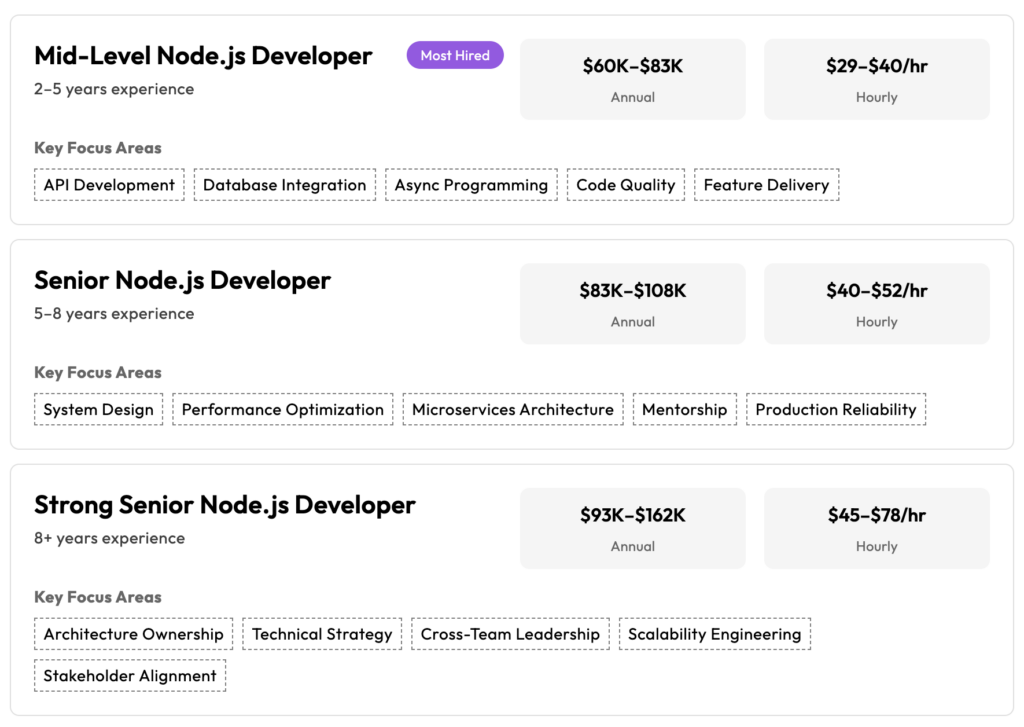
Consider Project Phase and Developer Seniority

Early-stage projects benefit most from senior Node.js developers who can make sound architectural decisions and establish best practices from the beginning. These engineers prevent technical debt that would require expensive refactoring later. For startups in the MVP phase, hiring a senior or lead-level Node.js engineer—even as a freelancer for initial architecture—can be one of the best investments you make.

As your project matures and architecture stabilizes, mid-level Node.js programmers can effectively maintain and extend the codebase, implement well-defined features, and fix bugs. Junior developers work best when you have senior engineers available for mentorship and can assign clearly scoped tasks.

Evaluate Years of Experience Appropriately

While years of experience matter, they’re not the only factor. A developer with 2-3 years of intensive, high-quality Node.js work may be more valuable than someone with 7 years of sporadic exposure. Look for depth of experience with relevant technologies, participation in complex projects, and evidence of continuous learning.

Budget and Pricing Considerations

Node.js developer rates vary significantly based on location, experience level, and engagement model. Senior/expert Node.js developers in major tech hubs command premium rates but bring architectural expertise and strategic thinking. Mid-level developers offer a strong balance of capability and cost for many startups. Junior developers provide the most economical option when you have technical leadership in place. Offshore and remote developers can offer 30-50% cost savings compared to onshore talent while maintaining quality. Be realistic about the relationship between cost and expertise—attempting to save money by hiring underqualified developers typically backfires.

Common Use Cases

Node.js excels in specific application categories where its asynchronous, event-driven architecture provides distinct advantages.

E-Commerce Platforms

Online stores require fast page loads, smooth checkout flows, and integration with multiple third-party services (payment gateways, inventory systems, shipping providers). Node.js handles these requirements exceptionally well, processing concurrent user sessions efficiently while maintaining low latency. When you hire Node.js developers for e-commerce, look for experience with payment processing, security best practices, and high-traffic optimization.

Real-Time Applications

Node.js was practically designed for real-time functionality. Applications like collaborative editing tools, live chat systems, social media feeds, and multiplayer games benefit enormously from Node.js’s event-driven model. WebSocket support allows bidirectional communication between servers and clients, enabling instant updates without constant polling.

Chatbots and Conversational Interfaces

AI-powered chatbots, customer service automation, and conversational commerce platforms leverage Node.js for rapid response times and seamless integration with AI/machine learning services. The ability to handle multiple concurrent conversations efficiently makes Node.js ideal for this use case.

Microservices Architecture

Modern applications increasingly adopt microservices—breaking monolithic applications into smaller, independent services that communicate via APIs. Node.js is perfectly suited for microservices development due to its lightweight runtime, fast startup times, and excellent support for HTTP communication. When you hire dedicated Node.js developers for microservices projects, ensure they understand service boundaries, API contracts, and distributed system patterns.

API Development and Integration

Many successful startups build their competitive advantage on superior API integrations—connecting multiple services, aggregating data, and providing unified interfaces. Node.js excels at API development, whether building internal APIs for mobile apps and web frontends or public APIs for third-party developers.

IoT and Edge Computing Applications

The Internet of Things generates massive amounts of data from connected devices. Node.js’s efficiency and ability to handle numerous concurrent connections make it well-suited for IoT backend systems that collect, process, and respond to device data.

Streaming and Media Applications

Applications that process or deliver video, audio, or large file uploads benefit from Node.js’s stream processing capabilities. The runtime can handle data chunks as they arrive rather than waiting for complete files, reducing memory usage and improving responsiveness.

Pricing and Budget Considerations When Hiring Node.js Programmers

Understanding the economics of different hiring models helps you make informed budget decisions.

Full-Time In-House Developers

Hiring full-time Node.js developers for your in-house team provides maximum control, deepest integration with company culture, and strongest long-term commitment. However, it’s also the most expensive option when accounting for salary, benefits, equipment, office space, and onboarding time. In major tech markets, senior Node.js engineers command salaries ranging from $120,000 to $180,000+ annually, while mid-level developers typically earn $80,000 to $120,000.

Dedicated Remote Developers

Hiring dedicated remote Node.js developers, whether through platforms or direct engagement, offers significant cost advantages while maintaining commitment and integration. Remote developers work consistent hours for your team, participate in meetings and planning, and build deep understanding of your product—but typically cost 20-40% less than equivalent onshore talent due to geographic arbitrage.

Freelance and Contract Developers

Freelance Node.js programmers provide maximum flexibility, allowing you to scale development capacity up or down as needed. This works particularly well for defined projects, specific features, or short-term team augmentation. Hourly rates for freelancers vary widely—from $40-80/hour for mid-level developers to $100-200+/hour for top specialists—but you only pay for actual work without benefits or equipment costs.

The challenge with freelancers is finding high-quality talent and managing potential availability constraints. Freelancers may work on multiple projects simultaneously, which can impact responsiveness during critical periods.

Offshore Development Teams

Offshore Node.js developers from countries with strong technical education systems but lower cost of living can offer substantial savings—often 50-70% below North American rates. Regions like Eastern Europe, Latin America, and South Asia have produced many excellent engineers who work effectively with Western companies. Success with offshore teams requires strong project management, detailed specifications, and acceptance of time zone challenges.

Hiring Process

Efficient hiring processes save time and improve candidate quality, helping you find top Node.js developers faster.

Clarify Requirements Before Searching

The more specific your requirements, the better your matches. Document technical prerequisites, soft skill needs, engagement model preferences, time zone constraints, and budget parameters before beginning your search. This clarity helps candidates self-select appropriately and reduces time wasted on mismatched interviews.

Leverage Pre-Vetted Talent Pools

Rather than screening hundreds of resumes yourself, leverage platforms that have already evaluated candidates. Lemon.io‘s 24-hour matching process connects startups and CTOs with vetted Node.js developers who meet specific criteria, dramatically accelerating the hiring timeline. This approach is particularly valuable for founders without technical backgrounds who may struggle to assess developer capabilities accurately.

Focus on Practical Assessment

During evaluation, prioritize practical demonstrations over theoretical knowledge. Ask candidates to walk through past projects, explain architectural decisions they made, describe challenges they overcame, and demonstrate problem-solving approaches. For critical hires, consider paid trial projects that let you evaluate work quality in realistic scenarios before committing to longer engagements.

Onboard Effectively

Even experienced Node.js developers need proper onboarding to understand your business context, codebase conventions, development workflows, and team communication norms. Invest time in comprehensive onboarding documentation, assign an experienced team member as their initial point of contact, and set clear short-term goals that allow them to contribute quickly while learning your systems.

Manage Time Zones and Workflows

When working with remote or offshore Node.js developers, establish overlap hours for synchronous communication, use asynchronous tools (documentation, recorded demos, detailed tickets) to minimize coordination overhead, and create transparent project tracking so everyone understands priorities and progress. Proper workflow automation and project management tools become essential as teams grow and geographic distribution increases.

Build Long-Term Relationships

Whether you hire full-time staff or engage contractors, invest in relationships with strong performers. Node.js developers who deeply understand your product, technology decisions, and business goals become exponentially more valuable over time. Regular feedback, growth opportunities, and fair compensation help retain top talent—significantly more cost-effective than constantly recruiting replacements.

Building High-Quality Software with the Right Node.js Talent

The decision to hire Node.js developers represents a strategic choice that shapes your product’s performance, your team’s velocity, and your startup‘s ability to compete effectively. With over 318,000 companies globally using Node.js and adoption continuing to grow, the technology has proven itself as a reliable foundation for everything from small startup MVPs to massive-scale platforms serving millions of users.

However, the abundance of Node.js programmers in the market means that careful selection is crucial. The right engineer brings not just coding ability but also architectural judgment, problem-solving skills, communication effectiveness, and cultural fit. Whether you choose to hire dedicated Node.js developers for long-term engagement, bring on remote talent to access global expertise, or engage freelance specialists for defined projects, matching developer strengths to your specific business needs determines success. For founders and CTOs focused on building exceptional products efficiently, platforms like Lemon.io streamline this critical hiring process by connecting you with pre-vetted, high-quality Node.js developers and enabling 24-hour matching.