

When founders discuss developer hiring, one name has dominated for a decade: Wellfound.
Long the go-to for startup-minded talent, the platform’s reputation is currently at a crossroads. Despite its legacy, many leaders now report frustration with dipping candidate quality and flat volume.
Is Wellfound still a must-use tool in 2026? We pit it against modern, high-velocity alternatives to see which platforms are effective for hiring—and which ones just fill your inbox with noise.
A Quick Wellfound Overview: What It Is & How It Works
Let’s start with the basics. Wellfound is one of the most recognizable hiring platforms in the startup world. It was launched as AngelList Talent’s hiring product to solve a specific problem: helping early-stage companies find talent who want to work at startups.
Today, the platform operates as a job board connecting 130K+ tech companies with a global pool of 10M+ startup-ready candidates—not just devs but also project managers, marketers, and community experts.
Source: Wellfound website
The core of Wellfound’s promise: make it easy for startups to connect with candidates—without relying on recruiters or agencies.
For founders, Wellfound is an inbound lead magnet for talent: companies create a profile and post a job description, and candidates apply through the platform.
Besides, Wellfound includes several tools to streamline hiring: an applicant tracking system, messaging, filters, employer branding, and AI-powered sourcing.
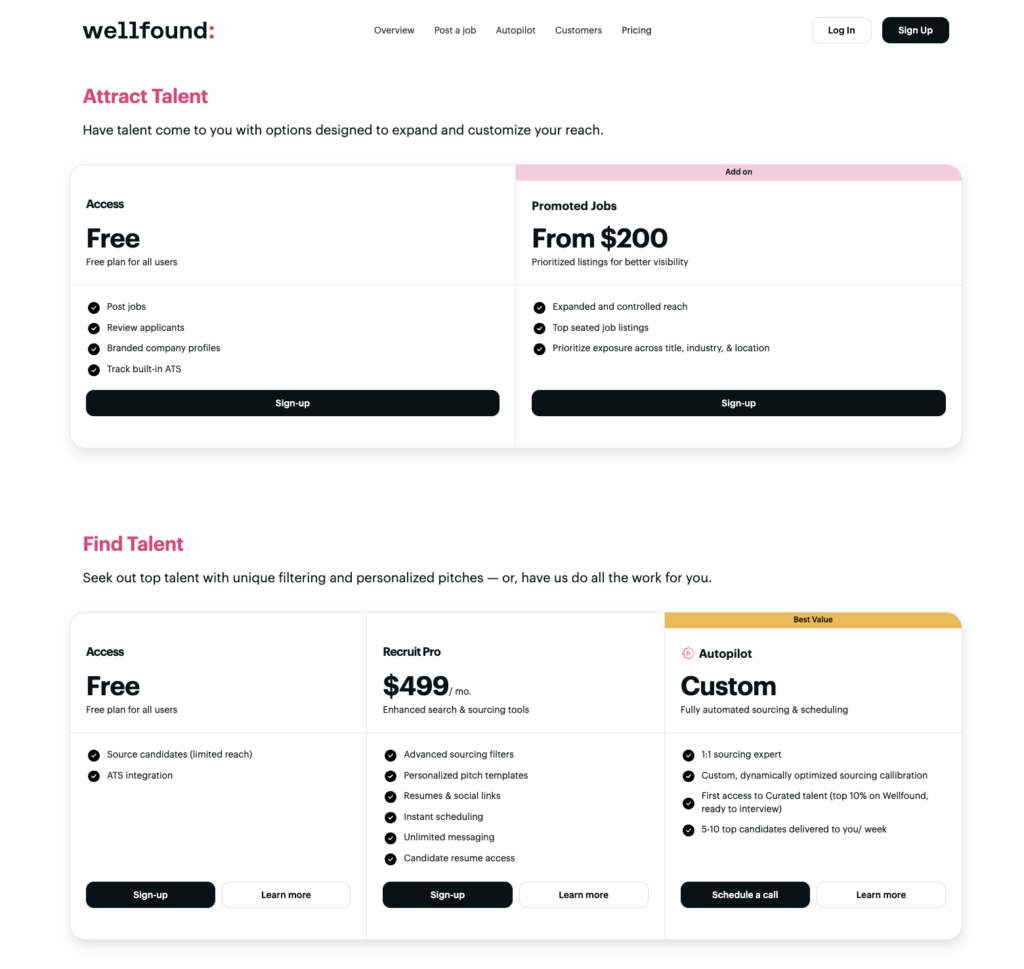
The main reason many startups try Wellfound first is its accessible pricing model. You can start with a free plan that allows unlimited job postings, applicant tracking, and basic candidate sourcing.
Paid tiers unlock additional capabilities. For example, promoted job listings (starting around $200) and Recruit Pro mode (about $499/mo) with advanced filters, unlimited outreach, and access to CVs.
Source: Wellfound website
In brief, Wellfound is designed to connect you with a pool of startup-minded job search enthusiasts. But as many discovered soon after registration, turning that wide candidate pipeline into the right hire requires significant time, effort, recruiting skills, and branding investments.
Will Wellfound Cover Your Hiring Request?
Choosing a job site is about whether the platform matches your stage, hiring urgency, and role type.
The same channel that works perfectly for one startup can become a bottleneck for another. For example, startups that create a buzz in the media attract x10 attention (and best candidates!) on Wellfound, but those who did zero PR efforts experience a lack of applications.
Let’s find out where Wellfound shines and where it tends to fall short. Below, we list the most common hiring needs and how Wellfound can or cannot help with them:
Role |
Company / startup stage |
Should you consider Wellfound? |
|---|---|---|
Startup generalist, operations lead |
Pre-seed or seed startup building a tech team |
✅ Good supply of “startup athletes” comfortable wearing multiple hats and joining very early companies ⚠️ Poor fit if you need a person with years of CTO experiencee |
Junior or mid-level software engineer |
Early-stage startup with a limited budget extending its team |
✅ Large pool of medium-rate engineers interested in early product impact; no markup ⚠️ If you need rapid hiring with strong vetting, be ready to thoroughly screen many applicants |
Senior dev (full stack, backend, frontend) |
A scaling company that strengthens its tech team |
❌ Time-consuming filtering due to a large number of unqualified applicants |
Highly specialized tech hire (e.g., ML engineer, AI) |
Deep-tech or AI startup |
❌ The candidate pool is too shallow for rare tech profiles |
Executive hire (CTO, Head of Product) |
Growing startup building leadership team |
❌ Almost no executive candidates on the platform |
Hiring multiple engineers quickly |
Team scaling from ~5 to 20 engineers |
❌ Screening volumes are overwhelming |
Confidential replacement |
Company replacing leads or a sensitive role |
❌ Public job postings risk exposing internal changes |
When Wellfound works perfectly…
Wellfound performs best when startups are hiring their first team members or filling early operational roles. The platform mostly attracts middle-level candidates who actively want to work in startups and are comfortable with the trade-offs like smaller teams and fast-moving priorities.
Another scenario is when a startup operates on a tight hiring budget but still wants strong visibility among startup-minded professionals.
The trick here is that companies with some traction—such as recent funding, media coverage, or a fast-growing user base—often attract strong interest from candidates. Yet, if you are a lesser-known project and your idea doesn’t stand out, the best candidates will ignore you in favor of someone else.
When Wellfound is not enough…
The limitations of Wellfound tend to appear when startups begin hiring specialized or senior tech roles.
Besides, since the platform functions as a job board, companies often receive a high volume of applications but must handle all vetting themselves. This can become time-consuming when hiring devs with experience in a specific niche like banking or healthcare, rare-expertize engineers, or qualified candidates for lead positions. For example, finding a senior backend engineer or a machine learning specialist may require reviewing hundreds of profiles with no guarantees.
Wellfound also struggles when speed matters. For example, scaling teams from 2 to 15 engineers is doomed if you don’t have several months to check each applicant.
Wellfound Alternatives for Tech Roles in Startups
Even if Wellfound fits some early-stage hiring scenarios, it’s far from the only option available to leaders building a productive technical team. Depending on your priorities—whether it’s faster hiring, a senior position, or access to a specific talent pool—other channels may solve the exact limitations you encounter on this platform.
Below, we’ll explore three groups of alternatives: job boards that expand your reach, curated talent marketplaces that reduce screening time, and additional strategies for sourcing developers at events and on social media.
Job boards & communities
Job boards and developer communities are usually the first place founders look when they start hiring. And some of them work better than Wellfound just because they are more specialized or are used by more people.
Here, we skip LinkedIn jobs and focus on dev-focused platforms—several alternatives to consider alongside Wellfound—and explain why.
We Work Remotely
for senior roles
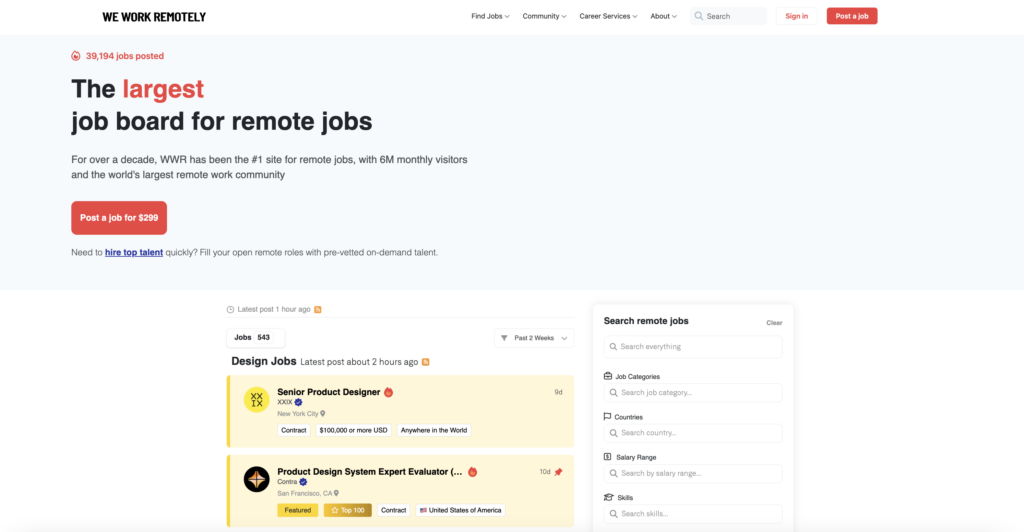
It is one of the longest-running remote job boards. And it has built a loyal audience of remote professionals across engineering, product, and design. For startups building fully remote teams, We Work Remotely offers visibility among experienced remote workers and talented digital nomads, which is a huge problem with Wellfound, where junior and mid-level specialists dominate.
Source: We Work Remotely website
Remote OK
for rare experts
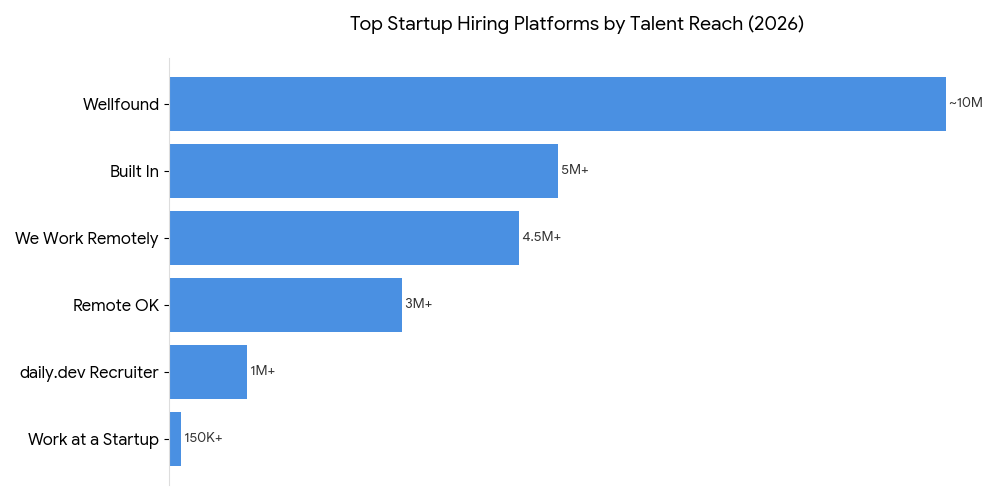
This job board is 3 times smaller than Wellfound, yet it is one of the most popular remote-first job boards for rare-expertise developers. As you might guess, the platform attracts engineers looking for remote work—not just everyone interested in startups. Here, listings are simple and highly visible, though companies should expect a large volume of applications to review, which can lead to time lost.

Source: Remote OK website
daily.dev Recruiter
for innovation-savvy devs
daily.dev started as a developer knowledge-sharing and tech tool user reviews platform and community used by thousands of engineers daily. Its recruiting section gives you access to developers already engaged with coding content and emerging tools. For you, this means reaching technically active candidates rather than only traditional job seekers, so that rare developer roles for ambitious projects can be covered. Extra advantage: Their recruiting tool helps you filter profiles automatically.

Source: daily.dev website
Built In
for PR & tech hud hire—Austin, LA, New York
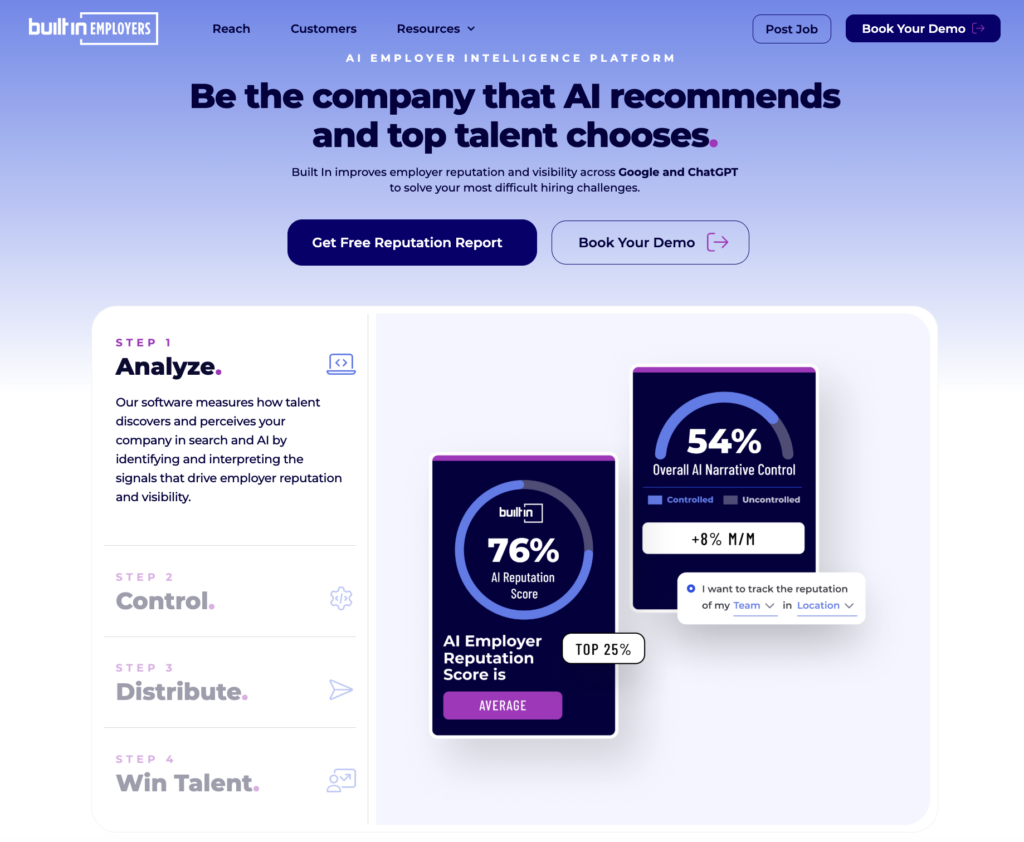
Here is a tech-focused media that includes a tech job board for big tech hubs (Chicago, New York, Austin, Los Angeles, etc.). Built In was originally launched as a community and content platform focused on local tech innovations, and now it combines tech news, employer content, a startup job board, company profiles, a careers page, and local tech community posts.
For you, the main value is visibility among other startups and mid-level devs in specific cities. Mind that to attract community members, you need to make your mission resonate with them—that’s the platform’s standard.
Source: Built In website
Work at a Startup (by Y Combinator)
for the community only
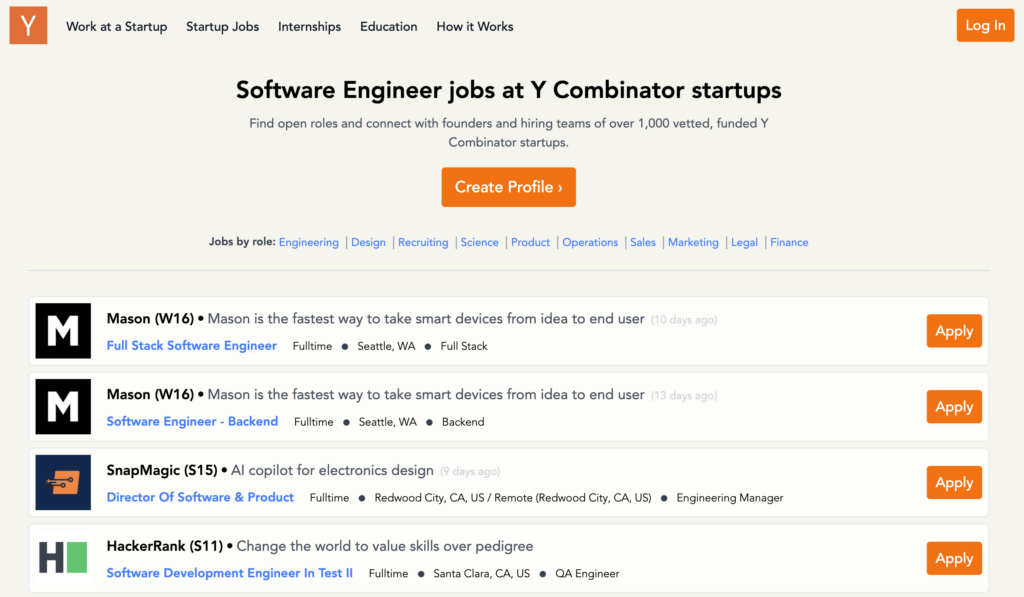
Work at a Startup is a hiring platform created by a startup accelerator to connect engineers and startup operators with YC-backed companies. Here, candidates create profiles describing their skills, startup interests, and preferred roles, while you browse or receive matches to your job request. Direct founder-to-candidate communication included. But there’s a limitation: the platform is designed for YC startups only. Alternative communities: Techstars and 500 Global.
Source: Work at a Startup website
GitHub
for manual vetting
While the original GitHub Jobs board has been closed, GitHub itself remains a powerful recruiting channel. Many lead source developers are directly reviewed by reviewing their real-time open-source contributions, repositories, and activity histories.
This approach allows you to evaluate real code and technical interests (so the vetting problem you have with Wellfound is resolved), though it requires more proactive outreach from your hiring team. The downside: you need to find devs manually—and reach out to them by contacts they added to their profiles.
Let’s compare all the options:
Platform |
Free job posting |
Talent pool size |
Candidate verification |
Direct messaging |
CV/profile access |
|---|---|---|---|---|---|
Wellfound |
✅ |
~10M startup-ready candidates |
❌ |
✅ |
✅ |
We Work Remotely |
❌ |
4,5M+ visitors/mo |
❌ |
Limited |
Profile |
Remote OK |
❌ |
3M+ remote workers & database of 70K+ vetted profiles |
❌ |
Limited |
Profile |
daily.dev Recruiter |
✅ |
1M+ active developers |
❌ |
✅ |
Profile |
Built In |
❌ |
5M+ users |
❌ |
Limited |
✅ |
Work at a Startup |
✅ |
150K+ tech professionals |
❌ |
✅ |
✅ |
GitHub |
No job posting |
100M+ developers |
Indirect via code contributions |
✅ (external) |
Profile + repos |
Startup-friendly vetted talent platform
While job boards provide visibility and are mostly free, vetted talent marketplaces focus on speed and candidate quality.
The candidate providers we mention below screen developers before introducing them to you, which speeds up your hiring. For startups that need to ship quickly—or simply don’t have the resources to run dozens of interviews—these options can serve as an efficient hiring channel.
Lemon.io
for no-risk collaboration with senior devs
Lemon.io is a curated marketplace for senior developers, designed for startups and SMBs. Unlike Wellfound—where you must manually filter through a sea of unvetted applications—we provide a zero-noise hiring experience.
You receive your first pre-vetted candidates, matched to your requirements, within just 24 hours. The vetting process includes deep-tech screening, CV verification, and soft-skill tests. Furthermore, we build pipelines for specialized and leadership roles that Wellfound often fails to capture.
We also offer a low-risk cooperation model: a flexible monthly subscription to the developer of your choice, backed by a free replacement guarantee to ensure your project never loses momentum.

Source: Lemon.io website
Underdog.io
for in-house hire
Underdog operates as a curated talent acquisition network connecting engineers, product managers, and designers with scaling companies. The platform is popular among venture-backed startups and enterprises hiring full-time team members. As a startup lead, you connect to the platform and share your hiring request—after which you are contacted by hiring managers who curate the process and build a pipeline for you.

Source: Underdog.io website
Dice
for job boarding to vetted candidates
Dice is a long-established tech hiring marketplace in the form of a job board focused on vetted engineers and IT professionals, mostly freelance-oriented. It is focused on North America clients and allows you to search a large database of technology professionals, filtered by specific skills and technologies.
It’s often used by companies that want access to a senior-level engineering talent pool. The concept here is hybrid: you still post a role yourself, yet it is only visible for pre-vetted tech professionals.

Source: Dice website
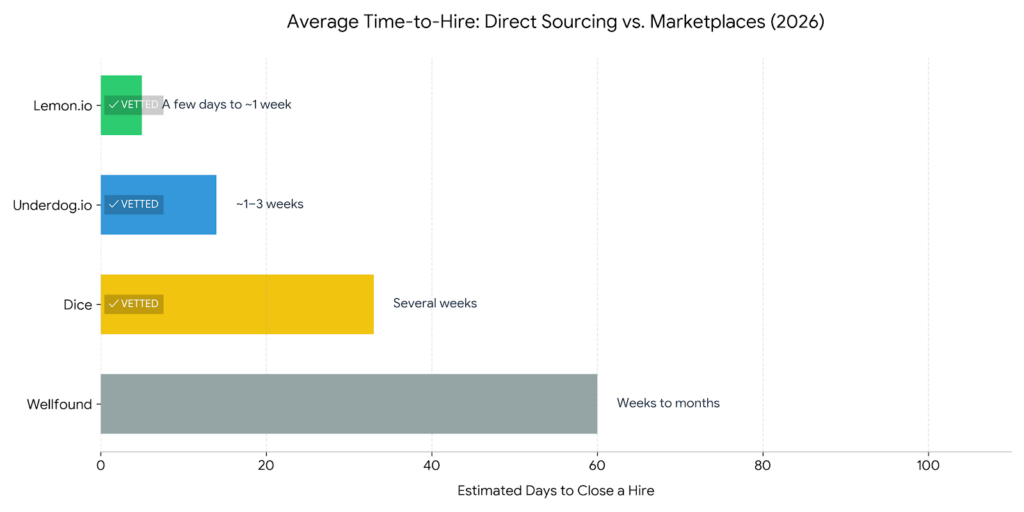
Key takeaway for founders. Vetted marketplaces trade a higher cost for lower hiring friction. So instead of reviewing hundreds of job applications—as often happens on Wellfound—you get a smaller set of candidates who have already passed technical screening. This reduces your time-to-hire for engineering roles.
Platform |
Talent vetting |
Time-to-hire |
Pricing model |
Best for… |
Candidate list access |
Free replacement |
|---|---|---|---|---|---|---|
Wellfound |
❌ |
Weeks to months |
Free + paid sourcing tools |
Early startup roles |
✅ |
❌ |
Lemon.io |
✅ |
~1 week |
Dev hourly rates (monthly subscription) |
Senior devs & leads |
✅ |
✅ |
Underdog.io |
✅ |
~1–3 weeks |
Recruiting fees |
Full-time engineers |
❌ |
✅ |
Dice |
✅ |
Several weeks |
Job posting fee |
Various IT professionals |
✅ |
❌ |
More about tech recruiting strategies, hiring KPIs, and top partners: 10+ Best Tech Staffing Companies for Startups in 2026.
3 other ways startups find developers
Not every successful startup hire comes from a job board or hiring marketplace.
In fact, many early-stage teams discover their best engineers through communities, networks, and direct outreach, especially when looking for senior or lead developers who are not actively applying for jobs.
Yes, these channels require more effort from founders, but they often produce stronger cultural fit and workflow alignment:
Tech meetups
Developer events remain one of the most effective ways to build authentic connections with engineers. Conferences such as Web Summit and Collision Conference, along with smaller local meetups for companies and non-profits, give you the opportunity to meet developers in person and talk about your products. These environments are valuable for startups building new technologies.
Referrals from existing engineers
Employee referrals remain one of the most reliable hiring channels in tech. Developers often have strong professional networks formed through previous companies and university programs. When startups encourage referrals, they gain access to candidates who already come with a recommendation and strengthen their human resources. An alternative way is to ask for recommendations via LinkedIn.
AI-powered talent search
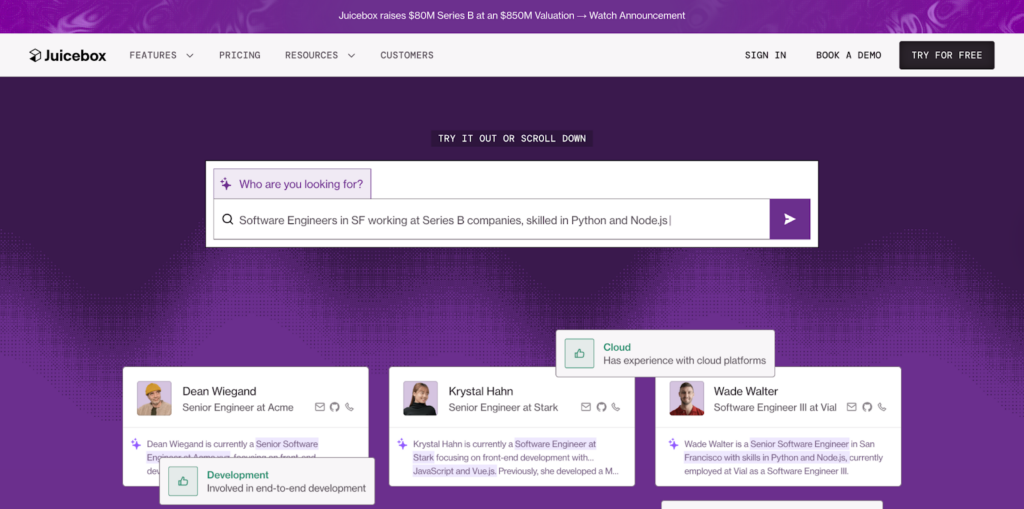
Another emerging approach involves AI-driven talent discovery tools such as PeopleGPT by Juicebox. Instead of waiting for candidates to apply, it searches across datasets to identify developers based on skills, technologies, and professional activity. And this automation saves your time.
For founders who need to reach passive candidates—developers who are not actively job-hunting—AI-powered sourcing can expand the talent pool.
Source: Juicebox website
What’s the Safest Way to Start Hiring Developers?
By now, it’s clear: no single hiring channel is a silver bullet.
The right approach depends on your specific objective—whether you’re hiring your first engineer, a niche specialist, or scaling an entire department. A platform that works at one stage may become a bottleneck at the next one.
To succeed, avoid relying on a single source. Instead, diversify your search for candidates to balance speed, reach, and quality:
- Job boards (e.g., Wellfound) are best for casting a wide net and attracting startup-minded talent.
- Curated marketplaces are ideal for reducing screening time.
- Referrals & networks are the gold standard for hiring leadership and high-trust roles.
Start your journey on Wellfound—it’s accessible, free, and great for early-stage visibility. However, as your product evolves and your time becomes more valuable, switch to a startup-focused marketplace like Lemon.io.
Instead of managing the entire funnel yourself, you gain access to developers who have already passed technical screening, background checks, and soft-skills interviews.
The result—you meet relevant candidates within 24 hours and can finalize a hire within a week. With a flexible monthly subscription and a free replacement guarantee, your team’s productivity stays secure as your needs shift.