

“AI engineer” has become a catch-all for specialists who do vastly different things:
- AI API integrator who crafts AI-powered product features with OpenAI or Anthropic;
- “Vibe coder” who accelerates development with AI coding tools to ship MVPs fast;
- Machine learning engineer who builds custom models when off-the-shelf AI isn’t enough, and many others.
If you are struggling to understand what AI engineers your product craves, let us help you navigate. This article breaks down each role and the real-world problems they solve—because hiring the wrong type can cost $250/h for work a $60/h specialist could handle.
And, yes, whatever vetted AI expert you are about to hire, you can find them on Lemon.io.
Which “AI Engineer” Do You Need?
Artificial Intelligence is evolving faster than its job titles. In 2026, the term “AI engineer” can describe anything from a deep-learning scientist inventing new models to a product engineer wiring ChatGPT into your new SaaS feature.
The terminology is still fluid, but the market has already settled around several recognisable roles with their specific skill sets, responsibilities, and costs.
Machine Learning Engineer
Job title variations: ML Scientist, AI machine learning engineer, Applied ML Scientist, AI Research Engineer, Deep Learning Engineer
An ML engineer or ML scientist is the most traditional—and technically demanding—AI role. These specialists are often generalists. They build and train machine learning models from scratch using datasets, often relying on frameworks such as PyTorch, TensorFlow, and Scikit-learn.
An AI machine learning engineer’s work begins long before the “AI magic” appears and is business-focused data science. ML engineers collect and analyse data, clean it, design model architectures, and train neural networks.
You hire for this role when off-the-shelf tools like ChatGPT or Claude are:
- too generic for your needs,
- too expensive at scale,
- or can’t solve your specific tech problem.
This role is common in deep-tech startups, where a unique AI model is the core intellectual property. A data scientist is a narrow specialisation for this role, focused on extracting insights from the data your company has.
An entry-level engineer focuses on data pipelines, model training, and experimentation under supervision. A senior AI research engineer designs architectures, optimises model performance, and may publish research or even invent new tech that keeps competitors at bay.
Machine learning engineers are rare and expensive—but when the product depends on unique AI capabilities, they are the only role that can deliver it.
PRO TIP
If you are building a specific product that relies on computer vision, such as remote diagnostics tools in healthcare, NLP (natural language processing), or speech and audio engineering for smart home devices, you need an ML expert with dedicated computer science education and hardware awareness.
AI Integrator
Job title variations: AI API Integrator, AI Product Engineer, AI Application Engineer, AI Solutions Architect
AI integrators (most commonly called “AI engineers”) are currently the most in-demand AI specialists in startups. They work hand in hand with product managers to boost digital product performance. Instead of building models from scratch, they combine powerful existing models such as OpenAI, Anthropic, or Google systems with your product logic, APIs, and third-party databases to create cutting-edge user-facing features.
The toolkit used by AI product engineers includes prompt engineering, retrieval-augmented generation (RAG), vector databases like Pinecone or Weaviate, and orchestration frameworks such as LangChain or LlamaIndex.
In simple words, this is the engineer who turns “we should add AI” into a working feature inside your product.
Typical implementation covers:
- AI customer support agents;
- “Chat with your data” or chatbot tools;
- Automated research assistants;
- Automated on-platform content generation.
Many well-known AI features—from productivity and generative AI tools for visuals to AI copilots integrated into SaaS platforms—are built by engineers in this category.
An entry-level AI product engineer can integrate APIs and build prototypes, but relies on existing architectures. A senior certified artificial intelligence engineer is in charge of the AI integration roadmap. They design workflows and autonomous AI agent systems for multi-step tasks such as research, automation, or operations management.
“Vibe Coder”
Job title variations: AI-Assisted Developer, AI-Augmented Engineer, AI-First Developer
The rise of advanced coding copilots—such as Cursor, Claude Code, and GitHub Copilot—has created a new type of developer: the AI-assisted engineer, often called a “vibe coder.”
These are classic full-stack, frontend, and backend developers who use AI coding tools—AI pair-programming assistants and autonomous coding agents (most popular options are Supabase for backend and Vercel for frontend)—to accelerate their software development. As a result, instead of manually writing every function, they guide AI systems that generate, refactor, and test code across large parts of the codebase.
For startups, the business value here is speed:
- Fast prototyping;
- Testing more hypotheses in a short time;
- Quick MVP launches.
A low-level AI-assisted developer relies heavily on AI suggestions and requires hands-on code reviews from their leads. A senior engineer who works with AI coding or testing tools acts like an architect and is in charge of decision-making. They define system goals, orchestrate AI coding agents, and ship features at a high pace.
Note that AI-augmented is often a complex process, not just a one-shot, prompt-based action. Even though there are AI app-building platforms like Lovable and Bolt, often called “vibe coding” tools, neither is suitable for professional tasks due to the limitations and code mess they generate at scale.
More on this topic: Founder’s Guide to Hiring Software Developers in the 2026 AI Surge [pro tips]
AI Infrastructure Engineer
Job title variations: LLMOps Engineer, AI Infrastructure Engineer, AI Platform Engineer, AI Data Engineer
If AI product engineers build the features, LLMOps engineers make sure those features run reliably, quickly, and affordably. These specialists keep your AI running fast, reliably, and cheaply by managing the background tech and cutting API costs. In smaller teams, this role overlaps with AI interactions or ML engineering.
This engineering role as a standalone one becomes critical once an AI feature reaches scale and thousands of users interact with it daily. For example, if your AI agent takes 15 seconds to respond or costs $10,000 per month in API usage, this is the engineer who fixes it.
Infrastructure management by these experts includes:
- Model fine-tuning;
- Improving AI infrastructure performance;
- Database optimisation,
- AI observability platforms.
Many startups adopt this role once their AI features gain traction and operational complexity grows. An entry-level infrastructure engineer focuses on monitoring, logging, and maintaining pipelines. A senior specialist redesigns system architecture to improve speed and reduce operational costs.
The career path for these specialists may start with AI integration and go further to a computer science expert specialised in AI.
How to Vet AI Engineers
For leaders without an AI background, the safest interview approach is to evaluate candidates across what they have shipped, how they think about the product, and how well they understand the tools behind their work. A strong candidate will easily connect technology to business.
Below are the AI engineer requirements:
Role |
Tasks |
Tools & Technologies |
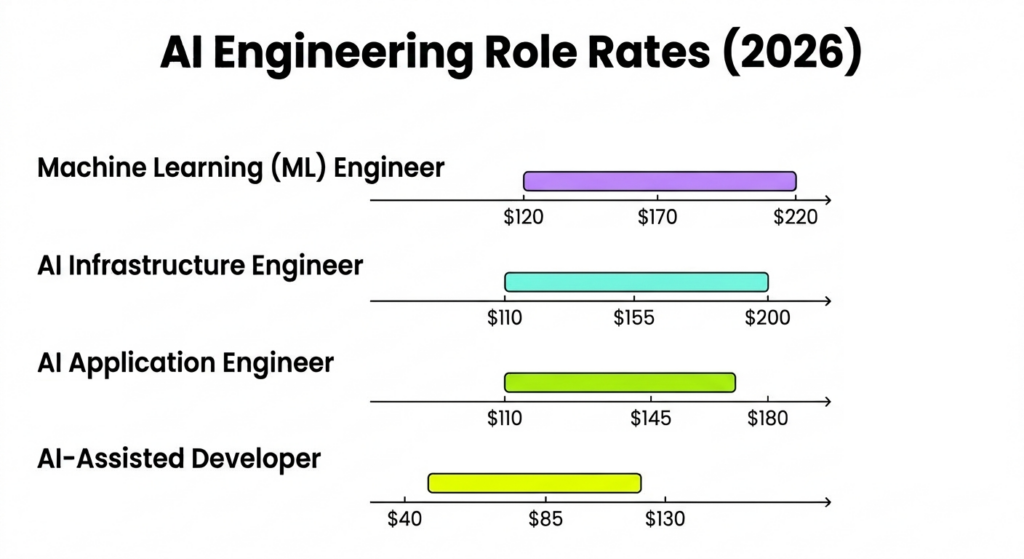
Hourly rate |
|---|---|---|---|
ML Engineer |
build and train ML models design neural network architectures optimise models for accuracy |
Python, PyTorch, TensorFlow, Scikit-learn, Pandas, NumPy, MLflow, Kubernetes, cloud ML platforms (AWS/GCP/Azure) |
$120–$250+ |
AI Integrator |
build product features using existing AI models integrate LLM APIs implement chatbots, AI copilots, and autonomous workflows design RAG pipelines and AI UX |
OpenAI (ChatGPT) / Anthropic / Google (LaMDA AI, Gemini) APIs, LangChain or LlamaIndex, vector databases (Pinecone, FAISS, Weaviate), Python, TypeScript, FastAPI, cloud infrastructure |
$90–$180 |
AI-Assisted Engineer |
accelerate software development by using AI coding assistants |
AI coding assistants (GitHub Copilot, Cursor, Claude Code), standard engineering stacks and web frameworks (React, Java, Node.js, Next.js) |
$40–$130 *standard engineering rate |
ML Engineer
Strong machine learning engineers show understanding of data, experimentation, and model performance. They can clearly explain how they trained their models, what data they used, and the measurable improvements they achieved for your business.
The best candidates discuss accuracy, inference speed, and the trade-offs in training critical to your use case. They understand the whole process—from preparing data and building the model to launching it and keeping it running smoothly.
Also, a good ML engineer will quickly ask about your dataset quality and availability, because data is usually the limiting factor.
Core skills:
- ML algorithms and deep learning
- Model training, evaluation, and experimentation
- Data pipelines and feature engineering
- Model deployment & monitoring
AI Integrator
The best AI product engineers think like product builders first and AI specialists second. They should be able to describe how they turned large language models into real product features such as assistants, automation workflows, or AI-powered analytics.
It’s a good sign if, during your tech interview, your candidate talks about how fast the AI responds, how accurate and consistent it is, and how they prevent mistakes. They should also understand how to combine LLMs with your company’s data.
Candidates who rely heavily on AI but cannot explain how the generated code works are a clear red flag. Another warning sign is someone who can’t describe their testing and code review process.
Core skills:
- API integration and backend development
- Retrieval-Augmented Generation (RAG)
- Prompt engineering and evaluation
- Designing AI product workflows
AI-Assisted Engineer
A strong AI-assisted developer understands how to multiply their productivity with AI tools and perform high-quality engineering. In other words, they know when to rely on AI-generated code and when to review or rewrite it manually.
Strong programmers treat AI as a collaborator rather than a replacement for engineering thinking. However, avoid candidates who rely heavily on AI but can’t explain the generated code and manually adjust it if needed.
Core skills:
- Full-stack development (or narrower)
- Rapid prototyping
- AI-assisted coding workflows
- Debugging and refactoring with AI tools
Crafting a Winning Job Request [checklist]
Before job postings or contacting your hiring partner, it’s worth finalising the fundamentals of your need and translating them into the actual request.
Many start with “we need full stack AI developer,”—but that description is far too vague to find (and moreover attract!) the right candidate. The clearer you are about your product goals, data, and constraints, the faster a recruiter or hiring platform can connect you with the right specialist.
Here are questions to ask yourself and get prepared for hiring:
1. What business problem are you trying to solve?
Start with your product outcome. Are you trying to automate customer support, personalise recommendations, analyse documents, or build a completely new AI-powered product?
When you clearly define the business problem, it becomes easier to determine whether you need an ML engineer, an AI integrator, or another type of specialist.
One of the most common startup team mistakes is assuming they need an “AI developer” when the real problem isn’t AI itself. Sometimes, what you need is a strong full-stack engineer who uses AI tools to structure the data and building a custom model is not the case.
2. Is AI the core of your product or just a feature?
If your startup’s core value is based on proprietary AI (for example, predictive analytics), you likely need a machine learning engineer. If AI is simply enhancing your product—such as adding a chatbot or automated workflows—an AI product engineer may be the right fit.
3. Do you already have relevant data?
Many AI projects depend heavily on data availability and quality. Ask yourself whether you already have datasets to train models on, or whether your solution will rely mostly on existing models and APIs.
If your project depends on training custom models, the required expertise—and cost—will be significantly higher. And if you need data first, the right fit would be a data scientist.
4. What stage is your product in?
Your hiring needs depend on product maturity. Early-stage startups may prioritise speed and experimentation, making AI product engineers or AI-assisted programmers a better choice. Companies with a growing user base may instead need engineers focused on performance, reliability, and infrastructure (LLMOps).
5. What tech environment will your AI engineer work in?
Even a short description of your stack helps filter candidates quickly. Mention the main languages, frameworks, and infrastructure your product already uses. For example: Python backend, TypeScript frontend, AWS infrastructure.
6. What level of task ownership and seniority do you expect?
A senior full-stack AI developer can design architectures, evaluate trade-offs, and make strategic decisions. Junior engineers may be strong implementers, but need guidance. If your team lacks AI expertise, hiring a senior specialist is usually the safer choice. Later, you can reinforce your team with juniors.
7. What matters most: speed, cost, or scalability?
Different engineers optimise for different outcomes. If your priority is launching quickly, you may want someone focused on integration and rapid development. If your biggest concern is API cost or scaling infrastructure, you may need an engineer specialised in optimisation and operations.
How fast can you hire AI engineers with Lemon.io?
Knowing which AI engineer your product needs is one thing—finding them before your competitors do is another. And in a field that moves this fast, the cost of a bad or too-late hire might be your lost market share.
This is where most companies lose their lead. Weeks of momentum are sacrificed to a hiring funnel filled with candidates who ace the buzzwords but fail to ship solutions. The good news is that Lemon.io eliminates this for you.
We maintain a hand-picked network of senior AI devs—from LLM architects to AI integrators—who have already survived:
- AI-focused technical interviews that cover all aspects mentioned in this article;
- Soft skills and professionalism audits;
- Background checks.
As a result, you get a curated list of engineers proven to deliver AI-based or AI-empowered solutions.
The process of finding your right hire is built for the speed of 2026. You register, tell us your stack and goals, and we help you translate them into a precise role, ensuring you don’t overhire or overspend. Within 24 hours (often faster), you receive 1–3 hyper-relevant candidates.
PS. Glossary—Your Full List of AI-Engineering Roles in 2026
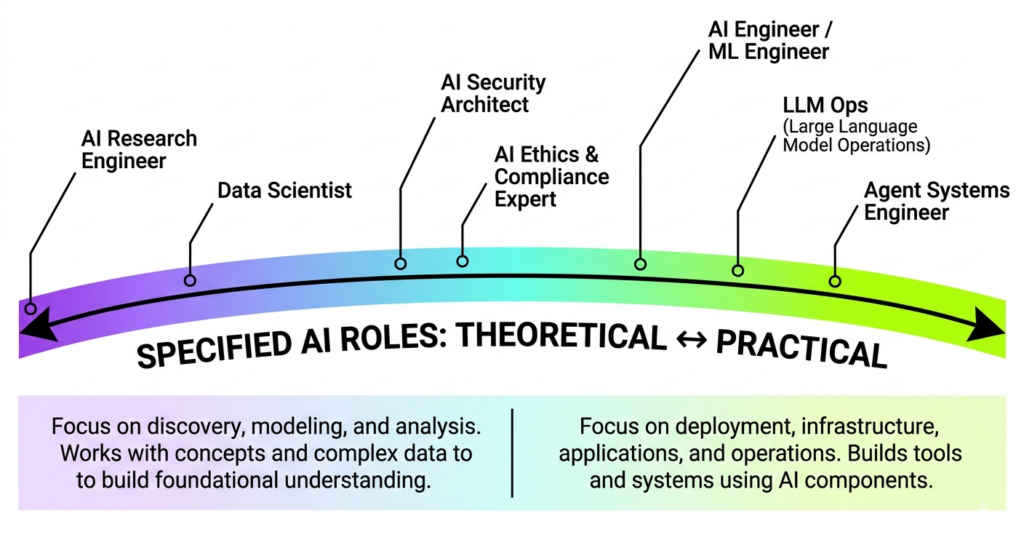
Agent systems engineer—focuses on “agentic” workflows—building AI that can use tools (browser, email, terminal) to complete multi-step tasks.
AI-assisted engineer—uses AI coding tools to accelerate development; they act as an architect-reviewer, guiding AI to write code while ensuring quality and security.
AI ethics & compliance expert—ensures the AI isn’t biased and follows new 2026 global regulations (EU AI Act, etc.).
AI infrastructure architect—designs the GPU (graphics processing unit) clusters and cloud environments (AWS Bedrock, Azure AI) needed to run heavy AI workloads.
AI interaction designer (AIX)—specialises in how humans and AI communicate, focusing on trust and intuitive flows.
AI product engineer—a full-stack developer specialised in integrating LLM APIs (OpenAI, Anthropic, and others) into consumer-facing apps.
AI product manager—The strategist who defines the AI roadmap, manages model risks, and measures business ROI.
AI research engineer—transforms theoretical AI papers into functional prototypes by building, testing, and optimising experimental models.
AI security architect—protects against “prompt injection,” data poisoning, and adversarial attacks on your models.
Applied ML researcher—develops new algorithms or in-house architectures when off-the-shelf solutions aren’t enough.
Computer vision (CV) specialist—focuses on machines that “see” (satellite imagery, medical scans, autonomous vehicles).
Data scientist—analyses complex information to find hidden patterns and trends that help a company make smarter business decisions.
Edge AI (TinyML) engineer—makes models small enough to run locally on hardware (phones, smartwatches, or IoT devices).
LLM Ops (large language model operations) engineer—manages the deployment, cost-tracking, and scaling of models; the DevOps of the AI world.
ML engineer—builds the engine of AI by designing and training machine learning models that can learn from data and improve on their own.
Multimodal AI engineer—works with models that process text, image, video, and audio simultaneously.
Prompt architect (interaction specialist)—expert in advanced prompting techniques (Chain-of-Thought, ReAct) and designing the “personality” and reliability of the AI’s output.
Reinforcement learning (RL) engineer—specialised in training AI through trial and error (common in robotics and gaming).
Speech & audio AI engineer—expert in voice cloning, real-time translation, and acoustic modelling.
Vector database engineer—specialist in RAG (retrieval-augmented generation) and managing high-speed memory for AI systems.