

Due to the pace and nature of AI tech, hiring an AI engineer is different from a traditional developer search. Plus, with AI-polished profiles everywhere, it’s becoming harder to tell an expert from a surface-level pro at a glance.
This Lemon.io guide shows you how to read an AI engineer’s CV, spot the credentials that matter, and use a vetting framework that saves time—with a test task and interview questions included.

AI Engineer Types & Duties
The term “AI engineer” serves as an umbrella for several distinct profiles. Depending on whether you are building your own machine learning model, adding a chatbot to your SaaS, or crafting recommendation systems for a shopping platform, you need a different hire.
The key AI-related roles in 2026:
- Machine learning engineers are building and training AI models using custom datasets. They are expensive, rare, in demand, and necessary only if you are building unique models or doing heavy fine-tuning on proprietary data.
- An AI API integrator uses existing AI models to automate workflows. They connect your product to APIs such as ones for ChatGPT, Claude, or Gemini—and build the automation infrastructure (like RAG) that makes those models useful for your business.
- An AI-assisted coder is a modern full-stack developer who uses ready-made AI solutions to do 80% of the code work. They ship features at 3x (or more!) the speed of a traditional coder.
- AI optimizer (LLMOps) ensures your AI is fast, cost-effective, and reliable in production, and that your AI project is scalable.
And what’s important for you is that each of these roles has its own tech and soft skill requirements.
As a vetted developer marketplace built for startups, Lemon.io has spent years perfecting the art of screening and testing AI engineers. We’ve distilled that experience into a hiring framework that covers both the technical depth and the specific mindset required for every AI developer type.
To understand which profile fits your team and how to tell them apart, check out our deep dive: AI Engineers: Who They Are & Whom You Need.
AI Engineer Job Requirements: Education
In 2026, the AI engineering career path—from machine learning expert to AI-assisted coder—is rarely a single trajectory.
While a bachelor’s degree in computer science remains the gold standard for entry-level roles, the industry now values a hybrid professional who blends the mathematical rigor of research scientists with the pragmatic ship-it mentality of a classic software engineering specialist.
Here’s an overview of the degrees and institutions that are clear indicators of quality.
The academic foundation
While manual coding can be assisted by AI, the underlying logic can’t. When filtering degrees, scan CVs for mathematical depth rather than trending AI titles. Bachelor’s degrees to look for:
- Computer Science (CS) is the gold standard, with a concentration in ML and data science.
- Mathematics or Physics is desirable for R&D roles.
- Statistics and Statistical Analysis a good choice for research-heavy foundational roles.
- Computer Engineering is excellent for AI startups that interact with hardware (robotics, edge AI, IoT, computer vision).
- Artificial Intelligence. These specialized degrees are well-suited to applied AI roles where engineers need to hit the ground running with modern frameworks using time-proven algorithms.
There are also several Ph.D. and Master’s degrees that indicate the candidate has in-depth knowledge, both theoretical and practical. Those qualification is great for lead positions:
- A Master’s in Computational Linguistics is the “secret weapon” for startups building heavy NLP or LLM-based products.
- Master of Engineering is a great choice for less scientific startups because its program is industry-aligned and project-heavy.
Don’t discount online courses. A Master’s from Georgia Tech (OMSCS) or UT Austin’s online AI program—those are the best institutions for tech education in the world—is often more demanding than many mid-tier in-person degrees.
Tier-one educational institutions
These schools are the standard for AI research, big data analysis, and engineering. Expect to pay a 25% to 50% premium for candidates from these places.
Region |
Institutions |
|---|---|
United States |
Carnegie Mellon (CMU), Stanford, MIT, UC Berkeley, Georgia Tech |
Europe |
ETH Zürich (Switzerland), Oxford/Cambridge (UK), TUM (Germany) |
Canada |
University of Toronto, University of Montreal (Mila), University of Waterloo |
Asia |
Tsinghua University (China), National University of Singapore (NUS) |
Courses & professional certificates for AI engineers
The modern market for AI engineer training is saturated with “intro” certificates. To find a strong engineer, look for courses that emphasize architecture and production-level deployment rather than cover the basics of AI or prompt engineering.
Courses in machine learning, deep learning, Natural Language Processing (NLP), neural networks, and cybersecurity—all are good signs if you hire an AI infrastructure engineer or AI-assisted full-stack developer.
Here are some training for AI engineers that have high credibility in 2026:
- DeepLearning.AI—the universal benchmark for understanding neural network fundamentals.
- AWS Certified Machine Learning—proves a candidate can handle high-scale deployment on SageMaker AI or Bedrock (generative AI application builder).
- Google Professional ML Engineer—excellent for candidates working with data-heavy pipelines and Vertex AI.
- NVIDIA DLI certifications—the mark of an engineer who understands GPU optimization—critical for keeping your API costs down.
- LangChain / LangGraph certification—proves a candidate can build complex, multi-step AI agents.
- AI Security & Governance (e.g., IAPP AIGP)—vital for SMBs in regulated industries (FinTech, HealthTech) to ensure the AI is compliant and safe.
- Microsoft Bootcamp certificates (Azure AI Engineer Associate) are the go-to for integrating Azure OpenAI and building conversational AI.
Core Technical Requirements for AI Engineers
What about the universal AI knowledge base—valid for machine learning engineers, AI API integrators, vibe coders, and optimizers? Regardless of their specific title, every AI engineer must be able to navigate some tech pillars:
Algorithmic literacy
AI engineers should understand how data transforms into a prediction. Knowledge of machine learning algorithms is essential for ML engineers to build and optimize. For AI API integrators, it’s about understanding a model’s limits so they don’t promise features the AI can’t deliver.
Data plumbing
Any AI engineer should know how to move data from a database into a format that AI can read. It is the bread and butter of AI optimization and integration. API integrators must be fluent in vector databases.
AI benchmarking
An AI developer should be able to determine whether the AI is actually getting smarter or just getting more expensive. This skill is critical for optimizers and integrators. If they can’t define a “success metric” for a prompt, they are just guessing.
Cyber security
It is a non-negotiable for all roles. An AI leak can sink a startup—so your candidate should be able to prevent prompt injection and ensure data privacy (GDPR/SOC2 compliance for AI).
And here’s a detailed technical skill breakdown by role:
Role |
Primary Task |
Tech Stack & Core Skills |
|---|---|---|
ML Engineer |
Building, fine-tuning, and maintaining the ML brain of your product |
Frameworks: PyTorch, TensorFlow, Scikit-learn, Apache Hadoop. Logic: linear algebra, transformer architectures. Infrastructure: MLOps (MLflow, Kubernetes), Data Engineering (Spark). |
AI API Integrator |
Connecting apps to external models (ChatGPT, Claude) via APIs and managing data flow |
Orchestration: LangChain, LlamaIndex, RAG, Keras API, Anthropic/Google APIs. Data: Vector DBs (Pinecone, Weaviate), REST/GraphQL. Language: Python, TypeScript, FastAPI. |
AI-Assisted Coder |
Using AI IDEs (integrated development environments) to handle boilerplate while focusing on product logic |
Mastery: Cursor, GitHub Copilot, Supermaven. Stack: React, Node.js, Next.js, Python, Java. Skills: unit testing, code review expertise, rapid prototyping. |
AI Optimizer (LLMOps) |
Ensuring AI isn’t too slow for users or too expensive for the budget |
Ops: GPU/TPU orchestration, cloud FinOps (cost control). Perf: quantization (model shrinking), inference scaling, vLLM/TGI. |
Lemon.io matches startups and SMBs with vetted senior AI talent—from ML experts and API integrators to AI-assisted developers. The platform team handles pre-screening, technical interviewing, and deep background checks. You can focus on the final product-fit interview; we’ll ensure technical excellence is already in place.
Soft Skills Requirements for AI Devs
The important differentiator between strong candidates and all the rest is judgment. Especially when it comes to small teams where every person shapes the product and culture. These are the most critical AI engineer skills related to the work culture for tech startup teams that will secure their growth:
Ownership & product thinking
In artificial intelligence development, it’s dangerously easy to get lost in optimizing the model—spending weeks to make it just 1% more accurate while ignoring the full user experience. To avoid this, you need someone who views the AI as a product. A strong candidate won’t give you a pure technical answer when faced with a trade-off. They prioritize the final user experience and business ROI.
More on the product-thinking mindset in engineering: Founder’s Guide to Hiring Software Developers in the 2026 AI Surge [pro tips].
Technical “translation”
AI is inherently complex, and as a founder, you need an engineer who can explain high-level trade-offs in simple words. And if an engineer can’t explain a concept like RAG to stakeholders with no tech background, they likely don’t understand the business impact of their own technical choices. Look for those who naturally use relatable analogies and check in frequently to ensure the logic makes sense to the rest of the team.
Problem prediction
AI systems fail in unpredictable, quiet ways—such as subtle bias or hallucinations—that traditional unit tests often miss. You need an engineer who considers the “what if” and the ripple effects of their code on your brand’s reputation. When a problem arises, a great hire doesn’t just offer a quick technical patch; they discuss accountability, user trust, and long-term risk.
Innovation adaptability
The AI field moves faster than any other industry. A tool or library that is considered state-of-the-art today might be obsolete by Friday. A great AI engineer must be willing to “kill their darlings” if a better, faster way to solve the problem emerges.
You need a person who is genuinely excited when a new model release makes their last three months of work redundant, because they value the new efficiency most.
And there are other minor aspects that are yet valuable for your team! Use this table during your post-interview debrief to quantify the soft skill check:
Soft skill |
🟢 Green flag |
🔴 Red flag |
|---|---|---|
Product thinking |
Asks about users and business goals. Prioritizes speed & cost over 100% accuracy |
Obsesses over academic benchmarks |
Task ownership |
Uses “I” when discussing failures and “We” for wins; proposes solutions for messy data |
Blames bad data, vague requirements, or APIs when things don’t work |
Communication & teamwork |
Explains AI concepts using simple analogies; checks if you understand |
Uses heavy jargon to gatekeep info; dismisses non-technical feedback as uninformed |
Problem-solving |
Breaks a large problem into small, testable milestones |
Jumps straight into coding without asking clarifying questions; over-engineers |
Adaptivity |
Admits when a chosen tool isn’t working and pivots quickly—not “married” to their code |
Gets defensive when challenged; continues using outdated methods because used to them |
Tech curiosity |
Mentions specific papers, newsletters (e.g., The Batch), or recent model releases (e.g., Claude 4, GPT-5) |
Only knows the tools used in their last job; hasn’t explored new frameworks in 6+ months |
Self-development |
Has a clear plan for what they want to learn next and what advancements they are aiming to make |
Can’t name a single new skill they’ve learned independently in the last year |
Hands-on Experience Check for AI Talent
AI-augmented writing can make a junior sound like a seasoned AI research scientist. To find proven, battle-tested talent, look past job titles and search for evidence of deployment. Here are specific indicators of high-level execution:
- Active contributions
Check GitHub or Hugging Face for original repositories. A high-quality README and a history of resolving complex issues indicate they can maintain code.
- Production metrics
Prioritize candidates whose CVs mention business impact. Look for phrases like “managed 20k monthly active users,” “reduced inference latency by 40%,” or “cut API costs by half.”
- The specialization match
Ensure their past work aligns with the role you are hiring for—an AI integrator should show a portfolio of RAG-based apps, while an AI Optimizer should have documentation on GPU orchestration or model quantization. If you build a product in a highly regulated industry—like healthcare or banking—relevant experience is essential.
In addition, ask these to see if they’ve actually lived through the problems they claim to solve:
Tell me about a time your model performed perfectly in training but failed in the real world. Why did it happen, and how did you fix it?
How do you handle it when the OpenAI or Anthropic API goes down, becomes extremely slow, or changes its output format overnight?
How do you verify that the code generated by your AI IDE (like Cursor or Copilot) isn’t introducing a security vulnerability or a silent memory leak?
Walk me through a specific instance where you reduced the cloud bill for an AI feature without ruining the user experience.
The best candidates will pivot their answers toward business impact. They shouldn’t just explain the data structure approach they took, but also why that specific model or API was the right choice for the company’s bottom line.
When an engineer can link a technical decision to an increase in user retention or a saved month of development time, you’ve found someone who can help your startup scale.
Test Assignment Examples
A resume tells you what an engineer has done; a test assignment is something that can prove that they can do exactly what you need, under pressure and within your work framework.
A test technical task isn’t just to see if the code runs—but to see if the candidate can navigate their own solution, detect failures, and fix flaws in real time. Here is how to structure an assignment for each of the four core AI-related roles:
The ML engineer + Data hygiene challenge
Provide a messy, raw dataset (e.g., a CSV with missing values and inconsistent formatting) and ask them to fine-tune a small open-source model, such as Llama-3-8B, for a specific classification task.
What to look for: A senior engineer won’t jump to training. They will document how they cleaned the data first. So look for scientific rigor—did they provide concrete metrics like Precision and Recall, or just “vibes-based” examples? Crucially, check whether they kept a separate test set to ensure the model does not memorize the training data.
AI API integrator + RAG prototyping
Ask them to build a RAG system using several specific internal data PDFs (such as FAQs for your app). The goal is a chatbot that answers questions based exclusively on those files.
What to look for: This is a test of hallucination control. Ask the bot a question not covered in the PDFs; a production-ready engineer ensures the bot says “I don’t know” rather than making up an answer. Looking for traceability too—whether the output includes references to the source material.
AI-assisted coder + legacy refactoring
It can be any low-importance development task from your current scope. One of the options: hand over a buggy, poorly documented legacy code of your product. Ask them to refactor it and add three new features using modern AI tools like Cursor or GitHub Copilot.
What to look for: This tests critical thinking. Did they (and the AI) blindly replicate the original bugs in a prettier format, or did they catch and fix the underlying logic? Look for automated unit tests to verify that the AI-generated code is reliable and modular, ensuring complete debugging.
LLMOps + efficiency sprint
Provide a script for a heavy model that runs slowly or consumes too much memory. Task them with reducing the memory footprint or latency by 30%.
What to look for: Financial literacy and trade-off analysis. Can your candidate explain the trade-off between cost and quality, and their decision-making process? (good answer example: “We saved 40% on memory, but the model is 2% less accurate.”) Other things to check: whether they calculate the cost-per-request savings.
Meeting to present test task results
Once the task is submitted, schedule a 20-minute presentation meeting for the real vetting. Start with a why-audit by asking a candidate to defend their choice of a specific library or architecture. A senior hire will justify their decision in terms of long-term scaling, security, or reliability.
To test their business understanding, throw a “curveball.” Ask your candidate how they can execute the same task with 50% of the budget or twice as fast.
Hire Top AI Engineers with Lemon.io
By following the framework we provided above, you have a higher chance of getting the right candidate for your tech team. However, there’s also a time issue.
In 2026, the average time to hire a specialized AI engineer on your own ranges from 45 to 90 days. And for startups whose competitive edge is flexibility, that might be too long.
What can you do to get the right AI-expert faster?
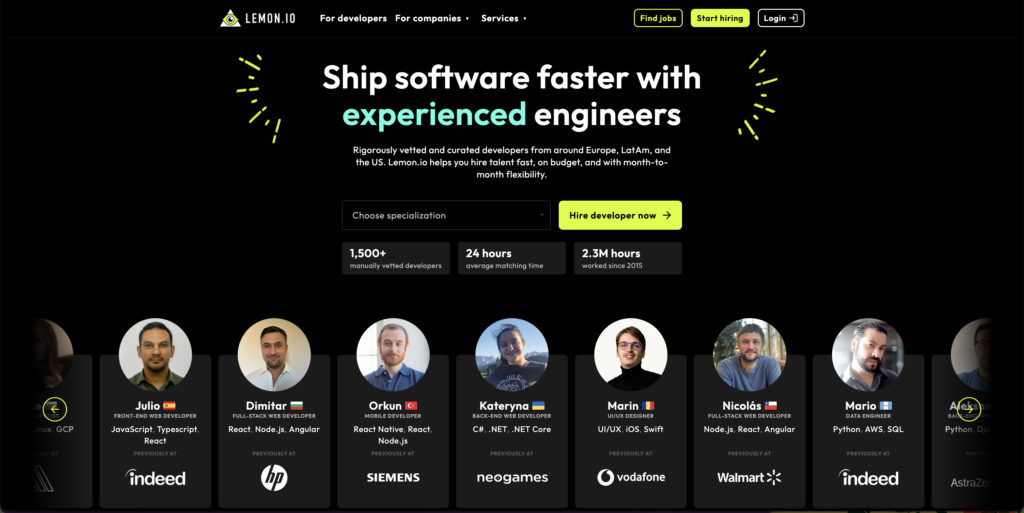
That’s where Lemon.io, the marketplace for senior devs, helps. For you, we handle the AI engineers screening and vetting discussed in this article. Besides, you get a critical safety net—the replacement guarantee. That’s how it works:
Step 1. Brief, 1st day
You leave a request on Lemon.io, and soon have a discovery call to share your startup’s goals and identify which of the four AI archetypes—ML engineer, integrator, coder, or optimizer—you need.
Step 2. Match, 2nd day
We scan our pre-vetted pool and present several candidates who fit both your budget and specific technical stack.
Step 3. Final Interview, days 5th to 7th
You conduct a single, high-impact interview focused on soft skills and cultural match and approve a candidate.
Step 4—final! Onboarding, days 8th to 10th
The contract is signed through the Lemon.io platform, and the AI engineer begins contributing to your product immediately.
Ready to start? Remember that the most impactful AI products are being built by those who choose to move decisively and fast. And we are here to ensure your technical foundation is as strong as your ambition.