

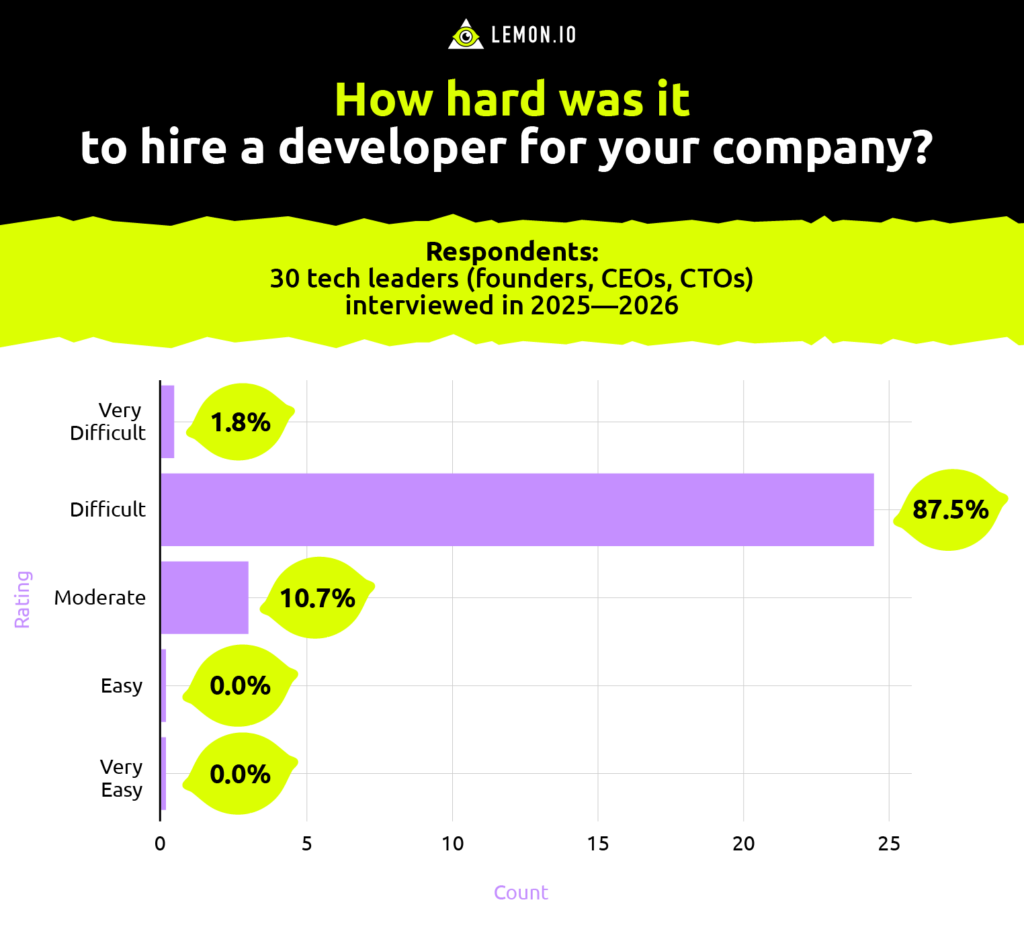
Remember when hiring developers was just posting a job and picking the best GitHub profile? Those days are dead and buried. Our survey of 30 tech leaders reveals a brutal truth: 87.5% now rate hiring skilled engineers as “difficult” or worse.
As a marketplace that vets and matches dedicated developers with startups and growing companies every day, Lemon.io sees this crisis firsthand. In this report, we break down what’s really causing the shortage, where companies lose time and money, and what works to hire faster and smarter today.
Raw Numbers: Why 87.5% of Tech Leaders Are Losing Sleep
Open your company’s tech job board. Now count the days those roles have been sitting empty. Feel that knot in your stomach? You’re not alone.
Our survey stripped away the corporate speak and got real with 30 tech leaders about what’s actually happening in the trenches of the job market. The verdict? Not a single respondent rated current hiring as “easy” or “very easy.” Instead, a staggering 90%+ called it straight-up difficult. In other words, the current talent gap is huge.
“About 30 percent of developer applications for contract opportunities will show the technical depth and collaborative accountability they require to be enterprise engineers,” reports Gor Gasparyan, Founder of Passionate Agency. The other 70%? They look great until you put them in front of real production challenges.
Here’s what keeps showing up in our data:
- 3-6 months: Average time to fill senior roles (double the pre-pandemic timeline)
- 4-8 weeks: How long it takes to land even basic freelance positions
- 50% of companies waste time interviewing up to 60% of unqualified candidates
The twist? It’s not a quantity problem. “We’re drowning in options but starving for quality matches,” reports Charles Blechman, after 30+ years in tech leadership. While your inbox fills with applications, finding engineers who can architect solutions, debug production issues, and communicate with stakeholders feels like hunting for unicorns who code.
And those rockstar computer science experts you’re chasing? They’re not job hunting anymore. They’re picking their projects, naming their rates, and probably making more than you paid them at their last full-time gig.
More Programmers, Less Talent: The Cruel Math of Modern Hiring
The talent pool got bigger, but finding actual digital transformation swimmers got harder.
“I had to let two freelancer candidates go last year,” shares Guillermo Triana, CEO of PEO-Marketplace. “Both were budgeted $5,000/month because they couldn’t rewrite and migrate legacy API endpoints with simulated load. That wasted the company $20,000+ in total hours and failures.”
The numbers tell the story:
- 74% of businesses fail to conduct proper technical assessments
- Only 7% of new technical hires can deliver value immediately
- 45% of hires lack the required skill sets and knowledge of certain frameworks after being hired
- Only 30% of those applications show the technical depth needed for enterprise work
- $20,000+ wasted on failed technical assessments at one company alone
But here’s where it gets interesting: Companies aren’t just struggling to implement their hiring initiatives—they’re struggling to hire the right people.
The market is flooded with developers who look qualified on paper but can’t deliver in production. While candidate pools grow larger, the portion that can actually architect solutions and solve complex problems keeps shrinking.
The result? A market flooded with software developers who can pass initial screenings but struggle with real-world complexity. Meanwhile, truly skilled engineers command premium rates and cherry-pick their projects. Your job post might get 100 applications, but finding one who can architect solutions that scale? That’s the real challenge.
Learn more about the developer job market trends: The 11 Highest Paying Software Engineering Jobs.
The Skillset Emergency (And Why Software Developer Shortage Is Worse Than You Think)
Your tech stack needs three things to function: infrastructure that scales, AI capabilities that deliver, and engineers who can talk to humans.
Our survey across tech companies revealed a clear hierarchy of skills shortages, with:
- DevOps and cloud infrastructure lead at 18 mentions,
- followed by cybersecurity specialists (12 mentions),
- and AI/ML engineers (11 mentions). But raw numbers only tell half the story.
DevOps Desert: Why Your Infrastructure Team Keeps Quitting
Need to scale? Ship faster? Keep your systems from falling over? Good luck with posting vacancies and finding someone to fill them. DevOps and cloud infrastructure talent topped our survey as the most critical shortage, and the impact hits where it hurts most: your ability to ship and scale.
“The shortage in DevOps and cloud infrastructure talent is the biggest hurdle,” emphasizes Bogdan Condurache, Chief Product Officer at Brizy. “Without those roles filled, product launches get delayed, and scaling becomes painful.”
It’s not just about delayed launches. When your infrastructure team is understaffed, every other department feels it, so you can’t streamline production. Development slows down, security gets compromised, and your entire tech stack starts showing cracks. Peter Barnett, VP of Product Strategy at Action1, puts it bluntly: “Many engineers list cloud skills, but few have hands-on experience in real enterprise environments.”
The cost? Tech companies report delays of 3-6 months on critical infrastructure projects. Meanwhile, the DevOps engineers you do have are burning out handling systems that should be managed by teams twice their size. And when they quit? Your scaling plans go right out the window.
Everyone Uses Generative AI, Nobody Masters It: The New Tech Paradox
Can generative AI solve the software engineer shortage? Yes and no. AI tools promised to make developers more productive. Instead, they’ve made hiring ten times harder. Why? Because now everyone’s resume looks AI-enhanced, but real AI engineering talent remains painfully scarce, and the global shortage of machine learning experts is critical.
“We’ve got more folks entering the field leveraging AI tools to speed up their learning curve,” notes Dr. Thomas W. Faulkner, drawing on 15+ years of HR experience. “That’s great for them as independent freelancers, but for companies, it’s a double-edged sword.”
The gap isn’t in using AI — it’s in building it. “We struggle most with AI infrastructure and data pipeline engineers,” explains Justin Wheeler, CEO of Luppa AI. “It’s relatively easy to find developers who can work with pre-built models, but it’s harder to find those who can optimize and maintain AI systems for production.”
Even technical interviews for tech roles connected to emerging technologies have become unreliable. “Everyone looks good in a coding interview now,” admits Mamta Nanavati, Engineering Leader at Omnissa. “But can they reason through system design without ChatGPT? Can they debug something gnarly in production? LLMs are great productivity boosters, but they’re not a substitute for actually understanding how systems work.”
This means your typical generative AI-powered developer can implement features using pre-built tools. But when you need someone to architect AI systems, optimize performance, or handle data pipelines at scale? That talent pool suddenly looks a lot smaller.
In-Demand Developers Need More Than Code
Why is there a global shortage of software engineers? Because writing perfect code isn’t enough anymore for the tech sector. “The most overlooked skill gap is emotional intelligence combined with technical depth,” explains Blechman. “We can teach someone Kubernetes, but we can’t easily teach them how to have difficult conversations about technical debt with a CEO who’s never coded.”
The shortage isn’t just about quantity or technical skills, as Ruth Jennifer Cruz, Founder of Wolf King USA, points out: “It’s about finding talent that bridges technical excellence with business understanding.” Over half of technically qualified candidates still fail projects due to poor communication or self-management.
What separates successful developers from the entry-level ones?
- They flag blockers early instead of hiding problems by applying their broad technical expertise
- They manage deadlines without constant supervision and can adapt to various workflows
- They can explain complex technical decisions to non-technical stakeholders
- They turn tense client situations into opportunities for trust-building and new partnerships
This reality hits especially hard in remote work and staff augmentation. When your developer can’t walk over to the product team’s desk, their ability to communicate clearly and manage themselves becomes as crucial as their Git commits. At Lemon.io, where only 1.2% of developers make the cut, soft skills aren’t a “nice to have” — they’re what separate successful projects from expensive failures.
The Real Price Tag (It’s Not Just Salaries)
Bad hires don’t just cost money—they cost momentum. And recruiters know it. While companies obsess over salary negotiations, the real expenses pile up in delays, fixes, and missed opportunities. Our tech leaders revealed a pattern of cascading costs that start with a poor hire and end with entire projects derailed.
Expensive Lessons: What a Bad Tech Workforce Actually Costs
That $20K lost on failed technical assessments? It’s just the first domino. The real carnage happens when unqualified developers slip through instead of the skilled workers you need. “Companies want unicorns with every certification,” notes Scott Crosby from EnCompass, “but qualified candidates exist – they just don’t check every arbitrary box on job postings.” This disconnect between expectations and reality isn’t just frustrating—it’s expensive.
How expensive? Let’s do the math:
- Hiring cycles in startups now stretch 2-3x longer than pre-pandemic levels
- Senior role job openings sit empty for 3-6 months (up from 6-8 weeks)
- Technical specialists? 2-4 months minimum
- Some specialized positions take 6-12 months to fill
Each empty seat caused by the tech talent shortage triggers a chain reaction. Your existing team burns out covering the gaps. Security reviews get rushed. Features ship late. Meanwhile, competitors with fully staffed teams eat your market share.
But the truly painful costs? They’re harder to measure:
- Lost quarters waiting for critical tech talent hires
- Missed market opportunities while positions stay empty
- Technical debt that compounds with every short-staffed sprint for development teams
- Team morale crashing as in-house workloads double
- Customer trust eroding with each delayed release
And when do you finally hire? Nearly half of technical hires now reveal skill gaps after they’re onboarded, forcing companies to choose between more training resources or starting the expensive hiring cycle all over again.
The New Timeline Reality: Why Hiring Takes 3x Longer
Remember eight-day hiring cycles? Neither do we. Tech hiring, whether it’s about tester or developer jobs, now moves at a glacial pace, and it’s not because companies are being picky.
Traditional hiring playbooks fall apart when candidates have more leverage than employers. Top talent now takes their time evaluating opportunities, often juggling multiple offers while your hiring manager struggles to schedule that final interview.
The verification process alone has become a marathon.
What used to be a straightforward technical assessment now requires:
- Multiple rounds of specialized interviews
- Real-world project evaluations
- Team fit discussions
- Security clearance checks
- Client-specific requirements
Meanwhile, the best candidates get snapped up while companies debate whether someone checks every box on their wishlist. And while everyone blames the talent shortage, the hard truth is that companies create half their hiring delays. Over-engineered technical assessments, endless interview rounds, and requirements lists that read like technical fever dreams – these aren’t market problems. They’re self-inflicted wounds that cause corporate attrition.
The outcome? A hiring process that drags on while business opportunities slip away.
More on this topic: How Much Does It Cost to Build an App in 2025?
Winning Moves: What’s Working Right Now
While most companies complain about the talent shortage, the smart ones are actually doing something about it. Our survey revealed clear patterns among teams that consistently land top talent.
Strategy |
What Works |
Why It Works |
|---|---|---|
Global Talent Search |
Treating freelancers like team members, not temps |
Better code, faster delivery, and institutional knowledge stays |
Long-term Freelance |
Treating freelancers like team members, not temps |
Better code, faster delivery, and institutional knowledge stays |
Hybrid Teams |
Full-timers + freelancers working together |
Scale fast without the “us vs them” drama |
Smart Testing |
Real projects instead of algorithm puzzles |
See how people actually work, not how they interview |
Referral Power |
Letting your best people find your next people |
Quality attracts quality |
Build vs Buy |
Internal training that doesn’t waste time |
Grow your own experts while keeping your sanity |
The companies nailing this aren’t following some secret formula. They’re just treating talent acquisition like product development: test, measure, adapt.
Wait . . . Why Not Just Upskill My Current Team?
Your team needs to learn and cover its skills gaps. They know it. You know it. But between putting out production fires and covering for empty positions, who has time for bootcamps?
Every tech leader in our survey pointed to the same problem: time. Not budget. Not motivation. Just the brutal reality that teams are too overwhelmed handling current workloads to focus on growth.
“Existing teams are already overworked from the skills crisis itself,” explains Crosby. “It creates a vicious cycle — people leave due to burnout, remaining staff get more overwhelmed, and there’s no time for training.”
Here’s the catch-22: Companies can’t hire because they lack the capacity to vet and onboard. They lack capacity because their teams are overworked. Teams are overworked because companies can’t hire. Round and round we go, while technical debt piles up and burnout spreads.
Are the companies breaking this cycle? They’re not waiting for magical pockets of “free time” to appear. They’re treating skill development like any other critical system: it either gets resources, or it fails.
Game Over or Game On? Your Call
In 2026, the tech talent crunch is reshaping how companies build technical teams. Tomorrow’s winners opt for smarter assessments, stronger relationships, and hiring models that align with how top engineers work.
The companies that get this are building global talent networks instead of waiting for “perfect” local hires. And yes—there are experienced, production-ready software engineers out there, ready to build your next product. The question is: can your hiring process reach them?
That’s where Lemon.io comes in. Our marketplace of vetted, experienced developers was built specifically for startups and growing SMBs that need to scale development capacity fast.
So if you’re ready to stop hoping the right candidate applies—and start working with dedicated developers matched to your exact scope—it’s time to talk!